By the end of this hands-on guide you will have a clear, actionable statement of your life purpose, a 6-week plan to test it, and daily spiritual methods to sharpen personal clarity and inner focus. Expect 3–8 hours of active self-work across the first two weeks; this assumes a beginner-to-intermediate skill level with mindfulness and journaling.
Before you start
- Quiet space for 20–40 minutes (allocate 3–5 sessions per week).
- A bound journal or notebook and a pen (50–100 pages recommended).
- Timer (set for 10, 20, and 30 minutes), candle or small altar item optional.
- Basic meditation skill: ability to sit for 10 minutes with simple breath awareness.
- Open mind and willingness to experiment for at least six weeks.
Transition: start by grounding what “purpose” actually means so your next steps have a stable reference point.
Understanding What “Purpose” Really Means
Purpose is a directional quality that gives actions and choices coherence over time — a sense of ordering for day-to-day life that ties into larger meaning. Here I use life purpose to mean a personally resonant mission or set of aims that integrates your gifts, values, and a felt contribution to others or the world. Purpose answers the existential question of “why am I here?” with a practical orbit: small choices, repeated, that reflect an underlying mission.
Purpose sits at the intersection of psychological motivation and spiritual significance. Psychologically, purpose channels attention and goal-setting; spiritually, purpose functions as a compass for meaning and connectedness. When both are present you get personal fulfilment and energetic alignment. If you want deeper reading on the relationship between meaning and wellbeing, see the finding meaning in life guide.
Purpose is not a static label or single, dramatic revelation. Think of it like a lighthouse beam: it illuminates a direction that adapts as you move. This guide emphasizes practical discovery—methods you can practice—and spiritual wells that deepen clarity rather than promise a single “answer.”
For a foundational review of why spirituality and purpose matter to wellbeing, consult the core pillar on Importance of spirituality and purpose for wellbeing.
Transition: now that you have a working definition of purpose, we’ll look at common blocks that stop discovery in its tracks.
Common Challenges When Struggling to Find Your Purpose
- Confusion about direction — Feeling pulled in multiple directions or unable to prioritize. This often reflects competing values or stage-of-life shifts; it’s resolved by mapping choices to short-term tests rather than global commitments.
- Lack of meaning in current roles — Work or relationships may feel empty. This can create a mismatch between activity and contribution. Small projects that test a new role for six weeks are more informative than grand career changes.
- Fear of failure — The worry that exploring purpose will lead to rejection, financial loss, or regret. Cognitive-behavioural research shows fear narrows options; practice graded exposure (small experiments) to reduce avoidance. According to a 2024 industry report by the American Psychological Association, structured behavioural experiments reduce avoidance-related decision paralysis (source: American Psychological Association).
- Doubt about spirituality — People often separate spiritual practices from practical life choices. When spirituality is misunderstood as vague, it’s avoided. Reframe spiritual tools as attention-training and values amplification exercises.
- Overwhelm and burnout — Overwhelm blurs inner signals. Emotional exhaustion impairs decision-making and creativity. Prioritise rest rhythms: 20 minutes of restorative practice daily reduces cognitive load.
- Perfectionism — Waiting for the “perfect” mission blocks iterative testing. Purpose is emergent; allow drafts and revisions.
- External pressure and identity confusion — Familial or cultural expectations can misalign your path. Distinguish inherited narratives from self-authored ones using reflective prompts (see Step 2 prompts later).
- Emotional blocks: grief, shame, anger — These can feel like permanent silences. Work with contained emotional processing: 15–30 minute journaling sessions focused on one emotion, twice weekly.
- Lack of tools for clarity — Not knowing which practices to use leads to sampling paralysis. Use a 5-step toolkit (meditation, journaling, values mapping, small experiments, accountability) and apply each for two weeks.
- Misunderstanding “calling” — Expecting a single, dramatic calling leads to disappointment. Instead, think in layered purposes (primary mission + roles + seasonal projects).
Transition: having seen common blocks, prepare your inner landscape—mindset and spirit—so your exploration produces durable clarity and focus.
Preparing Your Mindset and Spirit for Purpose Discovery
Preparation is about establishing baseline calm and spiritual readiness so insights aren’t drowned out by noise. Below are practical, time-bound steps you can start today.
- Set a two-week daily meditation habit — Sit for 10 minutes each morning for 14 consecutive days. Use breath-counting or a guided mindfulness meditation. Mindfulness trains attention and increases self-awareness; many studies note improved emotional regulation after short practices (see National Center for Complementary and Integrative Health for summaries). Aim for 10 minutes on days 1–7, 15 minutes on days 8–14.
- Journal for focused reflection — Use time-boxed journaling: 20 minutes, three times per week. Try the expressive writing method: write continuously for 20 minutes about what matters, without editing. For structure, use the prompts under Step 2 in the main steps below. Keep entries dated; review every two weeks for patterns.
- Identify spiritual needs essential for growth — Clarify which elements you need (community, ritual, silence). Spend one session listing top three needs and commit to one small action per need (e.g., join a weekly circle, set a nightly prayer). See resources on spiritual needs essential for growth.
- Practice a weekly silence ritual — Block 60 minutes weekly for silence: no screens, no planning. Use this to notice long-form thoughts and recurring yearnings. Record three insights right after the silence session.
- Create a minimal altar or reminder — A physical focus point (candle, stone, image) supports intention. Spend 2–3 minutes each morning touching this object and repeating a 6–10 word intention statement.
- Begin simple energy regulation — Learn one breath practice (box breathing: inhale 4s, hold 4s, exhale 4s, hold 4s) and use it for 2 minutes before each journaling or meditation session to reset the nervous system.
- Check baseline emotional intelligence — Once this week, map common triggers and their physical sensations. Spend 10 minutes writing how fear, doubt, and shame show up in your body and note a 1–2 word label for each.
- Practice being more spiritual — If you want structured guidance on expanding spiritual habits, consult being more spiritual for simple progressive practices.
- Schedule accountability — Find a partner or small group for biweekly check-ins to reflect on insights and experiments. A time-limited accountability check (30 minutes) is sufficient to keep momentum.
Transition: with mindset and spiritual readiness in place, move into the core practical steps for discovering your life purpose—structured, testable actions.
Practical Steps to Discover Your Life Purpose
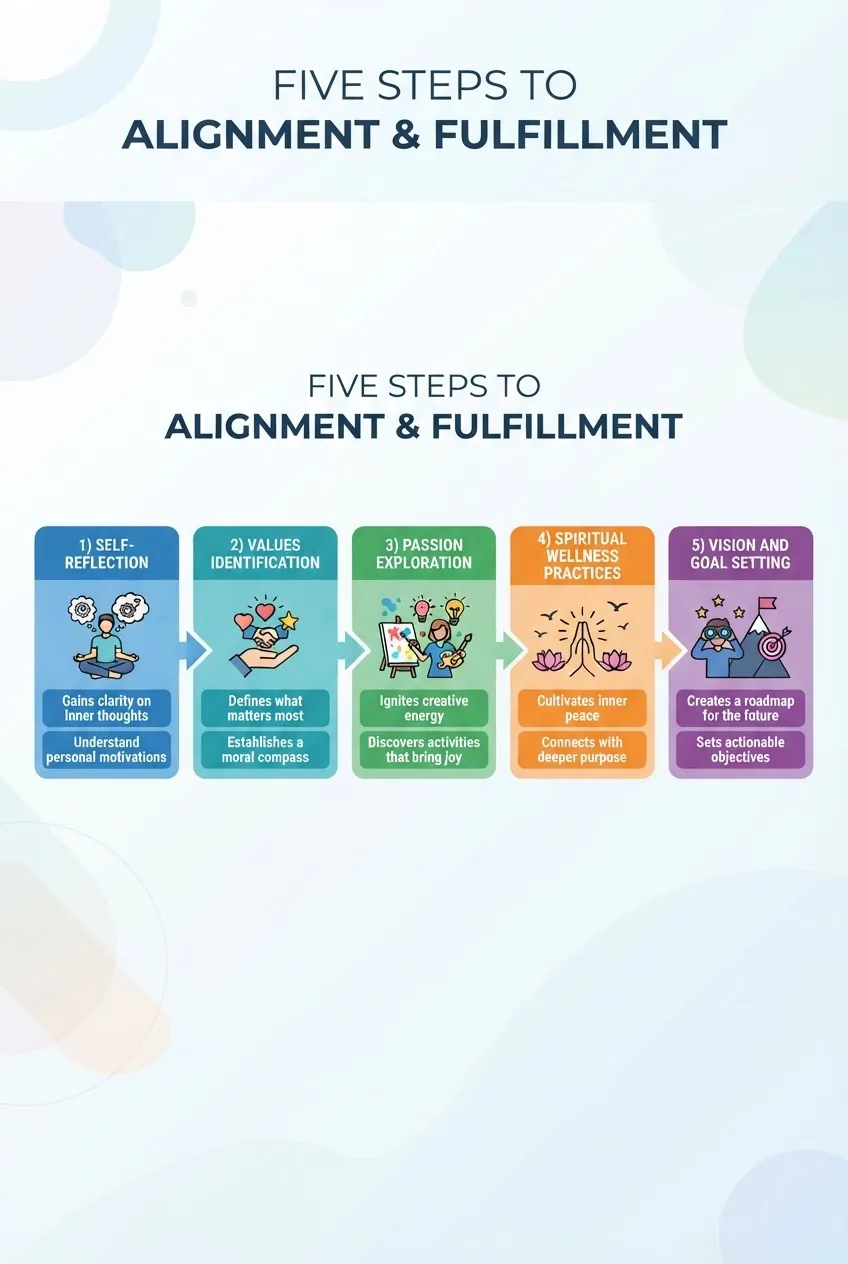
This is the main work: a step-by-step, hands-on sequence you can complete in 6 weeks. Each step has clear tasks, timing, and measurable outcomes. Use the enclosed exercises exactly as written.

-
Step 1 — Do focused self-reflection (3 sessions)
Time: 3 sessions of 30–45 minutes across one week. Outcome: 3 emergent themes that reappear in writing and feeling.
Use these deep reflection questions as prompts. The first session: answer ten targeted questions (set timer 30 minutes). Sample prompts (write without censoring):
- “When I feel most alive, what am I doing? List three distinct moments.”
- “What small kindness did I give that felt like a contribution?”
- “If money were no object for 2 years, what projects would I start?”
After each session, extract 3–5 keywords. At the end of week one, cluster keywords into candidate themes (e.g., teaching, healing, creating). Count the frequency of each theme over three sessions—those with frequency ≥2 become your initial candidate purpose themes.
-
Step 2 — Discover your core life values in practice (2 sessions)
Time: two sessions of 45 minutes. Outcome: 4–6 ranked values with behavioural examples.
Use the structured exercise from discover your core life values: list 20 qualities, reduce to 10, then create forced-choice pairings to rank top 6. For each top value, write two specific actions that demonstrate it in your week (e.g., value: connection — action: schedule one 60-minute call with a friend; value: service — action: volunteer 2 hours monthly).
Link to goals: every purpose test should align with at least two of your top values. For clarity work, consult the practical guide on identifying your values and goals.
-
Step 3 — Explore passions and strengths with short experiments (3 experiments)
Time: three 2-week micro-experiments (6 weeks total). Outcome: measurable feedback on enjoyment, competence, and external response.
Design experiments that are: low-cost, time-limited, and measurable. Examples:
- Teach a 60-minute community workshop (test: engagement and registration numbers).
- Write and publish three blog posts on a topic (test: how writing feels and reader response).
- Volunteer in a mentoring role for 4 sessions (test: sense of contribution and feedback).
Measure each experiment with three metrics (scale 1–10): enjoyment, ease (skill), and perceived impact. Keep a simple log: Date, Activity, Enjoyment score, Skill score, Impact score, One sentence insight.
-
Step 4 — Use spiritual wellness practices to increase clarity and test resonance (ongoing)
Time: daily 10–20 minute practices across each experiment. Outcome: increased inner focus and clearer intuitive signals about fit.
Integrate these tools: journaling prompts (see below), guided meditations for discernment (10–15 minutes), and brief prayers or intention-setting (30–60 seconds). Define what I mean by journaling prompts: specific questions to steer reflection (samples below).
Journaling prompts (use one per practice): “What felt aligned today?” “What drained me?” “If I woke tomorrow and this work was thriving, what changed?” Use a 10-minute timer and write continuously.
If you want a deeper dive into spiritual wellness methods and their evidence, see enhancing spiritual health and wellness.
-
Step 5 — Create a vision statement and immediate 6-week plan
Time: one 60–90 minute session after your three experiments. Outcome: a 15–30 word purpose statement and a 6-week goal plan.
Format for a purpose statement: “I exist to [contribution] by [primary method] so that [largest effect].” Example: “I exist to teach life skills by offering small-group workshops so that busy adults feel equipped to lead with purpose.” Test your statement by translating it into three weekly actions for the next six weeks.
Use SMART criteria for the 6-week plan: specific actions, measurable outcomes, achievable thresholds, relevant to your purpose, and timeboxed. Example: “Run one 60-minute workshop with at least 8 registrants within six weeks and collect five participant feedback forms.”
Challenge Tool When to use Fear of failure Graded experiments (2-week tests) Before big decisions Overwhelm Daily 10-minute breath practice When attention fragments Shame / identity doubt Reflective journaling + accountability After critical feedback For help with values-driven goal setting see the identifying your values and goals guide.
-
Step 6 — Evaluate, iterate, and commit to a 12-week pilot
Time: three 30–45 minute reflection sessions over 12 weeks. Outcome: decision to continue, pivot, or pause, with concrete metrics.
Metrics to use for each pilot: average weekly enjoyment ≥7/10, skill improvement ≥1 point per two weeks, at least one external indicator of impact (feedback form, sign-up numbers, or personal income threshold if relevant). If two of three metrics are positive at 12 weeks, scale the work for 6 months with monthly reviews.
Transition: after practical steps you’ll want spiritual tools that deepen clarity and sustain focus—this section describes them and how to apply each.
How to Use Spiritual Wellness Practices to Gain Clarity and Focus
Spiritual wellness refers to practices that cultivate meaning, connection, and inner calm. Here, we treat spiritual tools as concentrated attention practices that reveal values and priorities. First occurrences of terms like chakra balancing (a system of energetic centres in the body used in some traditions) and inner focus (a sustained attention toward internal states) will be defined plainly: chakra balancing involves gentle attention and breath around energy centres; inner focus is the discipline of directing attention inward to notice priorities.
Core practices and how to use them:
- Meditation for discernment — 10–20 minutes daily. Use a guided meditative prompt that asks: “Which action this week most aligns with my top two values?” Record the resulting insight immediately.
- Prayer or intention-setting — Short spoken or silent statements (15–60 seconds) each morning. Intention statements sharpen the day’s choices and act as micro-goals.
- Journaling rituals — Structured pages: morning intention, evening reflection, plus a weekly summary. Use the three-question format for evening: What aligned? What drained energy? One adjustment for tomorrow.
- Energy alignment — Simple breath and body scans that take 5–12 minutes to notice tension and release. Use before high-stakes decision-making to avoid reactive choices.
- Chakra balancing — If you work with subtle energy, a 10–15 minute guided practice focusing on root to crown can stabilise sense of safety and connection. Keep practices brief and observable: after a 10-minute session, record one change in mood on a 1–10 scale.
- Sacred action — Small ritualised acts that give work a sacred quality: lighting a candle before creativity, dedicating outcomes to service. These remind you that purpose links inner intention to outward action.
- Community and spiritual counsel — Periodic sharing in a trusted circle or with a spiritual guide accelerates clarity. If you notice repeated themes surfacing in group feedback, weigh them heavily—community echoes often validate personal signals.
While using spiritual practices, watch for signs that spiritual guidance is clarifying purpose: increased ease deciding, stronger emotional resonance when thinking about certain activities, and less time spent second-guessing. For a discussion about recognizing deep soul connections and how they can point to purpose, review that sibling article.
If you want broader examples of spiritual practices to complement what you choose here, that article lists gentle variations to experiment with. For a primer on overall wellbeing frameworks that include spiritual practices, the National Center for Complementary and Integrative Health summarises evidence on mindfulness and contemplative practices.
Transition: after establishing practices that generate clarity, you need systems to maintain that clarity and stay focused on your purpose across months and life changes.
Maintaining Clarity and Staying Focused on Your Purpose Over Time
Maintaining clarity combines ritual, measurable goal-setting, and resilience strategies so purpose doesn’t become an aspirational idea but a lived reality. Create daily and weekly rituals, adjust goals regularly, and build resilience.
Daily rituals: 10–20 minutes total comprising a 5-minute breath practice, a 5–10-minute intention-setting or prayer, and a 2–5-minute journaling note. For a fuller list of daily spiritual practices that reinforce purpose, consult the linked guide.
Weekly reviews: 30–45 minutes to evaluate metrics (enjoyment, skill growth, impact), adjust the 6-week plan, and set one sacred action for the week. Use a simple scoreboard: three metrics with numerical tracking—if a metric drops by ≥2 points in a week, apply one corrective action (rest, change format, or ask for feedback).
Discipline without harshness: think in seasons. You may intensify for 12–16 weeks then enter a recovery season of lower output for 4–8 weeks. This protects long-term stamina.
If you need direction after purpose discovery, the find your life path article offers next-step frameworks. To integrate purpose into all life domains and sustain balance, see building meaning and life balance.
Transition: if you reach barriers you can’t resolve alone, consider when to bring in outside support.
When to Seek Support: Coaches, Groups, or Spiritual Guides
Seek support if you experience persistent emotional blocks (intense grief, prolonged depression), if experiments repeatedly fail to produce actionable insight, or if you want structured accountability. Professional life coaches can provide frameworks and accountability—see the International Coach Federation for coach standards (ICF).
Choose support based on need: therapists for mental health concerns, spiritual directors for discernment and soul care, and certified coaches for structured goal and skills development. If you opt for a group, pick a cohort that uses weekly practices and feedback cycles.
Transition: below are application-oriented sections required by this hands-on guide format—common mistakes, a compact checklist, and when to call professionals.
Common mistakes and how to avoid them
I’ve observed the following failures in practice and share how I corrected them.
- I started with grand commitments. I assumed a full career pivot was required and burned out. Avoidance: run three 2-week micro-experiments and treat them as data, not destiny.
- I skipped measurement. I relied on vague feelings of “this feels right.” Avoidance: record numerical ratings (1–10) for enjoyment, skill, and impact after each session.
- I used spiritual practices inconsistently. Irregular rituals produced confusion rather than clarity. Avoidance: commit to a daily 10-minute practice for two weeks before judging its effect.
- I sought external validation first. Waiting for other people’s approval stalled progress. Avoidance: collect one batch of evidence (three experiments) before soliciting wide feedback.
- I ignored rest cycles. Pushing without recovery led to muddled decisions. Avoidance: schedule a 4–8 week recovery season after 12–16 weeks of focused effort.
Checklist: Verify your work
- Completed 3 self-reflection sessions and identified ≥3 candidate themes.
- Ranked top 4–6 values and linked behaviours to each.
- Ran at least three 2-week micro-experiments with recorded metrics.
- Established daily spiritual practices (10–20 minutes) for at least two weeks.
- Written a 15–30 word purpose statement and a 6-week SMART plan.
- Set weekly reviews and simple numerical tracking for enjoyment, skill, and impact.
When to call in a professional
Contact a mental health professional if you experience suicidal thoughts, persistent inability to function, or clinical depression or anxiety. Seek a certified coach if you want structured accountability for scaling a purpose-driven project, and consult a spiritual director or trained counsellor for deep discernment work. For professional coaching standards and credentials, consider resources from the International Coach Federation.
Final transition to close: the practices above will produce clarity when applied deliberately—summarised key takeaways follow.
Conclusion
Key takeaways: purpose is an emergent compass formed by practising attention, testing small experiments, and integrating spiritual discipline. Start with two weeks of daily meditation and three structured self-reflection sessions, then run three 2-week experiments aligned to your ranked values. Track enjoyment, skill, and impact; if two of three metrics are positive after 12 weeks, scale up.
CTA: Ready to begin? Create your first 2-week experiment this week, set a daily 10-minute practice, and schedule your first weekly review for seven days from now. If you’d like tailored support, consider coaching or spiritual guidance to accelerate clarity.