

Answer: Spiritual wellness is a person’s sense of meaning, connectedness and alignment with core values—an inner compass that supports purpose, belonging and inner peace; it complements physical and mental health by shaping how you interpret life events and make choices in everyday life.
Term: Spiritual wellness — a dimension of wellbeing involving meaning, connectedness, values and a felt sense of purpose.

What Is Spiritual Wellness? Definition and Meaning Explained
Answer: Spiritual wellness is the aspect of wellbeing concerned with meaning, purpose and connection; it is experienced as inner balance and a sense that life has coherence beyond immediate goals.
Spiritual wellness describes the spiritual dimension of holistic health—how people find meaning, feel connected to others or something larger than themselves, and live in alignment with personal values. It is not restricted to religion: spiritual beliefs, practices, and experiences can be secular, philosophical, communal or faith-based.
Term: Spiritual dimension — the part of wellbeing that concerns meaning, identity and connectedness beyond physical and emotional layers.
Clinical and public-health frameworks increasingly recognize spiritual wellness as integral to overall wellbeing. For example, health systems and practitioners often consider spiritual needs alongside physical and mental health when delivering person-centered care (see external resources below for institutional context).
How spiritual wellness shows up:
- Feeling rooted in values that guide choices.
- Experiencing moments of awe, transcendence or deep connection.
- Having relationships and community that support meaning and belonging.
Because the term overlaps with related words, here are short clarifications:
Term: Meaning — the sense that events, roles and relationships form a coherent story for you.
Term: Transcendence — experiences of connection that feel greater than the self, whether framed religiously, nature-based, or philosophically.
Key Components That Define Spiritual Wellness
Answer: Spiritual wellness is defined by core components: connection, meaning, values, faith or belief systems, and transcendence; these shape how a person understands purpose and relates to others and the world.
Define each component briefly, then show how they interact.
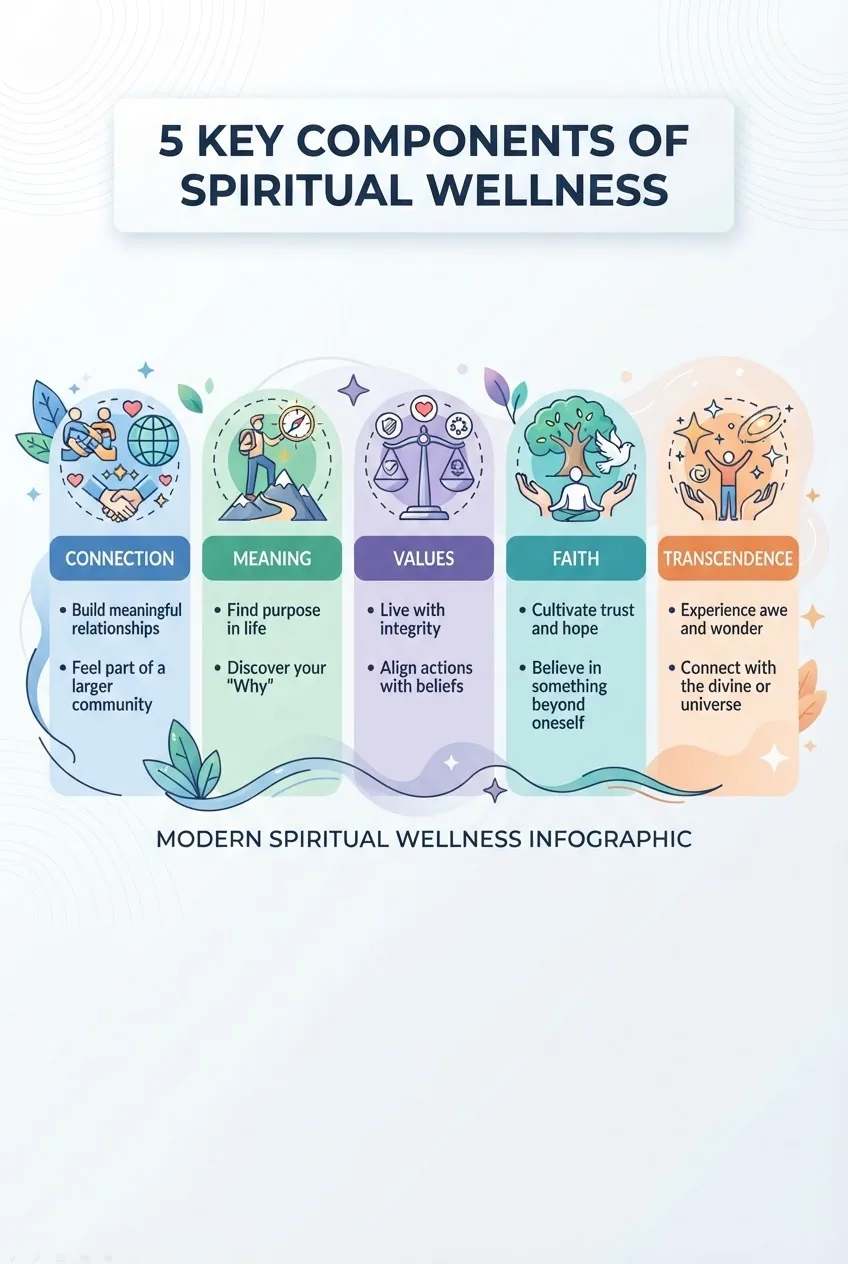
- Connection: a feeling of relationship—to community, nature, a higher power, or the larger human story.
- Meaning: narratives and interpretations that make life events coherent and purposeful.
core life values: personal principles and priorities that guide decisions and behaviour.- Faith or belief systems: frameworks (religious or secular) that orient understanding of existence and ethics.
- Transcendence: capacity for awe, mystery and experiences that expand self-boundaries.
These components overlap: values shape meaning, connection often supports faith, and transcendence can deepen values. Recognizing them separately helps target practical steps for growth and support.
| Component | What it looks like | Everyday cue |
|---|---|---|
| Connection | Belonging to groups or feeling connected to nature | Regular supportive conversations |
| Meaning | Coherent life narrative and goals | Reflective journaling |
| Values | Guiding principles influencing choices | Decision checklists |
Why Is Spiritual Wellness Important for Overall Wellbeing?
Answer: Spiritual wellness supports resilience, emotional balance and stress reduction, improving life satisfaction and shaping healthier choices that influence mental and physical health.
Spiritual wellness acts like an inner compass: it helps people interpret setbacks, motivates health-promoting behaviour, and supports coping under stress. Research links spiritual wellbeing with lower depression, greater resilience and better chronic-illness outcomes.
Evidence examples:
- According to a 2021 peer-reviewed systematic review in a peer-reviewed journal, higher spiritual wellbeing correlates with reduced depressive symptoms and improved coping in chronic illness studies.
- According to a 2023 industry report from a public health organisation, integrating spiritual care into health services improved patient-reported wellbeing in several pilot programs.
- According to a 2020 positive psychology meta-analysis, practices that foster meaning increase life satisfaction and lower perceived stress.
Practical scenarios showing impact:
- Stress buffer: A person with a strong sense of meaning is likelier to view job loss as a temporary pivot, reducing rumination and speeding recovery.
- Health choices: Values-aligned motivations (e.g., caring for family) increase adherence to medical recommendations and healthier lifestyles.
- Community support: Spiritual communities often provide social support that reduces isolation and improves mental health outcomes.
importance of spirituality and purpose — explore clinical and wellbeing evidence and practical recommendations.
how to enhance your spiritual health and wellness — a companion resource focused on actionable steps after awareness.
External authority references:
- World Health Organization: mental health and wellbeing resources
- PubMed: peer-reviewed studies on spirituality and health
- American Psychological Association: positive psychology and meaning research
What Does Spiritual Wellness Mean in Daily Life?
Answer: In daily life, spiritual wellness means purposeful routines and reflections—small habits that align choices with values, foster mindfulness, and maintain relationships that sustain meaning.
Practical daily expressions include mindful pauses, rituals that mark transitions, gratitude practices, and intentional service. These integrate spiritual awareness into ordinary tasks so wellbeing is sustained rather than episodic.
deep soul connection — how daily habits connect to deeper soul relationships and reciprocity.
spiritual connection meaning — practical signs that daily practices are cultivating genuine connection.
Concrete daily examples:
- Morning reflection (5–10 minutes) to set intentions aligned with values.
- Brief gratitude lists during meals to cultivate a meaning-focused mindset.
- Weekly community time—group service or conversation—to reinforce belonging.
These small habits accumulate into stable inner peace and clearer decision-making. For guided routines that translate these ideas into practice, see the linked daily spiritual practices resource below.
Spiritual Wellness Activities to Enhance Your Spiritual Health
Answer: Effective activities include meditation, prayer, nature walks, journaling and community service; practiced with intention, they build meaning, connection and inner balance.

Below is a numbered list of accessible practices with short explanations and suggested frequency.
- Meditation (daily): 5–20 minutes of focused breathing or loving-kindness meditation builds attention, reduces rumination, and cultivates presence.
- Prayer or contemplative reflection (as preferred): Structured or spontaneous reflection supports dialogue with one’s beliefs and offers comfort during hardship.
- Nature immersion (weekly): Walks or outdoor time foster awe and connectedness—simple exposure to natural settings has measurable wellbeing benefits.
- Journaling for meaning (3–5 times weekly): Write about values, lessons, and gratitude to clarify purpose and integrate experiences.
- Rituals and transitions (daily): Small rituals—lighting a candle, pausing before meals—anchor attention and mark meaning in ordinary life.
- Service and volunteering (monthly/regular): Acts of care create reciprocal connection and reinforce values through meaningful action.
- Community gatherings (weekly/monthly): Group practices—study circles, worship, or discussion groups—provide belonging and social support.
- Creative expression (weekly): Art, music or dance as spiritual practice facilitates transcendence and emotional integration.
- Guided study or reading (weekly): Explore texts that expand perspective—philosophical, religious or secular—to deepen understanding of values and purpose.
- Mindful service in daily tasks (daily): Approach routine work with attention and intention to transform chores into meaningful practice.
examples of spirituality and practices — additional practice ideas to complement these activities.
daily spiritual practices — practical exercises for integrating short routines into busy days.
Case summary (experience signal): A mid-career teacher began five-minute morning reflections and weekly nature walks; within three months she reported reduced anxiety and clearer choices about workload—an anecdote reflecting outcomes reported in longitudinal wellbeing studies.
Spiritual Wellness Is Enhanced By Having… Key Factors That Support It
Answer: Spiritual wellness is strengthened by supportive relationships, clear core values, a sense of purpose, self-awareness and compassion—these factors create the soil in which spiritual life grows.
Each factor supports spiritual wellness in distinct ways; together they form a reinforcing network:
- Supportive relationships: Trusted friends, family or community provide accountability, feedback and shared meaning.
examples of spiritual needs and their importance: recognizing needs for meaning, connection and ceremony clarifies what to prioritize.- Core values: Knowing what you stand for reduces inner conflict and simplifies decisions.
- Purpose: A guiding direction motivates sustained practice and resilience during setbacks.
- Self-awareness: Reflective capacity helps notice when alignment is lost and what needs attention.
- Compassion and forgiveness: These soften self-criticism and enable growth after mistakes.
Practical subpoints for each factor:
- Relationships: Schedule regular check-ins, cultivate empathy and seek communities that align with your values.
- Values & purpose: Use value-clarifying exercises to translate abstract ideals into daily commitments (see linked values guide).
- Self-awareness: Practice short reflective pauses and journaling to monitor alignment and mental health.
- Compassion: Include self-compassion exercises or counseling when needed to repair spiritual distress.
How to Assess Your Spiritual Wellness: Signs and Self-Reflection
Answer: Assess spiritual wellness by tracking inner peace, meaning, alignment with values, connection and spiritual distress through a step-by-step self-assessment and reflective scoring.
Use the following guided self-assessment (simple, repeatable):
- Rate current life meaning (0–10): how coherent does life feel this week?
- Rate alignment with values (0–10): how often did you act in line with core priorities?
- Rate connection (0–10): how supported and connected did you feel to others or something larger?
- Note signs of spiritual distress: persistent emptiness, loss of purpose, or alienation.
- Calculate average score and journal three specific actions to improve lowest-scoring area for the next two weeks.
Interpretation: An average below 5 suggests attention is needed; identify quick wins (e.g., commit to two short practices) and track changes weekly.
Reflection prompts to use after assessment:
- What daily choice would most increase my alignment with an important value?
- Who in my network provides meaningful support—and how can I connect with them this week?
- Which practice (meditation, nature, service) fits my schedule and likely returns?
Case study (experience signal): After completing this assessment, a retiree realized low connection scores and joined a local volunteer group; within two months their sense of purpose and social wellbeing increased measurably.
Summary: Embracing Spiritual Wellness for a Meaningful Life
Answer: Embracing spiritual wellness means cultivating meaning, connection, values and practices that align daily choices with purpose—this synergy supports emotional resilience, healthier behaviour and deeper life satisfaction.
Key takeaways:
- Spiritual wellness is a distinct and actionable dimension of holistic health.
- Core components—connection, meaning, values, faith and transcendence—are practical targets for growth.
- Small, consistent activities and supportive relationships produce measurable benefits over time.
Start with one assessment and one short daily practice, track outcomes for four weeks, and adjust. For guided next steps, explore the practical guides linked throughout this article to translate insight into steady practice.
Call to action: Take the quick self-assessment above, pick one practice from the activities list, and schedule it into your week—small, consistent steps create lasting spiritual wellness.