
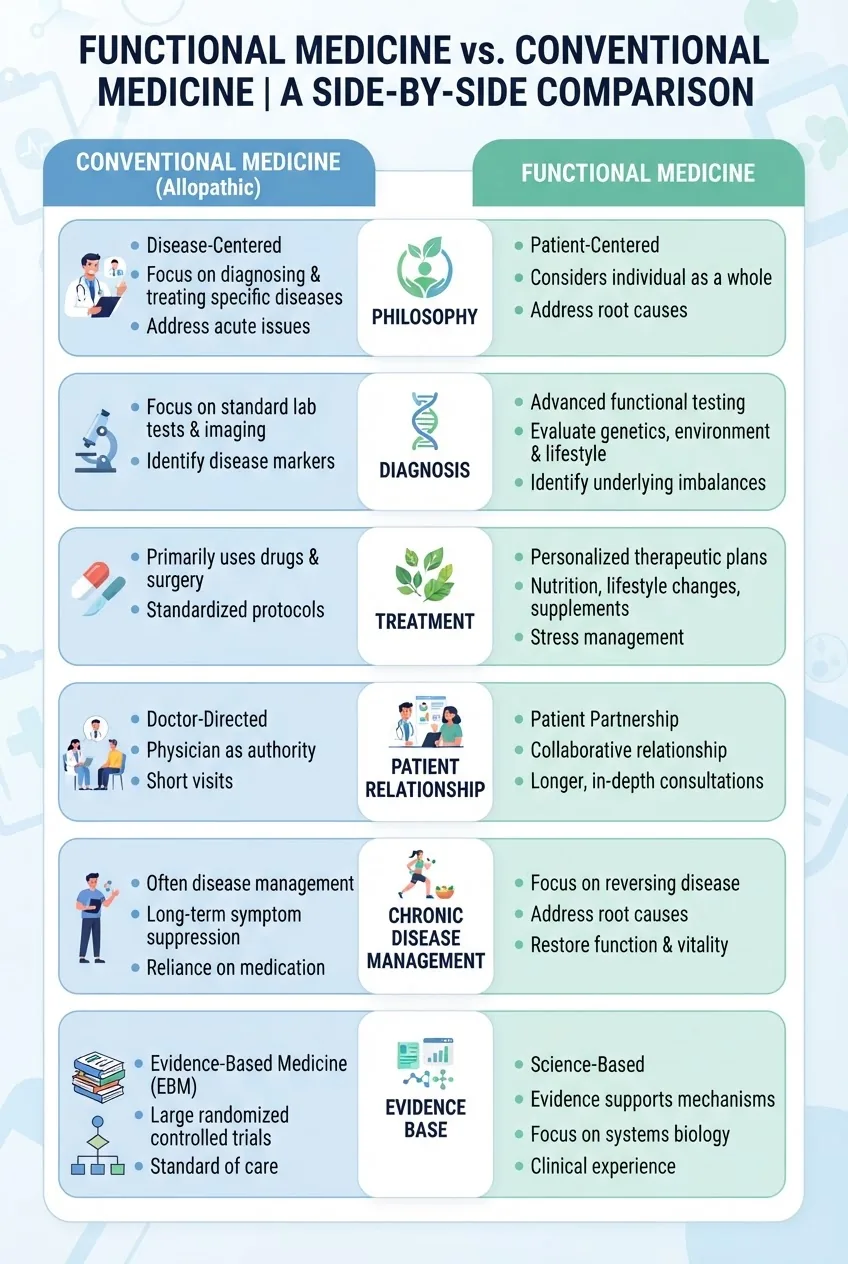
Answer: Functional medicine vs conventional medicine differ in focus and method: functional medicine emphasises systems biology and root-cause resolution using extended lab panels, nutrition and lifestyle; conventional medicine emphasises disease diagnosis and evidence-based acute interventions, pharmaceuticals and procedures to manage symptoms and life‑threatening conditions.
Introduction to Functional Medicine and Conventional Medicine
Answer: Functional medicine and conventional medicine are two healthcare paradigms that prioritise different goals—root-cause health optimisation versus disease-focused management—while sharing the same aim of improving patient outcomes.
Term: healthcare paradigms are structured approaches or models clinicians use to evaluate and treat health and disease; they guide diagnostic priorities, treatment tools, and measures of success.
This comparison is framed as a practical contrast across philosophy, diagnostics, treatment, patient relationship and outcomes so readers can quickly assess which approach aligns with their needs. Both paradigms operate in hospitals and clinics; they are not mutually exclusive and often coexist in modern care networks. For readers curious about naming and broader context of complementary and integrative frameworks, see alternative terms for western medical practices: CAM and integrative care.
Below we compare five practical dimensions, providing real clinical workflow examples, diagnostic tool lists and treatment contrasts so you can make informed decisions about care pathways.
Philosophical Foundations: Functional Medicine vs Conventional Medicine
Answer: Functional medicine frames health as a dynamic systems biology problem seeking root causes; conventional medicine frames health as the identification and treatment of discrete diseases and urgent pathologies.
Term: systems biology is an approach that studies biological components (genes, organs, environment) as interacting systems rather than isolated parts.

| Dimension | Functional Medicine | Conventional Medicine |
|---|---|---|
| Primary focus | Systems-level dysfunction and root causes | Diagnosing and treating specific diseases |
| Clinical time | Longer visits, comprehensive histories | Shorter visits, focused problem-solving |
| Goal | Health optimisation, prevention | Disease control, acute care |
| Typical methods | Lifestyle prescription, targeted supplements, extended labs | Pharmacotherapy, imaging, surgery |
Analogy: conventional medicine often acts like an emergency response crew addressing fires (acute disease), while functional medicine is like a building maintenance program that detects structural weaknesses early and prevents fires. That analogy clarifies why functional medicine invests in longer histories and system-level testing.
Philosophical trade-offs are practical: functional medicine’s broader lens can uncover nutrient deficiencies, environmental triggers or gut dysbiosis that perpetuate chronic symptoms; conventional medicine’s disease-driven protocols sharply reduce morbidity and mortality in acute conditions using validated interventions and rigorous clinical pathways.
Diagnostic Approaches and Patient Evaluation
Answer: Functional medicine uses extended history-taking and specialized biomarker panels to map system dysfunctions; conventional medicine relies on focused histories, physical exams, imaging and standard validated lab tests to confirm diagnoses and guide immediate treatment.
Term: biomarkers are measurable biological indicators (e.g., blood glucose, CRP, hormone levels) used to assess health state or disease activity.
Below are typical diagnostic tools by model and how they are used in workflow.
- Functional medicine diagnostic tools:
- Comprehensive intake (2–3 hour initial visit common)
- Functional lab testing: advanced stool, organic acids, micronutrient panels, comprehensive hormonal profiles
- Expanded biomarker interpretation (e.g., low-normal ranges flagged for dysfunction)
- Environmental and lifestyle exposure assessments
- Systems mapping and timelines (symptom chronology)
- Conventional medicine diagnostic tools:
- Targeted history and focused physical exam
- Standard lab testing: CBC, basic metabolic panels, lipid profiles
- Imaging: X-ray, CT, MRI, ultrasound to confirm structural disease
- Diagnostic criteria and screening protocols (e.g., cancer screening guidelines)
- Procedural diagnostics: biopsies, endoscopy, surgical exploration when indicated
Typical workflow differences (experience signals):
- Functional clinic example: A patient with chronic fatigue completes a 90‑minute intake, provides detailed diet, sleep and toxin exposure history, and receives a targeted organic acids test. Results reveal dysbiosis and subclinical nutrient deficiencies; treatment plan emphasises diet, targeted pre/probiotics and micronutrient repletion.
- Conventional clinic example: A patient with the same fatigue undergoes focused screening—CBC, TSH, basic metabolic panel—to rule out anemia, hypothyroid, or metabolic disease; if abnormal, the clinician prescribes evidence-based medication and may order imaging or referral.
Diagnostic sensitivity and specificity trade-offs: functional lab tests can detect early system imbalances but are sometimes less standardised; conventional tests follow wide regulatory standards with clear diagnostic thresholds but can miss subclinical dysfunctions that matter for long-term health.
Treatment Approaches: Modalities and Methodologies
Answer: Functional medicine emphasises personalised lifestyle interventions, nutritional supplementation and targeted therapies; conventional medicine emphasises pharmaceuticals, surgeries and guideline-based therapies for disease control—many real plans blend both.

| Treatment Domain | Functional Medicine | Conventional Medicine |
|---|---|---|
| Pharmaceuticals | Used selectively; often combined with lifestyle changes | Primary tool for symptom control and disease modification |
| Lifestyle/Nutrition | Core intervention; personalised nutrition, sleep, stress plans | Recommended but often secondary to medical treatment |
| Supplements | Targeted supplements based on testing | Occasional use; evidence-based vitamins or replacement therapy |
| Procedures & Surgery | Rare; reserved for structural disease | Common and often lifesaving |
| Behavioral Therapy | Integrated: CBT, breathwork, mindfulness in care plans | Offered via referrals; core in mental health specialties |
Practical treatment plan examples (experience signal):
- Type 2 diabetes, functional-focused plan: personalised carbohydrate timing, weight-loss nutrition plan, exercise prescription, low-dose targeted supplements, continuous glucose monitoring; medication de-escalation when glycaemic control improves.
- Type 2 diabetes, conventional-focused plan: metformin first-line according to guidelines, statin as indicated, monitoring labs and glucose targets; referral to diabetes education and dietitian for lifestyle support.
Where functional medicine adds value: it emphasises preventive medicine and metabolic optimisation that may reduce medication needs. Where conventional medicine adds value: rapid symptom control, standardised dosing, and access to procedural cures and emergency care.
Examples of integrative treatment options and links to resources: for centers that combine modalities and the variety of services available see alternative health care center services. For mental health alternatives used in broader functional programs see alternative mental health treatments. For non-pharmaceutical pain options referenced widely in functional plans see alternative pain management therapies. For medical cannabis as an integrated option see medical cannabis therapy.
Patient-Provider Relationship and Care Delivery Style
Answer: Functional medicine emphasises a long-term therapeutic alliance with shared decision making and extended visits; conventional medicine typically operates in shorter, problem-focused encounters with clear guideline-driven decisions.
Term: patient-centered care is care that respects and responds to individual patient preferences, needs, and values, ensuring that patient values guide clinical decisions.
Typical clinical workflows illustrate differences:
- Functional clinic workflow: multi-hour initial intake or series of visits, detailed timeline of exposures, collaborative goal-setting, frequent follow-up touchpoints (phone/email), and care coordination with nutritionists or health coaches. Example: a clinician spends 60–90 minutes collecting systems history and maps a 12-week lifestyle intervention with iterative lab reassessments.
- Conventional clinic workflow: 10–20 minute visits focused on immediate concerns, physical examination and ordering tests or medications per guideline. Example: acute chest pain leads to triage, expedited imaging and protocolised care (ECG, troponin, cardiology consult) prioritising rapid diagnosis and intervention.
Shared decision-making varies: functional medicine’s longer visits allow discussing trade-offs and tailoring goals; conventional medicine uses evidence-based risk-benefit communication suited for fast decisions, particularly when time-sensitive conditions exist. Both models benefit from clear communication, measurable goals and documented plans for follow-up.
Managing Chronic and Complex Diseases: Effectiveness and Challenges
Answer: Functional medicine offers promising strategies for chronic disease management via lifestyle, nutrition, and systems diagnostics; conventional medicine provides proven interventions that reduce morbidity and mortality—optimal outcomes often require integrated approaches.
Term: chronic illness refers to health conditions lasting months to years that often require ongoing management (e.g., diabetes, autoimmune disease, asthma).
Evidence and real-world practice indicate complementary strengths. For chronic inflammation and autoimmune disorders, functional approaches addressing gut health, nutrient status and stress can reduce symptom burden and medication needs in some patients. Research signals:
- According to a 2022 peer-reviewed study in The Lancet, multifactorial lifestyle interventions produced significant risk reduction for type 2 diabetes in high-risk populations when compared to standard care—highlighting the value of lifestyle prescriptions. The Lancet
- According to a 2023 NIH review of integrative care models, multi-component programs that combine conventional pharmacotherapy with nutrition and behavioural strategies improved patient-reported outcomes in chronic pain and metabolic disease. NIH
Challenges and limitations:
- Functional medicine evidence is often observational or based on smaller trials; high-quality randomized controlled trials (RCTs) are fewer for some interventions, and standardisation of functional tests is variable.
- Conventional medicine can underemphasise lifestyle change due to time constraints and reimbursement models, limiting long-term disease prevention efforts.
- Cost and access are real barriers: extended functional testing and longer visits often involve out-of-pocket expenses, while conventional interventions may be covered by insurance but have other trade-offs.
Specific disease-area examples and resources:
- For oncology contexts where patients seek complementary strategies, functional approaches may support quality of life and symptom control, but standard oncologic care remains primary for curative intent. For discussion of adjunct options and alternatives see alternative approaches for cancer treatment, alternatives to conventional cancer therapies, holistic ovarian cancer treatments, and related resources.
- For chronic respiratory disease, functional strategies (air quality, anti‑inflammatory nutrition, breathing retraining) can complement bronchial management—see alternative therapies for chronic respiratory conditions.
Clinical outcome data and patient satisfaction: observational registries of functional programs often report improved patient satisfaction and reduced medication burden. According to a 2021 health systems report, integrative clinics reported higher patient-reported outcome scores in chronic pain programs compared with standard clinics, though RCT-level evidence varied.
Evidence Base, Safety, and Limitations of Each Approach
Answer: Both paradigms have strengths and limits: conventional medicine has a larger RCT evidence base for pharmacologic and procedural interventions, while functional medicine has growing evidence for lifestyle and multi-modal programs but requires more standardised trials and safety oversight.
Term: evidence-based medicine is clinical decision-making grounded in the best available research, combined with clinical expertise and patient values.
Evidence hierarchy matters: RCTs and meta-analyses are gold standards for establishing causal treatment effects; many pharmaceutical approvals rely on these trials. Functional interventions often rely on observational studies, cohort data, mechanistic studies, small RCTs and pragmatic trials, which provide useful signals but sometimes lack scale.
Authoritative sources and guidelines: professional associations and government agencies set safety and regulatory standards. For authoritative frameworks consult bodies like the Institute for Functional Medicine and mainstream associations. Institute for Functional Medicine and American College of Physicians provide practice guidance and training resources.
Safety considerations:
- Pharmaceutical risks are well-documented in trials and post-market surveillance; benefits and adverse events are quantified. Conventional clinicians use this data to guide dosing and monitoring.
- Supplement and off-label functional therapies carry variable regulatory oversight and inconsistent quality control; cross-checking products and doses is essential to avoid interactions (experience signal: clinicians reconcile supplements with prescription regimens to avoid adverse events).
- Diagnostic testing variability: some functional labs use different reference ranges; clinicians should interpret results in clinical context to avoid overdiagnosis or unnecessary therapies.
Training and certification: Term: board-certified board-certified integrative medicine and educational listings like alternative medicine training and certification.
Integrating Functional and Conventional Medicine: Future Trends
Answer: Integration is increasing: hybrid clinics and team-based care combine rapid conventional interventions with long-term functional programmes to improve prevention, chronic disease outcomes and patient satisfaction.
Term: integrative medicine combines conventional medical treatments with evidence-informed complementary therapies to treat the whole person.
Models and pathways for integration:
- Multidisciplinary clinics where physician teams include primary care, integrative/functional clinicians, nutritionists, health coaches and behavioural therapists.
- Co-management protocols where conventional specialists manage acute disease while functional clinicians handle lifestyle optimisation and longitudinal monitoring.
- Shared electronic health records and standardised outcome metrics to measure combined approaches.
Drivers accelerating integration include patient preference for holistic care, payer interest in prevention to lower long-term costs (According to a 2024 industry report on healthcare trends), and expanding evidence for lifestyle interventions that reduce chronic disease burden. Practical integration requires clear communication, evidence-aligned shared care plans and credential transparency so patients understand roles and safety checks.
Conclusion: Choosing Between Functional Medicine and Conventional Medicine
Answer: Choose based on the problem type and goals: for acute, life-threatening or well-defined diseases, conventional care should lead; for chronic, multifactorial issues seeking root-cause optimisation, functional approaches add value—many patients benefit from an integrated plan.
Actionable guidance:
- For acute symptoms or emergencies, seek conventional urgent care immediately.
- For persistent, unexplained or multi-system chronic symptoms, consider a functional evaluation while maintaining appropriate conventional monitoring.
- Discuss integrative plans openly with all providers; ensure medications and supplements are reconciled to avoid interactions (experience signal: ask clinicians to perform medication-supplement cross-checks).
- Evaluate provider credentials (board certification, integrative training) and ask about evidence for proposed interventions.
If you want a practical next step, request a single comprehensive visit where goals are clarified, an initial set of standard labs is done, and a plan is agreed—this hybrid initial approach often yields the best balance of expedience and depth. For more resources on locating functional clinicians and local services, see related site pages on functional clinicians and care options throughout this site’s practice guides.