

A holistic view is an integrative perspective that considers the whole person—physical, mental, social and environmental factors—when understanding health or behaviour; it connects causes and contexts to deliver coordinated support, prevention and wellness strategies rather than focusing only on isolated symptoms or single systems.
What Does It Mean to Define Holistic View?
Answer: A holistic view means seeing a person, situation or system as an interconnected whole, where parts influence each other and outcomes emerge from combined relationships, context and history.
Term: holistic perspective — an integrative viewpoint that emphasises interdependence among components of a system (e.g., mind, body, environment).
Defining a holistic view begins by rejecting reductionism—the idea that a problem is fully explained by a single cause or isolated symptom. Instead, it adopts systems thinking and integrative thinking to map interactions (biological, psychological, social, environmental) that shape outcomes. Imagine a puzzle: each piece matters, but the picture arises from pieces combined.
This view uses multiple lenses—biological (how the body functions), psychological (thoughts, emotions), social (relationships, roles) and contextual (work, culture, environment)—to form a comprehensive outlook and guide decisions. It also emphasizes prevention and resilience, not only treatment.
Clarifying common overlapping terms: a whole-person approach prioritises the person’s full life context; integrative viewpoint signals blending methods and disciplines; comprehensive outlook indicates planning across time and domains.
For definitions of related concepts and fine distinctions among terminology, see definitions of holistic terms.
Overview of Holistic Theory and Its Foundations
Answer: Holistic theory is a family of ideas—rooted in systems theory, ecological models and the mind‑body connection—that explains how interconnected parts produce patterns and why care must consider relationships, context and multiple causal pathways.
Term: holistic theory — theoretical frameworks that prioritise interrelatedness and emergent properties over isolated mechanisms.
Historically, holistic thinking appears across traditions but gained formal traction in the 20th century via systems theorists (Ludwig von Bertalanffy), pioneers in holistic medicine and integrative psychology. Systems theory introduced the idea that systems have properties not reducible to parts; the ecological model in public health emphasises multilayered influences (individual, interpersonal, community, societal).
Conceptually, three foundations anchor modern holistic theory:
- Interconnectedness: elements in a system affect each other bidirectionally (e.g., stress alters immune function; illness affects work and relationships).
- Emergence: system-level behaviours (well-being, chronic pain) arise from complex interactions rather than single causes.
- Context sensitivity: the same treatment or behaviour can have different effects depending on environment, history and co-occurring factors.
The mind-body connection is central: psychological states influence physiology (e.g., chronic stress affects hormonal and immune systems) and physical health feeds back into mood and cognition. Integrative psychotherapy techniques (e.g., acceptance-based, somatic interventions) operationalise these ideas by addressing bodily sensations alongside thoughts and relationships.
Foundational thinkers—from von Bertalanffy in systems theory to early integrative health practitioners—shaped a theory that supports whole‑person care models and preventive health strategies. Over time evidence has grown: meta-analyses and reviews examine integrative approaches for chronic disease and mental health, though research quality and scope vary by modality.
For organizational definitions and global framing of health that align with holistic principles, see authoritative sources such as World Health Organization (WHO) and professional psychology frameworks like those at American Psychological Association (APA).
Holistic Support Explained: What Is and How It Works
Answer: Holistic support is coordinated care and practical assistance that integrates physical, emotional, social and environmental elements—through care coordination, multidisciplinary planning and personalized practices—to improve outcomes and resilience.
Term: holistic support — deliberate support strategies that address multiple domains of a person’s life in a coordinated way.
Holistic support functions by assessing multiple domains (medical history, psychology, lifestyle, social supports), prioritising patient goals, and aligning interventions across providers or practices. It often uses care coordination—case managers, care plans and regular reviews—to ensure interventions complement rather than conflict.
Practical elements of holistic support typically include:
- Comprehensive assessment (medical, mental, social determinants)
- Collaborative goal-setting with the person (patient-centered support)
- Integrated interventions (e.g., medication plus psychotherapy plus lifestyle changes)
- Ongoing follow-up and prevention-focused planning
Real-world example (experience signal): a 48-year-old with chronic low back pain worked with a multidisciplinary team: a GP, physiotherapist, psychologist and health coach. The team created a shared plan that combined targeted exercise, graded exposure for fear-avoidance, sleep hygiene and workplace adjustments. After 12 weeks the patient reported less pain interference and improved function—illustrating care coordination and emotional/physical integration.
Holistic support is not the same as unstructured alternative care: it emphasises evidence-informed practices, measurable goals and safety checks. For readers seeking services, resources on finding alternative holistic practitioners and models for delivery may help access coordinated options.
Holistic support may use a holistic well-being model to map interventions across domains; see an example of integrated wellness programming in holistic well-being model.
Holistic Approach Examples Across Different Domains
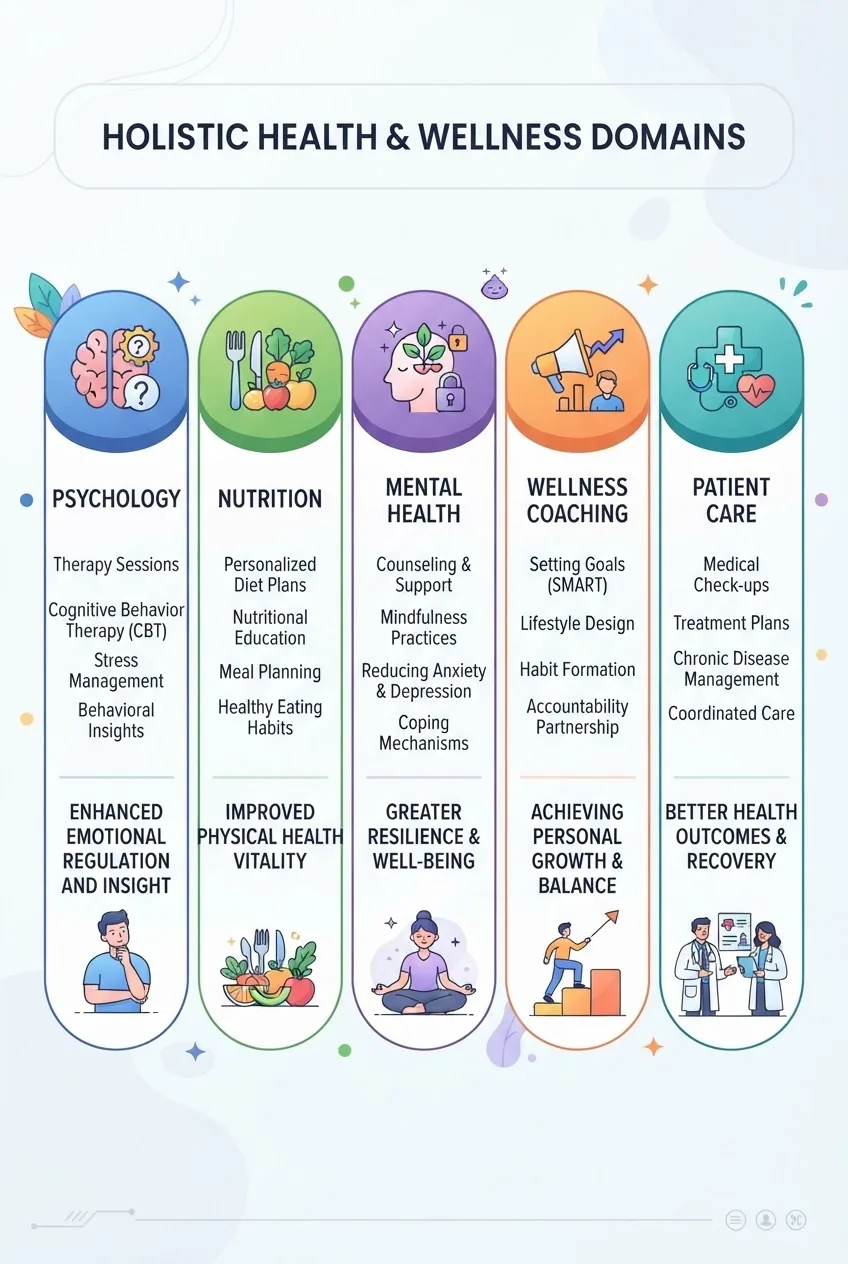
Answer: Holistic approaches appear across psychology, nutrition, mental health, coaching and patient care as integrated strategies combining multiple domains to improve function, prevent decline and support long-term wellness.
-
Holistic approach to psychology: Combines cognitive, emotional and somatic interventions—for example, integrative psychotherapy that pairs cognitive restructuring with body‑awareness techniques to treat trauma and improve regulation. This model treats the person’s context, relationships and biology together rather than only symptoms.
-
Holistic nutrition counseling: A dietitian considers metabolic health, eating patterns, cultural foodways and emotional relationships with food to design sustainable plans that address digestion, energy, social eating and stress-related eating. This transcends isolated calorie-counting.
-
Holistic wellness coaching: Coaches help clients align sleep, movement, stress management and purpose; plans include micro-habits, environment tweaks and relational supports to create sustainable well‑being gains rather than single-dimension fixes.
-
Whole-person patient care (primary care model): Primary care that coordinates specialists, mental health, social work and community resources to manage chronic disease, emphasising prevention, lifestyle and social determinants along with medical treatment.
- Community-based preventative health program: A neighbourhood program integrates nutrition education, group exercise, screening and referrals for housing or employment support—addressing upstream determinants to reduce long-term disease risk and strengthen resilience.
These examples show how integrative thinking and systems thinking create applied models across domains. For readers exploring modalities or practitioner training, consider credential programs like holistic nutrition counseling and the broader holistic healing methods guide for deeper study.
How the Holistic Approach Differs From Conventional Models
Answer: Holistic approaches differ by emphasising whole-person care, prevention, and system interactions, while conventional models often focus on discrete symptoms, single-organ systems or episodic treatment.
Term: reductionist model — an approach that isolates parts of a system as independent causes and treats them separately.
| Feature | Holistic Approach | Conventional/Reductionist Model |
|---|---|---|
| Primary focus | Whole-person wellness, context, prevention | Specific disease or symptom control |
| Treatment style | Multidisciplinary, integrated plans | Single-discipline, protocol-driven |
| Goal | Function, resilience, prevention | Symptom resolution, disease markers |
| Measurement | Composite outcomes (quality of life, function) | Biomarkers, test results |
| Typical timeline | Longitudinal, preventive | Episodic, acute-focused |
Summary: The holistic model expands the lens to include behavioural, social and environmental drivers and often requires coordination across disciplines. A trade-off can be complexity and resource intensity; conventional care may be faster for acute stabilization but may miss upstream causes that holistic models address.
Benefits and Challenges of Adopting a Holistic Support Approach
Answer: Benefits include improved patient engagement, broader outcome gains and preventive impact; challenges include limited evidence for some modalities, coordination costs and system barriers to integrated delivery.
Term: patient-centered care — care that respects and responds to individual patient preferences, needs and values.
Benefits (callouts):
- Improved functional outcomes: Holistic plans target quality of life and daily function, not just lab values.
- Prevention and resilience: Addressing lifestyle and social determinants reduces long-term risk.
- Patient engagement: Collaborative goal-setting increases adherence and satisfaction.
- Comorbidity management: Whole-person care is effective for patients with multiple interacting conditions.
Evidence signals: According to a 2023 review in the Journal of Alternative and Complementary Medicine, integrative care programs showed modest improvements in chronic pain and quality-of-life measures compared to usual care; results vary by program design and outcome metrics (peer-reviewed journal source).
Challenges (callouts):
- Research gaps: High-quality randomized trials are limited for many integrated programs; heterogeneity in methods complicates comparison.
- Coordination costs: Multidisciplinary teams require time, communication infrastructure and funding.
- Regulatory and reimbursement barriers: Health systems and insurers may not cover team-based or non-procedural services adequately.
- Quality assurance: Ensuring safe, evidence-aligned practices across varied modalities needs governance and training.
Authoritative perspectives support cautious integration: the World Health Organization frames health broadly and supports multisectoral action for well-being (global health authority); professional psychology (APA) endorses integrated care principles while noting training and outcome measurement considerations (professional authority). For research context and further reading, consult the Journal of Alternative and Complementary Medicine at Journal of Alternative and Complementary Medicine, WHO at WHO, and APA at APA.
Safety & limitations: Holistic approaches are complementary; they may complement conventional medicine but rarely replace acute medical interventions. Always check for contraindications and coordinate with licensed providers. Where evidence is limited, start with low-risk interventions (lifestyle, psychoeducation) and monitor outcomes.
For a deeper dive into clinical benefits, see key health advantages of holistic medicine.
How to Apply a Holistic View and Support Approach in Everyday Life
Answer: Apply a holistic view by systematically assessing multiple life domains, setting integrated goals, creating small daily practices across mind, body and environment, and tracking progress with simple measures.
Term: integrative thinking — an approach that combines insights from different disciplines to form coherent, practical plans.
Step-by-step how-to guide:
- Map your domains: List health, sleep, movement, nutrition, stress, relationships, work and environment. Note one problem and one strength in each.
- Prioritise goals collaboratively: Choose 2–3 goals that affect multiple domains (e.g., “sleep 7 hours” improves mood, cognition and immunity).
- Create micro-habits: Break goals into daily 5–15 minute actions (e.g., 10-minute evening wind-down, 15-minute walk) that build consistency.
- Integrate supports: Add practical supports—reminders, accountability buddies, counseling or coaching—so changes persist.
- Monitor simple measures: Use brief weekly check-ins: sleep hours, mood rating, energy, and functional tasks completed.
- Adjust with systems thinking: If one change stalls, ask which linked domain is blocking progress and adapt (e.g., stress undermines appetite, so address stress first).
- Use training and certification if needed: For professional-level support or to become a practitioner, explore health coach certification programs or local options for formal training local holistic wellness coach training.

Practical checklist you can use today:
- Morning: 5-minute breathwork, plan one nutrition choice
- Midday: brief walk, hydration, social check-in
- Evening: journaling, screen-winddown, consistent sleep time
- Weekly: 20-minute review of goals and adjustments
Applying a holistic view is iterative: measure, adjust and scale. If you want formal guidance or credentialing to support others professionally, consider accredited programs such as the health coach certification programs or local training options.
Conclusion
Answer: A holistic view frames people and problems as interconnected systems, guiding support toward whole‑person care, prevention and integrated solutions; applying it requires assessment across domains, coordinated steps and measurable goals.
Key takeaways: define holistic view as a systems-based, whole-person perspective; use holistic support to coordinate interventions across physical, emotional and social domains; weigh benefits (function, prevention, engagement) against challenges (evidence gaps, coordination effort) and start with low-risk, trackable changes.
Ready to apply a holistic perspective? Begin by mapping your domains and setting one integrated goal this week; for professional training or deeper modality exploration, consult accredited programs and the resources linked above.