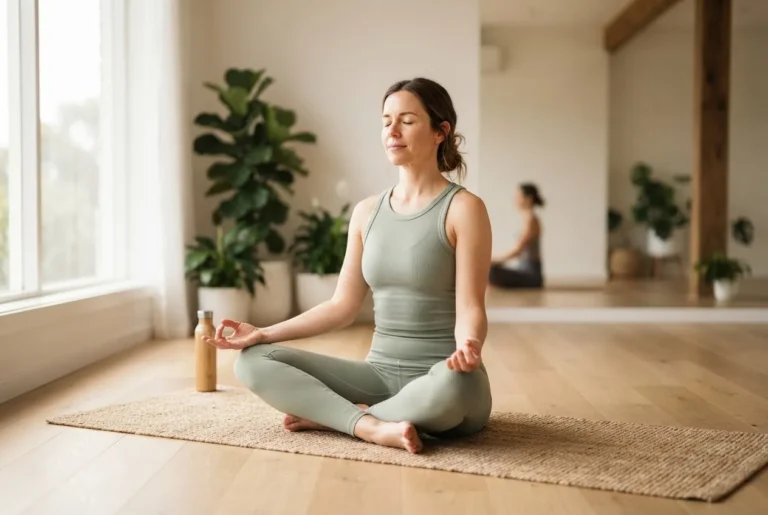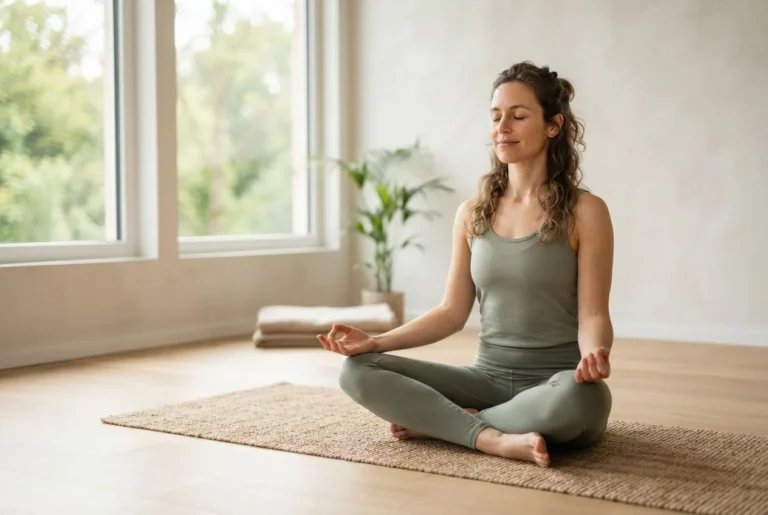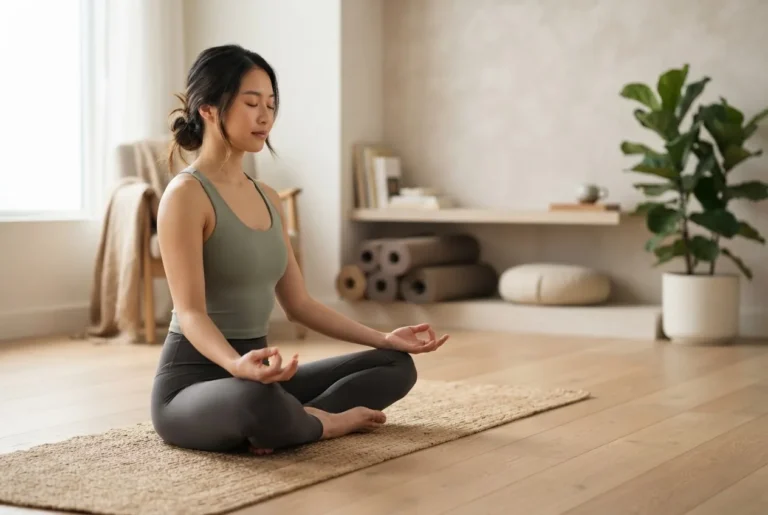
By the end of this hands-on guide you will have written, adapted and recorded practical relaxation scripts you can use for daily stress relief; plan on 2–4 hours to learn and draft one complete script, and 30–45 minutes to record a session. This guide assumes a beginner-to-intermediate skill level in meditation or yoga instruction.
Before you start
- Quiet space or small room where you can sit or lie down for 5–20 minutes.
- Notebook and pen or a digital editor for drafting scripts (30–60 minutes of drafting time).
- Timer and optional metronome app for pacing (set to 50–70 beats per minute for calm speech rhythm).
- Recording device: smartphone with simple audio app or USB microphone (if recording for others).
- Optional yoga mat and cushion for posture demonstration during sessions.
- Awareness of any health conditions or medications—see professional advice section at the end.
Start here: the steps below walk you from concept to a recorded session, then show how to adapt scripts for specific stress triggers and combine them with yoga or mindfulness practices. Follow each step, test with 1–3 users (or yourself), and refine.
What Are Relaxation Scripts and How Do They Work?
Relaxation scripts are intentionally written guided texts—spoken or read—that lead a listener through calming, body-focused and mind-guided exercises to trigger the body’s relaxation response. They combine breath awareness, progressive muscle relaxation, visualization, and brief cognitive reframing to reduce sympathetic arousal and lower perceived stress.
How they work: spoken cues focus attention outward (voice) and inward (body sensations). This structured attention interrupts ruminative thought patterns, lowers heart rate and breathing rate, and engages parasympathetic activity. The mechanism aligns with the Benson Relaxation Response framework, which shows that a regular cue-response practice can lower markers of stress physiology (peer-reviewed study evidence supports this approach).
Practical example (brief excerpt): “Breathe in for four, hold for two, out for six. Feel your shoulders drop like sea-foam on a quiet tide.” That short cue pairs breath timing with imagery to slow respiration and invite a felt change.
Research and context: the benefits of guided relaxation align with larger evidence about mindfulness and stress reduction. For wider context on meditation benefits see the benefits of meditation guide, which summarises physiological and psychological findings.
For those seeking more technical tools beyond basic scripts, the advanced stress relief tools resource lists biofeedback and clinically supervised protocols that can augment scripted practice.
Evidence notes: randomized and longitudinal studies—see a representative peer-reviewed review—for example, mindfulness- and relaxation-based interventions consistently reduce self-reported stress and anxiety scores across populations (peer-reviewed journal). According to a 2023 World Health Organization report, mental health concerns, including stress-related disorders, remain a major public-health issue globally (government health organization report).
Transition: now that you understand the why and what, the next section lists the components you should include in any effective relaxation meditation script.
Key Components of Effective Relaxation Meditation Scripts
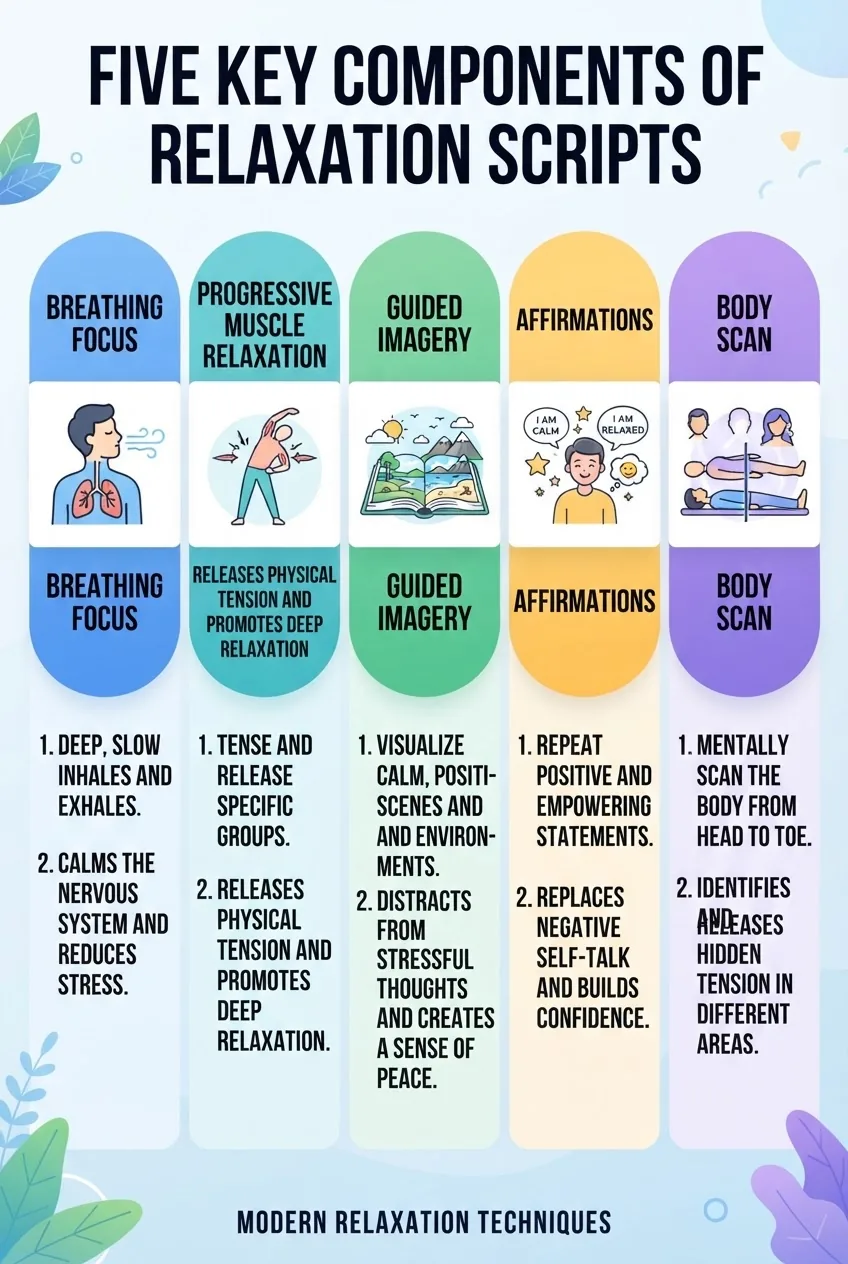
This section breaks down the core elements to include and why each matters. Use the infographic as a quick checklist.
-
Breath focus — Anchor attention and regulate physiology
Purpose: slow and pattern the breath to shift autonomic balance toward the parasympathetic nervous system. Use measurable patterns: 4:2:6 (in:hold:out) or 4:6 (in:out) for beginners. Aim for 5–7 breaths per minute when deepening relaxation; regular practice reduces baseline respiration rate over weeks.
Apply: Begin scripts with a 60–90 second breath-centering segment. For guided practices that teach breathwork, link to breathing meditation exercises.
-
Progressive muscle relaxation (PMR) — Release tension systematically
Purpose: reduce somatic tension by alternately tensing and releasing muscle groups; this heightens proprioception and creates a contrast that makes relaxation felt. Typical PMR timing: 30–90 seconds per major muscle group; a full PMR sequence takes 8–12 minutes.
Technique: cue a sequence from feet to face (or vice versa) with precise timing. Define tension level (“tense moderately for 5 seconds”) and release (“let go and notice warmth”).
-
Guided imagery / visualization — Engage safe, vivid images to widen calm
Purpose: use sensory-rich scenes to shift cognitive content away from stressors. Preferred images are stable and controllable—a sheltered cove, a warm light, or the rhythm of waves.
Timing: 2–6 minutes of visualization in a 10–20 minute script. Keep language sensory (sight, sound, touch, smell) but concise to avoid overloading cognitive processing.
-
Body scan — Develop interoception and release localized tension
Purpose: systematically bring awareness to sensations from toes to crown, noticing without judgment. A focused body scan helps identify chronic holding patterns and anchors attention to present-moment experience.
Timing: 6–12 minutes for a full body scan; micro-scans of 60–90 seconds are effective as quick resets.
-
Affirmations and short cognitive reframes — Reframe threat appraisals
Purpose: brief, present-tense statements (e.g., “I am breathing calm into my chest”) help shift habitual negative thought loops. Keep them short (6–10 seconds each) and pair with breath or movement cues.
Warning: avoid over-positive, unrealistic claims that can backfire for anxious clients; aim for factual, grounding language.
-
Supporting elements: tone, pacing and environment
Voice qualities and structure shape engagement. Speak slowly (110–140 words per minute for relaxation), use soft consonant emphasis, and allow 2–4 seconds of silence after key cues to let sensations register. Structure sessions: Opening (1–2 minutes), Core practice (4–15 minutes), Transition/closing (1–2 minutes).
Deepening resources: to explore other meditation methods that pair well with these components, see meditation techniques for mindfulness.
| Component | Purpose | Suggested timing |
|---|---|---|
| Breath focus | Reduce respiration rate, anchor attention | 1–3 minutes |
| Progressive Muscle Relaxation | Release somatic tension | 8–12 minutes |
| Guided imagery | Shift cognitive content to calming scenes | 2–6 minutes |
| Body scan | Increase interoception and relaxation depth | 6–12 minutes |
| Affirmations | Short reframes reduce negative appraisals | 30–90 seconds |
Transition: with components in place, the next section supplies complete, ready-to-use scripts you can practice and adapt.
Sample Relaxation Scripts for Stress Relief
Below are four full scripts—5-minute, 10-minute, progressive muscle relaxation (12–15 minutes), and a brief autogenic-style script (6 minutes). Use them as templates, then tailor voice, imagery, and pace to your needs.

5-minute grounding and breath script (quick reset)
(Use when you have five minutes; ideal between meetings or before sleep.)
- Settle: Sit or lie comfortably, hands resting, eyes softly closed. Take two natural breaths.
- Breathe pattern: Inhale slowly for four counts, pause two, exhale for six. Repeat four full cycles.
- Scan: Bring attention to your feet—notice contact with the floor or cushion. Move attention up through the legs, hips, abdomen, chest, shoulders and jaw. Pause briefly at any tight spot and imagine breathing warmth into that area for two breaths.
- Anchor phrase: On each exhale, think: “calm returns with my breath.” Repeat three times.
- Return: Gently deepen breathing, wiggle fingers and toes, open eyes when ready.
Quick complements: Need a shorter practice? See our 2-minute guided meditation script for very short resets, or 3-minute meditation scripts for slightly longer micro-practices.
10-minute progressive-breath + imagery script (deepening)
(A good daily practice to unwind after work or as a morning calm routine.)
- Opening and intention: Sit comfortably or lie on your back. Set a gentle intention: “I practice to calm my nervous system.” Take three conscious breaths to arrive.
- Extend the breath: Inhale for four, hold one, exhale gently for six. Continue for one minute. Allow the exhales to lengthen slightly each cycle.
- Progressive release: Starting at your feet, tense the muscles gently for five seconds—then release. Move up: calves, thighs, hips, abdomen, chest, hands, arms, shoulders, neck, face. Spend about 45–60 seconds per region.
- Visualization: Imagine a warm, golden light at the top of your head. With every exhale, imagine that light flowing slowly down and washing tension away. Notice colour, temperature, and gentle sounds—keep images simple.
- Body scan and integration: After the light reaches your feet, rest in stillness for 60 seconds; observe any sensations without judgment.
- Close: Bring attention back to breath for two cycles, wiggle, and open your eyes. Optionally write one word describing how you feel.
12–15 minute Progressive Muscle Relaxation (full sequence)
(Structured PMR for people holding somatic tension; follow exact timing.)
- Position: Lie flat with support under knees or sit with legs uncrossed. Allow the jaw to relax.
- Sequence timing: For each muscle group: tense 5–7 seconds at 50–60% maximum, then release and rest for 10–15 seconds while scanning sensations. Use a calm, even voice and 90–120 seconds per pair of regions.
- Group order: Feet and toes → calves → thighs → hips and glutes → abdomen → lower back → chest → hands and forearms → upper arms → shoulders and neck → face and scalp.
- Finish: Spend 2–3 minutes in a breathing pattern (4 in, 6 out) and a final body scan from toes to crown.
Tip: When leading, cue tension level and use consistent counts so listeners learn the rhythm.
6-minute autogenic-style relaxation script
(Autogenic training emphasizes warmth and heaviness; suitable for people who respond well to somatic imagery.)
- Settle and breathing: Sit or lie comfortably; breathe slowly for six breaths.
- Heaviness cues: “My right arm is heavy and warm.” Repeat for both arms, then legs: “My legs are heavy and warm.” Allow 10–12 seconds after each phrase.
- Heartbeat and breath suggestions: “My heartbeat is calm and steady.” “My breathing is calm and even.” Pause to feel each sensation.
- Return: Reaffirm contact with the surface beneath you, deepen breath, and open eyes when ready.
For more script templates and downloadable formats, consult the guided meditation script templates resource.
Transition: these scripts are ready-to-use; the next section shows exactly how to adapt them for personal use and different stress triggers.
How to Customize Relaxation Scripts for Personal Use
Customization increases engagement and effectiveness. The steps below are practical edits you can make quickly, with example modifications you can test in one session.
-
Identify the trigger or context (5–10 minutes)
Action: list when you will use the script (e.g., pre-sleep, before public speaking, between meetings). Note common sensations (tight throat, shallow breathing) so cues address them directly.
Example modification: for performance anxiety, include a short ‘grounding’ segment that anchors to feet and breath before imagery.
-
Choose voice and pronouns (5 minutes)
Action: decide whether to use first-person (“I am”) or second-person (“You are”) based on listener preference. First-person often supports self-directed practice; second-person works better for guided group recordings.
Example modification: change “You breathe slowly” to “I breathe slowly” when recording for personal use.
-
Adjust pacing and silence (10 minutes)
Action: measure speech tempo. Read your script aloud and time each section. Aim for 110–140 words per minute overall, slower during breath cues. Insert 2–4 seconds of silence after major cues; use a timer or metronome to practice consistent pauses.
Example modification: extend the breath-hold from 1 to 2 seconds only if the listener is comfortable and not breath-sensitive.
-
Swap imagery to match personal associations (10–20 minutes)
Action: replace images that elicit memories (positive or negative) with neutral calm images. Ask yourself: does this image feel soothing or distracting? Substitute specifics: “a quiet lake at dusk” vs. “a tropical beach” depending on someone’s climate associations.
Example modification: for listeners who dislike water, choose a “sunlit room with warm wood floors” instead of ocean imagery.
-
Layer in movement or yoga cues if needed (10 minutes)
Action: add gentle movement cues (neck rolls, shoulder softening) to help somatic release for people restless when sitting. Provide exact counts (e.g., “roll the shoulders back three times, inhale on the lift, exhale on the release”).
Example modification: insert a 30-second shoulder-release sequence in the middle of a 10-minute script for office workers.
-
Test and iterate (30–60 minutes)
Action: conduct a trial session—self or with one listener. Ask for two specific ratings: perceived relaxation (0–10) and clarity of cues (0–10). Revise text to reduce ambiguous phrases and adjust pacing.
Example modification: if listeners report “mind wandering,” shorten visual descriptions and add a breath anchor every minute.
Practical tips:
- Keep language concrete and sensory-focused; abstract metaphors can lose engagement.
- Respect trauma histories—avoid commands to “relax” or to “let go” without offering alternatives; include “if you’d rather not, notice whatever you notice” options.
- Document versions: keep a short-form (5 min) and long-form (10–15 min) copy for quick selection.
Transition: once your script is customized, integrate it with other practices for deeper benefit—see the next section for step-by-step integration with yoga and mindfulness.
Using Relaxation Scripts Alongside Yoga and Mindfulness Practices
Combining scripted guided relaxation with yoga and mindfulness deepens the mind-body connection and supports sustained stress reduction. Below are practical integrations and a weekly plan you can adopt.
Daily routine example (20–30 minutes): 5 minutes breath-centering, 10–15 minutes gentle yoga sequence (cat/cow, child’s pose, seated forward fold), 5–10 minutes of your customized relaxation script for closure.
Practical integration tips:
- Use yoga to prime the body: Gentle asana sequences loosen large muscle groups so the subsequent body scan reaches deeper. For guidance on structured yoga programs, consider a 30 day yoga challenge for stress reduction to build consistency.
- Match breath vocabulary: If you teach ujjayi or coherent breathing in yoga, keep the script’s breath cues consistent with that practice to avoid confusion.
- Narrative sequencing: Use yoga as a “physical warm-up” and the relaxation script as the “cool-down” phase; this transition mirrors athletic practice and aids parasympathetic activation.
- Mindfulness bridging: Use short mindfulness prompts within scripts to cultivate present-moment awareness. For step-by-step exercises to expand mindfulness skills, see the mindfulness exercises for anxiety pillar resource.
- Adapt for classes and workshops: For group sessions, choose second-person phrasing and cue small movement options for different ability levels.
Bridge to anxiety-specific practice: online resources and clinical programs often pair MBSR-style courses with guided relaxation scripts for sustained outcomes. To explore evidence-based mindfulness curricula and their structure, review the Mindfulness-Based Stress Reduction programs at established institutions (renowned mindfulness institution).
Short program example (4 weeks): Week 1—daily 5-minute scripts; Week 2—add 10 minutes of yoga thrice weekly; Week 3—extend scripts to 10 minutes and practice twice-daily; Week 4—record one personal guided session to practice self-led relaxation.
For quick midday resets, alternate your longer scripts with the 2-minute guided meditation script. For brief focused practice, see 3-minute meditation scripts.
Transition: the next section explains how to lead or record sessions professionally and details voice and pacing choices.
Best Practices for Recording or Leading Relaxation Script Sessions
Below are concrete, reproducible steps for delivering effective live or recorded relaxation sessions, followed by a step-by-step recording walkthrough.
-
Plan session structure (total length 5–20 minutes)
Action: Decide Opening (1–2 minutes), Core (breath, PMR, visualization; 4–15 minutes), Closing (1–2 minutes). Keep transitions clear and note exact times in your script.
-
Set voice tone and pace (minutes of rehearsal)
Action: Target 110–140 words per minute; slower during breath cues. Use warm, even tones; avoid rising intonation at sentence ends. Pause durations: 2–4 seconds after short cues, 6–12 seconds after longer imagery prompts.
-
Environment setup (10–20 minutes)
Action: Record in a small, quiet room. Reduce reflections: close curtains, use soft furniture. Microphone distance: 15–25 cm from mouth; use a pop shield if available. Monitor room noise (air conditioner, refrigerator)—turn them off if possible.
-
Recording technical checklist (pre-recording tasks)
- Set sample rate to 44.1 kHz, 16-bit if using basic recorder.
- Record as WAV for best quality; MP3 is acceptable for quick sharing (192–256 kbps).
- Use a compressor gently (2:1) only if you know the software; otherwise record dry and process later.
-
Lead practice with incremental cues (in session)
Action: give exact counts for breath, label sensations, and allow silence. Example cue: “Inhale—two, three, four… hold two… exhale six.” Repeat two to four times before moving on.
-
Recording walkthrough — step by step (30–45 minutes for a single take)
- Warm your voice (3–5 minutes): hum, lip trills and recite script aloud once at normal pace.
- Run-through (5–7 minutes): read the script at least once while timing segments. Mark places to pause or rephrase.
- Position mic and test (3–5 minutes): record a short clip and listen for sibilance, clipping, room tone.
- Record full session (10–20 minutes): speak clearly, keep hydration nearby, stop and re-record only when necessary.
- Edit lightly (10–30 minutes): trim silence, normalize volume (-1 to -3 dB), add a gentle fade in/out and optional low-level ambient sound under -35 dB to avoid masking voice.
-
Trade-offs: script length vs. depth
Observation: Shorter scripts (2–5 minutes) excel for repeated daily micro-practices; longer scripts (>10 minutes) allow deeper somatic work and are more effective for chronic tension. Choose based on listener availability and response: if someone reports restlessness, prefer shorter, more frequent sessions.
Voice coaching notes: avoid monotone—vary pitch slightly to maintain warmth; emphasise open vowels and soften plosive consonants. A slow smile while speaking often softens tone and registers as warmth on recordings.
Transition: before you start leading or recording, read common mistakes below so you avoid predictable pitfalls.
Frequently Asked Questions About Relaxation Scripts
This section summarises frequent concerns and directs you to appropriate resources or professional care where necessary. See the dedicated FAQ section below for concise, snippet-ready answers.
If you need medication or therapy guidance, consult a qualified practitioner; resources on pharmacological and professional support are available below.
Step-by-step practice: Core actions (numbered steps)
The following steps are the hands-on core—write, test, record, and deploy a relaxation script. Each step begins with a bold, action-first line.
-
Draft a focused script — 45–90 minutes
Action: Write a complete script aligned to the target length. Start with an opening cue (breath), a body-led practice (scan or PMR), visualization or affirmation, then a closing. Use short sentences and include explicit timing brackets (e.g., [30 seconds silence]).
-
Read aloud and time — 15–30 minutes
Action: Read the script at your intended pace while timing each section. Adjust word counts to match target durations: approximate 110–140 words per minute. Mark places to extend silence.
-
Test with a listener — 30–60 minutes
Action: Lead the script with one listener or record and share. Ask for two measurable ratings: relaxation (0–10) and clarity (0–10). Note specific phrases that distracted them and adjust.
-
Record a clean take — 30–45 minutes
Action: Use the recording walkthrough above. Keep the mic 15–25 cm from your mouth, maintain steady breath control, and leave 3–5 seconds of silence at the start and end for editing.
-
Edit and export — 20–40 minutes
Action: Trim, normalize to -1 to -3 dB, and export as WAV or high-quality MP3. Keep a text transcript aligned with timestamps for listeners who prefer reading.
-
Deploy and schedule — ongoing
Action: Schedule daily or weekly practices. For group classes, offer both live and recorded options. Track engagement and adjust scripts monthly based on feedback.
Common mistakes and how to avoid them
I once led a 12-minute PMR without practicing the timing; listeners complained the pauses were too long and the tension-release felt awkward. Now I always time each section aloud and mark exact counts. Another time I used imagery that unintentionally evoked memories—I’ve learned to ask a participant’s preference and offer alternative images. I also used inconsistent breath cues; I now keep one breathing pattern per script and rehearse it until consistent.
Checklist: Verify your relaxation script practice
- Script length matches your target (5 / 10 / 15 minutes). Verify with a timed read-through.
- Breath cues are explicit and count-based (e.g., 4:2:6).
- Silences inserted: 2–4s after short cues, 6–12s after long cues.
- Voice test passed: 110–140 wpm, warm tone, soft consonants.
- Recording test passed: no clipping, < -35 dB ambient noise, correct mic distance (15–25 cm).
- Trial feedback recorded and at least two edits made.
- Alternate shorter (2–3 min) and longer (10–15 min) versions ready.
When to call in a professional
Use these scripts as supportive, self-care tools. Contact a clinician if: panic attacks increase with practice, intrusive traumatic memories surface during sessions, or there is suicidal ideation. For medication or clinical therapy decisions, consult a psychiatrist or psychologist. For therapy options, review counseling for anxiety.
Final transition: below is a compact FAQ section with concise answers and authoritative sources for deeper reading.