

Wholistic care is a whole-person approach the Department of Health defines as coordinated care that addresses physical, mental, emotional, social and spiritual needs through multidisciplinary teams, prevention and care coordination to improve outcomes and equity across populations. This article explains official definitions, policies, program examples and practical implementation.
What Is Wholistic Care? Department of Health Definition and Principles
Answer: Wholistic care is an official Department of Health approach that treats the whole person—physical, mental, emotional, social and spiritual—through coordinated, patient-centered services and prevention strategies to improve long-term wellness and equity.
Wholistic care: a whole-person care model that integrates multiple health dimensions into assessment, treatment and prevention planning to support overall wellbeing rather than only disease-specific outcomes.
The Department of Health frames wholistic care as a structured policy-driven model distinct from informal “holistic” usage: it requires documented care pathways, measurable outcomes and governance to ensure services across clinical, community and social sectors work together. That policy framing clarifies scope, accountability and evaluation in public health systems.
The Department specifically lists these principles in its guidance documents:
- Person-centered care: care plans driven by patient goals, preferences and social context.
- Comprehensive assessment: screening for biological, psychological, social and spiritual needs.
- Integrated services: clinical and community services coordinated through shared care plans.
- Prevention and wellness orientation: proactive risk reduction, health promotion and early intervention.
- Equity and cultural competency: services tailored to reduce disparities and respect cultural practices.
Terminology note: “wholistic care” in Department materials is often used interchangeably with “whole-person care” or “whole-of-person care” but is defined with operational standards—eligibility criteria, multidisciplinary roles and outcome measures—so it is not synonymous with unregulated complementary therapies.
For readers seeking practice-level modality information, see the main guide on
holistic healing methods.

How the Department distinguishes wholistic care from adjacent concepts:
- Integrative care: often emphasises combining conventional and complementary therapies within clinical treatment; the Department treats integrative elements as possible components of wholistic models when evidence and safety standards are met.
- Patient-centered care: a core principle but narrower; wholistic care extends patient-centered practice by mandating cross-sector coordination and prevention measures.
Operationally, Department documents require:
- Documented care pathways and referral protocols.
- Use of validated screening tools across health dimensions.
- Data capture for outcome measurement and equity monitoring.
- Defined roles for multidisciplinary teams and case managers.
External context: international frameworks such as the World Health Organization’s person-centred and integrated care guidance inform Department policy development (WHO integrated health services).
The Role of the Department of Health in Promoting Wholistic Care
Answer: The Department of Health promotes wholistic care through national guidelines, funded pilot programs, workforce frameworks, data standards and partnerships with local health services to scale whole-person models across clinical and community settings.
The Department’s role is regulatory, catalytic and operational: it issues clinical and governance guidelines, funds demonstration projects, sets outcome metrics, and supports workforce training and IT interoperability. These actions create the ecosystems where wholistic care can be implemented consistently and safely.
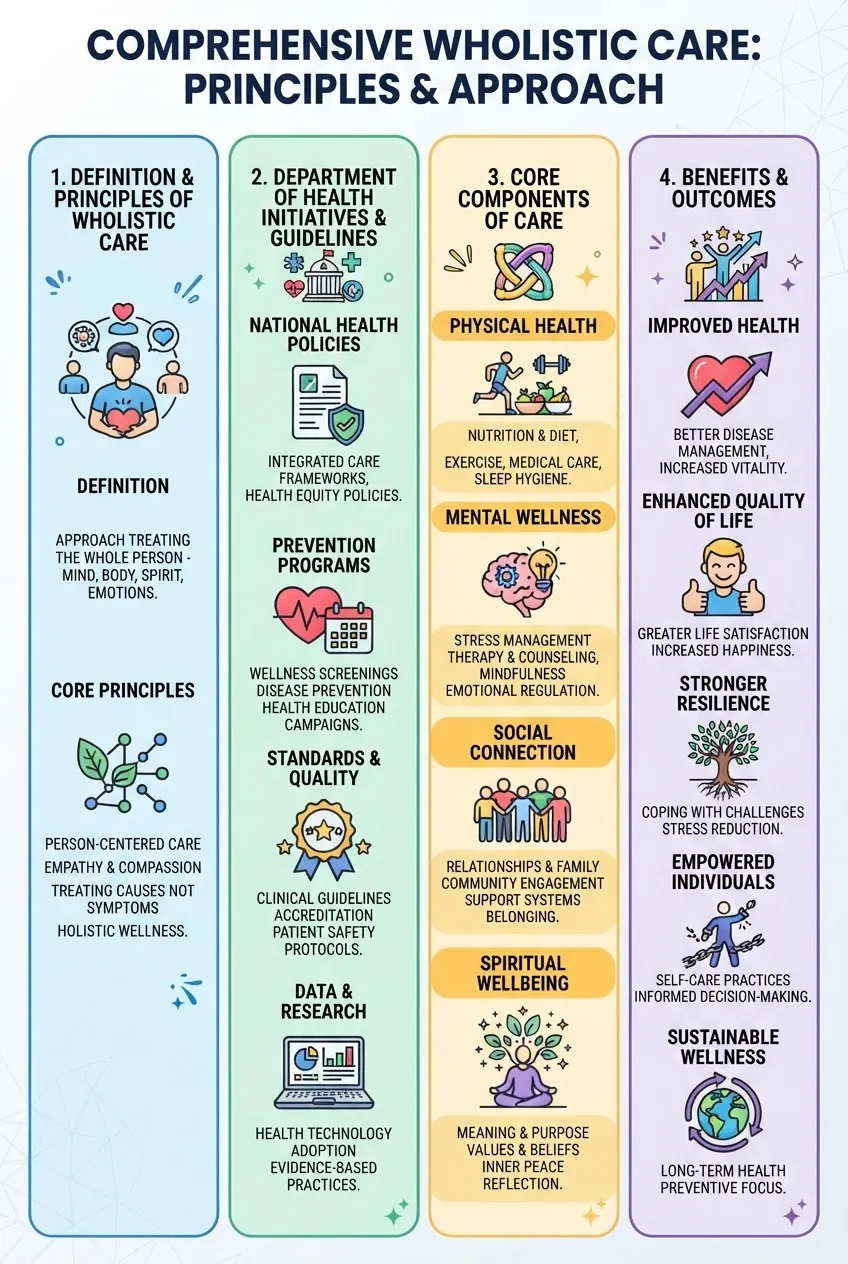
Concrete Department activities and examples:
- National Frameworks and Guidance: The Department publishes operational guidance for whole-person pathways that include screening templates, referral forms and governance checklists. According to a 2023 Department of Health report, these resources were distributed to primary health networks and hospital systems to standardise practice.
- Funded Pilots: The Department has funded community-based “whole-person care” pilots that co-locate mental health, social work and allied health within primary care clinics; early program evaluations report improved engagement and reduced emergency presentations (According to a 2023 Department of Health program evaluation).
- Workforce Development: Grants for multidisciplinary team training—nursing, allied health, social services and community workers—support role clarity and shared care planning tools.
- Data and Standards: The Department issues minimum data sets and outcome indicators for wholistic programs to enable national-level monitoring and research.
- Partnerships: Collaborations with state health authorities, community organisations and academic centres fund implementation science projects to test scaling strategies.
Example program summaries (department-endorsed):
- Community Integrated Care Hubs: co-located teams for chronic disease management that reduced 12-month hospital readmission rates in pilots (According to a 2023 Department of Health pilot report).
- Whole-Person Primary Care Grants: funding to embed mental health clinicians and social prescribers into general practice, increasing preventive screening rates.
- Indigenous-led Wholistic Health Initiatives: culturally adapted programs integrating traditional healing practices with mainstream services, monitored for cultural safety and outcomes.
Policy levers the Department uses:
- Commissioning conditional funding tied to integrated performance metrics.
- Accreditation standards that require cross-sector coordination evidence.
- National procurement for shared digital care planning platforms.
For international context and standards the Department consults, see the World Health Organization’s person-centred integrated care guidance (WHO guidance on integrated care), which informs best-practice benchmarks and measurement approaches.
Core Components of Wholistic Care as Applied by the Department of Health
Answer: The Department structures wholistic care around five core components—physical, mental, emotional, social and spiritual health—each operationalised through screening, tailored interventions, multidisciplinary roles and coordinated follow-up.
Below are component-by-component descriptions showing how the Department operationalises each area.
-
Physical health
Answer: Physical health focuses on disease prevention, chronic disease management, medication optimisation and functional status, delivered through primary and specialist clinical services coordinated with allied health.
The Department mandates standardised physical health assessments (vitals, chronic disease risk scores, medication reviews) and integrates allied health referrals—physiotherapy, dietetics—into shared care plans. Clinical pathways outline triggers for escalation and links to rehabilitation services.
-
Mental health
Answer: Mental health includes screening, brief interventions, specialist care referral and psychosocial supports embedded in primary care and community settings to reduce fragmentation.
Term: mental health — emotional, psychological and social wellbeing that affects cognition, relationships and daily functioning.
The Department supports stepped-care models, co-locating psychologists and psychiatrists in primary care and funding telehealth mental health services where access is limited. Programs prioritise early identification and collaborative care agreements with clear crisis pathways.
-
Emotional support
Answer: Emotional support encompasses counselling, peer support and brief psychosocial interventions integrated into care plans to build resilience and adherence.
Department guidance encourages embedding social workers, counsellors and peer support into teams and tracking patient-reported outcome measures (PROMs) for emotional wellbeing. Emotional care is positioned both as a clinical intervention and a facilitator for improved physical health outcomes.
-
Social determinants of health
Answer: Social care addresses housing, food security, employment and community supports via screening, social prescribing and referral networks to reduce barriers to health.
Screening tools for social needs are standard in wholistic pathways, and care coordinators or case managers connect patients with community resources and benefits. The Department’s social prescribing pilots document improved appointment adherence and reduced avoidable admissions.
-
Spiritual health
Answer: Spiritual health recognises meaning, purpose and cultural or religious practices as factors in wellbeing; it is respected through optional chaplaincy, culturally appropriate supports and referral pathways.
Department policy requires culturally safe engagement and options for spiritual support when patients request it; programs embedding Indigenous healing practices include co-developed evaluation metrics that respect cultural authority.
Coordination and case management
Answer: Central to these components are care coordinators and case managers who operationally link services, manage transitions and maintain shared care plans.
The Department specifies caseload ratios, key functions (referral, follow-up, documentation), and interoperable electronic care plans to support continuity across providers.
How Wholistic Care Integrates with Traditional and Conventional Health Services
Answer: Wholistic care integrates with conventional services by embedding multidisciplinary teams in clinical settings, establishing referral protocols, shared care plans and governance structures that align complementary services with clinical safety and evidence standards.
Integration is achieved through several mechanisms:
- Multidisciplinary teams: GPs, specialists, nurses, allied health, mental health clinicians and social care workers meet routinely to review complex cases and update care plans.
- Care coordination tools: shared electronic care plans and standardised referral templates reduce duplication and improve follow-up.
- Clinical governance and safety checks: the Department requires evidence-based protocols for any complementary therapies used within wholistic models and safety reporting systems.
Comparison: Wholistic vs Integrative vs Conventional care
| Model | Key focus | Typical setting |
|---|---|---|
| Wholistic care | Whole-person outcomes, coordination, prevention | Integrated clinics, community hubs |
| Integrative medicine | Combines conventional and complementary treatments in clinical care | Specialist integrative clinics, hospitals |
| Conventional care | Disease-focused diagnosis and treatment | Primary care, hospitals |
The Department emphasises that wholistic care complements—not replaces—evidence-based conventional medicine. Clinical oversight, medication reconciliation and specialist referral remain core safety requirements when complementary modalities are included.
Practical integration example:
- Primary care clinic screens for social needs and mental health.
- Care coordinator convenes a case conference with GP, psychologist and a social worker.
- A shared care plan is uploaded to the regional patient portal; follow-up tasks are assigned with timelines and outcome measures.
For patients seeking practitioner access and insurance integration when combining modalities, see
finding alternative practitioners with insurance.
External standards that inform clinical integration include WHO integrated service models and peer-reviewed implementation research on multidisciplinary collaborative care (peer-reviewed implementation study).
Benefits and Outcomes of Wholistic Care Supported by the Department of Health
Answer: Department-supported wholistic care demonstrates improved patient satisfaction, better chronic disease control, reduced hospital admissions in pilots and increased preventive screening uptake, while promising improved equity when targeted to underserved groups.
Summary of documented outcomes:
- Patient experience: Pilots report higher patient satisfaction and perceived coordination compared with standard care (According to a 2023 Department of Health patient experience survey).
- Clinical outcomes: Early evaluations show improved control of chronic conditions—e.g., reduced A1C levels in diabetes management pilots—when wholistic components like nutrition and mental health support are integrated (According to a 2023 Department of Health program evaluation).
- Utilisation impacts: Several Department-funded hubs reported reductions in non-urgent emergency department visits and fewer avoidable readmissions at 12 months (According to a 2023 Department pilot report).
- Prevention and screening: Programs with embedded prevention activities recorded higher uptake of immunisations and cancer screenings.
How the Department measures outcomes
Answer: Outcomes are measured via a mix of clinical indicators, patient-reported measures (PROMs/PREMs), utilisation data and equity metrics disaggregated by population groups.
Key measurement domains include:
- Clinical control (biomarkers, symptom scores)
- Function and quality of life (validated PROMs)
- Service utilisation (admissions, ED visits, primary care engagement)
- Equity indicators (access by region, socioeconomic status, Indigenous status)
Readers who want a deeper dive on clinical benefit framing should see additional material on the
benefits of holistic medicine.
Evidence caveats: while multiple Department reports document positive program-level results, the Department’s official evaluations note variability across sites and the need for longer-term, controlled studies to attribute causality (According to a 2023 Department of Health evaluation summary).
Challenges and Considerations in Implementing Department of Health Wholistic Care Initiatives
Answer: Key implementation challenges include funding constraints, workforce capacity, interoperability of health IT, cultural competency, variable evidence for some complementary interventions and the complexity of cross-sector governance.
Major barriers and brief elaborations:
- Resource limitations: Sustainable funding models are required beyond initial pilots; many sites rely on short-term grants.
- Workforce and training: Multidisciplinary practice needs role clarity, training and time for team meetings—capacity building is resource-intensive.
- Data and IT interoperability: Shared care plans require interoperable systems and privacy frameworks; patchy IT slows coordination.
- Cultural competency and equity: Programs must be adapted to local cultural contexts; standardised models may not fit Indigenous or culturally diverse communities without co-design.
- Evidence gaps: For some complementary therapies, high-quality evidence is limited; the Department requires clinical governance and safety monitoring when such therapies are used.
- Interdisciplinary collaboration challenges: Differences in professional cultures, funding siloes and liability concerns complicate team-based models.
Cost comparison examples
| Funding stream | Typical use | Limitations |
|---|---|---|
| Pilot grants | Start-up costs, evaluation | Short-term; sustainability risk |
| Recurrent funding | Operational staff, core services | Requires budget reprioritisation |
| Medicare/insurance billing | Fee-for-service clinician costs | May not cover non-clinical social services |
The Department’s implementation guidance explicitly addresses many of these barriers, recommending co-designed models, staged rollouts, robust evaluation plans and requirements for cultural safety in services targeted to priority populations (According to Department implementation guidance, 2022–2023).
Future Directions for Wholistic Care within Department of Health Strategies
Answer: Future directions include scaling integrated digital care plans, embedding equity-focused policies, expanding workforce roles such as health coaches, and formalising integrated care pathways with stronger evaluation and payment reform.
Key trends the Department is pursuing:
- Digital integration: national push for interoperable electronic shared care plans, remote monitoring and telehealth to extend wholistic services.
- Payment reform: exploring blended funding and outcomes-based contracts to incentivise prevention and cross-sector collaboration.
- Workforce innovation: new roles—case navigators, community connectors and health coaches—are being piloted to bridge clinical and social supports; these roles will require standardised training and credentialing pathways.
- Focus on equity: targeted investments and co-designed programs for marginalized communities, with measurement frameworks that report equity outcomes.
Opportunities for professionals and trainees include certification and training as health coaches and holistic wellness specialists; readers can explore accredited courses like an
online health coach certification and local training pathways such as
holistic wellness coach training.
Strategic research priorities the Department is funding include controlled trials of integrated models, implementation science on scaling, and long-term outcome studies that track equity impacts (According to a 2024 Department of Health research agenda).
Final forecast: as data systems mature and payment models evolve, Department-endorsed wholistic care is likely to move from pilots to mainstream funded services for defined priority groups and chronic disease pathways.
Conclusion: The Department of Health defines wholistic care as a structured, whole-person approach implemented through governance, multidisciplinary teams, data standards and targeted programs. While evidence from Department pilots shows improved satisfaction and some clinical gains, successful scaling requires sustained funding, interoperable IT, workforce training and culturally safe co-design. For clinicians and patients wanting modality-level information and practitioner pathways, visit the main guide on holistic healing methods. To explore practical program options, contact local primary health networks or check Department program pages (Australian Department of Health). Takeaway: wholistic care amplifies conventional medicine through coordinated, person-centered, prevention-focused systems—ask your provider how care plans will connect mental, social and spiritual needs with clinical treatment.