
Holistic health coach certification — by the end of this guide you will have a clear roadmap to select, complete, and leverage a certification program to launch a client-ready practice. Expect a realistic timeline of 6–18 months depending on part-time versus accelerated study; this guide assumes beginner to intermediate experience with wellness concepts and basic client communication skills.
Before you start, gather the following essentials so you hit the ground running:
- Professional ID and proof of education (high school diploma minimum; college or health degree helpful).
- Reliable computer with webcam, headset, and 10 Mbps internet for online lessons and practicals.
- Journal or digital note system and client management software trial (e.g., PracticeBetter, Healthie).
- Basic first-aid/CPR certificate if your target market requires face-to-face practice.
- Budget planning: allocate AU$1,200–AU$6,000 depending on program scope and accreditation.
Transition: Start with a practical definition so you and I share the same working language.
What Is Holistic Health Coach Certification?
Holistic health coach certification is a formal credential awarded after completing a structured training program that teaches coaching skills, lifestyle and behavior-change methods, and integrative health frameworks. A certified holistic health coach is trained to support clients across nutrition, movement, sleep, stress management, social connectedness and often spiritual or energetic dimensions — working from a whole-person model rather than a single-discipline intervention.
This certification typically covers coaching competencies (active listening, goal-setting, motivational interviewing), wellness sciences (basic nutrition, sleep physiology, stress response), and professional standards (scope of practice, referral protocols). Accreditation and program recognition vary: some credentials are aligned with recognized accrediting bodies, others are independent certificate programs focusing on experiential practice.
Definitions to note: accreditation means an external review that evaluates curriculum quality and institutional processes; motivational interviewing is a client-centered communication technique used to encourage behavior change.
For foundational reading on modalities that inform coaching practice, consult the holistic healing methods guide for context and techniques commonly referenced in training.
Transition: With the definition established, let’s examine why certification matters for your career and practice.
Why Become a Certified Holistic Health Coach?
Certification elevates credibility, clarifies scope, and expands career options. Below are concrete reasons people choose formal training instead of informal study.
- Professional credibility: Employers and clients prefer a certified practitioner—especially when certification is backed by an accrediting body.
- Clear practice boundaries: Certification teaches what you can safely coach and when to refer to allied professionals, reducing legal risk.
- Better client outcomes: According to a 2023 survey by NBHWC, programs using coaching frameworks reported improved client adherence and measurable outcomes — a reason clinical partners seek credentialed coaches (source: professional association survey).
- Marketability online: A searchable credential and practical experience (case studies and supervised hours) increase client conversion.
- Higher income potential: Career benefits of certification include the ability to charge premium rates, offer packages, and secure corporate or group contracts.
- Ongoing professional pathways: Certification is a springboard to a health coach masters degree or advanced specializations.
- Networking and mentorship: Accredited programs often include supervised practice, mentor feedback and community cohorts that speed skill acquisition.
For more about the scientific and health advantages that underpin coaching outcomes see the data on the benefits of holistic medicine.
Transition: Knowing “why” helps prioritise. Next, understand the curriculum elements that reputable health coach training programs include.
Core Components of Health Coach Training Programs
- Coaching skills and methodology — Core methods include motivational interviewing, active listening, solution-focused techniques, and stage-of-change models. Programs teach structured session flows (intake, assessment, goal-setting, behavior-change plan, follow-up cadence). Expect 40–100 hours of practice and observed coaching in a full program.
- Behavior-change theory — Common frameworks include Transtheoretical Model, Social Cognitive Theory, and Self-Determination Theory. These are used to design interventions that move clients from contemplation to sustained action.
- Basic clinical foundations — Foundational modules cover nutrition fundamentals, sleep hygiene, stress physiology, movement basics, and chronic disease risk factors. These modules clarify what coaches can discuss and when to refer to medical or allied professionals.
- Scope of practice and ethics — Accredited wellness certification programs teach legal documentation, confidentiality, informed consent, boundaries, and mandatory reporting. This reduces liability and clarifies referral pathways to licensed practitioners.
- Practical tools and platforms — Training introduces client management systems (PracticeBetter, Healthie), telehealth etiquette, intake forms, outcome measures (PHQ-9, GAD-7 for screening), and basic bookkeeping/invoicing tools. These practical skills make you client-ready on day one.
- Business and practice development — Modules on pricing, packages, marketing, group coaching design, and contracts. Expect templates for 1:1 contracts and sample scopes of practice to adapt.
- Supervised practicum and assessment — Reliable programs require 50–125 supervised coaching hours with recorded sessions and mentor feedback. Assessments include observed practicals, written exams, and case presentations.
- Accreditation and standards — Programs aligned with recognized accrediting bodies follow defined competency frameworks. For example, NBHWC alignment affects recognition and graduate pathways; see accreditation details in the program accreditation section below.
- Specialist modules — Nutrition and wellness coach certification tracks, mental health modules, or lifestyle coach certification options allow focused competence in specific niches.
- Continuing education and renewal — Many credentials require periodic CEUs or supervised hours to maintain active status; plan for 15–30 hours annually in most cases.
Transition: With curriculum clarified, compare program types so you can match delivery mode, cost and accreditation to your goals.
Types of Holistic Health Coach Certification Programs
The table below compares common program types by delivery mode, typical duration, approximate cost, and accreditation likelihood. Use it as a decision filter — later sections unpack how to choose the best fit.
| Program Type | Delivery Mode | Typical Duration | Approx. Cost (AUD) | Accreditation Likelihood |
|---|---|---|---|---|
| Certificate in Holistic Health Coaching | Online or blended | 3–12 months | 1,200–4,000 | Medium (varies by provider) |
| Accredited Wellness Certification (NBHWC-aligned) | Online with live labs | 6–12 months | 2,000–6,000 | High (meets NBHWC standards) |
| Lifestyle Coach Certification | In-person workshops + online | 4–9 months | 1,500–3,500 | Low–Medium |
| Nutrition and Wellness Coach Certification | Online with practicum | 6–18 months | 2,000–7,000 | Medium (depends on scope) |
| Mental Health Coach Certification | Online; often requires prior health qualification | 6–12 months | 2,500–6,500 | Medium (scope often restricted) |
| Health Coach Masters Degree | University (online or campus) | 1.5–2 years full time | 20,000–60,000+ | High (degree-level accreditation) |
If you want a curated comparison of providers, see the best online health coach certification programs article for program-level reviews and updates.
Transition: Use this comparison as input to a structured selection process—next we build that checklist into actionable steps.
How to Choose the Best Holistic Health Coach Certification Program
Choosing the right program is a process, not a single judgement. Work through these steps as a checklist to evaluate fit, quality, and career alignment.
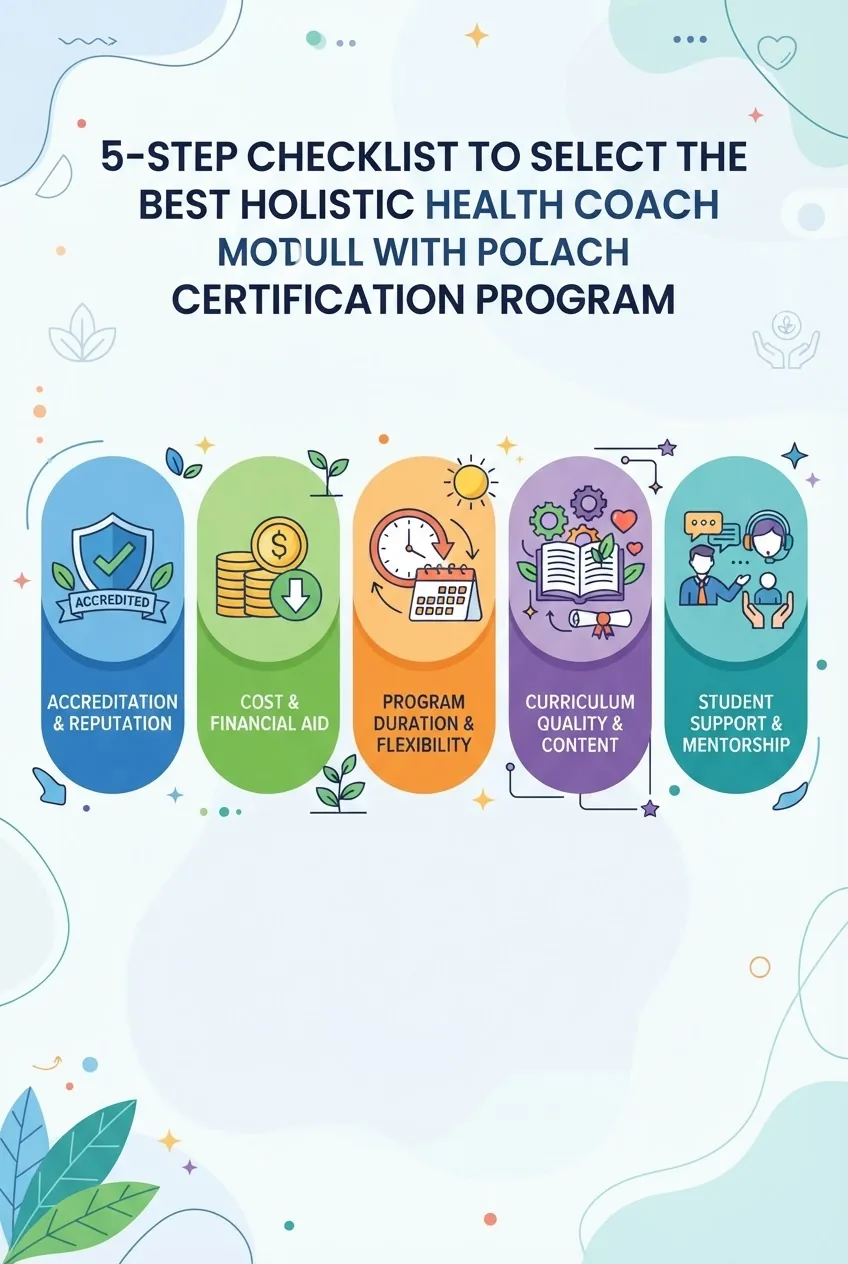
- Confirm accreditation and standards: Verify if the program aligns with recognized accrediting bodies. Search NBHWC and ICF competency alignment and check national education registers for degree programs. Accreditation affects employer recognition and graduate eligibility for advanced credentials.
- Match curriculum to your career goals: If you plan to offer nutrition counseling, ensure clinical nutrition hours are included; if mental-health-adjacent coaching is your goal, confirm trauma-informed modules and supervised practicum availability.
- Check practicum and supervised hours: Prefer programs with 50+ supervised coaching hours, recorded assessments, and mentor feedback. These practical hours are essential to move from theory to client-ready skill.
- Evaluate instructor and mentor credentials: Review faculty CVs for clinical or coaching experience. Instructors with ICF credentials or NBHWC-aligned backgrounds usually provide stronger mentorship.
- Assess business and career support: Look for business modules, marketing templates, and internship or job-placement assistance. Real-world client acquisition training increases ROI.
- Compare cost vs outcomes: Map cost to concrete deliverables—mentored hours, accreditation, exam fees, and lifetime access to resources. Consider financing, scholarships, or employer-sponsored study.
- Read independent reviews and graduate outcomes: Seek alumni case studies, employment rates, and graduate portfolios. A credible program shows transparent outcome metrics.
- Test the platform and student support: Trial the LMS, check response times for student support, and confirm assessment formats (live practical vs. multiple-choice).
- Location and modality preference: Decide between online vs in-person training modalities based on learning style, networking needs, and schedule constraints. Blended models often offer the best of both.
- Verify post-certification requirements: Check renewal, CEU requirements, and advanced pathways such as a health coach masters degree if you plan to continue academic advancement.
For readers preferring in-person options, you can find health coach training near me for a location-based shortlist.
Transition: With program selection strategy clear, follow this step-by-step pathway to complete your certification and launch your practice.
Step-by-Step Guide: How to Become a Certified Holistic Health Coach
Below is a hands-on, actionable sequence from enrollment to certified practice. Each step starts with a bold, action-first direction you can follow precisely.
Core steps — expect 6–18 months total depending on part-time intensity. If you pursue a health coach masters degree, add 18–24 months beyond initial certification.
- Decide your target client and niche. Define a primary niche (e.g., stress management for corporate clients, women’s hormonal health, or chronic disease prevention). Specify client criteria: age range, complexity (e.g., non-clinical vs. comorbid conditions), and desired outcomes. Narrowing scope reduces training needs and improves marketing clarity.
- Compare program scope to niche demands. Match curriculum requirements to your niche. For example, a nutrition-heavy niche requires a program with at least 40 hours of evidence-based nutrition content and supervised nutrition casework. If aiming for mental-health-adjacent coaching, choose a program with trauma-informed care and clear referral protocols.
- Verify accreditation and competencies. Check program claims against accrediting bodies. Use NBHWC standards for health coaching competencies and ICF competencies for core coaching skills.
- Enroll and complete core modules. Structure your study schedule: 6–10 hours/week for part-time learners. Track hours: aim for 150–300 study hours including readings, recorded sessions, and assignments. Use a learning management calendar and set 90-day milestones for module completion.
- Practice coaching with monitored sessions. Log 50–125 supervised coaching hours as required by your program. Use client management software (trial PracticeBetter or Healthie) to manage intake forms, scheduling, invoicing, and outcome tracking. Record at least 10 sessions for mentor review; set a feedback cycle every two weeks.
- Develop standard forms and intake tools. Create intake questionnaires, informed consent, and scope-of-practice documents. Templates should include red-flag criteria for referral (e.g., suicidal ideation, uncontrolled psychiatric conditions) and a local referral list to allied health professionals.
- Complete assessments and case studies. Most programs require a written case study and an observed practical exam. Prepare one 12-week client case with pre/post outcome measures (e.g., sleep hours, PHQ-9 change, weight or biometrics if relevant). Structure the case report: baseline assessment, intervention plan, session logs, measured outcomes, and reflective learning points.
- Pass the certification assessment. Assessment formats vary: live observed practical, recorded coaching evaluation, written exam, or a combination. If your program uses NBHWC standards, expect a multi-format competence check. If you don’t pass, follow the program remediation steps — retakes often require submission of remedial practice hours.
- Register with professional associations. Join relevant bodies (NBHWC, ICF or national associations). Membership provides referrals, liability insurance guidelines, and CEU opportunities. Some associations require background checks or proof of certification for listing on public directories.
- Build your practice infrastructure. Set up a business entity, professional indemnity insurance, booking system, and a minimum of three packaged offers (single session, 6-week starter, 12-week transformation). Price with a target of covering training recoupment within 6–12 months (e.g., if training cost AU$3,000, aim for AU$250–AU$350 per session or equivalent package pricing).
- Launch and iterate with outcome tracking. Run an initial pilot of 6–12 clients, collect outcome measures, and publish two anonymised case studies. Use client feedback to refine session flow, intake screening, and package structure.
- Plan continuing education and specialization. Map a 12–24 month CPD plan: 20–40 hours of advanced training (nutrition certification, mental health coaching, or corporate wellbeing). If considering academic advancement, identify health coach masters degree pathways that accept your certification credits.
According to a 2024 industry report, programs listing explicit NBHWC alignment have higher employer recognition (source: professional association industry report).
External references: NBHWC and ICF competency frameworks provide checklists you should map against any syllabus.
Transition: Now that you understand the process, here is practical advice from real-world experience to avoid beginner pitfalls.
Case study: From certification to six-figure practice
Anna completed an NBHWC-aligned certification in 9 months while working part-time. She logged 75 supervised hours, used PracticeBetter for client management, and launched a 12-week signature program. By month 12 post-certification she had three stable corporate contracts and a client roster generating AU$85,000 annually. Key actions: published measurable case studies and prioritized supervised practice.
Transition: Reflecting on common errors speeds progress and protects your reputation.
Cost, Duration, and Commitment of Certification Programs
Programs vary widely. Below are practical ranges and financing suggestions so you can plan time and money with confidence.
- Certificate programs: Duration 3–12 months; cost AU$1,200–AU$4,000. Expect 100–250 total study hours including practicals.
- Accredited NBHWC-aligned programs: Duration 6–12 months; cost AU$2,000–AU$6,000; include supervised hours built-in and stronger employer recognition.
- MSc or Masters-level health coach programs: Duration 1.5–2 years full-time; cost AU$20,000–AU$60,000+; suitable for clinicians or those seeking research roles.
Financial aid options: employer sponsorship, payment plans, scholarships offered by providers, or low-interest education loans. Budget for extras: software subscriptions (AU$20–AU$60/month), liability insurance (AU$200–AU$600/year), and certification exam fees (AU$150–AU$500).
Time commitment: Part-time learners should plan 6–12 hours/week; intensive cohorts may require 15–25 hours/week for accelerated completion.
Transition: If you’re considering specialty tracks, here are common advanced options and how they differ.
Specializations and Advanced Certifications in Holistic Health Coaching
Specializations deepen your expertise and market positioning. Below are common tracks and what they require.
Nutrition and wellness coach certification
Nutrition-focused programs provide in-depth macronutrient and micronutrient education, meal-planning frameworks, and clinical red flags requiring dietitian referral. Typical entry: 40–120 hours of nutrition education; many programs require practical meal-plan casework and supervised client hours. For a deep dive see the holistic nutrition certification resource.
How to become a certified mental health coach
Mental health coach certification focuses on coaching within non-clinical boundaries: screening for mental health conditions, suicide risk protocols, and trauma-informed approaches. Programs often require prior health qualifications or partnering with licensed mental health professionals for supervision. Certification does not substitute for clinical psychotherapy or diagnosis.
For an overview of mental-health integrated approaches, see holistic approach to mental health.
Lifestyle coach certification
Focuses on behaviors like sleep, movement, habit design, and daily routines. Typically shorter (3–6 months) with strong business-model modules for one-to-one and group coaching.
Health coach masters degree
A master’s degree offers research training, advanced clinical frameworks, and broader employment opportunities in healthcare systems. Expect university-level assessment, thesis or capstone, and full academic accreditation.
Transition: After specialization, plan how to convert certification into tangible career pathways.
Career Opportunities and Continuing Education After Certification
Certification unlocks multiple pathways. Below are the most practical routes and action steps for expanding career momentum.
- Private practice: One-to-one coaching, small-group programs, and online courses. Build packaged offers—single session AU$90–AU$250, 12-week program AU$800–AU$3,500 depending on niche and outcomes.
- Corporate wellness: Offer workplace programs and group coaching. Contract rates can be AU$1,000–AU$5,000 per workshop or AU$5,000–AU$40,000 annual retainer for ongoing services.
- Clinical partnerships: Work alongside naturopaths, dietitians, or primary care teams as a health-coaching specialist — ensure clear referral pathways and documented scope.
- Digital products and courses: Create evidence-based online courses and subscription models for recurring revenue.
- Education and training: Transition into instructor roles or mentor new coaches after accumulating supervised hours and demonstrable outcomes.
- Research and policy roles: Graduates of a health coach masters degree may enter research or health system roles shaping population-level interventions.
Continuing education: maintain your credential with CEUs, supervised hours, and peer supervision groups. Join associations for resources and referrals — membership often includes insurance guidance, ethical standards, and job listings.
If you plan to collaborate with other practitioners or refer clients, use this directory to locate local professionals: alternative practitioners near me.
Transition: Before you commit, learn common mistakes I’ve observed and how to avoid them based on real practice experience.
Common mistakes and how to avoid them
I once launched without a clear intake and paid the price: a client presented with unmanaged psychiatric symptoms and I lacked a referral protocol. I corrected this by implementing a mandatory screening (PHQ-9, GAD-7) and a local referral list. Now every client intake includes red-flag checks and an emergency contact.
Another error I made was underpricing services. Early on I charged hourly, which undervalued outcomes. Switching to outcome-based packages (6-week and 12-week) improved completion rates and tripled revenue within a year.
I also observed coaches who skipped supervised practice. Without mentor feedback, subtle communication errors persisted. Complete at least 50 supervised hours and record sessions for critique to accelerate competence.
Compact checklist to verify your readiness
- Enrolled in an accredited or clearly competency-aligned program.
- Completed minimum supervised hours required by your program (50–125 recorded).
- Developed standard intake and referral documents (including PHQ-9/GAD-7 where appropriate).
- Tested client management software and set up invoicing and insurance.
- Delivered at least one 12-week case and documented measurable outcomes.
- Joined a professional association and arranged liability insurance.
When to call in a professional
Refer clients immediately if they present suicidal ideation, acute psychiatric symptoms, unmanaged substance dependence, or suspected untreated severe medical conditions. Call a licensed mental health clinician or medical practitioner rather than attempting to manage these within coaching scope.
Transition: Final summary and next steps to begin your certification journey.
Conclusion: Your Path to Becoming a Holistic Health Coach
Holistic health coach certification is a pragmatic investment in your ability to support whole-person wellbeing. Choose programs that balance accredited standards, hands-on supervised hours, and business training. Begin with a clear niche, complete supervised practice, document measurable outcomes, and use accreditation alignment (NBHWC/ICF) as a quality filter. Start by shortlisting 3 programs that meet the checklist above and schedule informational interviews with program mentors within 14 days.
Ready to take the next step? Map out a 90-day study plan, confirm program accreditation, and book an informational call with your top provider this week.