
Careers in alternative medicine include licensed clinicians, wellness practitioners, researchers and industry professionals who use training in naturopathy, acupuncture, herbal medicine and integrative care; these paths combine formal degrees, certifications and supervised clinical experience to create clear job opportunities, realistic salary expectations and licensure routes across private practice, clinics and integrative hospitals.
Introduction to Careers in Alternative Medicine
Answer: Careers in alternative medicine span clinical practice, allied wellness roles and non-clinical work, each tied to different educational routes and licensing—this section gives an overview linking common degree choices to job outcomes and where practitioners typically work.
Term: Alternative medicine refers to medical practices used instead of or alongside conventional Western medical care, often emphasising natural or traditional therapies.
Alternative healing careers and holistic health jobs cover a wide spectrum: licensed clinicians such as naturopathic doctors and acupuncturists, allied practitioners like massage therapists and nutritionists, plus research, teaching and industry roles related to herbal products, supplements and wellness technology. Typical workplaces include private practices, integrative health clinics, wellness centres, hospitals adopting integrative care, community health settings and telehealth platforms.
A useful framing: think of career decisions as matching an education level (certificate, diploma, bachelor, master’s, clinical doctorate) to a workplace model (solo private practice, multi-disciplinary clinic, hospital-employed role, research or product development). Later sections map specific degrees to the jobs they realistically open.
If you want terminology primer on how alternative fields relate to conventional care, read alternative terms for Western medical practices.
Transition: next we outline specific educational pathways and certifications that lead to the most common alternative medicine career routes.
Educational Pathways: Degrees and Certifications for Alternative Medicine Careers
Answer: Educational pathways range from short certificate courses to clinical doctoral programs; choosing the right pathway depends on the career goal—clinical licensure requires accredited professional degrees and supervised clinical hours while many wellness roles accept diplomas or certificates plus continuing education.
Term: Accreditation means an independent body has evaluated an educational program for quality and standards; accredited programs are often required for licensing and professional recognition.
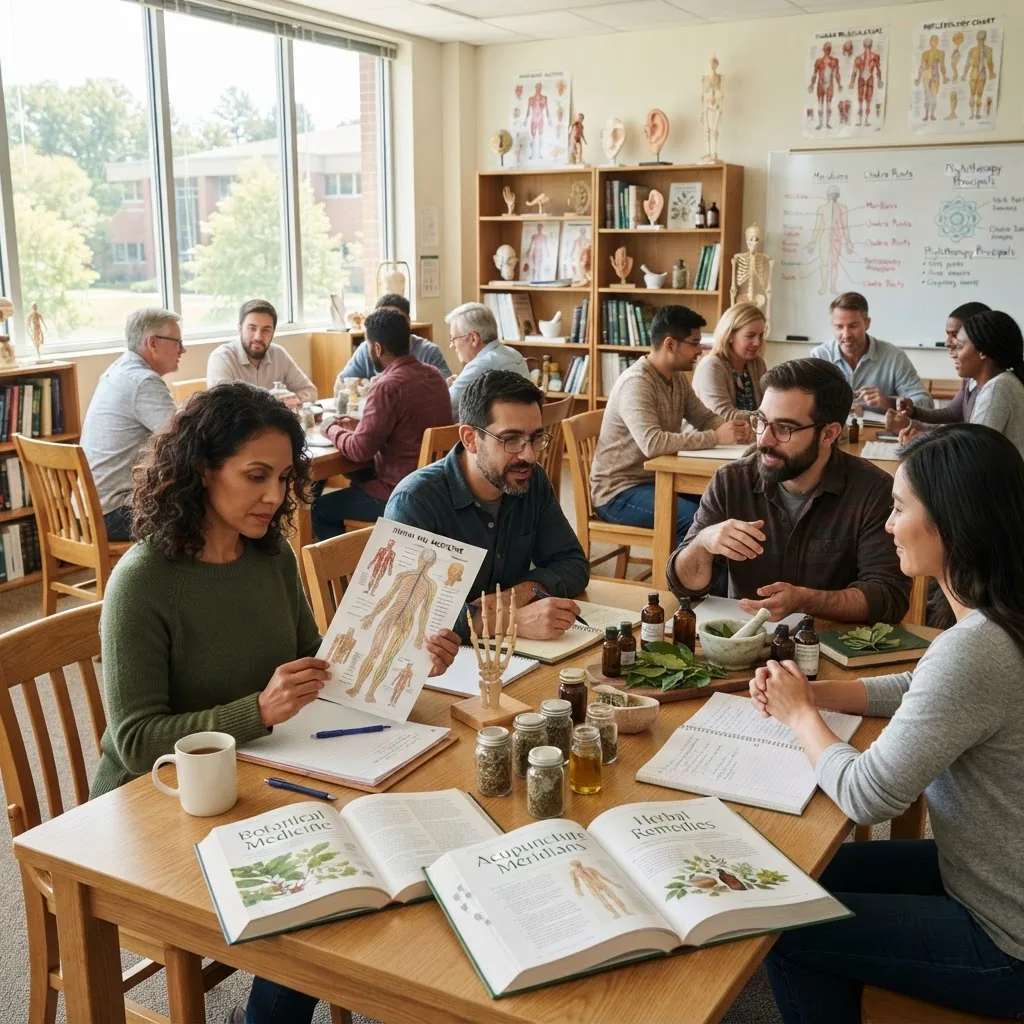
Most careers in alternative medicine follow one of these educational patterns:
- Short vocational certificates (weeks–months) for entry-level roles like massage therapy or wellness coaching.
- Diploma or associate programs (1–2 years) for clinical assistants, herbal technicians and allied practitioners.
- Bachelor’s degrees (3–4 years) that prepare graduates for advanced certification or postgraduate clinical training.
- Master’s degrees (1–3 years post-bachelor) focused on clinical specialisations, public health, or integrative medicine research.
- Clinical doctoral programs (ND, DAc) which include supervised clinical internships and are required for licensure in many jurisdictions for naturopathic doctors and some acupuncture professions.
Key decision factors when evaluating programs: accreditation status, clinical hours, scope of practice allowed post-graduation, availability of supervised internships, delivery mode (online vs. in-person), and reciprocity for licensing in other jurisdictions.
If you need details on distance learning options, see alternative medicine degree programs online for course formats and pros/cons.
Types of Degrees in Alternative Medicine
- Bachelor’s degree — 3–4 years; provides foundational science, clinical observation and often a pathway to graduate clinical programs; common in holistic health sciences or health sciences with complementary medicine specialisations.
- Master’s degree — 1–2 years post-bachelor; used for advanced practice fields, research, leadership positions and some integrative medicine certifications.
- Diploma and certificate programs — 6 months to 2 years; used for vocational roles like herbalists, massage therapists, and wellness coaches; good for faster entry into the workforce.
- Clinical doctorates — e.g., Naturopathic Doctor (ND) or Doctor of Acupuncture (DAc); include supervised clinical internships, and are required for independent practice in many regions.
- Postgraduate clinical diplomas — targeted clinically-focused training for experienced clinicians seeking added competencies (e.g., functional medicine, integrative oncology).
Key Certifications and Licensing in Alternative Medicine Careers
Answer: Certification and licensing depend on profession and location—some roles require state or national licensure (e.g., ND, acupuncturist), while others require board certification or voluntary certification from recognised councils to demonstrate competency.
Term: Board certification is a formal credential demonstrating a practitioner has met a recognised standard of specialty competence; it often requires exams and verified clinical hours.
Examples and practical notes:
- Acupuncturists often require board exams and state licensing; the National Certification Commission for Acupuncture and Oriental Medicine (NCCAOM) is a common certifying body in the U.S.
- Naturopathic doctors typically complete an accredited ND program plus licensing exams where regulation exists; many jurisdictions regulate practice tightly, while others offer limited or no licensure.
- Massage therapists and herbalists may be regulated at state or national level with required minimum hours and continuing education; certification boards vary by country.
- Integrative medicine board certification (board certified integrative medicine) is available for medical doctors or allied clinicians seeking formal recognition of integrative competency.
Licensing walkthrough (typical): select accredited program → complete required clinical hours → pass national/state board exam → apply for state licence and malpractice insurance → complete continuing education to renew licence. Specific steps vary considerably by profession and jurisdiction; always check local regulators.
Transition: now that you know educational routes and certification basics, the next section categorises the actual jobs you can pursue and what employers expect.
Career Opportunities in Alternative Medicine: Job Titles and Roles
Answer: Job titles range from clinical roles (naturopathic doctor, acupuncturist, herbalist) to allied and non-clinical positions (wellness coach, researcher, product developer); each title maps to specific education levels, certification requirements and typical salary/setting expectations.
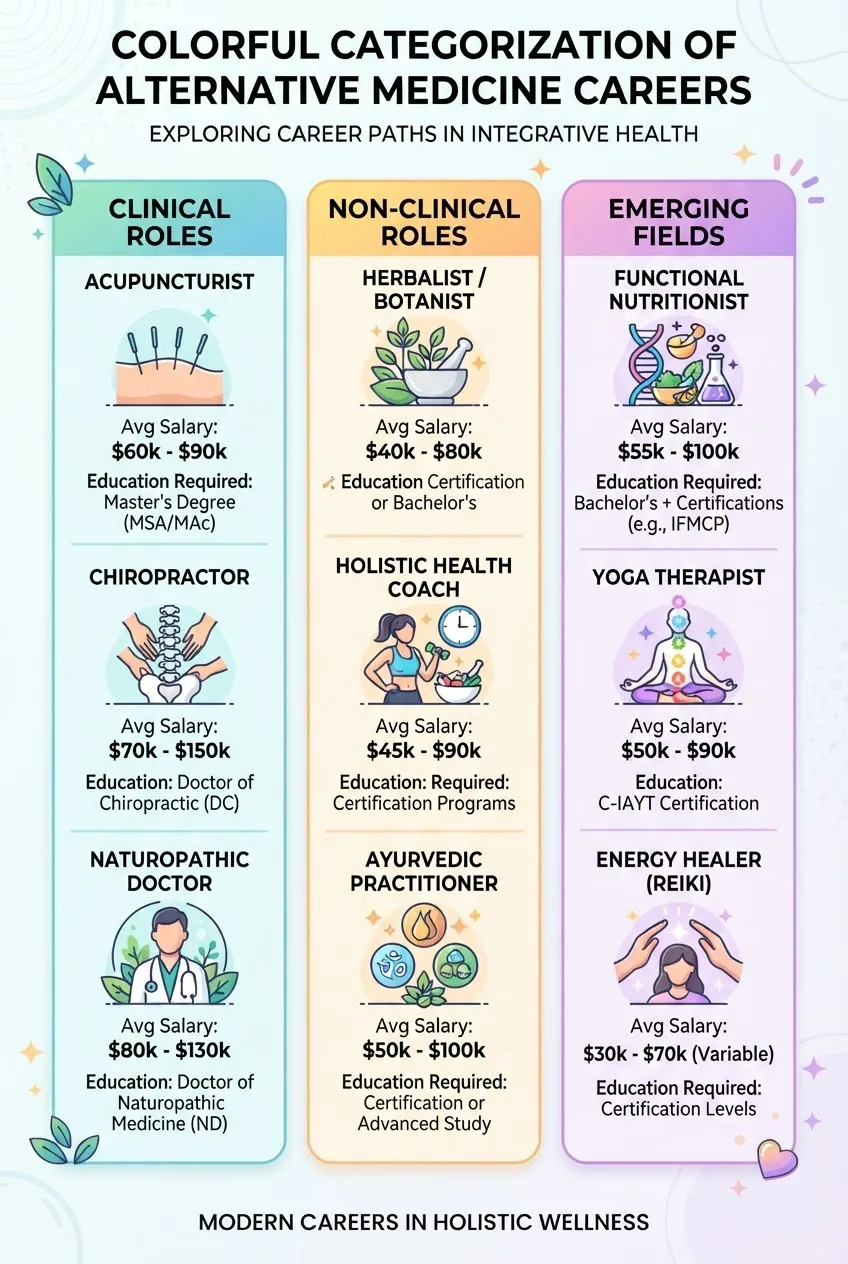
Below are the most common categories and representative roles with concise descriptions and typical educational requirements.
Clinical and Practitioner Roles
- Naturopathic Doctor (ND) — Primary clinical role using naturopathic principles; requires ND degree, supervised clinical training and licensure where regulated. Often works in private clinics, integrative hospitals or consults with oncology and chronic care teams.
- Acupuncturist / Traditional Chinese Medicine Practitioner — Uses needling, moxibustion and Chinese herbal medicine; requires diploma or degree plus board certification/licensure in many regions.
- Herbalist / Clinical Herbalist — Specialises in plant-based therapeutics; education ranges from certificates to diplomas; clinical herbalists often credential through professional herbalist associations.
- Registered Massage Therapist — Focus on soft-tissue therapies to manage pain and recovery; requires vocational training, clinical hours and local registration.
- Functional Medicine Practitioner — Typically a medical or allied health professional with postgrad training in functional/biomedical approaches to chronic disease; works in integrative clinics or primary care settings.
- Integrative Oncology Practitioner — Works with cancer patients on supportive care, symptom control and complementary therapies; usually requires clinical licensure plus integrative oncology certification.
- Nutritionist / Naturopathic Nutritionist — Clinical nutrition roles often require a bachelor’s or master’s plus specific dietetic registration where regulated; naturopathic nutritionists may work under ND scope.
- Chiropractor — Focuses on musculoskeletal health; requires chiropractic doctoral training and licensure in most jurisdictions.
- Homeopath — Offers homeopathic remedies and case-taking; education varies from certificate to diploma, and regulatory status depends on location.
- Clinical Aromatherapist — Uses essential oils therapeutically; vocational training and certifications commonly required for clinical practice.
For those interested in workplace environments, read the guide to alternative health care center services to understand multi-disciplinary clinic roles and patient service models.
Practitioners working in oncology-adjacent roles may consult on integrative protocols; see examples in alternative medicine for prostate cancer.
Mental-health-focused alternative careers appear in counselling, mindfulness and somatic therapies—see therapeutic options in mental health alternative treatments.
Clinical roles in respiratory care sometimes integrate botanical and lifestyle interventions; examples are in alternative therapies for asthma and allergies.
Pain clinics increasingly hire acupuncturists and manual therapists—see practice examples in alternative therapies for pain management.
Clinical roles often require higher education and licensure but yield autonomy and higher average earnings; many clinicians combine private practice income with adjunct roles in teaching or consultancy.
Non-Clinical and Supportive Careers
- Wellness Coach / Health Coach — Focus on behaviour change, lifestyle plans and preventive care; certificate or diploma common; coaches work in corporate wellness, clinics or private practice.
- Researcher / Academic — Conducts studies in complementary and integrative medicine; requires a master’s or PhD; work with universities, research institutes or journals.
- Product Development / Quality Assurance — Roles in herbal supplement companies, essential oils or medical cannabis firms; typically require science background plus regulatory knowledge.
- Regulatory Affairs / Compliance Specialist — Ensures product safety and regulatory compliance for herbal products, supplements and therapeutic devices; often a science or legal background plus industry training.
- Educator / Training Program Lead — Teaches vocational or academic courses in holistic health; often requires advanced credentials and teaching certifications.
- Medical Cannabis Clinician / Consultant — Specialises in therapeutic cannabis use; requires clinical credential plus jurisdictional authorisations—emerging field with growing employer demand.
Emerging roles include those in regulated medicinal cannabis: see career examples in medical cannabis therapy careers.
Transition: with roles mapped, the next section reviews job market data, growth projections and industry trends to help you prioritise specialisms.
Career Outlook and Industry Trends for Alternative Medicine Professionals
Answer: Demand for many holistic health professions is growing due to ageing populations, preventive care emphasis and patient interest in integrative options; outlook varies by role—some clinical careers show strong projected growth while regulatory and reimbursement issues remain constraints.
Key statistics and sources:
- Projected growth: According to a 2024 labor statistics report from the Bureau of Labor Statistics, demand for complementary and alternative health occupations (including massage therapists and allied practitioners) is expected to grow faster than average in many regions — check local BLS pages for profession-specific projections: Bureau of Labor Statistics.
- Integrative medicine adoption: According to a 2023 industry report from a leading integrative-health market analysis, hospital-affiliated integrative programs and outpatient wellness services expanded by double digits in urban centres between 2020–2023, driven by patient demand post-COVID-19.
- Salary benchmarks: Entry-level positions (massage therapist, health coach) often begin at local living wages; clinical roles (ND, acupuncturist) average mid-level practitioner salaries that vary widely—see comparative tables below and country-specific labour statistics for exact numbers.
| Role | Typical Education | Salary Range (typical) | Employment Settings |
|---|---|---|---|
| Massage Therapist | Certificate / Diploma | Low–Mid (varies by hours) | Spas, clinics, private practice |
| Acupuncturist | Diploma / Master’s, board cert. | Mid–High | Clinics, hospitals, integrative centres |
| Naturopathic Doctor (ND) | Clinical Doctorate | Mid–High (practice dependent) | Private practice, integrative healthcare teams |
| Wellness Coach / Nutritionist | Certificate to Bachelor’s | Low–Mid | Corporate wellness, clinics, online |
Industry trends and challenges:
- Growth areas: integrative oncology, pain management, mental health alternatives, medical cannabis and telehealth-delivered holistic services show the fastest employer demand.
- Challenges: inconsistent regulation and insurance reimbursement, variable public perception, and the need for high-quality research to secure hospital partnerships.
- COVID-19 impact: according to a 2022–2023 sector review, telehealth adoption accelerated hybrid practice models, enabling practitioners to scale coaching, follow-ups and group education online.
External resources for labour data and professional guidance: https://www.bls.gov for occupational projections; National Center for Complementary and Integrative Health for research summaries; NCCAOM for acupuncture certification standards.
Transition: after understanding market demand, the next section lists skills you must develop to win jobs and grow your practice.
Skills and Competencies Required for Success in Alternative Medicine Careers
Answer: Success requires clinical skills, interpersonal abilities, business management, evidence appraisal and ongoing continuing education; combining technical competence with practice-building and communication skills produces sustainable careers.
Core clinical and professional skills:
- Clinical assessment and diagnostic reasoning — accurate intake, contraindication awareness and treatment planning based on best available evidence.
- Manual and procedural skills — e.g., needling technique, massage modalities, herbal formulation skills depending on discipline.
- Interpersonal and communication skills — clear explanation of risks/benefits, motivational interviewing, culturally competent care.
- Business and practice management — billing, scheduling, marketing, digital presence, and regulatory compliance for private practice success.
- Research literacy and evidence appraisal — ability to interpret clinical studies and translate them into practice recommendations.
- Telehealth competencies — remote assessment, online patient engagement and secure record-keeping.
Continuing education and credential maintenance are essential: many licences require documented CE hours; specialised certifications (e.g., integrative oncology, pediatric naturopathy) improve referrals and income potential.
Case study: A graduate who completed an ND (4 years) plus 1,200 supervised hours launched a mixed private practice and part-time hospital consult role within 18 months by completing an integrative oncology fellowship and targeted networking with local oncologists.
Soft skills employers and patients value include empathy, clear documentation, time management and the ability to collaborate with conventional medical teams—especially for integrative roles.
Transition: use the skill list as a checklist when comparing programs and job postings; the next section helps you choose the right career path based on personal and market factors.
How to Choose the Right Alternative Medicine Career Path for You
Answer: Choose by aligning personal goals, scope-of-practice preferences, time-to-qualification, income targets and preferred work environment; use a stepwise evaluation to match programs and licensure prospects to realistic job markets.
Step-by-step selection process:
- Define your primary goal: clinical autonomy, part-time wellness work, research, or industry employment. This clarifies required education level.
- Map required credentials: research licensing requirements in your jurisdiction for desired roles and confirm program accreditation and clinical hour requirements.
- Assess timeline and cost: compare program duration, tuition, lost earnings during training, and likely time-to-licensure; create a 3–5 year financial plan.
- Evaluate job market locally: check local clinic demand, hospital integrative programs, and telehealth opportunities; refer to labour statistics and professional job boards.
- Plan for business skills: if private practice is a goal, budget for marketing, billing systems and malpractice insurance training.
- Pursue mentorship and supervised hours: secure internships or mentorships during training to increase employability and realistic expectations about daily caseloads.
Practical considerations: lifestyle preferences (self-employment vs. employed), patient population (chronic disease, oncology, mental health), geographic mobility and whether you want to combine conventional medical credentials with integrative training.
Analogy: Choosing a specialty in alternative medicine is like selecting a trade path—some are fast to credential and lead to immediate employment (massage, coaching), others require longer apprenticeships but give greater clinical scope and income potential (ND, chiropractic).
Transition: the conclusion summarises actionable next steps and resources for moving from education to employment in alternative medicine.
Conclusion and Next Steps for Pursuing a Career in Alternative Medicine
Answer: To pursue a successful alternative medicine career, choose an accredited program that matches your target role, verify licensure pathways, build clinical hours and business skills, and use professional associations and labour statistics to plan realistic timelines and earnings.
Next steps:
- Select 2–3 accredited programs and check licensure reciprocity in regions where you plan to work.
- Arrange informational interviews with practising clinicians to validate day-to-day work and income expectations.
- Budget for continuing education and certification renewals—professional associations often list accredited CE providers.
Resources and professional associations: consult national labour statistics (BLS), accreditation and certification bodies like NCCAOM, and research organisations such as NCCIH for evidence-based guidance.
Practical CTA: begin by shortlisting degree or certificate programs that match your desired job role, contact program admissions to confirm clinical hour placements, and network with local integrative clinics for mentorship and job leads.