
By the end of this guide you will have a practical toolkit of evidence-based, time-efficient stress management techniques for parents, step-by-step routines you can use in 1–15 minutes, and a simple integration plan you can start today. Expect to spend 20–90 minutes reading and practicing; skill level required: beginner to experienced parent-practitioner.
This article gives hands-on, parent-focused strategies — from breathing and yoga to time-management and tech tools — designed for the realities of childcare, work demands, and sleep disruption.
Before you start
- Quiet corner or chair (even 1 m² will do)
- Timer (phone timer or kitchen timer) and 1 notebook for journaling
- Comfortable clothes for short movement breaks
- One stress-tracking app installed (optional) — e.g., Calm, Headspace, or a simple mood journal
- Permission: plan one 2–5 minute practice daily for 7 days to test effects
Understanding Stress in Parenting: Causes and Effects
Parental stress comes from multiple repeatable triggers and has predictable physical and psychological effects. Recognising the patterns — what ignites stress, how it manifests, and how it accumulates — is the first practical step toward effective intervention. Below I map common triggers, the physiology behind the stress response and the short- and long-term consequences specific to caregiving roles.
Parental stress triggers: what commonly sets parents off
- Balancing work and childcare: competing deadlines and unpredictable child needs create chronic role conflict (work-family conflict).
- Sleep disruption: interrupted rest amplifies irritability and reduces executive control.
- Decision fatigue: constant small decisions (meals, routines) deplete mental resources.
- Loss of personal time: reduced self-care and social connection increase vulnerability to burnout.
How stress shows up in parents
Symptoms often include fatigue, heightened reactivity, poor emotional regulation, somatic complaints (tension headaches, chest tightness), withdrawal from partner or children, and difficulty concentrating. These signs reflect both acute stress responses and accumulating chronic stress that can lead to parental burnout.
Physiology: why these techniques work
Stress activates the sympathetic nervous system and the HPA axis (cortisol release); effective practices stimulate the parasympathetic nervous system (rest-and-digest), reducing heart rate and cortisol. Mindfulness and slow breathing directly influence vagal tone; restorative yoga and progressive muscle relaxation shift nervous-system balance toward recovery.
According to a 2024 report by the World Health Organization, chronic caregiver stress is linked to increased risk of mood disorders and reduced quality of care — validation that parent-focused prevention matters (WHO news).

Psychologically, parental stress reduces capacity for reflective parenting — the ability to pause and respond rather than react. Over weeks, this compounds into emotional distance and a higher incidence of harsh discipline. Recognising early signs like irritability, sleep loss and decreased patience lets you apply short interventions before escalation.
A 2023 mental health overview by the U.S. National Institute of Mental Health highlights that accessible, short practices (1–10 minutes) can reliably reduce physiological arousal and improve emotion regulation when practised consistently (NIMH).
Transition: Now that you understand causes and effects, the next section gives a practical, numbered toolkit you can implement immediately — from micro-breaks to 15-minute routines.
Key Stress Management Techniques for Parents
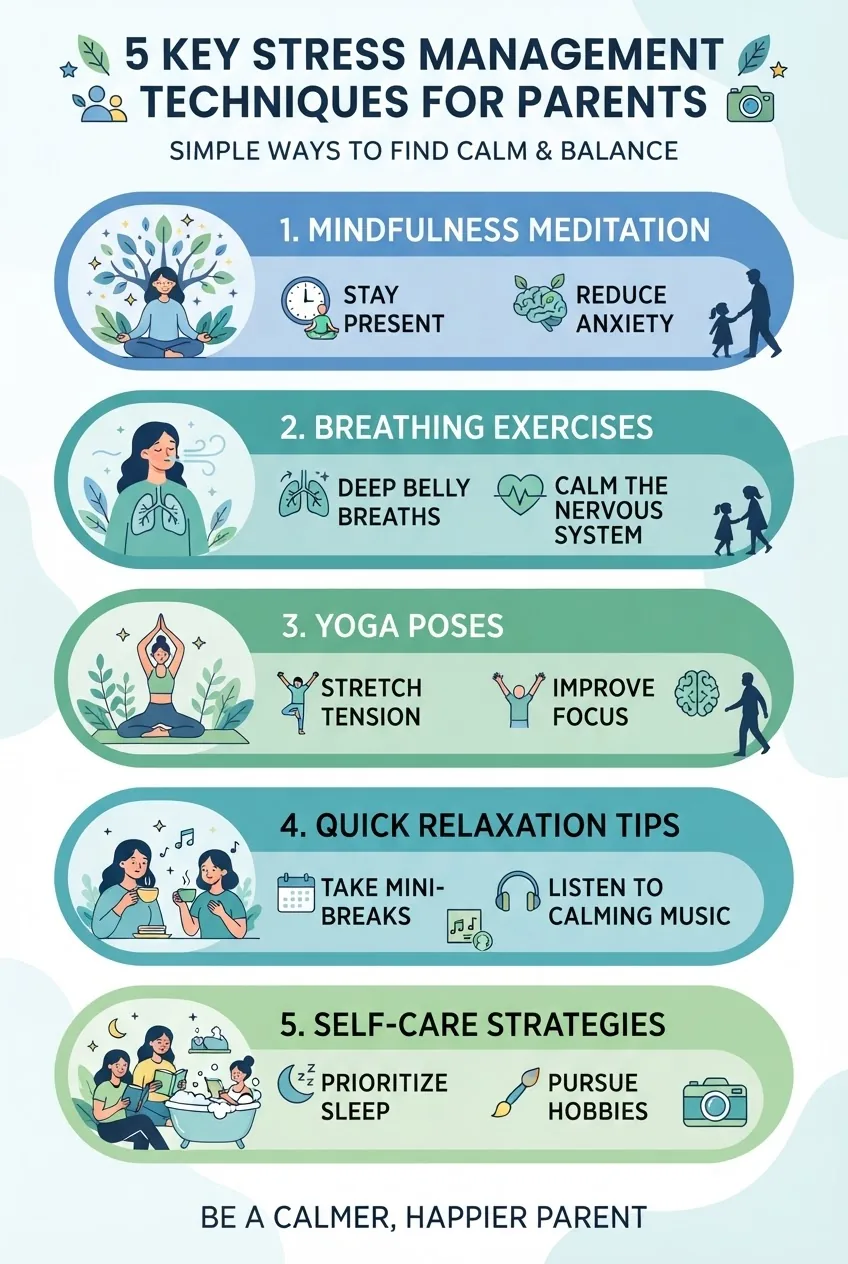
Below are step-by-step, numbered techniques that fit into real parenting days. Use them individually (1–5 minutes) or combine them into a 10–15 minute routine. For short scripts you can use immediately, see our quick guided meditations for stress relief resource for scripted options.
-
Immediate 60-second reset: Box breathing
- Action: Sit or stand; inhale for 4 counts, hold for 4, exhale for 4, hold for 4. Repeat 4 times.
- Why it works: Regulates breathing rhythms and signals safety to the vagus nerve.
- When to use: Mid-tantrum pause, before sending that sharp reply to a work email, during a middle-of-night feeding.
-
2–5 minute progressive muscle relaxation (PMR)
- Action: Tighten muscle group for 5–7 seconds (hands, shoulders, face), then release for 10–15 seconds. Move sequentially up the body. Total time: 3–5 minutes.
- Why it works: Differentiates tension from relaxation and lowers sympathetic arousal.
- Tip: Do while holding your child or after tuck-in for quick grounding.
-
3–10 minute mindful breathing break
- Action: Find a chair, set timer for chosen length. Focus on breath sensations; when distracted, label thoughts “thinking” and return to breath. Start with 3 minutes and add one minute each day.
- Why it works: Builds mindful awareness and emotional regulation; see the pillar for more on mindfulness exercises for anxiety.
- Tip: Do this after a stressful transition (school drop-off) for immediate clarity.
-
5–15 minute restorative yoga or chair sequence
- Action: Sequence example — 1 minute seated breath, 3 minutes gentle neck/shoulders stretches, 5 minutes child’s pose with long exhales, 2–5 minutes legs-up-the-wall or supported Savasana. Use props: pillow or rolled towel.
- Why it works: Slows breathing, deepens parasympathetic activation, releases muscular tension.
- Tip: Use after bedtime if alone, or include a child in gentle stretches to model calm.
-
Mood check and micro-journaling (2–5 minutes)
- Action: Write three quick lines: (1) current mood, (2) one trigger, (3) one small action to reduce stress. Save entries in a dedicated notebook.
- Why it works: Externalises thoughts, creates clarity and action planning for time-starved parents.
- Tip: Pair with a 60-second box breath to stabilise before writing.
-
Scheduled self-care slot (15–30 minutes weekly)
- Action: Block one 30-minute slot in calendar per week for restorative self-care — a walk, light yoga, or a cup of tea without screens.
- Why it works: Prevents cumulative depletion and models self-care for children.
- Tip: Trade slots with your partner or caregiver for reliability.
-
Social support check-ins
- Action: Schedule a 10-minute call or message thread with a friend or parenting group at least weekly.
- Why it works: Social support buffers stress; it’s practical and low-effort compared to therapy but still protective.
- Tip: Use brief support messages like “Need a vent for 5? Now or later?”
-
Behavioral change: small household systems
- Action: Implement two micro-systems: a 10-minute evening tidy routine and a 5-minute morning priority list. Use timers and delegate two tasks daily to a partner or older child.
- Why it works: Reduces decision fatigue and creates predictability that lowers chronic stress.
- Tip: Make the evening tidy a family habit; set a 10-minute “prep together” alarm.
-
Technology-assisted monitoring
- Action: Use one stress-tracking or mindfulness app for 7 days; note morning and evening mood. Try Calm or Headspace, or a simple mood-tracker.
- Why it works: Quantifies patterns and nudges consistency; see the Tools section for a walkthrough.
- Tip: Limit app notifications to one daily reminder to avoid alarm fatigue.
-
Parent-child co-regulation activities
- Action: Use 3-minute breath games (breathe like a balloon) or a 5-minute guided body scan with the child to teach regulation.
- Why it works: Co-regulation reduces both parent and child arousal and strengthens attachment.
- Tip: Make it playful; use props or stuffed animals to guide breaths.
Practical pairing: on a busy morning, combine Steps 1 (Box breathing, 60s) + 4 (3–5 minute chair yoga) + 5 (micro-journal 2 minutes) for a total 6–8 minute reset before leaving the house.
Transition: The next section expands on mindfulness, with micro-practices specially adapted to short windows parents actually have during the day.
Mindfulness Practices Specifically Designed for Busy Parents
Mindfulness enhances presence in parenting and improves emotional regulation. These are short, actionable mindfulness techniques you can practically insert into caregiving moments, complete with timing, scripts and troubleshooting. For short, guided resets, try our 3 minute meditation practices and read about the mental health benefits of meditation for parents.
-
Micro-awareness anchor (30–60 seconds)
- Action: Pick a sensory anchor — the feel of a spoon, the sound of a car, breath in your nostrils. Focus for 30–60 seconds, label distractions and return.
- How it helps: Trains attention control without long practice; useful during diaper change or while a child plays.
- Tip: Use a consistent anchor so it becomes a conditioned cue for calm.
-
Two-breath pause (15 seconds)
- Action: Inhale two slow breaths through the nose, exhale long. Notice shoulders drop. Resume task.
- How it helps: Immediate downregulation when you feel reactive.
- Tip: Practice this twice daily to build automaticity.
-
On-the-move body scan (2 minutes)
- Action: While walking with a stroller or around the house, mentally scan feet → calves → thighs → hips → belly → chest → shoulders → face. Soften each region for 5–10 seconds.
- How it helps: Grounding technique that fits movement and caretaking responsibilities.
- Tip: Keep timing to 2 minutes; set a gentle phone timer if needed.
-
Guided grounding with objects (1–3 minutes)
- Action: Choose a small object (stone, toy). Hold it, notice weight, texture, temperature. Describe three sensory details silently.
- How it helps: Shifts attention away from panic loops; quick return-to-present strategy.
- Tip: Use when supervising play that’s low-risk but stress-inducing (e.g., sibling squabbles).
-
Breath counting reset (3–5 minutes)
- Action: Count breaths silently to five and back to one for 3 minutes. If your mind wanders, start again at one.
- How it helps: Steadies attention and reduces ruminative thinking common with parental guilt.
- Tip: Use pre-bed to downregulate before night feeds or late work.
-
Mindful transition ritual (1–2 minutes)
- Action: Create small rituals to signal transitions (e.g., after work put keys in a basket, take two exhales, greet child). This draws a mindful line between roles.
- How it helps: Helps separate work stress from home role, reducing work-family conflict.
- Tip: Keep the ritual simple and repeatable.
-
Walk-and-notice practice (5–10 minutes)
- Action: Walk a block, notice three things you see, two things you hear, one thing you smell. Breathe calmly throughout.
- How it helps: Reorients the mind and reduces cortisol when repeated three times a week.
- Tip: If short on time, do a single block walk between tasks for a reliable reset.
-
Short loving-kindness script for parenting stress (3 minutes)
- Action: Sit quietly and repeat silently: “May I be safe. May I be patient. May my child be safe. May my child be calm.” Repeat for 3 minutes.
- How it helps: Increases compassion for self and child, reducing harsh responses.
- Tip: Use after a conflict to quickly reframe and repair.
-
Quick visualization reset (2 minutes)
- Action: Close eyes for 60–120 seconds; imagine a calm safe place. Use sensory detail (temperature, sound). Slowly return to present.
- How it helps: Lowers physiological arousal through guided imagery.
- Tip: Keep a single go-to image to speed recall under pressure.
-
Daily reflective micro-journal (5 minutes)
- Action: Each evening, write one win, one stressor, one small plan for the next day. Include one gratitude sentence.
- How it helps: Builds perspective and reduces rumination; reinforces progress.
- Tip: Use a small dedicated notebook; review weekly.
Transition: These mindfulness micro-practices pair well with gentle yoga movements when a parent has a slightly longer break. The next section lists simple, parent-friendly poses with precise instructions.
Yoga Poses and Movements Suitable for Parents at Home
Choose restorative, chair-based or short-standing sequences that restore flexibility and reduce tension without a long time commitment. Below are poses with clear step-by-step instructions and recommended durations tailored to parents with limited time. If you want a structured daily build, consider the 30 day yoga challenge for stress.

-
Child’s Pose (Balasana) — 2–5 minutes
- How to: Kneel, bring big toes together, knees hip-width. Fold forward, forehead on mat or pillow, arms extended or by sides. Breathe slow, long exhales (6–8 seconds) for 2–5 minutes.
- Benefit: Releases lower back and calms the nervous system (restorative yoga staple).
- Tip: Place a pillow under torso if pregnant or for extra comfort.
-
Seated Cat-Cow (chair-friendly) — 1–3 minutes
- How to: Sit tall, hands on knees. Inhale arching chest (cow), exhale rounding spine and tucking chin (cat). Move with breath for 8–12 cycles (1–3 minutes).
- Benefit: Mobilises spine; quick release between feeding or screen time.
- Tip: Keep feet flat and press gently through sit bones.
-
Supported Forward Fold — 1–3 minutes
- How to: From standing, hinge at hips with knees soft, rest hands on a chair or counter. Breathe long exhales for 60–90 seconds then slowly roll up.
- Benefit: Eases neck/shoulder tension; calms the mind.
- Tip: Use a chair to control intensity and avoid dizziness.
-
Legs-up-the-wall (Viparita Karani) — 5–10 minutes
- How to: Lie on back, hips close to wall, legs vertical. Support under sacrum if needed. Close eyes and breathe for 5–10 minutes.
- Benefit: Restores circulation, reduces leg fatigue and lowers heart rate.
- Tip: Safe for most parents; avoid if you have glaucoma or certain circulatory conditions without medical advice.
-
Chair Twists — 1–2 minutes
- How to: Sit tall, inhale lengthen, exhale twist right placing left hand on outer right thigh. Hold 3 breaths, repeat left. Do 1–2 rounds per side.
- Benefit: Releases back tension and stimulates digestion after meals.
- Tip: Keep movement gentle; don’t force deeper twist.
-
Standing Side Stretch (1 minute each side)
- How to: Stand with feet hip-width, interlace fingers overhead, lean right for 5 deep breaths, then left.
- Benefit: Lifts ribcage and expands breathing capacity.
- Tip: Keep knees soft to protect lower back.
-
Supported Savasana (Rest) — 5–10 minutes
- How to: Lie on back with pillow under knees and another under head. Breathe long, soft exhales for 5–10 minutes.
- Benefit: Deep parasympathetic activation; ideal post-bedtime when caregiver can rest undisturbed.
- Tip: If you can’t lie down, do a 3–5 minute seated restorative hold instead.
How yoga eases anxiety: Regular practice enhances interoceptive awareness and improves vagal tone, which lowers physiological reactivity. For an evidence overview, see our guide on how yoga can ease anxiety.
| Pose | Time | Primary benefit |
|---|---|---|
| Child’s Pose | 2–5 min | Lower-back and nervous-system calming |
| Seated Cat-Cow | 1–3 min | Spinal mobility, quick release |
| Legs-up-the-wall | 5–10 min | Circulation, parasympathetic activation |
Transition: Yoga and mindfulness work best together. Next we list practical tech tools, apps and community resources to support daily practice and monitoring.
Additional Tools and Resources for Stress Relief
The right tools reduce friction and make consistency more likely. Below are recommended categories, examples, and a practical walkthrough of how I use a stress-tracking app as a parent.
- Stress-tracking apps: Calm, Headspace, Moodfit — use daily check-ins (30 seconds) to map patterns.
- Guided meditation libraries: Short meditations and grounding tracks (3–10 minutes) that you can cue during naptime or commute.
- Journaling templates: Printed micro-journals with prompts (win, stressor, plan) for 2–5 minute entries.
- Wearables: Heart-rate monitoring with alerts for sustained elevated HR can cue a breathing reset.
- Local and online social support: Parent meetups, online forums, and peer groups for rapid emotional support.
- Relaxation tools: Eye masks, weighted lap blankets, or a noise machine for consistent sleep cues.
- Professional directories: Telehealth options for quick counselling sessions when needed.
Walkthrough — using a stress-tracking app as a parent (practical example):
- Install and set up (5–10 minutes): Choose one app (I use Calm for guided meditations). Set daily reminders for morning and evening 1-minute check-ins.
- Daily check-in (30–60 seconds): Log mood on a 1–10 scale and note one trigger or win. This creates a time-stamped pattern you can review weekly.
- Weekly review (10 minutes): Review trends: which times show elevated stress? Use that insight to schedule a 3-minute practice before known stress windows (e.g., 3:30 pm school pick-up).
- Protocol for escalation: If tracked baseline mood drops by 3+ points for more than two weeks, consider adding more supports (social check-ins, longer meditations) or see professional guidance.
For parents interested in specialized tools beyond apps, see our advanced anxiety management tools resource.
External evidence: A systematic review of mindfulness-based interventions for caregivers indicates consistent improvements in stress and mood when practices are adapted to caregiving schedules (peer-reviewed literature). For general mental health guidance and statistics on caregiver stress, consult the NHS and WHO resources (NHS, WHO news).
Transition: Tools help you practice. Next we cover how to integrate these techniques into daily parenting life so they stick long-term.
Integrating Stress Management Into Daily Parenting Life
Integration is the key difference between short-term relief and lasting resilience. This section gives concrete scheduling, boundary-setting and habit-building advice for parents balancing multiple roles.
Practical scheduling and time management tips
- Block micro-practices in your calendar: 2-minute morning anchor, 3-minute noon reset, 5-minute evening reflection.
- Use “when-then” planning: When I finish dinner, then I will do a 60-second box breath before the after-dinner routine.
- Delegate and trade: Arrange one 30-minute weekly trade with a partner or friend for uninterrupted practice.
Creating simple routines and boundaries
- Establish a 10-minute family-tidy ritual so tasks don’t pile into late night.
- Have a “release ritual” after work (take keys out, two long breaths) to separate roles and reduce work-family conflict.
- Set device boundaries: no screens for 30 minutes after child bedtime for restorative time.
Self-compassion and psychological tools
Apply brief cognitive-behavioral strategies: identify automatic thoughts that increase stress (“I must do everything”), counter with evidence-based reframes (“I did three important things today”). Use the 5:1 method: for every critical thought, note five small positive facts about the day.
Child-inclusive stress relief activities
- Co-regulation breathing games (3 minutes): blow bubbles together, count long breaths with visuals.
- Family “calm corner”: a small rug with a soft toy and a 3-minute guided visualization you play aloud.
- Movement breaks: a 2-minute family stretch or dance to a single song to reset energy.
A practical weekly plan for busy parents (exact):
- Daily: 1× 60s morning box breath; 1× 3–5 minute midday breathing or walk; 1× 2–5 minute PMR at night.
- Weekly: 1× 30-minute self-care block; 1× 20-minute family mindful activity.
- Monthly: 1× 30–60 minute review of stress-tracker data and adjustment of plans.
Transition: While these techniques fit most parents, there are warning signs when professional support is needed — covered in the next section.
When to Seek Professional Help: Managing Severe Parental Stress
Most strategies here suit mild-to-moderate stress. Seek professional help if stress is severe, persistent, or includes suicidal ideation, severe sleep disturbance, substance misuse, or if parenting capacity is compromised. Evidence-based options include counselling, CBT, medication and multi-family interventions.
Recognising burnout and severe signs: repeated inability to complete daily responsibilities, emotional numbing, and persistent exhaustion despite rest are red flags often seen in parental burnout studies. According to a 2024 report by a government mental health agency, early treatment improves outcomes and reduces family-level impacts (NIMH).
If you consider medication, review reliable information and consult a prescriber — see our internal resource on anti-anxiety medications information for educational context before meeting a clinician.
Professional avenues and tips:
- Short-course CBT: 6–12 sessions focused on behaviour and thought patterns related to parental stress.
- Parenting-focused therapy: targets parenting practices, co-regulation skills and family dynamics.
- Medication: used selectively and monitored; combined with therapy when indicated.
- Emergency help: contact crisis lines if safety is an immediate concern.
External guidance: NHS and WHO offer frameworks for when to escalate to professional care (NHS, WHO).
Transition: Before you leave this guide, read my practitioner-observed mistakes and a compact checklist to confirm your plan is implementable.
Common mistakes and how to avoid them
I’ve worked with hundreds of parents and repeatedly see the same errors. Here are real failures I observed and exact fixes you can apply.
- Mistake I saw: “I skipped micro-practices because I waited for a long block of time.” Fix: Commit to 60–180 second practices — they compound and are easier to schedule.
- Mistake I saw: “I tried ten apps and never stuck to one.” Fix: Choose one app for 14 days, use only two reminders a day, then reassess with data.
- Mistake I saw: “I compared my progress to other parents online and felt worse.” Fix: Use your own baseline data from the mood tracker and celebrate a 1-point average improvement in two weeks.
- Mistake I saw: “I did restorative yoga right before a late-night feeding and couldn’t wake.” Fix: Schedule restorative and deep practices for post-bedtime only when you have backup or on off-nights; otherwise use chair or standing sequences.
Checklist: Verify your stress-management setup
- I’ve selected one 60s, one 3–5 minute, and one 15–30 minute practice to try this week.
- I scheduled a 30-minute weekly self-care slot in my calendar.
- I’ve added a mood-tracking app and set two daily reminders.
- I have one social support contact to message when stressed.
- If stress worsens, I know where to access local professional support or crisis lines.
When to call in a professional
Call a mental health professional if stress persists for more than two weeks despite consistent self-help, if sleep is severely disrupted, if you experience persistent thoughts of hopelessness or harming yourself/others, or if parenting safety is compromised. Ask your GP for a referral to CBT or parenting-focused therapy and discuss medication if symptoms are severe — see our internal medication guide for background before consultation.
Conclusion
You now have a parent-focused toolkit of stress management techniques for parents: micro-breathing, quick mindfulness, short yoga poses, journaling and simple systems. Start with one 60-second and one 3–5 minute practice daily for seven days, track changes, and scale up. If symptoms persist or worsen, seek professional care promptly. Ready to start? Block your first two-minute practice now and test the box breathing reset.