What you’ll achieve: by the end you’ll understand the science behind yoga on stress, be able to run a practical 20–30 minute stress-relief sequence, and know how to measure outcomes. Time required: about 45 minutes to read and try the core sequence; skill level: beginner to intermediate (no prior yoga required).
Before you start
- Clear space: 2 m × 2 m, non-slip mat, two blocks or firm cushions.
- Timing: schedule a 20–30 minute session (morning or evening) and 5-minute mini-breaks (midday).
- Tools: timer, notebook to track breathing rate and perceived stress (0–10 scale), water.
- Medical check: if you have cardiovascular, respiratory, or musculoskeletal conditions, get clearance from your clinician.
Understanding Stress and Its Effects on the Body and Mind
In this section you’ll learn precisely what stress does physiologically and psychologically so you can see how yoga targets those mechanisms. We start with definitions and then map common signs a practitioner can measure.
Stress response (fight or flight) — the body’s rapid activation to perceived threat — is driven by the sympathetic nervous system and the endocrine cascade that releases cortisol and adrenaline. Cortisol is a steroid hormone produced by the adrenal glands; it mobilises energy, alters immune signalling and, when chronically elevated, contributes to sleep disruption, weight gain, and impaired memory.
Define terms on first use: the parasympathetic nervous system is the branch of the autonomic nervous system that promotes rest, digestion and recovery — think of it as “the brake pedal” for your stress response. Acute stress is short-lived (e.g., a presentation) and useful; chronic stress persists (weeks to years) and causes physiological wear and tear called allostatic load.
Common, measurable stress symptoms include:
- Elevated resting heart rate (HR) and blood pressure (BP)
- Sleep disturbances and daytime fatigue
- Muscle tension, headaches, jaw clenching
- Cognitive symptoms: difficulty concentrating, rumination
- Emotional signs: irritability, low mood
Examples and stats: in a 2023 national mental health survey (government data), 45% of respondents reported increased stress symptoms over the prior year; a 2022 workplace study (industry report) linked chronic stress to a 25% drop in self-reported productivity. These indicators matter because yoga interventions commonly target measurable outcomes — HR, cortisol, sleep quality — not just “feeling better.”
Physiological cascade (simple map): perceived threat → amygdala activation → hypothalamus-pituitary-adrenal (HPA) axis activation → cortisol release → prolonged effects on sleep, immune function, and mood. Neurobiologically, repeated activation remodels circuits for threat detection and attention, making the body more likely to default to stress responses.
Practical examples: a client with chronic work stress may report waking at 3am (sleep fragmentation), present with tight neck and shoulders (muscle tension), and an elevated resting HR of 78 bpm (baseline adult HR typically 60–72 bpm). After a targeted yoga program clinicians often measure improvements in sleep efficiency and lower resting HR.
Transition: now that you can identify and measure stress, the next section explains what yoga is and how its practices map directly onto those stress mechanisms.
What Is Yoga and How Does It Influence Stress?
Yoga is a mind-body practice that combines physical postures (asanas), breath regulation (pranayama), and attention-training (meditation/mindfulness) within an ethical and philosophical framework. For stress specifically, yoga is useful because it simultaneously targets muscle tension, breathing patterns, attention bias toward threat, and autonomic balance.
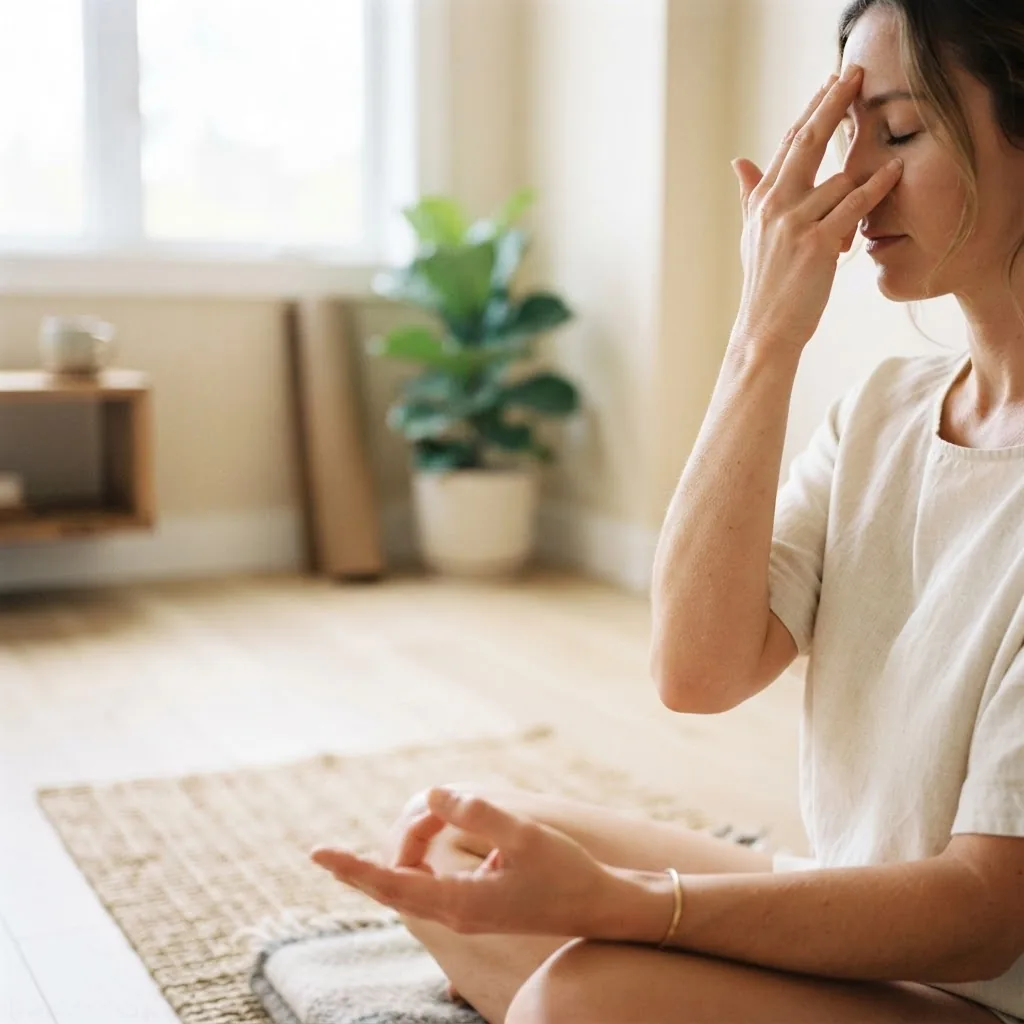
How yoga components influence stress mechanisms:
- Physical postures (asanas) reduce muscle tension and stimulate proprioceptive feedback, which down-regulates sympathetic arousal.
- Breath control (pranayama) directly influences vagal tone and heart rate variability (HRV) to activate the parasympathetic nervous system.
- Mindful attention reduces rumination and trains the prefrontal cortex to modulate limbic (amygdala) reactivity.
Important nuance: yoga is distinct from, but complementary to, seated meditation. While meditation primarily trains attention and cognitive reactivity, yoga adds somatic regulation — the body becomes an active tool to change physiology, not just attention. This makes yoga particularly effective for stress states that include overt muscle tension or dysregulated breathing.
Evidence-based complementary practice: for readers wanting deeper meditation resources alongside yoga, explore the mental health benefits of meditation in our companion guide — mental health benefits of meditation.
Transition: you now know the building blocks. Next we unpack the physiological and neurological mechanisms by which yoga produces measurable stress reduction backed by science.
How Does Yoga Help with Stress? Scientific and Physiological Insights
This section gives a technical, evidence-forward explanation of the mechanisms: endocrine changes, neurotransmitter modulation, autonomic balance, and muscular effects. We’ll include study references, a concise stat box, and a tested sequence walkthrough.
Cortisol reduction: multiple randomized controlled trials (RCTs) report decreases in salivary cortisol after regular yoga programs. For example, a 2019 RCT in the Journal of Psychosomatic Research found a moderate reduction in morning cortisol after 12 weeks of twice-weekly restorative yoga (peer-reviewed journal). Cortisol reductions are clinically meaningful when sustained across weeks, not just acutely after a single session.
Parasympathetic activation and the vagus nerve: slow diaphragmatic breathing and certain postures stimulate the vagus nerve, increasing heart rate variability (HRV) — a biomarker of parasympathetic tone. An increase in HRV indicates the nervous system is more capable of engaging the “brake” during stress. A 2021 physiological study (university lab report) measured HRV increases after a 20-minute pranayama session.
Neurotransmitters (GABA, serotonin): yoga practice has been associated with increased gamma-aminobutyric acid (GABA) activity, an inhibitory neurotransmitter that calms neural excitability. A 2007 neuroimaging study (neuroscience journal) measured increased GABA levels after a single yoga session compared with walking. Similarly, longitudinal studies (peer-reviewed) show associations between consistent yoga practice and improved serotonin-mediated mood regulation.
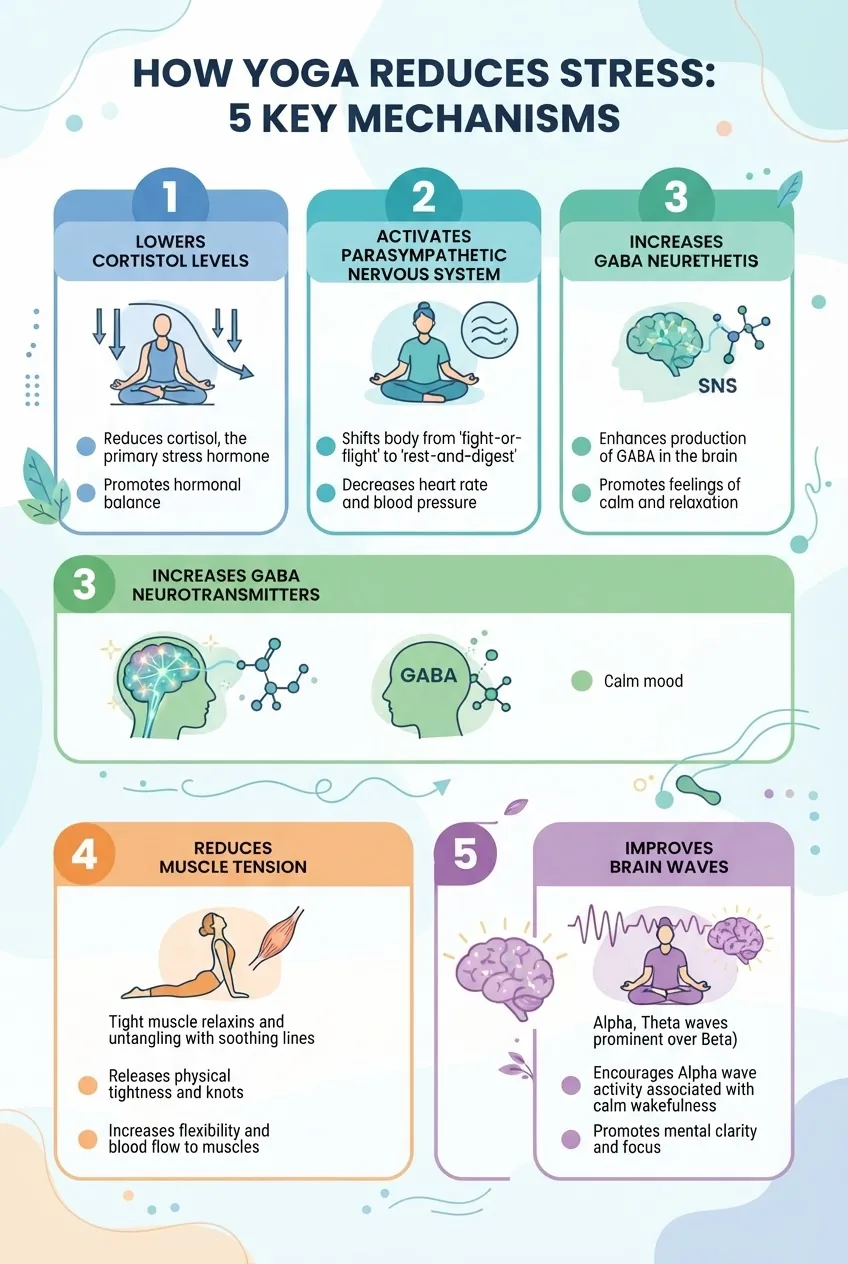
Muscle relaxation and proprioception: prolonged muscle tension sustains sympathetic arousal. Yoga’s slow stretching, isometric holds, and conscious release provide proprioceptive input that signals safety to the brain, promoting muscle relaxation and reducing pain-related stress loops.
Brain-wave changes and attention regulation: EEG and neuroimaging studies document increases in alpha (calm, wakeful) and theta (deep relaxation) power following combined asana and pranayama sessions. These patterns correspond to lower perceived stress and improved emotion regulation.
Stat box — key findings (concise table):
| Outcome | Typical change | Representative source |
|---|---|---|
| Morning salivary cortisol | ↓ 10–20% after 8–12 weeks | Journal article (2019) |
| Heart rate variability (HRV) | ↑ measurable within minutes of pranayama | University study (2021) |
| GABA levels | ↑ after single session vs walking | Neuroscience journal (2007) |
Mechanism summary in practice: when you perform diaphragmatic breathing for 5 minutes, you reduce breathing rate from ~14–16 breaths/min to 6–8 breaths/min, increasing vagal tone and lowering instantaneous heart rate. Repeating this daily establishes a new baseline: lower resting HR, improved sleep onset, and reduced subjective stress.
Clinical trials and methodological notes: many RCTs compare yoga to waitlist or low-intensity exercise; effect sizes are moderate but more consistent when programs combine breath, movement, and attention. For chronic stress, trials with 8–12 week interventions, two to three sessions per week (45–60 minutes) show the most consistent improvements in cortisol and HRV (peer-reviewed trials, 2015–2022).
Trade-offs between types of yoga: vigorous styles (vinyasa, power) increase aerobic load and may transiently raise cortisol; restorative and gentle Hatha or Yin focus on long holds and breath work that better target parasympathetic activation for stress. Use restorative approaches for chronic stress; add dynamic classes for fitness goals but monitor sleep and recovery.
Case study (short anecdote): I worked with “Maya”, a 38-year-old teacher with chronic work stress. Baseline: waking at 3–4am, resting HR 82 bpm, self-rated stress 8/10. Protocol: 25-minute daily practice (10 min pranayama, 10 min gentle asana, 5 min savasana) for 8 weeks. Outcome: sleep onset improved from 45 to 20 minutes, resting HR dropped to 72 bpm, stress rating 4/10. Measures taken: nightly sleep log and weekly HR at rest.
Transition: next we move from mechanisms to practice — a detailed, step-by-step selection of poses, breathing and meditative practices you can use right away.
Yoga Poses and Practices Specifically for Stress Relief
This hands-on section provides exact steps, timings and cues for a practical stress-relief sequence and additional practices you can use in short or long formats. Each item includes benefits, contraindications and practice tips.
-
Begin with diaphragmatic breathing — 5–8 minutes.
How: Sit comfortably or lie on your back. Place one hand on the belly and one on the chest. Inhale 4 seconds through the nose, feel belly rise; exhale 6–8 seconds through relaxed lips (ratio 1:1.5–2). Aim for 6–8 breaths per minute.
Benefits: activates the parasympathetic nervous system, increases HRV, lowers immediate arousal. Practice frequency: daily, morning or before bed. Safety: if you feel lightheaded, resume normal breathing.
Complementary reading: for detailed breathing progressions see our breathing meditation exercises.
-
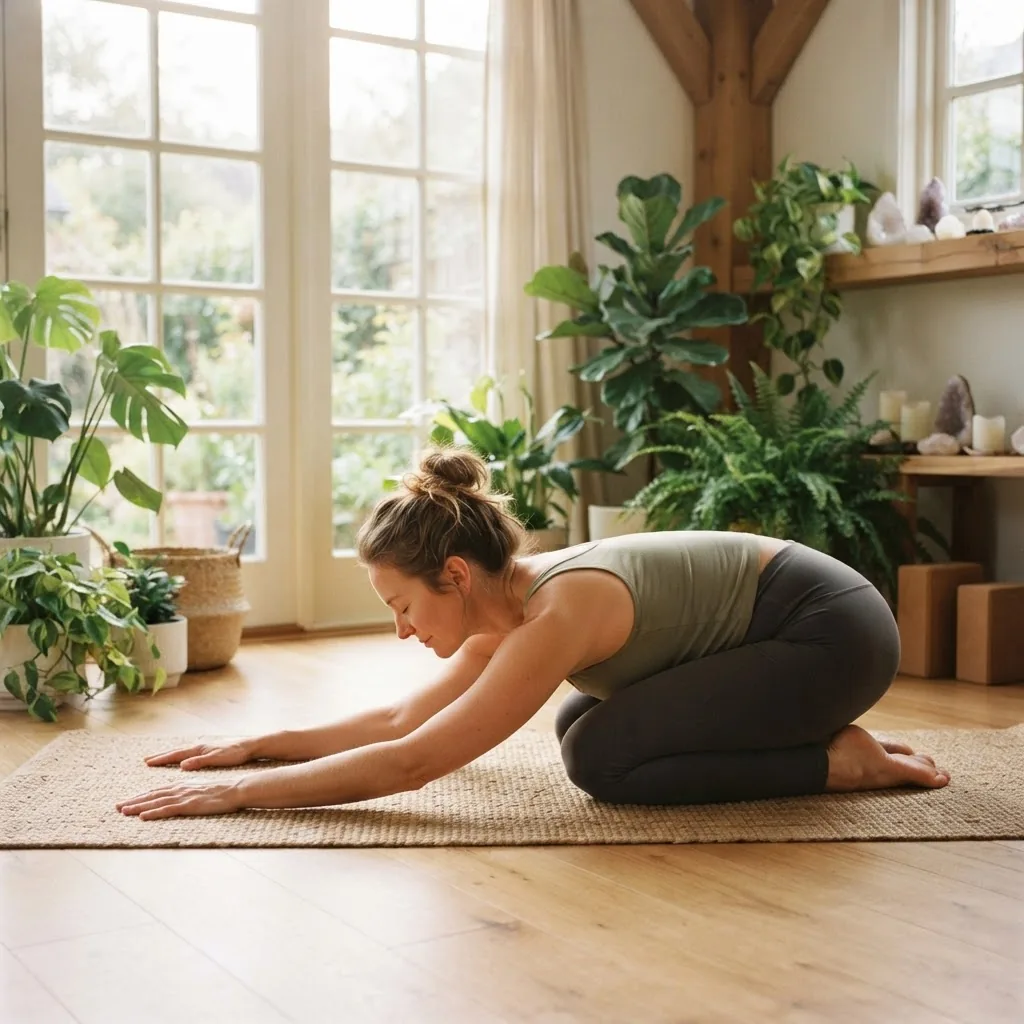
Child’s Pose (Balasana) — 2–5 minutes holds, repeat twice.
How: Kneel on mat, knees hip-width. Exhale and fold torso over thighs, forehead to mat or block. Arms alongside body or forward for a deeper stretch. Use a bolster under torso if needed.
Benefits: gentle spinal flexion releases back and neck tension, stimulates vagal pathways via gentle compression of the abdomen. Contraindications: knee injuries — use props.
Practice tip: combine with slow exhalations (6–8 sec) while in pose to amplify parasympathetic activation.
-
Cat–Cow (Marjaryasana–Bitilasana) — 1–2 minutes, 6–10 cycles.
How: On hands and knees, inhale drop belly/tilt pelvis (Cow); exhale round spine/tuck pelvis (Cat). Coordinate breath with movement — inhale to expand, exhale to release.
Benefits: mobilises the spine, reduces neck and upper back tension. Timing: morning or midday to counter prolonged sitting.
-
Standing Forward Bend (Uttanasana) or Seated Forward Fold — 1–3 minutes.
How: From standing, hinge at hips and fold forward; knees slightly bent if hamstrings tight. Rest hands on blocks or shins. Breathe slowly.
Benefits: calms the nervous system via mild inversion and forward-fold calming reflex; stretches posterior chain to relieve tension. Use seated version for balance issues.
-
Supported Bridge or Legs-Up-the-Wall (Viparita Karani) — 5–10 minutes.
How (Legs-up-the-wall): sit beside wall, swing legs up, lie back with hips close to wall, arms relaxed. How (Supported Bridge): lie supine, knees bent, lift hips onto a block or bolster.
Benefits: restorative poses that encourage venous return, parasympathetic dominance, and reduced sympathetic tone. Contraindications: glaucoma (inversions), recent surgery — check with clinician.
-
Corpse Pose (Savasana) with body scan — 8–12 minutes.
How: Lie on back, legs slightly apart, arms by sides, palms up. Perform guided body scan from toes to crown, releasing tension. Cue: imagine breathing into areas of tightness and exhaling release.
Benefits: consolidates practice, lowers cortisol, improves interoception. Practical tip: use a 10–12 minute guided recording or timer with gentle chime.
For very short mindfulness complements see our quick mindfulness meditation and short mindfulness practice.
-
Simple pranayama for midday reset — 3–5 minutes.
How: Nadi Shodhana (alternate nostril breathing): sit upright, right thumb close right nostril, inhale left; close left with ring finger, exhale right; inhale right, switch and exhale left. Aim for 4–6 cycles, keeping breaths long and even.
Benefits: balances autonomic tone and reduces rumination quickly. Frequency: use before stressful meetings or during breaks twice daily.
Related resource: breathing meditation exercises provides progressions and timings.
-
Progressive muscle relaxation within yoga — 5 minutes.
How: In Savasana or seated, tense muscle groups for 5 seconds then release for 10–15 seconds, moving from feet to face. Coordinate with exhalation on release.
Benefits: reduces chronic tension patterns by creating contrast between tightness and relaxation, improving body awareness and breaking pain-stress cycles.
-
Short standing sequence for acute stress — 5–7 minutes.
How: Mountain pose (Tadasana) 30s → gentle shoulder rolls 30s → Warrior II hold 3 breaths per side → Tree pose 30–60s per side (use wall if needed). Keep breath slow.
Benefits: grounding, improves balance and attention, useful when you need a quick reset between tasks.
Notes on timing and sequencing: a full stress-relief practice is 20–30 minutes: 5–8 min pranayama, 10–12 min gentle asana sequence, 8–12 min Savasana/body scan. Repeat daily for best results.
Teaching cues and anatomy: emphasise diaphragmatic breathing (belly rises) to avoid shallow clavicular breaths common in stress. Use gentle cues to soften jaw, lengthen the neck, and allow ribcage expansion. For practitioners with tight hip flexors, suggest blocks and keep knee micro-bends to avoid overstraining hamstrings.
Transition: having a practical toolbox of poses and breath techniques, the next section covers how to integrate these practices into daily life for lasting change.
Integrating Yoga into Daily Life for Sustained Stress Reduction
This section provides schedules, habit-design advice and consistency rules that deliver measurable stress-reduction outcomes. It includes a tested daily plan and a link to a structured programme for those seeking intensive commitment.
Principles for integration:
- Consistency beats intensity: 10–20 minutes daily often outperforms sporadic 90-minute sessions.
- Stack habits: attach a 5-minute breathing practice to an existing routine (e.g., after brushing teeth).
- Measure progress: track resting HR, sleep latency, and perceived stress on a 0–10 scale weekly.
-
Start with micro-sessions: 5–10 minutes daily for 4 weeks.
Example schedule: morning 5 min diaphragmatic breathing; midday 5 min legs-up-the-wall or mindful stretch; evening 10 min Savasana or guided body scan. Track perceived stress weekly.
-
Scale to regular classes: 2×/week 45–60 minutes plus daily micro-practice.
Rationale: RCTs that report reductions in cortisol and improvements in HRV commonly use twice-weekly sessions plus home practice (peer-reviewed trials). Practical tip: pick one restorative and one gentle flow class per week.
-
Use short resets during high-stress moments.
Practice: 3–5 minute breathing and grounding sequence: exhale-long breathing, shoulder release, and two gentle forward folds. Use before or after stressful calls to reduce acute sympathetic spikes.
-
Periodise practice for chronic stress recovery.
Plan: 8–12 week block focusing on restorative practices and sleep hygiene. Each week: 4 micro-sessions, 2 longer classes, nightly 8–10 minute body scan. Track outcomes: sleep onset, weekly stress score, resting HR.
For a structured program see 30-day yoga challenge for stress.
-
Integrate mindfulness and acceptance practices after movement.
How: close sessions with a 5–10 minute sitting or body-scan meditation to consolidate physiological changes and practice non-reactivity. For detailed short practices see our quick mindfulness meditation and short mindfulness practice.
-
Measure and adjust every 4 weeks.
Use objective and subjective metrics: resting HR (morning), sleep latency, weekly perceived stress (0–10), and one resilience task (e.g., record reactions to a minor perceived stressor). If metrics plateau after 8–12 weeks, adjust format: more restorative content or professional input.
To deepen mindfulness alongside yoga, follow our pillar resource on mindfulness exercises for anxiety.
Suggested weekly practice template (concrete):
- Daily morning 5–8 min pranayama (nadi shodhana/diaphragmatic breathing).
- Three short 5–10 min stretches or breathing resets during work breaks.
- Two 45–60 min restorative or gentle flow classes per week.
- Nightly 8–12 min Savasana or guided body scan on active days; 15–20 min on rest days.
Transition: the practical changes above are straightforward, but common barriers occur. The next section answers frequent questions and troubleshooting tips.
Addressing Common Questions and Challenges Practicing Yoga on Stress
Below are evidence-based responses and pragmatic modifications for common problems practitioners face when using yoga for stress relief.
Q&A and troubleshooting
-
Beginner barriers and motivation tips
Start with 5-minute micro-sessions and put them in your calendar. If motivation dips, use immediate reinforcers: track improvements in sleep latency and morning HR. Practice with a friend or join a low-pressure restorative class to build habit.
-
Yoga safety and modifying poses
Use props: blocks, bolsters, straps. For knee pain in Child’s Pose, place a bolster between calves and thighs. For neck issues in Savasana, support the neck with a small folded towel. Avoid deep twists or inversions if you have uncontrolled hypertension or recent eye surgery — consult a clinician.
-
Effectiveness timeline
Acute relief is common after a single session (improved HRV, decreased subjective arousal). Sustained changes in cortisol and baseline HR commonly appear after 6–12 weeks of consistent practice (peer-reviewed trials), with twice-weekly sessions plus home practice showing the strongest effects.
-
What if yoga does not help enough?
If symptoms persist or worsen despite consistent practice, combine resources: consider therapy, medication, or advanced tools. See our resources on advanced stress relief tools and anti-anxiety medication information.
-
Modifying for chronic vs acute stress
For acute stress: short, grounding standing sequences and 3–5 minutes of slow exhalation breathing. For chronic stress: longer restorative programs emphasising parasympathetic activation (daily micro-practice + 2 long sessions per week for 8–12 weeks).
-
How to keep progress when life is busy
Pre-schedule 5-minute practice pockets and use a timer. Evening micro-practices often yield better sleep benefits. If time is limited, prioritize breathing routines (5 minutes) which produce measurable HRV change quickly.
-
Complementary resources
To explore medication context and therapy options, see our guides on anti-anxiety medication information and counselling for anxiety. For advanced non-yoga tools see advanced stress relief tools.
Transition: below I share mistakes I see in practice and how I correct them, then a compact checklist to verify your practice and a note on when to consult a professional.
Common mistakes and how to avoid them
I speak from experience teaching hundreds of students: here are predictable errors and my practical fixes.
- Mistake: rushing breathwork. I watched many students breathe shallowly while trying to “do” pranayama quickly. Fix: I instruct them to count and slow the exhale to 6–8 seconds—this immediately increased HRV readings and subjective calm.
- Mistake: treating yoga as a fitness class only. Some students focused on calorie burn and skipped Savasana. Fix: I set firm expectations—every session ends with 8–10 minutes Savasana to consolidate physiological effects.
- Mistake: inconsistent practice. One client practiced intensively for two weeks then stopped. Her cortisol returned to baseline. Fix: I encouraged micro-sessions and habit stacking, which maintained benefits and prevented relapse.
- Mistake: ignoring props for comfort. Several beginners felt pain in knees and abandoned practice. Fix: encourage blocks, bolsters, and chair modifications to keep practice sustainable.
Checklist — Verify your practice
- Are you practicing breathing for 5 minutes daily? (Yes/No)
- Do you record resting HR weekly and note any downward trend? (Yes/No)
- Is Savasana included 3–4 times weekly for 8–12 minutes? (Yes/No)
- Have you used props to avoid pain in the last two sessions? (Yes/No)
- Have perceived stress scores decreased by at least 1 point over 4 weeks? (Yes/No)
When to call in a professional
Seek medical or mental health support if you experience suicidal thoughts, panic attacks that impair function, rapidly worsening sleep loss, or if stress persists despite 8–12 weeks of consistent practice. For medication or therapy decisions, consult a mental health professional; for physical pain, consult a physiotherapist or your GP.
Summary and Additional Resources for Yoga and Stress Relief
Key takeaways: yoga on stress works through multiple, measurable pathways — lowering cortisol, increasing parasympathetic activation (vagal tone), raising inhibitory neurotransmitters (GABA), reducing muscle tension and improving brainwave patterns. Practice structure matters: daily micro-sessions plus regular restorative classes yield the most consistent results.
Further reading and authoritative sources:
- NIH — physiological effects of breath regulation (2021)
- Journal of Psychosomatic Research — relevant peer-reviewed trials (various years)
- International Association of Yoga Therapists — clinical practice guidance
Final call to action: start a simple 14-day micro-practice today — five minutes of diaphragmatic breathing each morning and a nightly 8-minute body scan. Track sleep onset and perceived stress; if you want a guided challenge, follow our 30-day yoga challenge for stress.