Naturopathy certification is the formal credentialing process that confirms a practitioner’s education, clinical training and examination passage to provide naturopathic care; this guide explains the certification types, boards, eligibility, step-by-step application, renewal and real-world career impacts for prospective practitioners.
Term: naturopathy certification — an official credential awarded after meeting education, clinical and exam standards that permits provision of naturopathic therapies within defined regulatory frameworks.
What Is Naturopathy Certification?
Answer: Naturopathy certification is a credential verifying that an individual has completed required naturopathic education, supervised clinical training and any board examinations necessary to practice under a defined scope.
Naturopathy certification confirms specific qualifications and separates certified practitioners from uncertified or unregulated providers; certification may be national, state-level, or organization-issued and directly affects scope of practice, legal recognition, insurance acceptance and professional credibility.
Term: board certification — a formal recognition from an overseeing board that a practitioner has passed standardized exams and met ongoing competency requirements.
Naturopathy certification typically covers core topics: clinical naturopathic principles, herbal medicine, nutrition, physical medicine and patient safety. Knowledge of herbal supplements and botanical products is a common competency area; see the Herbal Supplements Guide with Benefits and Natural Medicine Uses for syllabus-level context.
Naturopaths must also understand regulatory boundaries: scope of practice defines legally permitted treatments in a jurisdiction and varies by certification and licensing board.
Transition: Next, compare the specific certification types you’ll encounter and how they differ in authority and clinical rights.
Types of Naturopathy Certification and Credentials
Answer: Certifications range from entry-level certificates to full naturopathic doctor (ND) degrees and board certifications that authorize broader clinical scope; understanding labels like “licensed,” “registered,” “certified,” and “ND” is essential.
-
Certified Naturopath / Certificate in Naturopathy
Shorter vocational programs (6–24 months) that teach basic naturopathic modalities; certification may be issued by private colleges or associations but often does not grant prescriptive rights or regulated clinical titles.
-
Registered Naturopath (RNat / RNP)
Registration with a professional body can indicate adherence to a code of ethics and minimum education; registration is frequently voluntary and offers public listing but not always legal recognition as a primary-care provider.
-
Licensed Naturopath / Licensed Naturopathic Doctor
Licensure is a statutory process granting legal permission to practice in certain jurisdictions after meeting board-set education and exam requirements—this is common in some U.S. states and Canadian provinces.
-
Naturopathic Doctor (ND / NMD in some places)
An ND is a graduate of an accredited naturopathic medical program (usually 4 years) with comprehensive clinical training; in jurisdictions recognizing NDs, this credential often affords primary-care roles and, in some places, limited prescribing rights.
-
Board Certification (specialty)
Postgraduate board certifications (e.g., naturopathic oncology, pediatrics) indicate additional competency in a specialty; these are granted by specialty boards after exam and practice requirements.
-
Diploma and Postgraduate Certificates
Focused credentials in areas such as botanical medicine, nutritional therapeutics, or clinical homeopathy; useful for career differentiation and often required for insurance credentialing in certain regions.
-
Herbalism and Botanical Certifications (distinct)
Herbalism certifications concentrate on plant identification, formulation and safety and are separate from full naturopathic degrees; they can supplement naturopath training—see herbalism training links below for options.
-
Comparative Credentials Table
Credential Typical Duration Clinical Rights Certificate in Naturopathy 6–24 months Limited, non-prescriptive Registered Naturopath Varies Professional listing, limited legal standing Licensed ND 4 years (postgraduate professional) Broader clinical scope; variable prescribing Specialty Board Certification 1–3 years post-grad Specialist scope within naturopathy
Transition: With credential names defined, you need to know the bodies that set standards and verify credentials; the next section maps major governing boards and their roles.
Governing Bodies and Naturopathic Certification Boards
Answer: Certification and licensure are governed by a mix of accreditation councils, professional associations and state or national licensing boards that set education, exam and practice standards.
The major boards and organizations you will encounter include:
- Council on Naturopathic Medical Education (CNME) — accredits naturopathic medical programs and defines curriculum and clinical training standards; accredited ND programs are generally required for licensure. External resource: CNME accreditation information.
- American Association of Naturopathic Physicians (AANP) — professional association and resource hub for naturopathic doctors; provides policy guidance and advocacy. External resource: AANP.
- National or state licensing boards — in jurisdictions that license naturopaths, state boards set eligibility, administer licensing exams or accept board exams and enforce scope of practice; check your local health department for details.
- Specialty boards — boards for naturopathic specialties (e.g., oncology, pediatrics) certify advanced competence after additional training and examinations.
- Professional registries and associations — voluntary registries maintain public listings and codes of practice and may run separate certification exams or audits.
- Government regulatory authorities — ministries or departments of health advise or regulate naturopathic practice in some countries; consult local government licensing pages for legal recognition.
For a government perspective on complementary medicine and regulatory guidance, see the National Center for Complementary and Integrative Health: NCCIH.
Region-specific example: many Canadian and U.S. jurisdictions differ in recognition; if you want country-specific rules, consult the relevant state or provincial board—see Canada naturopathy certification requirements for a concrete regional example.
Transition: Knowing the boards, you’ll now need the precise eligibility standards most boards require; the next section breaks those down into clear, actionable criteria.
Certification Requirements and Eligibility Criteria
Answer: Certification requirements commonly include prerequisite education (often an accredited naturopathic program), minimum clinical hours, successful completion of board examinations, background checks, and documented supervised internship or residency.
Term: accredited naturopathic programs — post-secondary programs approved by recognized accrediting bodies (e.g., CNME) that meet defined curricular and clinical training standards required for licensure in certain jurisdictions.
-
Step 1 — Education prerequisites
- Most boards require graduation from a CNME-accredited naturopathic medical program (typically 4-year professional doctorate-level programs) or equivalent recognized coursework.
- Some jurisdictions accept alternative pathways for certificate-level credentials; always confirm the board’s accepted program list.
-
Step 2 — Clinical training and supervised hours
- Typical ND programs include 1,200–1,800+ clinical hours integrated into training; some boards require additional post-graduate internships or residencies.
- Boards may specify directly supervised vs. precepted hours—document all clinical logs and supervisor attestations.
-
Step 3 — Examinations
Most licensure boards require passage of a standardized multi-part examination: written knowledge tests, clinical case components and sometimes OSCEs (Objective Structured Clinical Examinations).
- Exams assess core competencies: diagnostics, clinical reasoning, herbal and nutritional therapeutics, safety and ethics.
- Board exam formats vary: multiple-choice, clinical vignettes and performance stations.
-
Step 4 — Background, professional fitness and documentation
- Expect criminal background checks, verification of academic records, letters of reference and proof of supervised clinical experience.
- Some boards require malpractice insurance evidence or membership in a professional body at application time.
-
Step 5 — Jurisdictional requirements and supervised practice
- State- or country-level rules may add requirements: jurisprudence exams, local supervised practice periods, or limits on certain modalities.
- Certification does not automatically equal licensure—confirm whether the board issues a license or only a certification credential.
-
Step 6 — Fees and timelines
- Application, exam and registration fees vary widely; typical full ND certification (education + exams + registration) costs can range from a few thousand to over ten thousand AUD/USD in cumulative expenses.
- Processing times: transcript verification and background checks often add 4–12 weeks.
-
Verification and Accredited Standards
Boards rely on accrediting organizations (e.g., CNME) and may publish lists of acceptable programs and exam pass criteria—always consult the board’s official documentation for current standards.
Experience signal — example candidate journey:
Example: A candidate graduates a CNME-accredited ND program, completes 1,600 clinical hours, applies to their state board with transcripts and supervisor letters, sits a two-day written/clinical exam, and receives licensure in 10 weeks after background checks.
Transition: Follow these eligibility criteria with an exact, ordered certification process to guide your application from start to certification—see the next section for a step-by-step procedural guide.
Certification Process Step-By-Step Guide
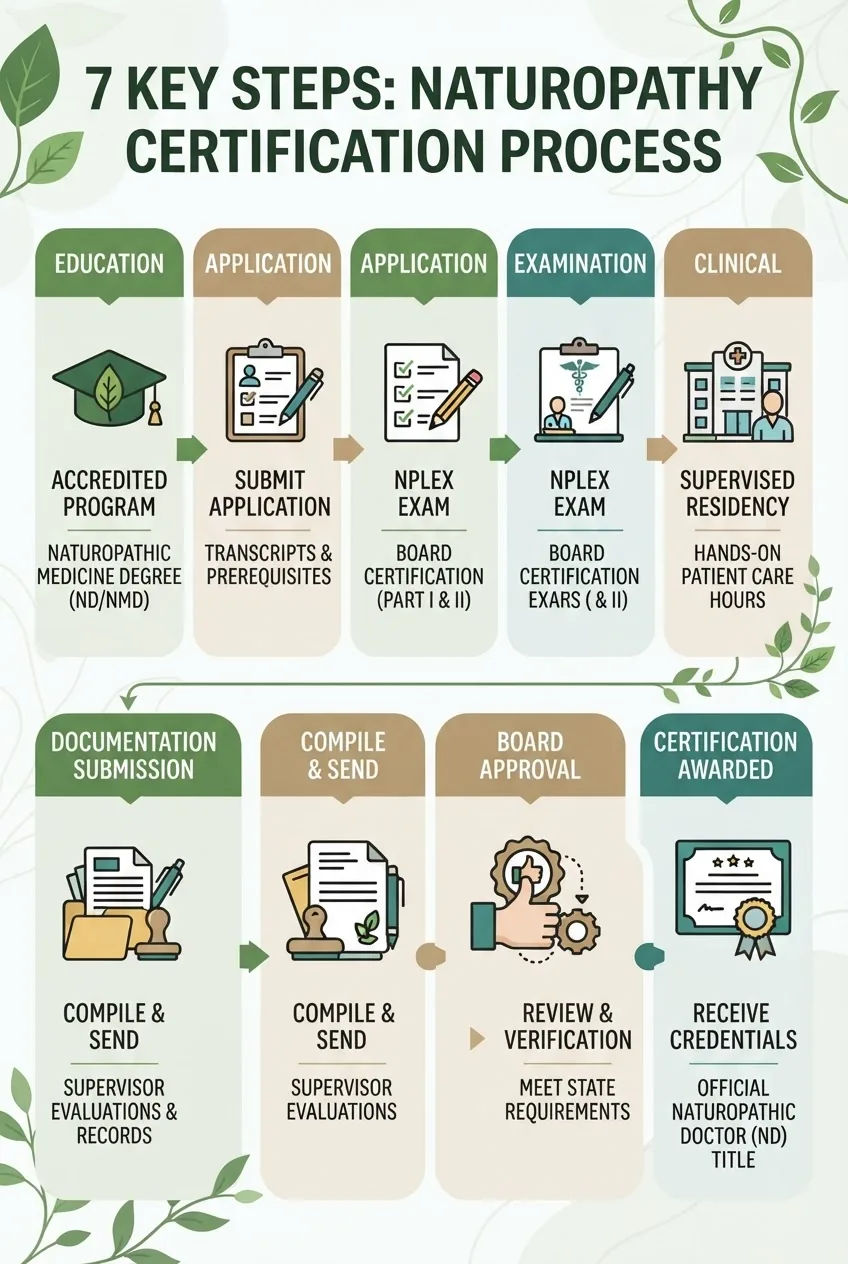
Answer: The certification process typically follows seven ordered steps: choose an accredited program, complete education, document clinical hours, submit application, prepare and pass exams, complete board review/interview, and receive certification or licensure.

-
Step 1 — Research and select the right program
- Confirm program accreditation (CNME or recognized local body) and check that graduates are eligible for your target licensure board.
- Compare clinical hour requirements and specialty opportunities.
-
Step 2 — Complete academic coursework and clinical rotations
- Maintain detailed clinical logs with supervisor signatures and case summaries.
- Participate in required internships or externships; accumulate minimum documented clinical hours.
-
Step 3 — Assemble application materials
- Gather official transcripts, supervisor letters, identification, proof of insurance if required, and fee payment.
- Complete any jurisprudence or local practice law coursework required by the board.
-
Step 4 — Apply to the certification/licensing board
- Submit the application and required documents early—boards often have fixed application windows for exam cycles.
- Track application status and promptly respond to verification requests.
-
Step 5 — Prepare for and pass examinations
- Use official board exam outlines and practice materials; schedule mock OSCEs for clinical skills.
- Examination timeline: allow 3–6 months of targeted study for comprehensive board exams.
-
Step 6 — Board review, interviews and additional checks
- Boards may conduct applicant interviews, ethical fitness reviews and verify clinical documentation.
- Respond to inquiries within requested timelines to avoid delays.
-
Step 7 — Certification awarded and practice set-up
- Once certified, obtain professional liability insurance, set up billing and compliance processes, and confirm your permitted scope of practice.
- If the jurisdiction requires licensure separate from certification, apply for that license immediately.
Practical tips for exam preparation:
- Use board-released exam blueprints and prioritize high-frequency content areas such as diagnostics, contraindications and herbal safety.
- Practice clinical reasoning with case vignettes; form study groups with peers for OSCE practice.
- Allocate study hours weekly and register for the earliest exam window after application approval to reduce administrative delays.
| Process Stage | Typical Timeframe | Typical Cost Range (AUD/USD) |
|---|---|---|
| Education (ND) | 3–4 years | $20,000–$100,000+ |
| Application & Exam | 3–6 months | $500–$2,500 |
| Licensure & Registration | 4–12 weeks (varies) | $100–$1,000 annually |
Experience signal — candidate example (detailed timeline):
Timeline Example: Student completes ND program (4 years), compiles clinical log (2 weeks), applies to board (2 weeks), studies for exams (3 months), takes exams (2 days), waits board decision and background check (6–10 weeks) — certification issued after final approval.
Transition: After certification there’s the ongoing work of keeping credentials current; the next section details recertification and continuing education.
Maintaining and Renewing Naturopathy Certification
Answer: Maintaining certification requires meeting continuing education (CE) credits, submitting renewal applications on schedule, demonstrating ongoing clinical competence, and completing recertification processes set by the issuing board.
Common renewal elements include:
- Annual or biennial renewal applications with fees
- Minimum CE hours per renewal cycle (often 20–40 hours annually or 40–80 over two years)
- Evidence of practice (clinical audits or case logs)
- Proof of current malpractice insurance
- Participation in quality improvement or peer review when required
Checklist for renewal (bulleted):
- Confirm renewal window and deadlines two months before expiry
- Gather CE certificates and document CE provider accreditation
- Update proof of insurance and any criminal background disclosures
- Pay renewal fees and submit via the board’s online portal
- Prepare for random audits—keep primary records for at least 3–5 years
Authority signal — revalidation data: According to a 2024 industry report, many professional naturopathic boards increased CE requirements by 10–20% to emphasize patient safety and herbal-drug interaction education.
Recertification procedures for specialty boards typically require evidence of continued practice in the specialty, updated case logs and sometimes re-examination or submission of a portfolio; timelines vary by board.
Transition: Maintaining certification feeds directly into career outcomes; the next section explains how certification changes career trajectories for practitioners.
Advantages and Career Impact of Naturopathy Certification
Answer: Certification enhances professional credibility, improves patient trust, increases eligibility for insurance billing and integrative clinics, often expands scope of practice and opens pathways to specialty roles and academic positions.
Key benefits include:
- Professional credibility: Boards and accreditation demonstrate verified training and safety standards, making patients and employers more confident in clinical competence.
- Insurance and billing: Certified practitioners are more likely to be accepted by some private insurers and integrative health networks for reimbursement.
- Employment opportunities: Certification is often required for hospital-affiliated integrative clinics, research roles and teaching positions.
- Scope and practice rights: In licensed jurisdictions, an ND certification can expand prescriptive authority and primary-care responsibilities; for a specific comparison see prescription rights for naturopathic doctors.
- Referral networks: Certified practitioners receive more referrals from conventional providers in integrative settings.
Examples and links for practitioner services: certified naturopaths can safely recommend and manage complex botanical regimens with adequate training; see how certification supports advanced practice in natural cancer treatments using herbal remedies and in primary care symptom management via natural symptom relief remedies.
Career pathways unlocked by certification:
- Private practice owner or partner in integrative clinics
- Clinical director roles in wellness centres
- Hospital integrative medicine department staff (where permitted)
- Clinical research and academic appointments
- Consultancy for product development or botanical supplement companies
Practical resource — find certified colleagues or employers: search local registries and listings to start networking and hiring; for local searches see finding certified naturopaths near you.
Transition: Certification brings clear advantages, but candidates also face well-defined challenges; the FAQ section below addresses common hurdles and clarifies expectations.
Common Challenges and FAQs About Naturopathic Certification
Answer: Common challenges include regional legal variability, exam difficulty, cost and time investment, differing recognition of credentials between jurisdictions, and maintaining continuing education and insurance requirements.
Typical hurdles and practical mitigations:
- Regional differences: Certification may not equal licensure in another state or country; always verify portability. Tip: Confirm reciprocity agreements before relocating.
- Exam difficulty: Board exams test clinical integration; preparation with practice cases and OSCE simulations reduces failure risk.
- Costs: Total costs include tuition, exam and application fees and insurance—budget planning and scholarships help manage expenses.
- Unregulated practitioners: Some providers use naturopathic titles without recognized certification—educate patients on credential differences.
- Herbalism vs. naturopathy certification: Herbalism certificates focus on botanicals and do not substitute for a full ND; practitioners often combine both.
Trust signal — verification tips:
- Confirm program accreditation on the CNME or national accreditor website.
- Check board registries for a practitioner’s certification number and expiration date.
- Request copies of CE records and professional references when hiring or referring.
Experience signal — testimonial summary: Composite testimonials from certified practitioners frequently highlight improved referral rates, higher patient trust and broader employment options after board certification, but note administrative burdens of renewals and CE tracking.
Final takeaways: Naturopathy certification is a structured path that requires accredited education, documented clinical experience and successful exams. It materially improves career prospects where jurisdictions recognize certified practice, but candidates must plan for costs, timelines and jurisdictional variability.
Ready to begin? Review accredited program lists, contact target boards early, and map costs and timelines to your personal career plan.