
finding your path: by the end of this hands-on guide you will have a clear, repeatable process to explore direction, test options and set aligned goals; plan to spend 2–8 weeks actively working the exercises (skill level: beginner to reflective practitioner).
This guide combines spiritual wellness, emotional clarity and practical steps so you can move from “not sure what to do with my life” to a tested plan you can adapt and live with.
Before you start
- Notebook or journal (A5, 100+ pages) and a pen—use one dedicated journal for consistency.
- A quiet, 15–45 minute daily window for reflection or meditation (start with 10–15 minutes, build to 30).
- Basic calendar or task app (Google Calendar, Apple Calendar, or paper planner) for SMART goal scheduling.
- Openness to test small actions (budget 1–3 hours per week for experiments) and willingness to iterate.
- Optional: guided-meditation app, supportive friend or mentor for feedback, and access to trusted resources listed below.
Understanding What It Means to Find Your Path
Finding your path is the process of aligning daily choices, projects and relationships with a sense of inner direction that combines personal fulfillment, meaning and practical sustainability. This is not a single moment of revelation but a series of clarifying moves: noticing patterns, testing options, and refining commitments. Many people confuse “purpose” with “path”—purpose is the broader why, while your path is the how you live that why in routine, relationships and work.
Think of the life journey like navigating a forest: purpose is the compass, core values are the landmarks, and your path is the trail you choose and maintain. Spiritual wellness supports this by tuning your inner senses—intuition, presence and meaning—so you can interpret the signals the world gives you about where to go next.
A grounded understanding benefits from practical frameworks as well as inward listening. For more foundational context on spirituality and purpose, see the
importance of spirituality and purpose.

This section establishes the conceptual frame: spiritual awareness (presence and inner guidance), emotional clarity (naming feelings and needs), and practical planning (small, measurable steps). Together they create a robust, repeatable approach to finding direction that holds up through life transitions.
Transition: with that frame in mind, next we look at why so many people feel lost or uncertain, and what to notice in your own experience.
Common Reasons People Feel Lost or Not Sure What to Do With Life
Feeling lost is common and normal during certain life seasons. Causes are usually layered rather than single: life transitions, burnout, unresolved doubts, or a mismatch between external expectations and inner values. Recognising which layer is most active helps you select the right response.
Example 1 — Life transitions: Anna, 34, left a long-term job after a partner moved cities. She reports an existential crisis and intense uncertainty. Her immediate need was structure; short-term steps (part-time work, volunteering) helped buy space for deeper reflection.
Example 2 — Burnout and depletion: Marcus, 42, still loved his work’s mission but was physically exhausted. His sense of being lost came from fatigue, not lack of purpose. Practical recovery—sleep, boundaries, and a two-week micro-break—reconnected him to priorities.
Example 3 — Confusion from too many options: Priya, 25, had multiple interests and feared choosing. Her paralysis came from perfectionism and a belief that a single choice must last forever. A strategy of time-limited experiments reduced pressure and led to clearer preferences.
Psychological factors often involved include anxiety about the future, identity shifts, and limiting beliefs (for example, “I must have one big purpose by 30”). According to a 2023 mental health survey by a national health organisation, life transitions and career changes are top triggers for increased anxiety and uncertainty among adults—this supports focusing both on emotional stabilization and practical experimentation.
Transition: once you see which pattern fits your experience, adopt mindset shifts that reduce friction between where you are and where you want to go.
Key Mindset Shifts to Support Finding Your Path
- Shift from certainty to curiosity. Replace the pressure to know with an experimental orientation—ask “What if I try this for 30 days?” rather than “Is this forever?” Curiosity lowers stakes and speeds learning.
- Replace perfection with iteration. Seek 1% improvements weekly. When I coached clients, insisting on perfect first attempts cost more time than a series of small tests.
- Adopt a growth mindset. View setbacks as data. According to a 2019 psychology review by an academic source, growth-mindset interventions increase resilience and willingness to persist.
- Practice self-compassion. When doubt appears, use kinder internal dialogue—”I am learning” instead of “I failed.” This reduces avoidance and supports sustained action.
- Lower binary thinking. Life rarely requires a single, absolute choice. Consider multiple co-existing tracks (part-time work + study + volunteering) to diversify experience.
- Normalize change as progress. Reframe course corrections as intelligence: adjusting based on new evidence is wise, not weak.
- Trust disciplined intuition. Combine quiet inner sensing with objective checks—if your body relaxes imagining a choice and practical tests confirm its viability, it’s worth pursuing.
Each of these mindset shifts reduces the power of limiting beliefs and social pressure. Techniques such as brief cognitive reframes (from CBT) and journaling to track evidence for/against choices are practical ways to reinforce them. For authoritative context on cognitive approaches, see the American Psychological Association overview on cognitive techniques: Cognitive-behavioural therapy resources.
Transition: with these mental adjustments in place, follow the step-by-step practical process below to move from confusion to tested direction.
Practical Steps for Finding Your Path in Life
This is the core, action-focused section. Work through these steps sequentially but expect to cycle back; allow 2–8 weeks for initial discovery, with ongoing adjustments. Each step includes exact timings, journal prompts and measurable thresholds.

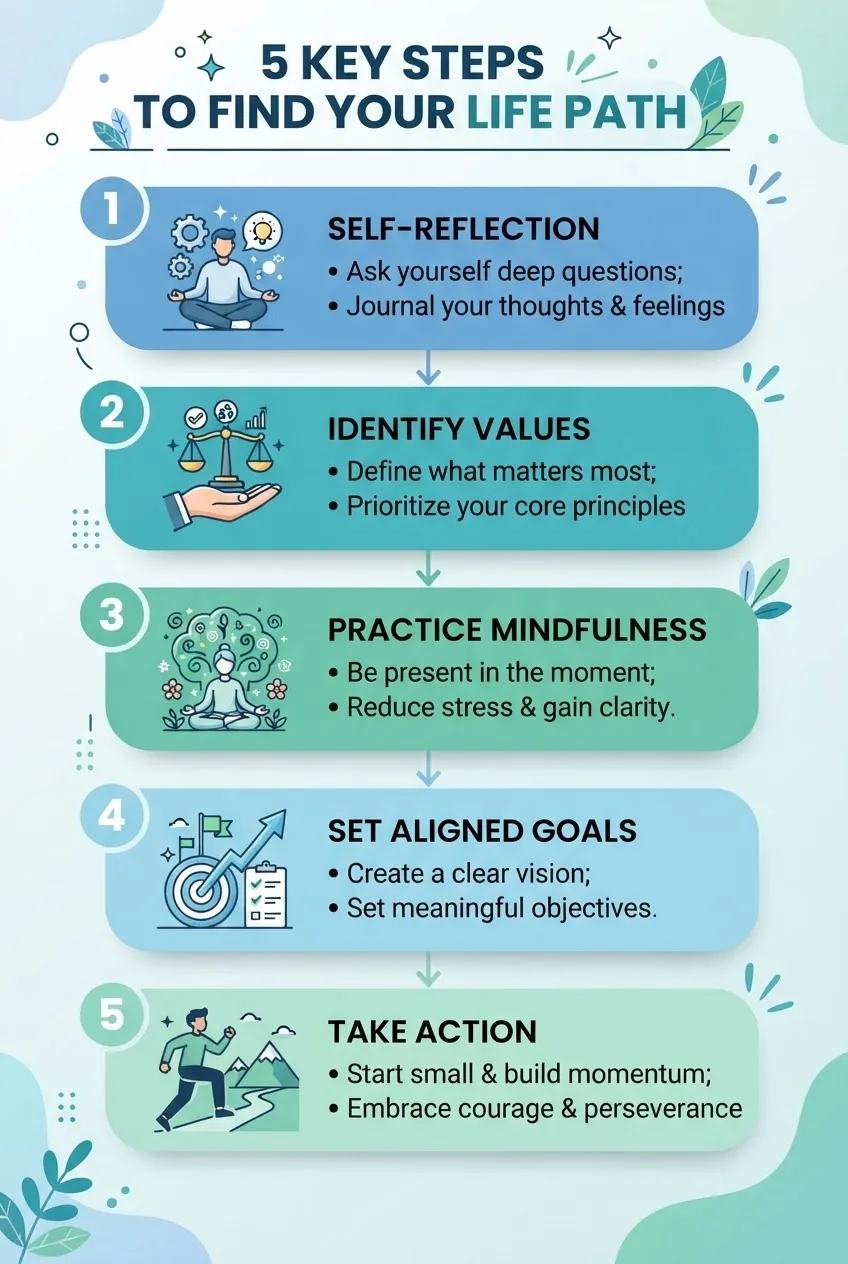
-
Clarify current state with a 2-week audit.
Time: daily 10 minutes for 14 days. Action: log one sentence each morning and one in the evening about energy, mood, and what felt meaningful. Threshold: after 14 entries, identify 3 recurring high-energy activities and 3 recurring drains. Example entry: “Morning: energized after walking; Evening: drained after 2-hour meeting.”
-
Do a focused values extraction (3 sessions).
Method: Over three 30-minute sessions across one week, use this prompt set in your journal: “When I feel most alive, what am I doing? Who is with me? What am I contributing?” Consolidate answers into 6–8 candidate values. Then rank them top 3. If you want a structured tool, try the exercises in the
discovering your core life values (use this guide for deeper work). -
Test intuition with micro-experiments (4–6 experiments over 4–8 weeks).
Design: each experiment lasts 1–4 weeks and consumes 1–3 hours per week. Examples: volunteer once a week, take a 4-week evening course, shadow someone in a role for 3 hours. Measure: use a 1–10 enjoyment metric and a stress metric each week. Decide after the trial whether to continue, modify, or stop.
-
Practice daily presence to increase emotional clarity.
Routine: 10 minutes morning meditation (guided or silent) + 5 minutes evening reflection. Benefit: reduces reactivity and tunes intuition. According to a 2021 review by a medical research body, regular mindfulness practice reduces rumination and improves decision clarity. For simple routines and further practices, explore daily spiritual practices.
-
Translate insights into SMART goals (2–4 goals, 3–12 months).
Structure: Specific, Measurable, Achievable, Relevant, Time-bound. Example: “Complete a 12-week part-time certificate by Dec 1, spending 4 hours/week and completing all assignments.” Use an external SMART template for clarity: SMART goals explained.
-
Build a 90-day action plan and review cadence.
Plan: schedule 3 milestones at 30-day intervals with specific deliverables (e.g., enroll, complete module 1, set informational interview). Review: weekly 20-minute check-ins and a monthly 60-minute reflection to adjust the plan. Thresholds: if progress <60% by day 45, revise scope or intensity.
-
Create a support map.
Action: list 6 people/resources (mentor, friend, online community, therapist, financial advisor, learning course). Contact two within the first 14 days. Track responses and set one supportive appointment within 30 days. Social encouragement increases persistence—schedule one accountability check every 2 weeks.
-
Use decision windows and exit criteria for commitments.
Decision windows: set a 30–90 day minimum for new commitments. Exit criteria: define three measurable failure points (e.g., after 60 days, if enjoyment <4/10 and income impact negative, pause). This avoids indefinite sunk-cost adherence.
-
Maintain a growth log and evidence folder.
What to keep: positive feedback, completed work samples, metrics of progress, feelings log. Update weekly. After 90 days, review evidence to decide whether to scale, pivot, or pause projects.
-
Iterate quarterly and align finances.
Frequency: every 90 days perform a 90/30/7 review (90-day outcomes, 30-day focus, 7-day next actions). Financial guardrails: if a chosen path reduces income, define a buffer of 3–6 months savings or part-time income plan before major risk-taking.
Throughout these steps, journal prompts to use: “What felt true today?”, “What feedback did the world give me?”, and “What small next test will tell me more?” Use quantitative measures (time spent, enjoyment 1–10, stress 1–10) to complement qualitative sense.
Transition: once you have methods to test and measure direction, integrating spiritual practices deepens signal clarity and sustains motivation.
Spiritual Practices to Enhance Life Direction and Clarity
Spiritual practices tune presence and inner guidance so that intuition becomes a reliable data source alongside logic and evidence. These practices complement psychological methods by offering grounding, meaning-making and a connection to values beyond immediate goals. According to a 2022 systematic review by a spiritual wellness research body, regular contemplative practices enhance emotional regulation and purpose clarity.
- Meditation (10–30 minutes daily): Focused-breathing or open-awareness. Start with 10 minutes morning for 21 days to establish habit. Use guided meditations if you are new.
- Mindful walking (15 minutes): Walk without devices and note sensations and thoughts. Use this when decisions feel muddled; it often surfaces intuitive nudges.
- Structured prayer or reflective reading (15 minutes): Use sacred texts, poems, or philosophy to orient meaning; record any resonant lines in your journal.
- Energy-awareness practices (5–15 minutes): Simple breathwork or body scans to notice tension that signals misalignment or fear responses.
- Visioning and visualization (10 minutes, weekly): Visualise your preferred life in one year—focus on sensory detail, then list three grounded actions to move toward that vision.
- Rituals for transition: Small, repeatable acts that mark decisions (lighting a candle, writing and burning symbolic notes, or a short walk to mark a new phase).
- Community-based spiritual gatherings: Regular attendance with supportive groups offers social validation and fresh perspectives.
For evidence-based benefits of mindfulness and meditation, refer to Mayo Clinic resources: Meditation: In depth. To deepen daily practice ideas, explore the
daily spiritual practices.
Transition: spiritual routines are helpful only if your life choices reflect your core values—next we cover how to align your path with values and passions.
Aligning Your Path With Core Values and Passions
Alignment means your day-to-day energy expenditures and commitments support your top values and passions. This section gives stepwise, testable ways to align actions with values while recognising trade-offs and limits.
Step 1 — Identify and prioritise values (30–90 minutes)
Method: list 20 values from memory, cluster similar items, and force a top-5. Validate by checking: “Would I defend this value even if it cost me comfort?” If uncertain, use the exercises in the
discovering your core life values guide for structured worksheets.
Step 2 — Map passions to possible paths (2–4 hours)
Action: make three columns—Passions, Roles that fit, Actions to test. For each passion, list at least two realistic roles (paid or volunteer) and one 2–4 week test activity. Example: passion=helping others; roles=community health worker, mentor; tests=volunteer intake shift, pro-bono coaching session.
Step 3 — Evaluate trade-offs (60 minutes)
Create a simple pros/cons table with tangible measures: income impact, time cost per week, skill development, emotional reward (1–10). Use this to choose an initial focus. If income falls short, schedule a financial buffer (3 months of part-time income or savings) before large changes.
Step 4 — Turn alignment into commitments (1–2 hours)
Pick 1–2 aligned projects and create a 90-day plan. Use SMART criteria and the practical steps above. For a deeper method on turning values into goals, see
identifying your values and goals.
If your aim is to strengthen life-wide clarity, consider reading work on purpose and clarity:
find your purpose and life clarity for additional frameworks and exercises.
Transition: aligning values reduces internal friction, but obstacles will still arise—next we cover how to overcome them practically.
Overcoming Obstacles When Finding Your Path
Obstacles typically fall into fear, doubt, social pressure, procrastination and limited resources. Each obstacle has cognitive, emotional and behavioural interventions. I draw on cognitive-behavioural tools and practical coaching experience below.
Fear and doubt: use exposure by designing tiny, low-risk wins (e.g., 30-minute informational interview) and document outcomes. Reframe sensations as information, not prohibitions.
Social pressure: set boundaries and practice short scripts (e.g., “I appreciate that advice; I’m experimenting with a different direction for 90 days.”).
Procrastination: break tasks into 25–45 minute focused sprints (Pomodoro method) and schedule them in your calendar as non-negotiables. Credit small completions publicly to build momentum.
Resource constraints: look for low-cost experiments—online courses, volunteering, informational interviews. If finances are a barrier, plan with a 3–6 month buffer or part-time income substitution.
When emotions impair clarity—overwhelm, grief, or depression—seek professional support. According to a 2024 study by a mental health research organisation, combining therapy with practical action plans improves decision-making outcomes compared to action alone.
Transition: after clearing common blocks, the key is sustaining momentum and adjusting your path as life changes.
Maintaining Momentum and Adjusting Your Path Over Time
Finding a path is iterative. Regular reflection, small wins and adaptive planning let you stay on course while remaining flexible. Make these habits concrete:
- Weekly review (20 minutes): log wins, setbacks, and one learning to apply next week.
- Monthly reflection (60 minutes): compare actual work against top 3 values and adjust goals.
- Quarterly 90-day audit: keep wins list and evidence folder; decide whether to scale, pivot or stop projects.
- Maintain a “course-correction” budget: reserve 2–5 hours/week for exploration to avoid stagnation.
- Keep relationships active: one mentoring call or community meetup per month to broaden input.
Allow for life changes: births, relocations and losses will change priorities. Use the same 90/30/7 review to re-evaluate direction when big events occur. Small, steady practices protect clarity during upheaval.
When to revise vs. persist
If after 90 days you have concrete growth and clearer data—persist. If not, apply exit criteria: less than 40% of your milestones met and consistent <4/10 enjoyment scores suggests a pivot. Use financial and social thresholds you set earlier to guide safe changes.
Transition: practical repetition and spiritual practices together build the resilience you need to stay on a path that feels right and works in life.
Common mistakes and how to avoid them
I have observed these real-world errors frequently while coaching:
- I waited for perfect clarity before acting. That produced paralysis. I now recommend a 14-day audit and at least one 2-week experiment within the first month to produce actionable data.
- I chased other people’s versions of success. That led to exhaustion and misalignment. Avoid this by using values-ranked top 3 as an immediate litmus test for decisions.
- I ignored small signals of misfit for too long. Small discomforts are early warnings. I advise setting three measurable warning signs and treating them as review triggers.
Checklist: Have I moved toward my path?
| Item | Yes / No |
|---|---|
| Completed 14-day energy and meaning audit | |
| Identified top 3 values and ranked passions | |
| Ran at least 3 micro-experiments | |
| Created 90-day plan with milestones | |
| Established weekly and monthly review habits |
When to call in a professional
Call a therapist or counsellor if low mood, anxiety or trauma impairs decision-making or daily functioning. Seek a career coach for structured job transitions or a financial planner when income risk is significant. Use professional help when emotions consistently score below 4/10 on daily audits or when you face legal, financial or health constraints that require specialist input.
Final takeaway: integrate spiritual practices that increase presence and inner guidance with pragmatic experiments, clear values work and measurable goals. This combined approach reduces the noise, surfaces sustainable options and gives you a repeatable method to adapt as life changes.
If you’re ready to continue, pick one micro-experiment from the Practical Steps section and schedule it in your calendar this week—small action is the first reliable clarifier.