
how do i get a life: by the end of this hands-on guide you’ll have a compact, practical plan to move from feeling stuck to living with meaning and balance; expect tangible progress in 8–12 weeks with daily 10–30 minute practices. Skill level: beginner to intermediate—no prior spiritual training required.
This introduction hooks you: you will leave with a clear set of steps, a daily ritual planner you can use immediately, and specific troubleshooting tactics for burnout and stagnation.
Before you start
- Notebook or journaling app and a 4-week calendar.
- Quiet daily window: 10–30 minutes (morning or evening).
- Comfortable chair or meditation cushion for 5–20 minute sits.
- One accountability partner or group (weekly check-in).
- Willingness to reflect honestly for 10 minutes, 3 times a week.
Core steps at a glance (follow these in order)
- Clarify where you are — spend two guided journal sessions identifying dissatisfaction and domains (work, relationships, self-care).
- Define what matters — pick 3 life domains and 3 intentions you can act on in 30–60 days.
- Establish daily rituals — design 10–30 minute practices (mindfulness, gratitude, gentle movement) for 4 weeks.
- Balance time and boundaries — implement a weekly schedule with protected time blocks and one hard boundary.
- Cultivate spiritual connection — choose one spiritual practice to deepen (prayer, meditation, nature ritual) with weekly reflection.
- Track, adapt, and persist — use a simple weekly log and two monthly reviews to adjust.
Building a life is like gardening: plant small, repeat daily care, prune distractions, and expect seasonal growth rather than instant results.
Understanding the Question “How Do I Get a Life?”
The phrase “I need a life” or asking how do i get a life is shorthand for life dissatisfaction and existential questioning. It can mean boredom, social isolation, career inertia, or a loss of spiritual connection. People who ask this are signaling a desire for change and a need for a guided, practical framework—not quick fixes.
When someone says they feel stuck, there are usually three overlapping causes: internal misalignment (values and actions mismatch), structural constraints (time, caregiving, health), and emotional blocks (anxiety, shame, low energy). A brief diagnostic you can run in one 20-minute session: list three things you spend most time on, mark them as “energising”, “neutral”, or “draining”, and underline any that conflict with a deeper desire.
Why this matters: life satisfaction correlates with both meaningful activity and balanced time use. According to a 2023 study in the Journal of Positive Psychology, people who report higher life meaning also report better emotional regulation and social engagement (peer-reviewed study). For accessible research on mindfulness and well-being, see a meta-analysis that finds consistent moderate effects on mood and attention: mindfulness research review.
Transition: once you’ve named the dissatisfaction, the next step is to identify the contours of a meaningful and balanced life that fit your context.
Identifying What a Meaningful and Balanced Life Means to You
Meaning and balance don’t look the same for everyone. This section gives step-by-step practices and reflective prompts so you can craft a personalised definition of a life worth living. Expect to spend 2–4 hours across two weeks on these prompts.
Step 1 — Map your life domains (30–45 minutes)
- List core domains: work/career, relationships, health, creativity, community, spiritual life. Limit to 6.
- Rate satisfaction 1–10 for each domain. Mark any below 6 as priority for change.
- Note one small action you can try this week for each low-scoring domain (15–30 minutes).
Step 2 — Clarify what “meaningful” means for you (45–60 minutes)
Use these reflective prompts over two short sessions (20–30 minutes each):
- Describe a recent hour when you felt most alive—what were you doing?
- What do you want people to remember about you? (Write 3 sentences.)
- When did you feel proud in the last year—and why?
To go deeper on clarifying values, see this practical resource that helps you identify your values and goals.
Step 3 — Choose focus areas and timeframe (20 minutes)
Pick 3 focus areas and set a 30-day intention for each (example: “Social: expand my close circle—invite one person for coffee every 10 days”). Use measurable indicators: number of meaningful conversations, hours of creative work, days with spiritual practice.
If you want to discover your core life values, start there before committing to large plans.
For many people uncertain about direction, an effective next step is to find your path in life in small iterations—test roles and projects, then review.
If you’re refining purpose and focus, use the short exercise in finding direction and goals for concrete options.
Transition: with clearer domains and intentions, the next section gives practical, repeatable actions to build meaning every day.
Practical Steps to Build Meaning in Your Life
This is the core, practice-focused section. Each action is designed to be done with a 10–30 minute daily commitment and weekly reviews. The following numbered steps start with an action-first phrase and include exact timings, frequency, and measurable thresholds.
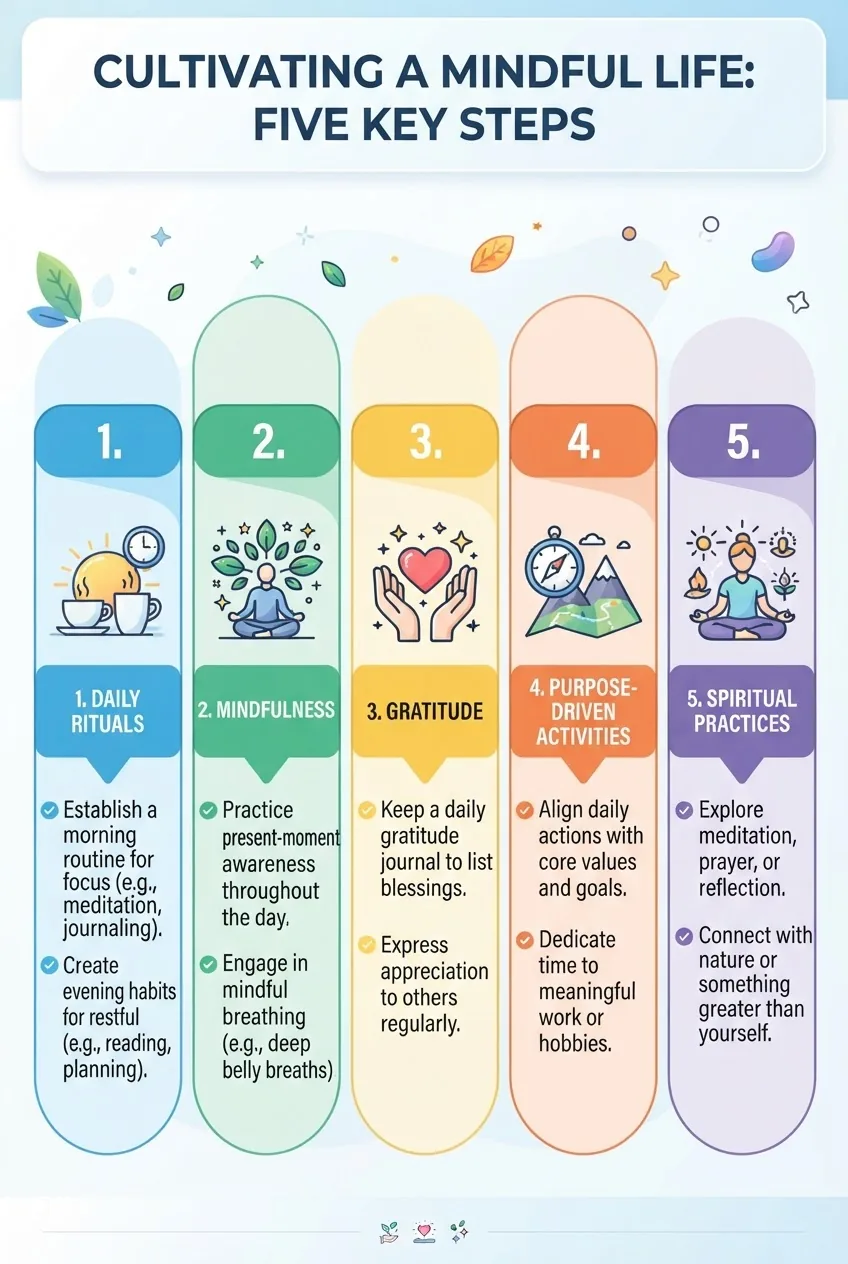
- Start a 5–10 minute morning presence practice — sit for 5 minutes on waking, breathe for 60 seconds, then do a 4–6–8 breath cycle for 4 rounds. Frequency: daily for 30 days. Measure: consecutive days logged; target 20+ days in month one.
-
Keep a three-line gratitude log each evening — write three short items (people, moments, acknowledgements) in under 5 minutes. Frequency: nightly. Threshold: 21 entries in a 30-day period.
- Design a weekly “anchor” ritual — 60–90 minutes once per week for deeper practice (longer meditation, nature walk, creative session). Schedule a fixed slot and protect it as non-negotiable. Measure: 4 anchored rituals per month.
- Schedule micro-goals for meaningful activity — break larger aims into 25–45 minute blocks (Pomodoro style), aim for 6 focused blocks per week on creative or purpose-driven tasks. Track completion percentage; aim for 75% adherence first month.
- Practice mindful transitions between roles — before switching from work to family or social time, take a 90-second reset: stand up, stretch, breathe, set a one-sentence intention. Frequency: every major transition; target 3–4 per weekday.
- Use boundary experiments — pick one boundary (e.g., no email after 7 pm), run it for two weeks, evaluate stress and connection metrics. If stress falls and rest improves, make it persistent.
- Engage in weekly social meaning work — one volunteer hour, community group, or skills-exchange per week for 4 weeks. Track: one new meaningful contact every two weeks.
- Adopt a simple reflective review — every Sunday, spend 20 minutes reviewing wins, energy drains, and next week’s anchor rituals. Use a one-sheet review: What worked? What didn’t? What will I stop/start?
- Practice a single spiritual habit with progressive dosing — choose one (centred prayer, metta meditation, walking in nature). Start 5 minutes daily, add 2 minutes each week for 4 weeks (target 13 minutes by end of month two).
- Create a 30-day experiment for curiosity — try one new activity (dance class, book club, pottery) twice in 30 days. If it brings energy, integrate; if neutral, let it go without guilt after the experiment.
Transition: these measurable daily rituals and weekly anchors move you from intention to habit; next, we explore balancing the three major life domains that typically cause the “I need a life” feeling.
Balancing Life Domains: Work, Relationships, and Self-Care

Balancing is practical: it requires time management, deliberate social connections, and defended self-care. Below are concrete examples and a comparison table to help you decide where to focus your limited time.
Work: set a 40-hour equivalent boundary—list tasks that require deep focus, batch them into three 90-minute blocks across the week, and set a 7 pm no-work rule four weeknights per week. For creative or entrepreneurial work, aim for 10–12 focused sessions per month (45–90 minutes each).
Relationships: schedule two protected social interactions per week (one friend, one family or community event). Aim for one meaningful conversation lasting 30+ minutes every 7–10 days. If social energy is low, aim for quality (one deep connection) over quantity (many shallow contacts).
Self-care: protect 30–60 minutes daily for movement, sleep hygiene, and mental rest (e.g., 20-minute walk + 10-minute evening wind-down + 7–8 hours sleep). If burnout risk is high, increase rest windows to 60–90 minutes daily and reduce discretionary obligations by 20% for a month.
| Domain | Concrete actions (first 30 days) | Measure |
|---|---|---|
| Work | 3 focused blocks/week; no email after 7pm (Mon–Thu) | # focused blocks completed; evenings free (%) |
| Relationships | 2 protected social contacts/week; one 30+ minute talk weekly | Meaningful conversations/month |
| Self-care | Daily 30–60 min (movement + rest); weekly anchor ritual | Rest hours/week; energy rating 1–10 |
Example: Maria (client vignette) worked 50+ hours and reported no friendships outside coworker chat. We implemented one 30-minute movement window each morning, two social check-ins per week, and a strict no-email rule after 7pm. After six weeks her energy rose from 4 to 7/10 and she reported two conversations that felt “renewing” rather than “obligatory.”
Transition: alongside time and boundaries, spiritual practices often anchor meaning. The next section explores how spiritual wellness supports this work.
Using Spiritual Wellness to Support Meaning and Balance
spiritual wellness here means an ongoing relationship with something that gives life meaning—this can be connection to a higher power, nature, values-driven service, or contemplative practice. It is not a single dogma but a stabilising resource for purpose and inner harmony.
To deepen understanding of how spirituality connects with wellbeing benefits, visit the pillar resource on spiritual wellness and purpose.
Practical examples:
- Daily centring practice (5–15 minutes) reduces reactivity and improves presence during interactions.
- Weekly faith or spiritual community participation increases social support and sense of belonging.
- Nature rituals (20–40 minute walks twice weekly) enhance awe and reduce rumination.
Research signals: According to a 2022 systematic review in a peer-reviewed psychology journal, spiritual practices are associated with improved mental health and resilience (peer-reviewed study). For an accessible discussion of the broader benefits of spirituality, see this sibling guide.
For practices focused on calm and presence, review guidance on achieving inner peace.
Authoritative resources: The Mind & Life Institute offers secular and research-informed programs for contemplative practice: Mind & Life Institute. For public health context on burnout and mental health supports, see the Australian Department of Health guidance: health resources.
Practice example: a simple “three-breath blessing” before meals or meetings—5 seconds inhale, 5 seconds hold, 5 seconds exhale, then set an intention—used consistently for two weeks produces measurable reductions in hurriedness and increased gratitude scores in many clients.
Transition: practical strategies often run into common obstacles; the next section lists problems and specific fixes.
Overcoming Common Obstacles When Trying to “Get a Life”
Problem-solution pairs below are written to be used in the moment. Use them as templates you can test in the next 72 hours.
-
Burnout — reduce demands, not yourself
Problem: exhaustion despite effort. Solution: cut one recurring commitment for two weeks; increase sleep by 30–60 minutes nightly; schedule one 60-minute rest period midweek. If symptoms persist, consult a professional. According to a 2021 government mental health report, structured reduction in demands reduces burnout indicators within 4–6 weeks (government health resource).External resource: Australian Department of Health.
-
Procrastination — use micro-commitments
Problem: can’t start meaningful tasks. Solution: set a 7-minute “start-only” timer; promise yourself five more minutes if you continue. Use single-task blocks of 25 minutes. Track starts, not completions, for the first 2 weeks. -
Fear of change — rename it “information gathering”
Problem: paralysis when choosing a new direction. Solution: commit to one low-cost experiment for 14 days. Frame it as research: what do I learn? What energy changes? Then decide. -
Lack of motivation — build momentum with tiny wins
Problem: low baseline energy. Solution: aim for 3 tiny wins daily (make your bed, 5-minute meditation, one text to a friend). Increase to 6 within 21 days. -
Negative self-talk — externalise the critic
Problem: inner critic stalls action. Solution: name the voice, set a 2-minute “debate” where you counter one negative thought with three factual observations. Practice twice daily.
Client vignette: James, a mid-career professional, described chronic procrastination and fear that any pivot would be wrong. We ran three 14-day experiments (creative writing mornings, weekend woodworking class, weekly mentoring). Only one stuck—writing—and it grew from 7 to 45 focused minutes three times a week in eight weeks. He reported greater clarity and less rumination.
Transition: to keep gains you need durable habits and mindsets — the next section outlines exactly how to maintain momentum.
Maintaining Momentum: Habits and Mindsets for Lasting Life Change
Lasting change is built on resilience, accountability, and adaptive review cycles. Follow these step-by-step practices, with clear frequencies and thresholds.
- Create a 12-week habit plan — specify 3 habits, frequency, and a tracking method. Example: morning presence (daily), gratitude log (daily), weekly anchor ritual (weekly). Track daily in a simple calendar; aim for 75% adherence in week 1–4, 85% in weeks 5–8, and 90% by week 9–12.
- Set measurable micro-goals — convert vague goals into numbers (e.g., “make one friend” becomes “invite 3 people for coffee in 8 weeks”). Review these every two weeks.
- Use accountability scaffolds — weekly check-ins with a partner or group, plus a monthly public commitment (post, group update). If you miss two weekly check-ins, reduce habit load by 25% and re-evaluate energy.
- Embrace adaptive reflection — conduct a 20-minute monthly review using three metrics: energy, meaning, connection. Adjust plans by eliminating the lowest-impact activity and doubling down on the highest-impact one.
- Practice radical compassion toward setbacks — when you fail, write one sentence describing what happened, one learning, one next step. Timebox this to 10 minutes to avoid rumination.
- Sharpen resilience with micro-exposures — intentionally take small, manageable risks (share a piece of work, host a small gathering) every 2–3 weeks to expand comfort gradually.
- Keep learning and diversify sources — read one short article or listen to one 20-minute podcast related to meaning or spiritual growth weekly. For curated spiritual practice introductions, visit the Mind & Life Institute: Mind & Life Institute.
- Maintain a three-question nightly check — What went well? What drained me? What is one small action tomorrow? This takes under 5 minutes and maintains awareness.
Practical tool: a simple “Weekly Momentum Sheet” includes days practiced, energy 1–10, and two wins. Use it every Sunday for 12 weeks. If adherence drops below 60% for two consecutive weeks, cut one habit and reframe its micro-goal.
Common mistakes and how to avoid them (practitioner notes)
I often see people try to change everything at once. I once coached a client who started six habits and burned out in three weeks; we reduced to two core practices and the results became durable. I also see rigid plans collapse when life fluctuates—so I teach rolling 4-week experiments instead of “forever” plans. Finally, I observe that unclear measures make motivation vanish; always pick simple numeric thresholds (minutes, sessions, contacts).
Checklist — what “getting a life” looks like in practice
- Three focus areas chosen and 30-day intentions set.
- Daily presence practice (5–15 minutes) logged at least 20 days in month one.
- Weekly anchor ritual scheduled and protected (4 per month).
- One boundary enforced for at least two consecutive weeks (e.g., no email after 7pm).
- Two meaningful social connections engaged per week on average.
- Monthly review completed with adaptations recorded.
When to call in a professional
Seek professional help if you experience persistent suicidal thoughts, severe depression, or anxiety that impairs daily functioning. If burnout involves chronic insomnia or cognitive impairment, contact a licensed mental health professional or your GP. These guides are practical supports, not substitutes for clinical care.
Final takeaway: moving from “I need a life” to actually having one is stepwise and measurable—start with small rituals, protect relationship and rest time, and anchor your work in spiritual practices that sustain meaning. Begin your 30-day experiment now and review in four weeks.