

Having a purpose means holding a coherent, enduring sense of why you live and where you direct your energy; it gives life significance, steady motivation and a framework for spiritual wellbeing in daily choices and relationships. This sense of meaning shapes values, emotional balance and a felt connection to something larger than the self.
Understanding What Having a Purpose Means
Answer: Having a purpose means an integrated understanding of what gives your life significance and direction—an ongoing orientation that links your values, identity and sense of contribution to a larger context.
Purpose: a sustained sense of intention that orients actions and decisions toward a perceived meaningful end.
Life purpose: a broader application of purpose across roles, relationships and long-term aspirations that gives a life its perceived significance.
Purpose is not a single goal or a checklist item; it is the interpretive lens through which personal meaning emerges. When someone asks “what does having a purpose mean?” think of purpose as an inner compass that integrates values and beliefs (the principles you hold) with the reasons you get up in the morning. For example, a nurse may find life significance in compassionate care; a retired engineer may direct their curiosity toward mentoring. Both describe purpose as a steady orientation rather than a transient desire.
Purpose connects to existential questions—why am I here?—and translates answers into lived priorities. It synthesises personal meaning and existential fulfilment, producing life clarity and a felt reason for living. Purpose and meaning overlap: meaning is the felt sense of coherence, while purpose adds direction and motive.
Note on terms: Personal meaning refers to the subjective sense that life events make sense; existential fulfilment indicates a broader satisfaction with existence consistent with one’s values and beliefs.

Table — Purpose, Passion, Goals: how they differ
| Concept | Core quality | Typical expression |
|---|---|---|
| Purpose | Directional meaning | Ongoing life orientation (e.g., serve, teach) |
| Passion | Intense enthusiasm | Strong interest in activities (e.g., art, sport) |
| Goals | Specific outcomes | Measurable targets (e.g., finish degree) |
Conceptual examples help: one person’s purpose might be “to cultivate healing through teaching,” which shapes career choices, family roles and spiritual practices. Another’s could be “to preserve beauty,” expressed across art, caregiving and community activism. These examples show how purpose ties identity to ongoing meaning and spiritual wellbeing.
Transition: The next section explores how that inner orientation links explicitly to spiritual wellness and the language of the soul.
The Spiritual Dimension of Purpose
Answer: The spiritual dimension of purpose frames purpose as a felt connection to something greater than the self—sometimes called soul connection or alignment with the higher self—which deepens inner peace and spiritual fulfilment.
Spiritual wellness: a state of being where an individual experiences meaning, connection and transcendence beyond material concerns.
In spiritual language, purpose is often described as the soul’s calling or a resonance between inner values and outer action. This dimension emphasizes connection to a higher good, collective wellbeing, or a sacred order. When purpose functions spiritually it supports inner peace and a sense of belonging to a larger whole: the “why” includes transcendent meaning.
Spiritual frameworks vary—from contemplative traditions that use silence and discernment to find alignment, to transpersonal psychology models that view purpose as an emergent expression of the higher self. Transpersonal psychology resources provide context for integrating psychological development with spiritual awakening. Recognition of deep soul connection signs can clarify purpose by showing where one’s inner values consistently orient attention and energy.
Spiritual fulfilment occurs when purpose is practised with integrity to values and beliefs; that integrity stabilises mental and emotional balance. For many, purpose brings the sense that daily life is an expression of a larger story, not a random series of tasks—this reduces existential angst and promotes resilience.
Psychospiritual models often recommend witnessing and reflection to distinguish ego desires from soul-directed purpose. Term: Inner peace here denotes a sustained calm rooted in coherence between values, actions and a felt spiritual connection.
Transition: Understanding spiritual dimensions clarifies why purpose matters for wellbeing, which the next section examines using psychological evidence and theory.
Why Is It Important to Find Your Purpose in Life?
Answer: Finding a purpose supports motivation, psychological health and wellbeing by providing mental clarity, emotional balance and resilience; empirical literature links purpose to lower depression, greater life satisfaction and healthier behaviours.
Psychological theory frames purpose as a foundational human need in several models: Viktor Frankl’s logotherapy emphasises meaning as central to human motivation; Self-Determination Theory highlights relatedness and autonomy as pathways through which purpose supports wellbeing; and recent meta-analyses link purpose to improved mental health outcomes. For example, According to a 2023 meta-analysis in the Journal of Positive Psychology, higher purpose correlates with greater life satisfaction and reduced depressive symptoms in adults Journal of Positive Psychology.
Practically, purpose organizes attention and goal-setting, increasing motivation and reducing aimless rumination. Purpose-driven people are more likely to maintain healthy routines and sustain social connections—both protective factors for mental health. According to a 2022 World Health Organization report, psychosocial investments that strengthen meaning and community ties contribute to broader mental health resilience; access the WHO summary here.
Linking spiritual needs to purpose strengthens outcomes: addressing spiritual needs such as belonging, meaning and transcendence often amplifies the wellbeing benefits of purpose by providing communal and existential support.
importance of spirituality and purpose for wellbeing
Conceptual steps that explain why purpose matters (not a how-to):
- Meaning formation: purpose translates life events into a coherent narrative.
- Value alignment: purpose aligns action with values, producing emotional balance.
- Behavioral economy: purpose focuses attention, conserving cognitive resources and increasing motivation.
- Social resonance: purpose often fosters connection and contribution, boosting wellbeing.
Caution and trust: purpose is subjective; some people find it through spiritual frameworks, others through relationships or service. If searching for purpose is causing distress, consult qualified mental health professionals for support.
Transition: With the importance clarified, consider how an active sense of purpose shapes everyday living and mental/emotional balance.
How Having a Purpose Impacts Daily Living and Wellbeing
Answer: Having a purpose changes daily living by providing life direction, increasing resilience, improving stress response and supporting mindful, intentional choices that foster fulfilment and emotional balance.
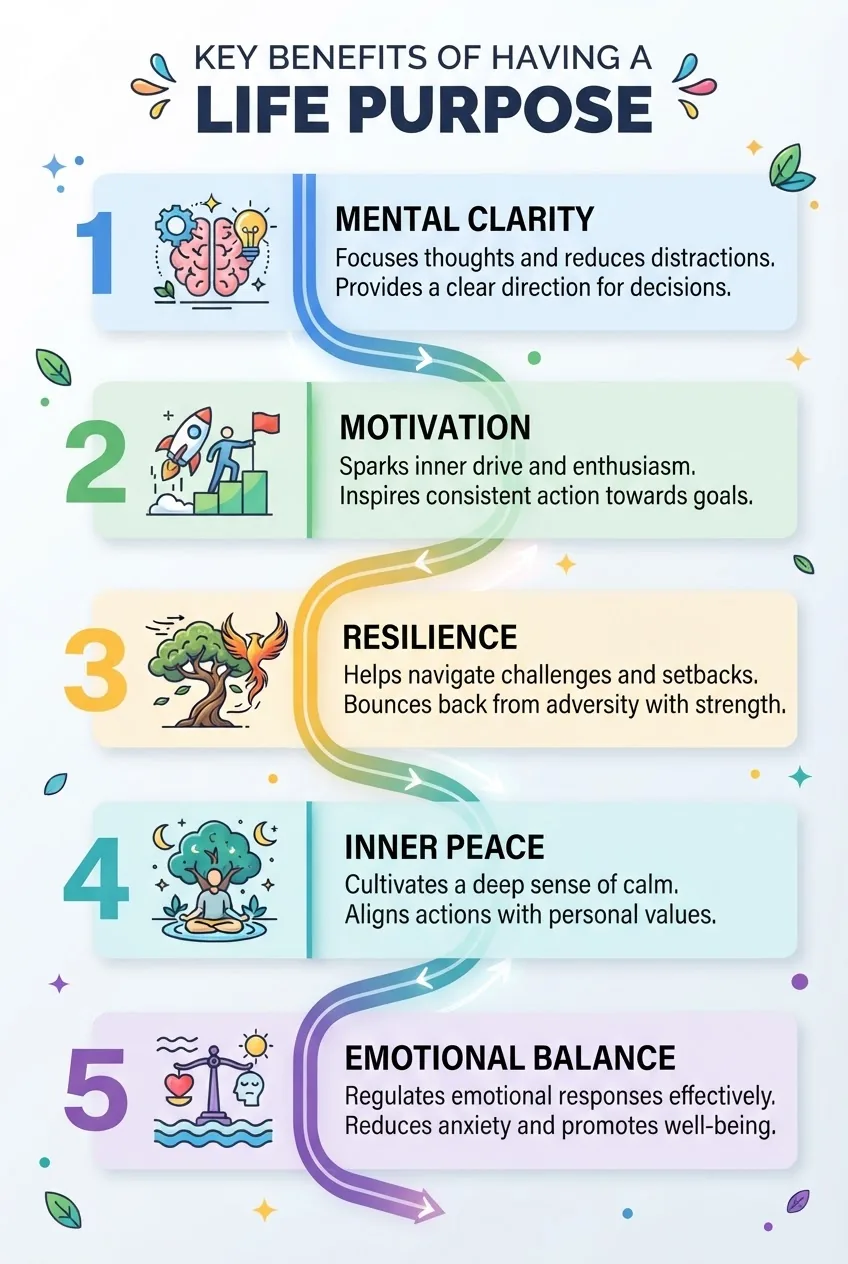
Five practical impacts of purpose on daily wellbeing:
- Life direction: Purpose gives a coherent sense of direction, reducing decision fatigue and clarifying priorities.
- Mental clarity: Purpose reduces rumination by anchoring attention to meaningful aims; this improves focus and cognitive energy.
- Resilience: Purpose buffers against setbacks by framing hardship as part of a larger narrative, increasing perseverance.
- Inner peace: Purpose cultivates calm when values and actions align; this supports emotional regulation and stress reduction.
- Motivation and drive: Purpose supplies sustained motivation, making routines and long-term goals more manageable.
building life meaning and balance
Additional daily effects include healthier sleep patterns, stronger social bonds, and a tendency to prioritise activities that align with long-term wellbeing rather than short-term gratification. Purpose makes choices more mindful: even small daily rituals gain significance when they serve a wider orientation.
A composite example illustrates impact: Maria (an anonymised composite) felt aimless after career change; once she articulated a purpose centered on “teaching presence and compassion,” she reported greater daily energy, improved relationships and reduced anxiety within six months, mirroring findings reported in clinical wellbeing studies.
Transition: Even with these benefits, several common misconceptions circulate about purpose; clarifying them avoids confusion.
Common Misconceptions About Life Purpose
Answer: Common myths—purpose must be singular, fixed, identical to passion or tied to grand achievements—are false; purpose can evolve, be modest, and coexist with changing goals.
- Myth: You must find one fixed purpose for life. Correction: Purpose can shift across life stages and contexts; multiple related purposes can coexist.
- Myth: Purpose equals passion. Correction: Passion is intense interest; purpose adds direction and ethical meaning beyond excitement.
- Myth: Purpose requires a dramatic calling. Correction: Purpose often appears in ordinary roles—parenting, neighbourly care, craftmanship.
- Myth: Finding purpose solves all mental health challenges. Correction: Purpose supports wellbeing but is not a substitute for clinical treatment when needed.
- Myth: Purpose is the same as goals. Correction: Goals are specific outcomes; purpose is the orientation that gives those goals meaning.
These corrections help maintain realistic expectations: purpose enriches life but does not guarantee constant happiness; it provides a compass for navigating complexity.
Transition: If your sense of purpose is emerging, these signs can indicate clarity; the next section lists them.
Signs You Have a Clear Life Purpose
Answer: Clear purpose is evident through consistent motivation, emotional fulfilment, aligned choices and a felt sense of direction that persists across time and situations.
- Consistent motivation: You feel regular drive toward certain activities without needing external rewards.
- Clarity in choices: Decisions feel easier because they filter through a consistent internal framework.
- Emotional fulfilment: Activities linked to your purpose bring sustained satisfaction rather than ephemeral pleasure.
- Alignment of values and actions: Your daily behaviour largely reflects your stated values and beliefs.
identifying values and goals - Social resonance: Your purpose naturally connects you with communities or causes that amplify meaning; note signs of spiritual connection can be part of this recognition.
signs of spiritual connection - Persistence through setbacks: You return to the same direction after obstacles because it feels essential.
- Sense of contribution: You experience a felt reason for living—actions feel like contributions to something meaningful.
finding your purpose
These signs are not a checklist to clear; they are indicators that can help confirm an ongoing orientation. Some people notice only a few signs at first and others develop them over time.
Transition: For those who want to fold purpose into their spiritual growth, the next section offers gentle guidance and inspirational framing.
Integrating Purpose into Your Spiritual Wellness Journey
Answer: Integrating purpose into spiritual wellness means allowing purpose to inform intentional living, spiritual growth and daily practices that align action with values and transcendence.
Integration is about alignment: aligning daily choices, small rituals and community involvement with a broader purpose supports spiritual health. Spiritual growth frameworks—from contemplative prayer to transpersonal practices—encourage seeing purpose as both gift and practice. Transpersonal psychology resources discuss how purpose can be a vehicle for personal transformation.
daily spiritual practices can support embodying purpose by creating consistent moments that align attention with values.
examples of spiritual practices—such as intentional service, mindful reflection, ritual gratitude or communal devotion—are ways to translate purpose into lived routine.
Integration benefits include enhanced spiritual health, reduced fragmentation between belief and action, and clearer life direction. For deeper work on enhancing spiritual health and wellness through purpose, consider resources on spiritual health integration and community practices.
enhancing spiritual health and wellness
Gentle conceptual walkthrough for recognising purpose through spiritual reflection (not step-by-step):
- Notice recurring themes: Pay attention to activities and concerns that consistently draw your attention over months or years.
- Test for resonance: See which themes produce a sense of inner calm and rightness when you imagine living them out.
- Check alignment: Compare themes to your stated values and to communities that reinforce them.
- Observe results: Notice whether living toward these themes improves emotional balance and relationships.
Integration is a gradual, reflective process that benefits from supportive communities, mentors and trusted spiritual guides. If spiritual practices trigger deep distress, seek professional support.
Transition: To close, the summary below invites reflection and next steps for continued exploration.
Summary and Encouragement for Spiritual and Personal Exploration
Purpose is the lived answer to “why”—a sustained orientation that supplies life significance, mental clarity and spiritual wellbeing. Reflect on values, notice what consistently engages your heart, and allow purpose to grow and adapt. For deeper reflection try curated life questions for reflection. If you experience persistent distress while searching for purpose, consult qualified mental health or spiritual counsellors for guidance. Embrace exploration: purpose often emerges slowly, through thoughtful living and compassionate service.
Final takeaway: Purpose matters because it creates a coherent story that links daily choices to deeper meaning, enhances spiritual wellness and supports emotional and psychological balance. Consider this article a reference point for ongoing reflection and a doorway to further resources.