
What you’ll achieve: By the end of this hands-on guide you’ll be able to compare, select and apply to an accredited alternative medicine degree online program, map a four-year course plan, and identify realistic career steps. Time required: 4–8 hours of research + 3–4 years to complete a bachelor’s; assumes beginner to intermediate knowledge of holistic health.
Before you start
- High school diploma or equivalent (minimum requirement for most bachelor’s entry).
- Transcript access and contact info for two referees for applications.
- Reliable laptop with webcam, 10 Mbps internet for synchronous sessions.
- Budget plan for tuition, textbooks and a modest practice kit (~AU$500–1,200 initial).
- Time: 10–20 hours/week (full-time) or 6–12 hours/week (part-time).
Follow these numbered, step-by-step sections to complete the full process: understand degree types, review curriculum, choose a program, meet admissions, prepare for online study, map careers and budget. Each main section below is presented as an actionable step you can complete.
-
What Is an Alternative Medicine Degree?
Step: Define the credential — An alternative medicine degree at the bachelor’s level is an undergraduate credential focused on non-conventional health systems, holistic approaches and preventive wellness. Programs come as a bachelor of science in alternative medicine, a BA in holistic studies, or as an integrative health degree online. These degrees blend foundational sciences (anatomy, physiology) with complementary modalities (herbalism, mind-body therapies, nutrition).
Curriculum emphasis varies: a Bachelor of Science in Alternative Medicine typically stresses lab-based biology and evidence-informed practice; a BA in holistic medicine emphasises cultural, philosophical and community health aspects. Integrative health degrees often include coursework on integrating complementary care with conventional medicine, clinical ethics, and interprofessional collaboration.
Common program outcomes: deliverable capstone projects, supervised clinical practicums, and competencies in client assessment, treatment planning and wellness coaching. Example capstone deliverables: a 6–12 month practice-based research project evaluating an herbal formulation’s effect on sleep quality, or a supervised community program implementing a mind-body resilience workshop series (deliverables: ethical approvals, pre/post metrics, 20–50 participant sample).

Terminology note: these programs sit within broader complementary and allied health vocabularies that include terms such as CAM and integrative care. For a full vocabulary primer, see alternative terms for Western medical practices such as CAM and integrative care.
Accreditation context: accreditation for alternative medicine programs varies by jurisdiction and by modality. In many countries government recognition or programmatic accreditation (for example, by professional boards) is necessary for clinical licensure in specific modalities; otherwise degrees confer academic qualification and scope-of-practice depends on local regulation.
-
Types of Alternative Medicine Degree Programs Online
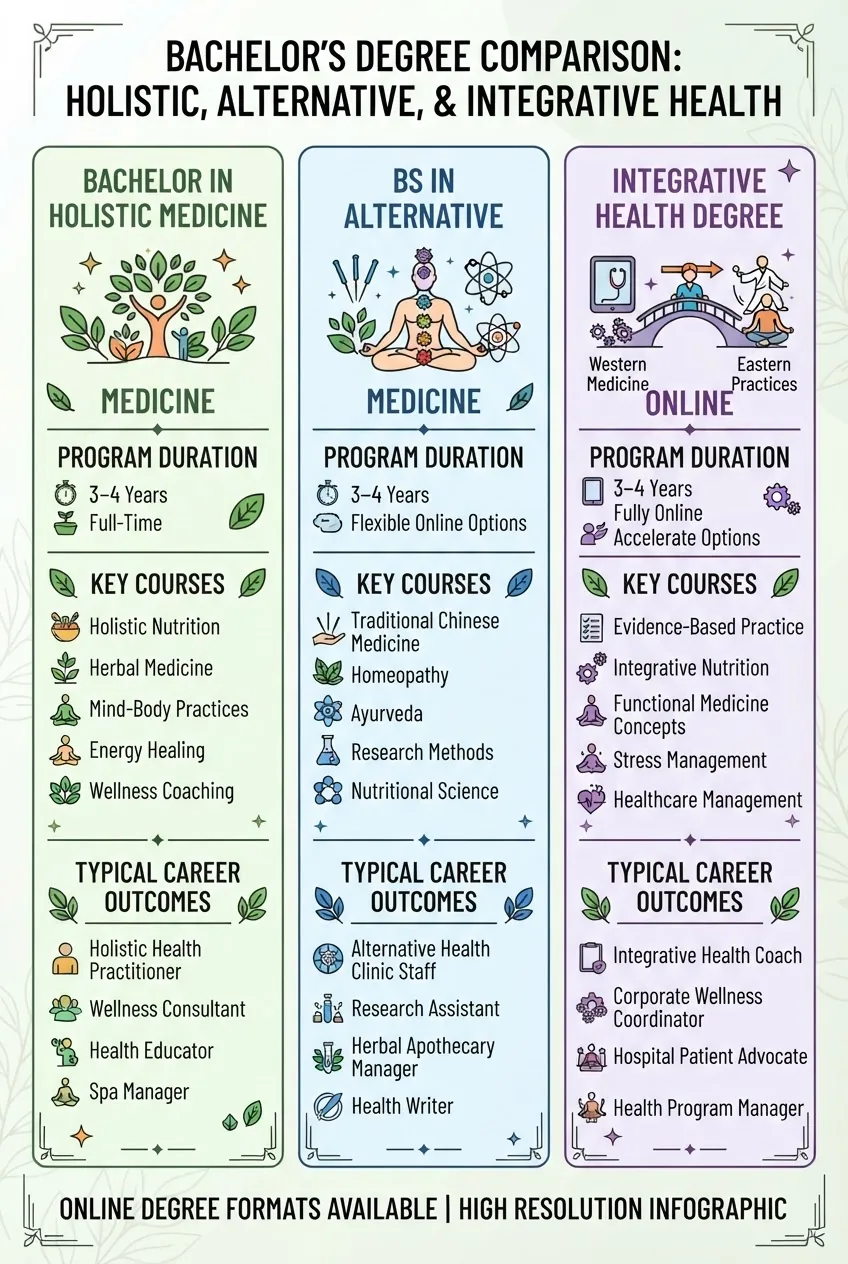
Step: Compare program types — Below is a numbered list of the main program types you’ll encounter online, with clear distinctions so you can match the program to your career goal.
- Bachelor of Science in Alternative Medicine (BSc) — Focus: biology, lab methods, pharmacognosy. Duration: 3–4 years full-time. Best if you want scientific rigor and potential for graduate study. Typical courses: anatomy & physiology, herbal pharmacology, research methods, clinical assessment.
- Bachelor of Arts in Holistic Medicine (BA) — Focus: cultural, philosophical, community health. Duration: 3–4 years. Best for education, community programs, wellness coaching. Typical courses: holistic theory, health communication, community practicum, ethics.
- Integrative Health Degree Online — Focus: blending CAM with conventional care, interdisciplinary collaboration. Duration: 3–4 years. Often chosen by those aiming for integrative clinics or hospital-based complementary services. Courses include integrative clinical practicum, health systems, interprofessional practice.
- Bachelor’s with Specialization Tracks — Focus: concentrated study in areas like herbal medicine, acupuncture theory (academic component), nutrition and mind-body therapies. Tracks usually add 2–6 courses (24–48 credit points) and often require a supervised practicum.
- Hybrid and Low-Residency Programs — Focus: mostly online coursework with short on-campus intensives (1–2 weeks annually) for hands-on skills (e.g., needling fundamentals, herbal materia medica labs). Duration: same as fully online; plan for travel budgeting (AU$200–1,000 per trip).
- Accelerated and Part-time Options — Accelerated tracks compress curricula into 2–3 years with heavier term loads (20–30 credits/term); part-time extends to 5–6 years with 6–12 credits/term. Choose based on work-life balance and licensing timelines.
Which is right for you? If you want clinical credibility and the option to pursue research or a master’s, choose BSc or integrative health degrees with strong science requirements. If community education, coaching, or health promotion is your goal, a BA or specialization track may be efficient.
-
Common Courses and Curriculum in Alternative Medicine Degrees
Step: Map the curriculum — Typical alternative medicine degrees online balance core sciences, modality-specific training, clinical skills and professional development. Expect a 120–140 credit-point curriculum (US/EN system equivalence) or 240–360 credit point systems depending on country.
Core domains (covered across most programs):
- Foundational sciences: Anatomy & Physiology, Biochemistry, Pathophysiology.
- Evidence & Research: Research Methods, Statistics for Health Sciences, Critical Appraisal.
- Clinical Skills: Health Assessment, Case Management, Ethics and Professional Practice.
- Modality Studies: Herbal Pharmacology, Nutrition & Wellness, Mind-Body Therapies, Basic Acupuncture Theory (theory components), Ayurvedic and Traditional Chinese Medicine overviews.
- Practice Management: Business of Holistic Health, Telehealth Practice, Record Keeping and Legal Frameworks.
Representative course list (with short descriptions):
- Herbal Pharmacology (Herbal Medicine classes) — Study active constituents, dosages, interactions with pharmaceuticals, safety profiles; lab or virtual herb ID modules. Assessment: formulation project and safety audit.
- Nutrition and Wellness Curriculum — Clinical nutrition, therapeutic diets, micronutrients and chronic disease management; deliverable: individualized nutrition plan with 12-week follow-up template.
- Mind–Body Therapies — Meditation, mindfulness-based stress reduction, breathwork and biofeedback fundamentals; students design and pilot a 6-session program (capstone element).
- Acupuncture Theory (academic) — Theory of meridians, point energetics, contraindications; practical needling usually reserved for hybrid components or postgraduate certification routes.
- Clinical Assessment & Differential Diagnosis — History taking, SOAP notes, red-flag recognition and referral pathways; includes simulated client interviews.
- Herbal Materia Medica & Formulation — Monographs, extraction methods, standardization, dosage calculations; final task: prepare two reimbursable herbal formulas with rationale.
- Complementary Approaches to Specific Conditions — Modules study evidence and protocols for conditions like chronic pain, mood disorders, respiratory conditions and oncology supportive care.
Many courses will reference condition-specific literature. For example, modules sometimes cover alternative medicine treatments for prostate cancer, mental health alternative treatments, and alternative therapies for asthma and allergies as evidence-review case studies.
Advanced coursework and electives that may appear:
- Advanced Cancer Care & Integrative Oncology — explores advanced cancer treatment options and symptom management. Emphasis: safety, evidence synthesis and communication with oncology teams.
- Holistic Oncology Modules — modules that include holistic alternative treatments for ovarian cancer as case studies focused on supportive care.
- Medical Cannabis Therapy Elective — studies dosing frameworks, pharmacology and legal considerations in medical cannabis therapy modules (where jurisdiction allows).
Typical assessment formats: weekly online quizzes, 2–3 research essays (2,000–4,000 words), practical assessments during hybrid intensives, supervised clinical hours (100–400 hours depending on school and modality) and a final capstone project (3,000–6,000 words or a practice-based portfolio).
-
How to Choose the Right Online Alternative Medicine Degree Program
Step: Evaluate and shortlist programs — Use this step-by-step checklist to narrow options from dozens to 2–3 finalists. Score each program against the criteria below on a 1–5 scale and keep programs scoring 18+.
Selection checklist (practical scoring)
- Confirm accreditation: Check institutional recognition and any programmatic accreditation relevant to your target modality. Search government listings (for example, national education departments or accreditation councils). Tip: If practical licensure is your goal, confirm the program meets local licensing board standards.
- Faculty expertise: Review instructor CVs — prefer clinicians with postgraduate qualifications and peer-reviewed publications or long clinical experience (5+ years).
- Clinical practicum options: Look for guaranteed supervised clinical hours and preceptor networks; if hybrid, confirm on-campus intensives schedule and travel expectations.
- Curriculum breadth: Ensure courses cover both core sciences and modality-specific training (for clinical roles, at least 30–40% of credit hours should be clinical or applied).
- Flexibility: Verify asynchronous content, exam windows, and maximum time-to-complete. If working, choose programs with flexible weekly deadlines and evening live sessions.
- Cost & financial aid: Compare tuition per credit and total program cost; ask about scholarships, payment plans and employer sponsorships.
- Graduate outcomes: Request graduate employment stats or licensure pass rates; programs with published outcomes are preferable.
- Technology & support: Confirm LMS platform, technical support hours, library access and dedicated student advisors for online learners.
Accreditation resources: check national education authority listings or accreditation councils. For example, refer to official information published by external bodies such as the Department of Education for institutional recognition and by professional boards for modality certification.
Walkthrough: Ask admissions three direct questions — (1) Does the program meet my state’s scope-of-practice for my chosen modality? (2) What exact supervised clinical hours are provided and where? (3) Can I complete the degree entirely online or will I need in-person practica? Require written confirmation.
Case study (anonymous): A mature student I advised wanted hospital-integrative work; we prioritized an integrative health degree online with hospital internship partnerships and faculty holding hospital appointments. They accepted an intake with guaranteed 200 supervised hours and finished in 3.5 years while working part-time.
-
Admission Requirements and Study Tips for Online Programs
Step: Prepare application and study habits — Admission requirements are straightforward but vary. Below are standard entry criteria and practical study strategies to succeed online.
Typical admission criteria
- Completed high school certificate or equivalent (score thresholds vary; some programs require minimum GPA 2.5–3.0).
- Transcripts for post-secondary study, where applicable.
- Personal statement (500–1,000 words) outlining interest and experience in holistic health.
- Two referees (academic or professional) and, for some programs, an interview or portfolio (especially for BA tracks).
- Proof of English proficiency (IELTS/TOEFL) for international students where required.
Study tips for online success
- Structure your week: Block 2–3 study sessions per weekday of 90–120 minutes and a longer 3–4 hour block on one weekend day. Use calendar apps and set recurring reminders.
- Create an indexed digital notebook: Use a note app (Evernote/OneNote) to track case studies, clinical protocols and herb monographs; tag by module and clinical relevance.
- Active learning: Convert lectures into 10-minute teaching clips you record for peers; explain clinical assessment steps aloud—this increases retention by 30–50% compared with passive review.
- Simulated practice: For assessment preparation, run standardized client interviews with peers or via telepractice; time sessions to 30–45 minutes and practice SOAP notes within 15 minutes post-session.
- Use student supports: Book weekly advisor check-ins, use library subject guides and access counseling or disability services early if needed.
Technical checklist before the term:
- Webcam resolution 720p or higher, headset with noise cancellation, reliable internet (10 Mbps up/5 Mbps down minimum).
- PDF scanner app for assignment uploads, access to data backup (cloud storage) and basic reference manager (Zotero/EndNote).
Student testimonial (anonymous): “I scheduled two 90-minute study blocks daily and joined a peer study group. I completed my clinical logs by doing telepractice twice weekly—this prevented last-minute log rushes and improved case write-ups.” This practical approach mirrors best-practice student behaviours I advise.
-
Career Paths and Opportunities with an Alternative Medicine Degree
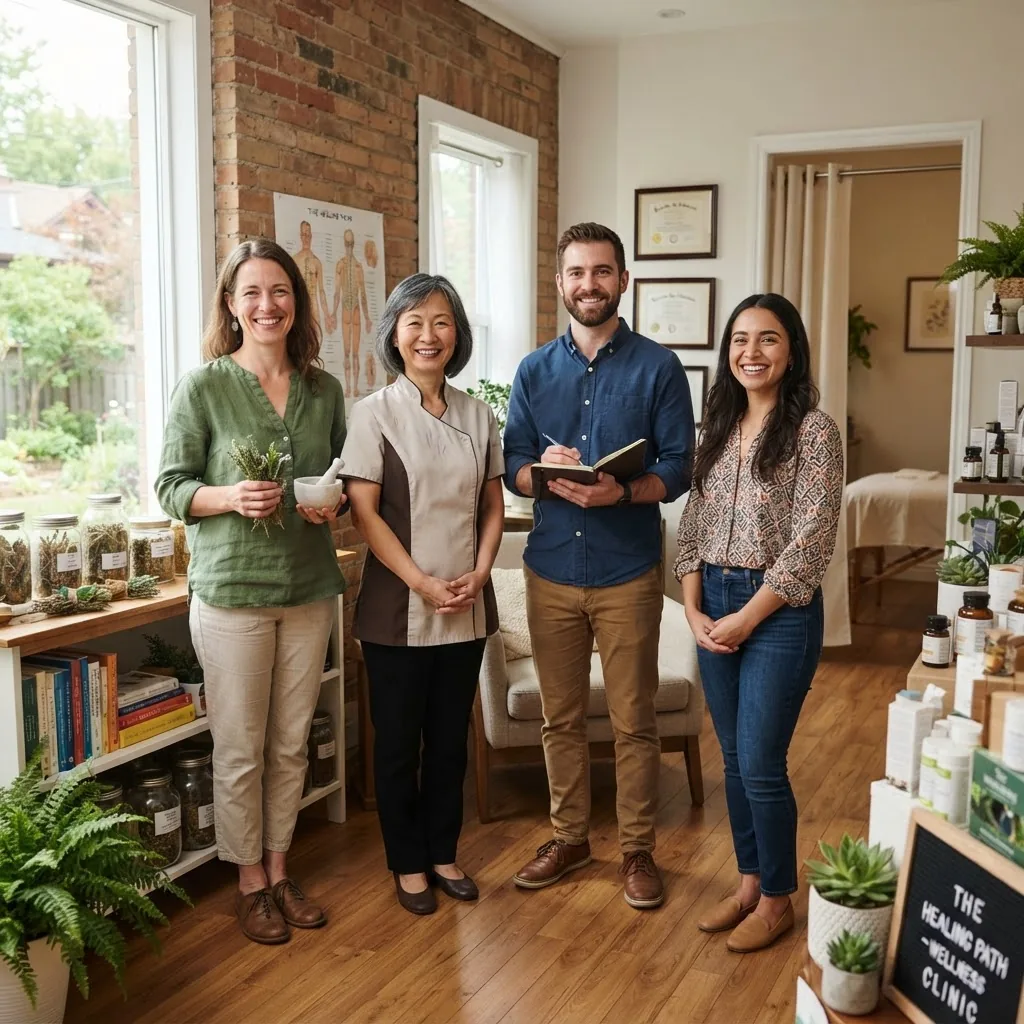
Step: Translate the degree into work — An online bachelor in alternative medicine opens a range of roles across clinics, community health, research support and business. Below are primary pathways, typical entry expectations, and next-step credentials.
Direct employment paths
- Holistic practitioner / herbalist: Work in private practice or wellness clinics offering consultations and herbal prescriptions. Entry: bachelor + supervised clinical hours; optional postgraduate clinical certification depending on jurisdiction.
- Integrative health coach / wellness counselor: Roles in corporate wellness, private coaching or community programs. Entry: BA/ diploma equivalence often sufficient; certification in coaching increases employability.
- Clinical support roles: Positions in integrative health centers assisting with patient intake, program delivery and care coordination. Entry: bachelor’s degree with practicum experience preferred.
- Public health and education: Program coordinators for community wellness initiatives, health educators in NGOs or schools.
Clinical specialties and advanced tracks
- Pain management specialist: Work alongside physiotherapists or pain clinics using integrative protocols; pathways often include postgraduate courses and specific training in modalities like acupuncture or therapeutic touch — see alternative therapies for pain management.
- Integrative oncology support: Provide supportive care in oncology centers (nutrition, mind-body therapy). Expect additional certification and strong liaison with oncology teams.
- Board-certified integrative roles: For clinicians seeking cross-disciplinary recognition pursue further certification — for overview see board-certified integrative medicine.
Academic and research directions
With a BSc you can apply for research assistant roles in integrative medicine labs or pursue a master’s examining practice outcomes. Research-focused graduates often contribute to clinical trials, literature syntheses and implementation studies in integrative settings; peer-reviewed publication experience increases competitiveness.
Entrepreneurial options
Many graduates start private clinics, online coaching platforms, product lines (e.g., herbal formulations) or educational services. Business skills courses included in many programs provide templates for practice set-up, budgeting (first-year operating cost estimate AU$8,000–15,000), and telehealth compliance.
For readers exploring practical clinic settings after study, review resources on alternative health care center services to map placement and employment options.
Labor market context: growth in consumer demand for complementary services is documented in sectoral analyses; check national labour statistics and professional body reports for the current year. According to a 2024 industry report, workforce demand in integrative health support roles increased year-over-year in community settings (source type: industry report).
Typical career progression timeline (example): Year 0–4: complete bachelor’s and 200–400 clinical hours; Year 4–6: obtain modality-specific certification and build practice; Year 6+: supervisory, educator or integrative clinic leadership roles.
For detailed career pathways and job role descriptions, see careers in alternative medicine.
-
Typical Program Duration, Cost, and Financial Aid Options
Step: Budget and timeplan — Use the stat block below to compare typical durations, tuition ranges and financial aid options. All figures reflect typical international program structures; confirm local currency and fees with institutions.
Program Type Duration (full-time) Typical Tuition Range Common Financial Aid BSc in Alternative Medicine 3–4 years AU$18,000–45,000 total Scholarships, HECS/loan schemes, payment plans BA Holistic Medicine 3–4 years AU$12,000–30,000 total Merit awards, bursaries, employer sponsorships Integrative Health Degree 3–4 years AU$20,000–50,000 total Graduate assistantships (rare), scholarships Program duration depends on credit load and transfer credits; many online students transfer diploma credits (up to 25–50% of program). Accelerated options reduce duration to 2–3 years but expect 20–30 credits/term.
Financial aid sources to explore:
- Institutional scholarships and bursaries (merit-based or need-based).
- Government student loans and grants (check national schemes; according to a 2024 Department of Education report some jurisdictions expanded education loan eligibility for online degrees—source type: government report).
- Professional association scholarships for members (check relevant national bodies).
- Employer sponsorships, especially for clinicians seeking upskilling within hospitals or health services.
Return on investment: calculate expected first-year post-degree earnings (or self-employment revenue) against total cost. Example threshold: if total program cost is AU$30,000, and first-year net revenue exceeds AU$15,000 with growth to AU$40,000 by Year 3, ROI timeline often falls within 2–5 years depending on location and demand.
Common mistakes and how to avoid them
I once advised a student who enrolled in a fully online herbalism degree expecting to practise acupuncture immediately; the program lacked hands-on needling hours and local licensure was not achievable without postgraduate clinical hours. Avoid this: verify practicum requirements against licensing rules before enrolling.
I also observed students underestimate supervised clinical-hour logging; they tried to complete 300 hours in the last 6 months and rushed assessments. My advice: schedule consistent weekly clinical practice (e.g., 4 hours/week will accrue ~200 hours per year) to avoid end-of-course bottlenecks.
Checklist: Verify these before you enrol
- Program accreditation and modality recognition by local boards.
- Exact number of supervised clinical hours and where they take place.
- Faculty clinical credentials and published outcomes.
- Clear cost breakdown (tuition, travel for intensives, kit costs).
- Flexible study options and technology requirements.
When to call in a professional
If your goal requires statutory licensure (e.g., to practise acupuncture or naturopathic primary care), consult your state/provincial licensing board or a qualified education adviser before applying. Also engage a professional accountant or business mentor when planning private practice startup finances exceeding AU$5,000 in monthly overhead.
How to Choose the Right Online Alternative Medicine Degree Program
Transition: Now that you have the checklist and warning signs, revisit program shortlists and score them using the earlier practical scoring method. This repeat evaluation helps spot red flags and confirm fit.
Follow these final selection steps: request course outlines, ask for sample timetables, confirm practicum placement policies in writing, compare graduate outcome data and verify transfer credit policies. Prioritise programs that publish graduate employment or licensure pass rates.
Admission Requirements and Study Tips for Online Programs
Transition: With your chosen program in mind, prepare strong application materials—tailor your personal statement to the program’s clinical focus, secure referees who can speak to your suitability for patient-facing roles and gather transcripts early to avoid delays.
Career Paths and Opportunities with an Alternative Medicine Degree
Transition: As you progress through clinical hours and the capstone, actively build a professional network: attend local integrative conferences, join professional associations and publish case studies or community program evaluations to accelerate employability.
Typical Program Duration, Cost, and Financial Aid Options
Transition: Budget realistically for both tuition and practical costs—hands-on clinics, kits, travel for hybrid intensives—and confirm refund policies for interrupted study.
Frequently Asked Questions
Below are concise, featured-snippet optimized answers to the most common questions students ask before and during enrolment.
Common closing summary
By following this hands-on guide you will be able to identify the right online alternative medicine degree for your career goal, apply with confidence, and structure your study and finances for on-time completion. Next step: shortlist 3 programs, request detailed unit outlines, and schedule an admissions call this week.
Call to action: Ready to shortlist programs? Download course outlines, compare clinical hour guarantees, then contact admissions for written confirmation; if you want help, book a 60-minute program planning session with a qualified education adviser.