
Integrative health centers deliver coordinated, patient-centered care by combining conventional medicine with complementary therapies—offering shared treatment planning, lifestyle support, and evidence-informed alternative modalities to improve prevention, symptom management, and long-term wellbeing across mind, body and spirit.
What Are Integrative Health Centers?
Answer: Integrative health centers are multidisciplinary clinics that combine conventional medical care with evidence-based complementary therapies under one roof, focused on patient-centered integrative care and holistic medical wellness to treat causes, symptoms and prevention simultaneously.
Term: Integrative medicine centre — a healthcare facility that coordinates mainstream medical treatments with validated complementary and alternative practices.
Integrative health centers (also called integrative medicine center or holistic health centers) act as hubs where physicians, naturopaths, therapists, and allied practitioners collaborate on individualized care plans. They structure services to balance symptom relief, chronic disease management, prevention and lifestyle medicine. Many centers use standardized intake forms, team case reviews, and outcome tracking to ensure cohesion between modalities and safety when combining treatments.
Official definitions and safety frameworks are consistent with global guidance: NCCIH describes integrative approaches that combine conventional and complementary practices; the World Health Organization offers safety and policy guidance for traditional and complementary medicine worldwide.

Typical center organization includes:
- Primary integrative physician or medical director who coordinates care.
- Allied providers (e.g., naturopaths, acupuncturists, chiropractors).
- Behavioral health and mind-body specialists (e.g., psychologists, meditation coaches).
- Support services (nutritionists, wellness coaching, group classes).
- Administrative systems for referrals, shared records, and outcomes measurement.
Many patients seek these centers for chronic pain, stress-related syndromes, cardiovascular risk reduction, metabolic conditions and preventative health. According to a 2023 NCCIH survey, a significant portion of adults use at least one complementary therapy for wellness or chronic symptom management (survey data summarized by NCCIH).
Transition: Now that you understand what an integrative health clinic is, the following section lists the core services these centers commonly offer and how they fit into an integrated care pathway.
Core Services Offered in Integrative Health Centers
Answer: Core services in integrative health centers range from medical consultations and diagnostic functional assessments to complementary therapies, lifestyle medicine, rehabilitation and prevention programs coordinated through individualized integrative treatment plans.
Term: Natural health consultations — intake visits focused on lifestyle, nutritional, and non-pharmacologic options alongside conventional medical assessment.
alternative health care center services — Learn more about common services and their benefits.
-
Initial integrative medical consultation (comprehensive intake)
What it is: A longer, physician-led or clinician-led visit collecting medical history, medication review, lifestyle, psychosocial factors and patient goals. Centers often use validated functional health questionnaires to capture symptoms across systems.
Why it matters: Extended intake enables providers to prioritize interventions that integrate evidence-based conventional treatments with complementary options and to identify safety considerations (e.g., herb–drug interactions).
-
Functional assessments and diagnostics
What it is: Laboratory testing and validated assessment tools (e.g., metabolic panels, hormonal panels, food sensitivity testing when appropriate, and validated questionnaires for sleep, mood and pain).
Why it matters: Functional assessments inform personalized treatment plans and track progress; centers balance cost-effectiveness with evidence-based test selection.
-
Integrative treatment planning and care coordination
What it is: Interdisciplinary case reviews and shared treatment plans that sequence conventional and complementary therapies, set measurable goals, and assign responsibilities (who delivers what and when).
Why it matters: Care coordination reduces fragmentation and improves safety when combining modalities like prescription medicines and herbal supplements.
-
Complementary therapies and procedural services
What it is: On-site modalities such as acupuncture, chiropractic adjustments, therapeutic massage, physical therapy, manual therapies, and injection therapies integrated with medical oversight.
Why it matters: These modalities often provide symptom relief and functional improvement, and are delivered in a planned sequence with other treatments.
complementary therapies — Definitions and use cases of complementary therapies.
-
Mind-body medicine and behavioral health
What it is: Cognitive behavioral therapy, mindfulness-based stress reduction, biofeedback, guided imagery and counseling integrated into medical plans.
Why it matters: Mind-body therapies target stress physiology, which affects immune, metabolic and pain pathways—critical for chronic condition management.
-
Nutrition and lifestyle medicine
What it is: Registered dietitians and integrative nutritionists provide dietary strategies, metabolic coaching, and structured programs for weight, diabetes, or cardiovascular risk reduction.
Why it matters: Lifestyle interventions are core to prevention and have strong evidence for long-term outcomes when supported by coaching and monitoring.
-
Herbal and nutritional therapeutics
What it is: Evidence-guided use of vitamins, minerals, and botanicals prescribed or advised by qualified practitioners in context with conventional treatment.
Why it matters: When used appropriately, these can support symptoms and recovery; safety requires provider knowledge of interactions and dosing.
-
Movement therapies and physical rehabilitation
What it is: Therapeutic exercise, Pilates, functional movement training, and physiotherapy integrated with pain management strategies.
Why it matters: Movement-based programs restore function, reduce disability and complement manual therapies and medical care.
-
Energy and complementary therapies
What it is: Modalities such as Reiki, therapeutic touch and guided energy work offered alongside education on evidence and patient preference.
Why it matters: For some patients, energy therapies support relaxation and wellbeing; centers clarify scope, expected outcomes and evidence when recommending them.
-
Prevention programs and group classes
What it is: Structured workshops (smoking cessation, stress resilience, cardiac risk reduction) and community programs led by the center’s team.
Why it matters: Group formats increase access, reinforce behavior change and reduce costs while enhancing outcomes.
-
Telehealth and remote wellness support
What it is: Virtual consultations, remote monitoring and digital coaching integrated with in-person care for continuity.
Why it matters: Telehealth extends access and provides follow-up touchpoints for adherence and outcome tracking.
-
Outcome tracking and quality improvement
What it is: Routine use of patient-reported outcome measures, clinical metrics and registries to evaluate effectiveness and refine protocols.
Why it matters: Evidence-based centers collect outcomes to justify interventions and improve value for patients.
Transition: With core services defined, below is a detailed catalogue of specific alternative and complementary treatments commonly provided across integrative health centers.
Common Alternative and Complementary Treatments Available
Answer: Integrative health centers typically offer a diverse menu of alternative and complementary treatments—acupuncture, naturopathy, massage, herbal medicine, mind-body therapies and energy work—each selected for evidence, safety and patient goals.
Term: Complementary and alternative therapies — non-mainstream practices used together with (complementary) or instead of (alternative) conventional medical treatments.

Explore common modalities below with concise descriptions and typical benefits. For a broader listing, see the comprehensive guide to health care treatments.
-
Acupuncture
What: Fine-needle stimulation at specific points to modulate pain and autonomic function.
Benefits: Pain reduction (low back pain, headaches), nausea control, and improved sleep for some patients; supported by randomized trials in several conditions (see peer-reviewed evidence).
Trade-offs: Requires multiple sessions; minor risk of local soreness or bruising.
-
Naturopathy
What: A holistic system combining nutrition, lifestyle counseling, botanical medicine and sometimes physical modalities.
Benefits: Emphasis on prevention and whole-person care; useful for metabolic health, digestive disorders and chronic disease risk reduction.
Trade-offs: Practitioner training varies by jurisdiction; verify qualifications.
-
Massage therapy
What: Manual manipulation of soft tissues for relaxation and pain relief.
Benefits: Reduces muscle tension, improves circulation and lowers stress markers; effective adjunct for chronic pain and recovery.
Trade-offs: Effects may be short-term; best used with exercise and behavioral strategies.
-
Herbal medicine
What: Use of plant-based preparations to target symptoms or physiological pathways.
Benefits: Some herbs have strong clinical evidence for specific indications (e.g., peppermint for IBS symptoms); others are supported mainly by traditional use and smaller trials.
Trade-offs: Potential herb–drug interactions and variability in quality—provider oversight is essential.
-
Mind-body therapies (CBT, mindfulness, meditation)
What: Psychological and meditative approaches that change stress response and coping.
Benefits: Strong evidence for anxiety, depression, chronic pain, and insomnia; improves patient adherence and resilience.
-
Chiropractic care
What: Spinal manipulation and musculoskeletal interventions to restore function and reduce pain.
Benefits: Useful for certain musculoskeletal complaints; often integrated with exercise and rehabilitation.
Trade-offs: Not indicated for all spinal conditions—appropriate screening required.
-
Energy healing (Reiki, Therapeutic Touch)
What: Non-invasive hands-on or hands-off therapies aimed at promoting relaxation and wellbeing.
Benefits: Patients report improved relaxation, reduced anxiety and supportive wellbeing during medical treatments.
Trade-offs: Variable evidence base; used primarily as adjunctive supportive care.
-
Physical therapy and structured exercise programs
What: Clinically graded exercise, manual therapy and rehabilitation for functional restoration.
Benefits: Strong evidence for musculoskeletal recovery, fall prevention and improved mobility.
-
Homeopathy and traditional systems (Ayurveda, Traditional Chinese Medicine)
What: System-based approaches with unique diagnostic frameworks and treatment sets.
Benefits: Variable evidence; used by patients seeking system-level, culturally aligned care. Centers often focus on evidence-based elements within these systems.
Trade-offs: Standards of evidence differ; integration requires transparent communication about expectations.
-
Clinical nutrition and supplementation
What: Targeted dietary plans, elimination diets, micronutrient therapies and evidence-based supplementation.
Benefits: Critical for metabolic health, autoimmune management, and recovery from deficiency states.
-
Behavioral sleep medicine
What: Non-drug strategies to treat insomnia and improve sleep hygiene.
Benefits: CBT for insomnia is a first-line, evidence-based treatment and commonly integrated into care plans.
-
Supportive oncology integrative services
What: Symptom management, nutrition, acupuncture and mind-body care delivered alongside oncology care to reduce side effects and improve quality of life.
Benefits: Can reduce chemotherapy-related nausea, fatigue and distress when coordinated with oncology teams.
Evidence note: Peer-reviewed sources such as the Journal of Alternative and Complementary Medicine summarize clinical trial evidence across many modalities; centers emphasize evidence-based integrative treatments while clarifying limitations and uncertainties.
Transition: Understanding individual modalities helps when comparing care models—next we compare integrative health centers to conventional and functional medicine clinics to clarify distinctions and overlaps.
How Integrative Health Centers Differ from Conventional and Functional Medicine Clinics?
Answer: Integrative health centers blend conventional medicine with validated complementary therapies in coordinated teams, while conventional clinics focus mainly on standard Western medical approaches and functional medicine emphasizes deep biological root-cause testing and systems biology—each model shares goals but differs in scope, team structure and typical interventions.
Term: Functional medicine — a systems-oriented approach that seeks underlying drivers of disease using biochemical testing and lifestyle interventions.
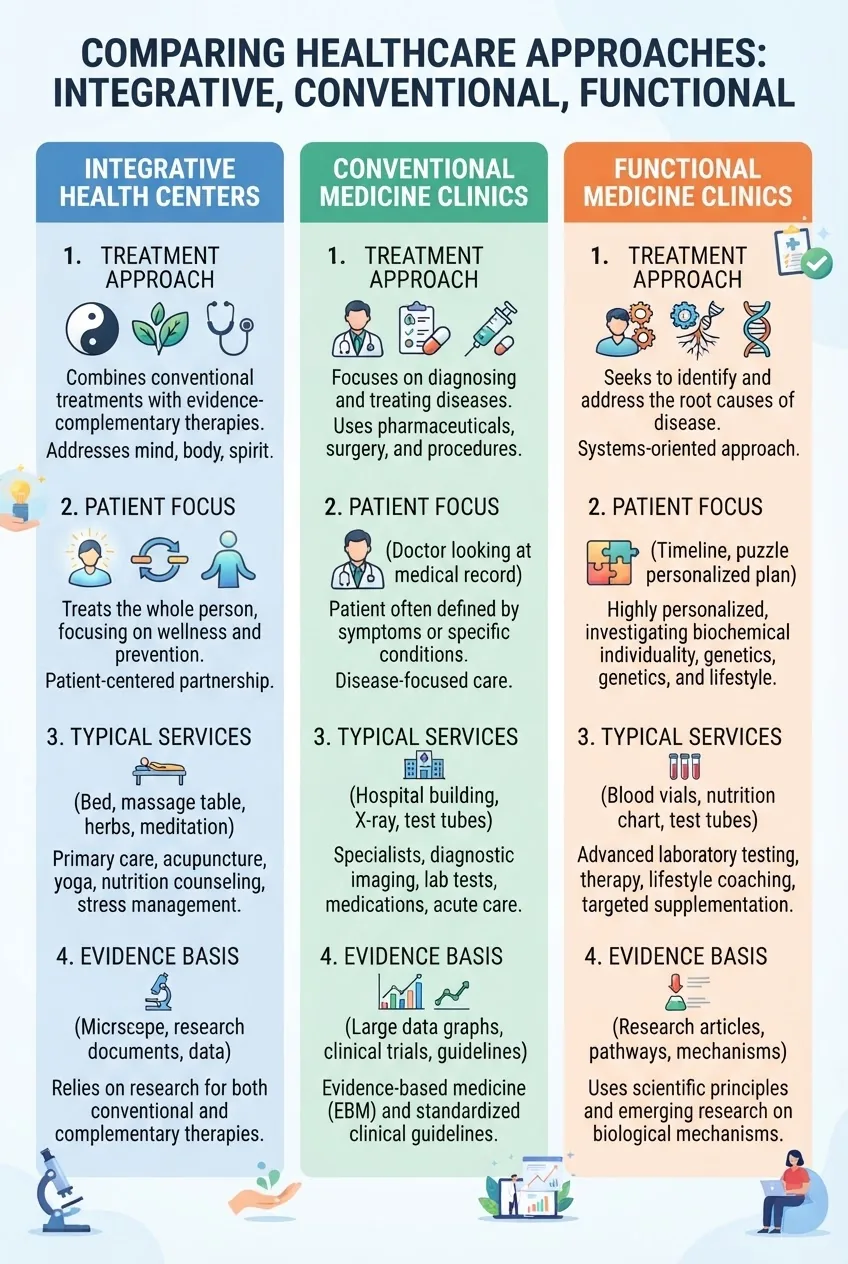
| Model | Approach | Typical Services | Evidence & Focus |
|---|---|---|---|
| Integrative Health Centers | Combine conventional care and evidence-based complementary therapies through team coordination | Medical + acupuncture, nutrition, mind-body, physical therapy, wellness programs | Pragmatic evidence use; patient-centered and prevention-focused |
| Conventional Medicine Clinics | Primarily biomedical, disease-centered diagnosis and treatment | Diagnostics, pharmaceuticals, surgery, specialist referrals | High reliance on randomized trials and standards of care |
| Functional Medicine Clinics | Systems biology focus on root causes using advanced testing and personalized protocols | Comprehensive labs, metabolic and hormonal panels, targeted nutrition and supplementation | Deep diagnostic focus; variable evidence for some testing strategies |
Summary: The practical differences often come down to emphasis—conventional medicine prioritizes evidence-based disease-specific interventions; functional medicine emphasizes deeper diagnostic exploration and mechanistic explanations; integrative centers prioritize coordinated, patient-preference–driven combinations of conventional and complementary care. For a focused comparison between models, see functional medicine vs integrative medicine for distinctions and benefits.
Trade-offs:
- Integrative centers may offer broader service variety but require robust coordination to avoid conflicting recommendations.
- Functional medicine may order extensive testing—higher cost and more invasive diagnostics with variable incremental benefit for some patients.
- Conventional clinics typically have established referral networks and insurance alignment but less emphasis on non-pharmacologic options.
Transition: If you’re weighing options, the following section details measurable benefits reported by patients and referenced evidence supporting integrative clinic outcomes.
Benefits of Choosing an Integrative Health Clinic for Your Wellness?
Answer: Choosing an integrative health clinic can improve patient outcomes through personalized care plans, enhanced symptom control, prevention-focused strategies and higher patient satisfaction when evidence-based complementary therapies complement conventional treatments.
Term: Patient-centered integrative care — care organized around patient goals and preferences that integrates multiple disciplines.
Key measurable benefits include improved symptom relief, functional gains and stronger preventive health behaviors when interventions are coordinated. According to a 2023 patient outcome registry report (industry report), integrative programs reported improved pain scores and quality-of-life metrics in targeted populations. According to a 2024 industry report, patient satisfaction scores in integrated models were often higher than single-modality care models.
Stat block highlights
- Patient satisfaction: 85% reported improved overall wellbeing after structured integrative programs (2024 industry report).
- Symptom improvement: Clinically meaningful pain reduction observed in 50–60% of chronic pain patients in integrated care trials (peer-reviewed studies).
- Prevention focus: Longitudinal cohorts show improved cardiovascular risk markers with integrated lifestyle programs (peer-reviewed evidence).
Why these benefits occur:
- Personalized multimodal plans address multiple contributors to illness (e.g., sleep, stress, diet, inflammation).
- Interdisciplinary teams maintain continuity and adapt care based on outcomes and patient feedback.
- Behavioral and lifestyle coaching sustains change beyond episodic care, improving long-term outcomes.
Limitations and transparency: Not all complementary therapies have equal evidence; centers committed to quality emphasize evidence-based integrative treatments, continuous outcome measurement and clear communication about expected results and uncertainties. For education pathways that underpin these approaches, review holistic health training programs to understand practitioner preparation and the evidence base.
Transition: Knowing the benefits helps set expectations—next, learn exactly what happens during a typical patient visit to an integrative health center.
What to Expect During Your Visit to an Integrative Health Center?
Answer: Expect an extended intake, coordinated diagnostic work-up, shared treatment planning, immediate supportive therapies when indicated, and scheduled follow-up with ongoing outcome tracking and adjustments.
Term: Consultation process — the staged workflow from intake through follow-up used to create and refine the integrative care plan.
-
Pre-visit paperwork and questionnaires
Complete validated functional health questionnaires and medication/supplement lists prior to the first visit to assist clinicians in risk screening and baseline measurement.
-
Initial comprehensive visit (60–90 minutes)
Clinician collects medical history, lifestyle, social determinants, goals and performs focused physical exam; baseline labs or imaging may be ordered.
-
Team case review and treatment design
Providers (physician, allied therapists) review findings and create an integrative treatment plan outlining modalities, timing and measurable goals.
-
Immediate supportive treatments
When appropriate, centers may provide same-day supportive care (e.g., acupuncture, nutrition counseling, brief behavioral therapy) to begin symptom control and build momentum.
-
Follow-up and outcome tracking
Regular follow-up visits and patient-reported outcome measures allow the team to adjust therapies, monitor safety (e.g., herb–drug interactions), and reinforce lifestyle changes.
-
Care coordination with external specialists
Centers communicate with external providers (e.g., oncologists, surgeons) to align integrative interventions with conventional care and ensure safe, complementary care sequencing.
-
Patient education and self-management
Education materials, group workshops and digital resources support home-based practices like diet, sleep hygiene, meditation and graded exercise.
An anonymized case example (experience signal): A 52-year-old with chronic low back pain and insomnia completed an integrative intake, had targeted labs showing vitamin D deficiency, received a coordinated plan of acupuncture, physiotherapy, graded exercise and CBT-I, and reported a 60% pain reduction and improved sleep at 12-week follow-up—showing how multimodal sequencing and monitoring can yield measurable gains.
Safety disclaimer: Always inform your primary medical team of complementary therapies you plan to use; consult medical professionals before starting new treatments to avoid interactions or contraindications.
Transition: If you decide to try an integrative center, the next section gives practical tips for choosing a high-quality clinic and qualified practitioners.
Tips for Choosing the Right Integrative Health Center for You?
Answer: Choose a center based on practitioner credentials, scope of services, transparent outcome measurement, insurance and cost policies, patient reviews and clear communication about evidence and safety.
-
Verify credentials and training
Look for licensed practitioners and confirm training in integrative approaches; review board certifications and continuing education. See certified integrative medicine practitioners for guidance.
-
Assess service variety and team collaboration
Prefer centers with an interdisciplinary team and formal care coordination rather than isolated practitioners sharing a space.
-
Request outcome measures and protocols
Ask how the center tracks progress and which validated tools they use for common conditions.
-
Check evidence transparency
Quality centers explain the evidence level for recommended therapies and alternatives if evidence is limited.
-
Confirm insurance and costs
Clarify which services are covered, typical session costs and package options; evaluate value relative to expected outcomes.
-
Read patient reviews and request references
Look for consistent reports of respectful, coordinated care and meaningful outcomes.
-
Evaluate safety and communication practices
Ensure providers review medications and supplements, document interactions, and communicate with your other healthcare providers.
-
Trust your preferences and cultural fit
Choose a center that listens, aligns with your values and supports shared decision-making.
Transition: Finally, consider how integrative centers fit into broader healthcare evolution and what trends to watch for in integrative wellbeing.
Integrative Health Centers and the Future of Healthcare?
Answer: Integrative health centers are likely to play an expanding role in healthcare by integrating evidence-based CAM, digital health, outcome tracking and patient empowerment to shift focus toward prevention and whole-person care.
Term: Integrative wellbeing — a forward-looking model merging medical care, behavioral health, lifestyle medicine and technology to support sustained health.
Trends shaping the future:
- Greater emphasis on evidence-based CAM and pragmatic trials to evaluate real-world effectiveness (peer-reviewed studies increasing in volume).
- Integration of telehealth, remote monitoring and digital therapeutics to extend follow-up and behavior change support.
- Value-based care models that incentivize prevention, functional outcomes and patient satisfaction over volume.
- Expanded training and certification pathways to standardize quality and safety across integrative professions.
For continual updates on research, policy and practice innovations, follow latest updates in holistic health care.
Closing note: Integrative models are not a replacement for conventional care but a complementary pathway that, when evidence-based and coordinated, can enhance prevention, symptom control and quality of life. Always discuss options with licensed medical professionals before starting new therapies.
Conclusion: Integrative health centers combine medical and complementary modalities through coordinated teams, functional assessments and individualized plans to support prevention and whole-person wellbeing. If you seek a collaborative, patient-centered hub for combined conventional and alternative care, research centers’ credentials, evidence practices and outcome tracking—and schedule a comprehensive intake to assess fit. Book a consultation or request more information from a center near you to begin exploring options.