
What you’ll achieve: By the end you’ll have a clear, step-by-step plan to become a certified holistic health practitioner, including realistic timeframes (typically 6–24 months), entry skill level (beginner to allied-health), and the exact training paths to pursue — online or in-person.
Assumes: basic computer literacy, high‑school level biology or equivalent, and a commitment of 5–15 hours/week during training.
Before you start
- Prerequisites: high school diploma or equivalent; for degree-level programs, an undergraduate degree or specific pre-reqs may be required.
- Tools & materials: reliable laptop, 10 Mbps internet, Zoom or similar video platform, PDF viewer, note-taking app (Evernote/OneNote), and access to a local clinic or supervised practicum for clinical hours.
- Budget planning: expect AUS$1,500–$25,000 depending on certificate vs degree; plan for extra costs (books, insurance, exam fees).
- Time commitment: 5–20 hours/week; full-time accelerated options exist (6–9 months), standard paced programs 12–24 months.
What Is a Holistic Health Practitioner?
A holistic health practitioner is a health professional who assesses and supports a person’s wellbeing across physical, mental, emotional and environmental domains rather than focusing solely on isolated symptoms. This role blends evidence-informed conventional knowledge with complementary and alternative medicine approaches — such as nutrition, herbal medicine, lifestyle counseling, mind-body techniques and energy-based therapies — to create personalised care plans.
Scope of practice varies widely by education, credential and jurisdiction: some practitioners deliver lifestyle and wellness counseling only, while others — with advanced degrees or licensure — may perform clinical assessments and co-manage care with medical providers. That variability is why a clear understanding of the difference between certification and licensure is essential. Certification often functions like a professional badge showing mastery of a curriculum, while licensure (where it exists) grants legal authority to diagnose or treat certain conditions.
Typical daily activities include intake interviews, holistic assessments, designing nutrition and lifestyle plans, delivering mind-body interventions (breathwork, relaxation training), prescribing or recommending herbal or nutritional products within program scope, and documenting client progress. Holistic practitioners also coordinate with other practitioners when clients need medical care.
Philosophically, holistic practice emphasises the whole person. For a concise primer on the underlying philosophies and practical modalities a practitioner uses, see the holistic healing methods guide. For a deeper look at the conceptual framing behind person-centred practice, consult this explanation of defining a holistic view and this glossary of holistic health definitions.
Because the role integrates behavioral counselling with complementary modalities, many programs emphasise communication, motivational interviewing and documentation standards in addition to technical subject matter. This makes the holistic health practitioner a bridge between wellness-oriented clients and mainstream healthcare when integrated appropriately.
Transition: Now that you understand the role and scope of a holistic practitioner, read on to learn why formal certification matters and how it changes client trust, career options and regulatory responsibilities.
Why Get Certified as a Holistic Health Practitioner?
Certification signals that you completed a recognised curriculum and met assessment standards — essentially, it’s like earning a professional badge that shows your knowledge and skills in holistic healing. Certification provides:
- Professional credibility: clients and referral sources trust documented training.
- Market differentiation: a certification distinguishes you from untrained competitors and clarifies your scope.
- Access to insurance, employer roles or membership in professional associations where certification is required.
- Structured learning: a curriculum ensures you cover key topics (ethics, pathology red flags, referral pathways).
Below are concise benefits with practical notes:
- Client trust: Certified practitioners commonly report higher initial client conversion rates because documentation reassures clients on competence.
- Regulatory navigation: Certification clarifies your legal scope — many regions restrict claims and invasive interventions to licensed clinicians only.
- Career mobility: Certification can be stacked toward advanced credentials like diplomas, graduate certificates or degrees.
For evidence on the health value of integrative approaches and to enrich your understanding of the comparative benefits, see benefits of holistic medicine which summarises clinical and population-level findings supporting multi-modal care. According to a 2024 industry report, interest in accredited holistic and integrative training grew approximately 14% year-over-year across online learning platforms (source type: industry report), indicating employers and clients increasingly seek formally trained practitioners.
Transition: Certification has clear benefits, but program types vary. The following section compares program formats, accreditation, costs and clinical requirements so you can choose the pathway that fits your goals.
Types of Holistic Health Practitioner Certification Programs
Regulatory and quality oversight differs by country. In Australia, check national higher education regulators such as the Tertiary Education Quality and Standards Agency for university-level programs (TEQSA), while government health guidance on complementary medicine training and safe practice is available from national health agencies (Australian Department of Health). In the US, look to accreditation agencies and professional boards like the National Certification Commission for Acupuncture and Oriental Medicine (NCCAOM).
| Program Type | Typical length | Accreditation / oversight | Clinical practicum | Typical cost (AUD) |
|---|---|---|---|---|
| University degree (BSc/MSc) in integrative or complementary health | 1–4 years | Regional/national higher ed regulator (e.g., TEQSA) | Extensive (200–1,000+ clinical hours) | $5,000–$30,000+ |
| Accredited diploma / vocational (RTO) | 6–18 months | Registered Training Organisation (ASQA in Australia) | Moderate (50–300 hours) | $1,500–$8,000 |
| Professional certification (non-degree) | 3–12 months | Professional bodies or private certifiers (varied) | Often short or optional (0–100 hrs) | $500–$4,000 |
| Online certification programs | 3–24 months | Varies: DEAC, regional accreditors, or unaccredited | Virtual practicum or local placements (0–300 hrs) | $500–$15,000 |
| Natural health practitioner programs (naturopathy/herbalist) | 1–4 years | Professional boards, regional accreditors | Substantial for clinical roles (200–1,000+ hrs) | $3,000–$40,000 |
Prose breakdown:
University degree programs
These provide the deepest theoretical grounding and are best if you later want to pursue advanced clinical roles or academic work. Degrees typically include anatomy, physiology, pathology, ethics, research methods and supervised clinical practice. Accreditation is formal and regionally recognised; credits often transfer into postgraduate training.
Vocational diplomas and RTOs
These are applied, competency-based courses (e.g., in Australia, delivered by Registered Training Organisations) focusing on practical skills for immediate practice within defined scopes. They often include workplace-based assessments and are cost-effective for people who want to start a private practice quickly.
Professional certifications (non-degree)
Offered by private institutes or professional associations, these vary widely in depth and recognition. They are useful for skill expansion (e.g., herbal medicine, aromatherapy) but may not substitute for accredited clinical qualifications. Check whether a certification is recognised by any professional body you intend to join.
Online certification programs
Online programs range from short workshops to fully accredited graduate certificates. Quality indicators include: documented learning outcomes, assessment methods, clinical placement options, and recognized accreditation. Online delivery typically uses learning management systems (LMS) such as Moodle or Canvas, synchronous platforms like Zoom for live clinics, and telehealth tools for virtual practicums. When selecting online options, confirm how clinical hours are arranged locally and how practical skills are assessed.
Accreditation bodies and oversight: Look for programs reviewed by national higher education regulators (TEQSA in Australia), vocational regulators (ASQA), or recognised accreditation agencies in your country. Professional associations (for example, the American Holistic Health Association) may list acceptable training standards — check those before you enrol (AHHA).
Transition: With those program types in mind, the next section gives a practical, step-by-step pathway you can follow right away to become certified.
How to Become a Certified Holistic Health Practitioner — Step by Step
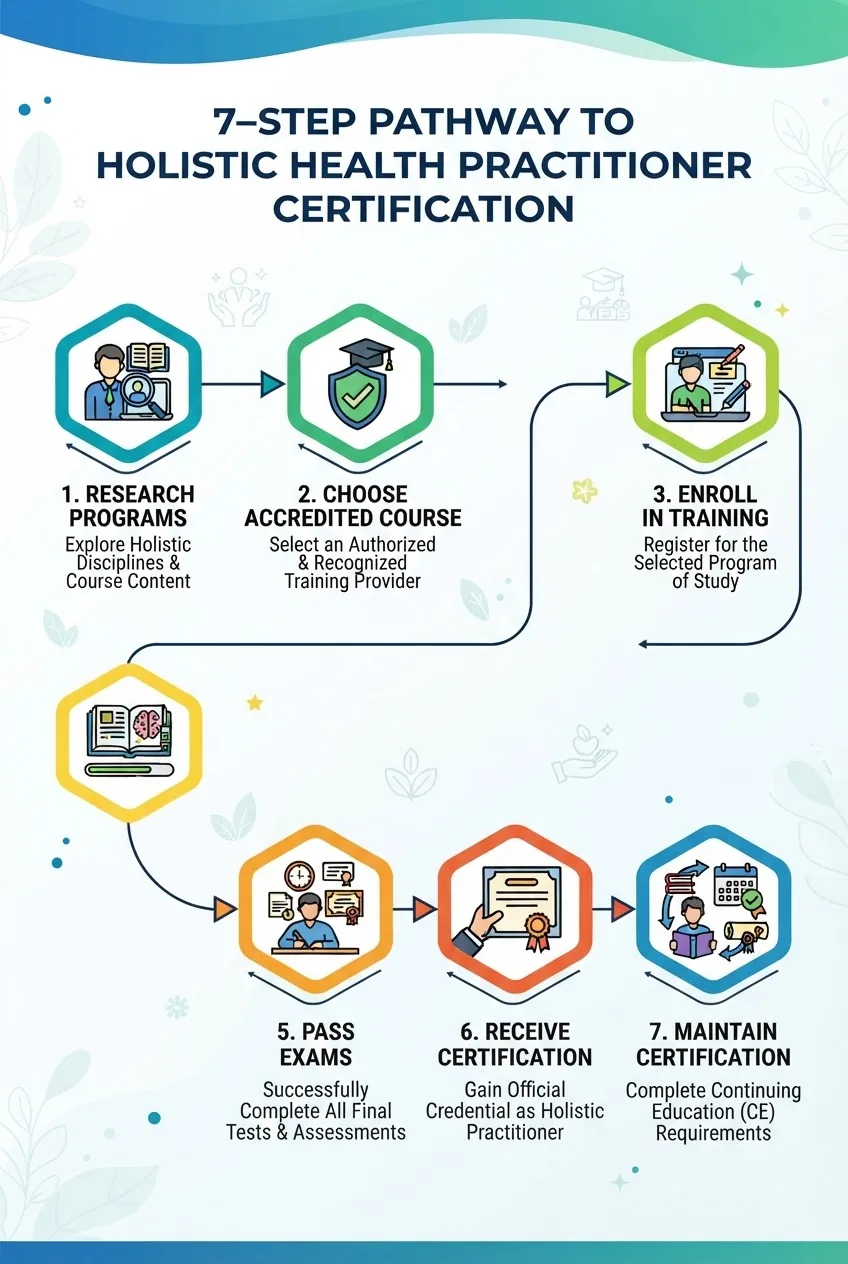
- Decide your end goal — Define whether you want to be a wellness coach, naturopathic clinician, integrative health educator, or complementary therapist. Timeline guide: wellness coaching (3–6 months); vocational diploma (6–18 months); degree-level clinician (2–4 years). Write your goal using a single sentence: e.g., “Start a private holistic practice offering lifestyle and nutrition counselling within 12 months.”
- Map required credentials — Research legal restrictions in your state/region for your chosen scope. If you plan to diagnose or prescribe herbal formulations, you’ll likely need degree-level qualifications or licensure. Decision point: if your region restricts diagnosis to licensed practitioners, opt for referral and co-management training rather than diagnostic scope.
- Shortlist accredited programs — Create a comparison spreadsheet with columns: program name, delivery (online/in-person), accreditation (TEQSA/ASQA/DEAC/regionally accredited), clinical hours, total cost, duration, and student support. Select 3 finalists with at least one accredited option. Walkthrough tip: weigh clinical hours heavily — for primary care intent aim for programs with 200+ clinical hours.
- Verify accreditation and recognition — Contact the program and the accrediting agency to confirm current status. Ask for graduate outcomes and placement statistics. Practical checks: request a sample syllabus, list of assessments, and practicum policies (who supervises, assessment methods, liability insurance requirements). Record responses and rate each program 1–5 on verification confidence.
- Plan financing and schedule — Calculate fees, books, practicum travel, insurance, and exam costs. Typical thresholds: certificate-level AUD $500–4,000; vocational diploma AUD $1,500–8,000; degrees AUD $5,000–30,000. Choose a pace: accelerated (5–15 hrs/day for 6 months), part-time (5–15 hrs/week for 12–24 months). Ensure employer benefits or student loans if needed.
- Enroll and set up your learning environment — Register, secure payment, set up LMS logins (Moodle/Canvas), and test your webcam and microphone. Allocate predictable study times: 2–3 evenings (2 hrs each) plus one 3–4 hour weekend block for practical skills. Use a task manager and calendar to log clinical supervision sessions and submission deadlines.
- Complete coursework and supervised practice — Follow a module completion plan: complete theoretical modules first (anatomy, pathology, pharmacology basics), then applied modules (herbal materia medica, nutrition planning, client interviewing), then practicum. For clinical competence aim for a minimum of 150–300 supervised client hours for vocational clinicians; for degree clinicians, aim for 500+ hours where required.
- Pass assessments and exams — Assessments may include case studies, clinical OSCEs (observed structured clinical examinations), written exams and portfolio reviews. Keep a practice log with dates, client types, interventions and supervisor initials — auditors commonly request this during certification review.
- Receive certification and register with associations — After passing assessments, request an official certificate or transcript. Join a professional association to access insurance and referral networks; membership often requires verified qualifications. Example: many graduates join national holistic associations to list themselves in practitioner directories.
- Maintain certification and pursue CEUs — Note renewal cycles (commonly 2–5 years) and continuing education unit (CEU) requirements (often 20–60 hours per cycle). Track CE activities and retain certificates of completion for audits.
Case study — Sarah’s 12‑month pathway (typical example): Sarah, 34, a yoga teacher, wanted to add nutritional counselling. She chose a 12-month accredited vocational diploma delivered online with a local practicum arrangement. Timeline and specifics: application month 0; orientation and foundational modules months 1–3 (60 hours); applied modules months 4–8 (120 hours); practicum months 7–11 (150 supervised client hours via a partnered clinic and telehealth, supervised by a registered clinician); final assessments month 12. Total cost AUD $5,400; weekly commitment 8–12 hours. She used Moodle for coursework, Zoom for supervision, and simple practice-management software for client notes.
Tools and platforms frequently used in online certification:
- Learning management systems: Moodle, Canvas, Blackboard — course materials, quizzes, and grading.
- Video and teleconferencing: Zoom, Microsoft Teams — live lectures and virtual clinics.
- Practice management / clinical documentation: JaneApp, Cliniko or simple secure cloud folders for supervised portfolios.
- Assessment platforms: Turnitin for essays, online OSCE scheduling tools for practicals.
Common mistakes and how to avoid them (from my practice)
I often saw students choose cheapest short courses without checking clinical hours; they completed theory but could not lawfully offer certain services. To avoid this, I always verify practicum hours and supervisor qualifications before enrolling.
I’ve also observed learners underestimate documentation requirements. I teach students to log every client contact with date, intervention, and supervisor initials — this single habit saved two graduates from certification audit issues.
Checklist before you finish training
- Certificate/transcript received and verified.
- Clinical log with minimum required supervised hours and supervisor sign-offs.
- Liability insurance obtained for practice start-up.
- Professional association membership applied/approved.
- Continuing education plan documented for next 2–5 years.
When to call in a professional
Call a legal advisor or professional association if you plan to diagnose, prescribe, or run a clinic with staff; get a healthcare lawyer to review business models and advertising claims. Consult a qualified clinical supervisor before treating complex conditions or prescribing herbal medicine at therapeutic doses.
Transition: With the practical pathway clear, next are specific accredited online programs you can evaluate right now.
Popular Accredited Holistic Health Practitioner Programs Online

This list highlights representative accredited online programs and offerings you should evaluate. Accreditation status and recognition vary by country; always verify with the accreditor listed by the provider.
- University-based integrative health certificates — Many universities offer graduate certificates or online micro-credential programs in integrative health or complementary medicine that are regionally accredited. These programs are usually credit-bearing and may stack into a master’s degree; accreditation is via the university’s regional regulator (e.g., TEQSA for Australian universities).
- American College-style online programs — Some online colleges specialise in integrative health and offer accredited graduate certificates or diplomas (look for institutional accreditation or endorsement by recognised bodies). These often include synchronous intensive weekends and supervised online clinics.
- Professional academies with accreditation — Institutions such as accredited distance education colleges (accreditation bodies like DEAC in the U.S.) provide diploma and certificate courses in holistic nutrition, herbalism, and clinical aromatherapy. Accreditation assures quality of distance delivery.
- Popular online health coach programs — Well-known industry programs (often non-degree) provide robust coaching methodology, business setup modules, and community support. These vary in external accreditation but can be useful for wellness coaching pathways; for comparison to coaching credentials study resources like the one on online health coach certifications.
- Hybrid naturopathy and natural health diplomas — These combine online theory with required in-person intensives and supervised clinical internships. They are designed for practitioners seeking a clinical naturopathic scope; accreditation may be through national naturopathic boards or regional education regulators.
Examples to investigate (representative types — confirm current accreditation directly):
- University Graduate Certificate in Integrative Health — credit-bearing, regionally accredited, includes evidence-based integrative curriculum and supervised telehealth practicum (best for stacking toward masters).
- Accredited Diploma in Natural Medicine — RTO-delivered vocational qualification with local clinic placement (good for immediate practice in natural health clinics).
- Online Holistic Nutrition Certification (accredited distance provider) — focuses on clinical nutrition, meal planning, and lab interpretation basics; often recognised by nutrition practitioner associations.
- Professional Clinical Herbalist Certificate (hybrid) — online theory plus in-person herb identification labs and supervised dispensing practicum.
- Comprehensive Health Coaching Program (industry-recognised) — business skills, coaching methods and client management; ideal for those combining coaching with other modalities.
How to vet these programs: request the program’s accreditor, ask for graduate employment stats, confirm how clinical placements are arranged, and check whether the program’s scope aligns with local legal requirements for practice.
Transition: Understanding program structure helps you anticipate coursework. The next section lists core classes and alternative medicine modules you’ll encounter.
Key Coursework and Alternative Medicine Classes Included in Certification Programs
Most quality holistic health practitioner training blends core biomedical knowledge with complementary modality training. Here are the most common coursework elements and sample module titles you should expect to complete:
- Core biomedical foundations — Anatomy & Physiology, Pathophysiology, Pharmacology fundamentals, Medical red flags and referral protocols.
- Holistic assessment skills — Client intake, health history, lifestyle assessment, functional testing basics and case formulation.
- Nutrition & lifestyle medicine — Clinical nutrition, dietary planning, supplementation, and behaviour change techniques.
- Herbal medicine & phytotherapy — Materia medica, herbal formulations, dosing, safety and interactions.
- Mind‑body techniques — Stress management, breathwork, guided imagery, cognitive‑behavioural strategies adapted for wellness work.
- Energy and manual modalities — Overview of energy therapies, basic clinical ethics regarding these modalities (varies by program).
- Practice management and ethics — Business setup, record-keeping, legal scope, marketing and professional boundaries.
- Research and evidence appraisal — Critical appraisal, reading RCTs, integrating evidence into practice.
Sample short course list (module-style):
- Foundations of Holistic Health — 40 hours
- Clinical Nutrition and Lab Interpretation — 60 hours
- Herbal Materia Medica — 50 hours
- Client Interviewing and Motivational Coaching — 30 hours
- Professional Practice and Ethics — 20 hours
- Supervised Clinical Internship — 100–300 hours
Nutrition often forms a large portion of curriculum. For a focused overview on accredited nutrition pathways within holistic training see holistic nutrition certification.
Mental health modules are increasingly standard. Programs typically include basic screening, referral practices, and integrative strategies for anxiety and depression; for specialised coursework see this review of holistic mental health approaches.
Transition: Once certified, a wide range of career options open up. The next section maps practical roles and income models.
Career Paths and Opportunities After Certification
Certification expands professional options across private practice, integrated clinics, corporate wellness, education and product consultation. Common roles include:
- Private holistic practitioner — solo practice offering intake, lifestyle plans, nutrition and non-invasive modalities. Earnings vary widely by location and hours: many new practitioners invoice AUD $60–$150 per hour.
- Wellness and lifestyle coach — focused coaching contracts for behaviour change; typically shorter client cycles and package pricing.
- Clinic associate or integrative clinic staff — working with naturopathic or integrative medical teams; salary models or revenue share vary.
- Corporate wellness consultant — staff wellbeing programs, workshops and seminars for employers.
- Educator or trainer — delivering workshops, continuing education or teaching in vocational programs.
- Product consultant or formulation advisor — advising natural product companies or health food retailers, with attention to legal advertising and claims.
Practical steps to building a career:
- Build a referral network: allied clinicians, allied health, GPs and therapists.
- List in practitioner directories: many associations host member directories that increase client referrals.
- Develop a clear, compliant service menu: list services you are legally trained to provide and clear referral pathways for medical conditions.
For help connecting with local health systems and referral networks, use this guide to finding alternative practitioners near me. If you plan to add coaching to your services, explore further training and standards in wellness coach training.
According to a 2023 industry report, practitioner demand in integrated health settings rose by about 10% over two years as clinics expanded complementary offerings (source type: industry report). Be mindful: income and job growth are local — check regional job boards and professional associations for accurate local forecasting.
Transition: Choosing the right program requires careful evaluation. The next section gives practical selection criteria and a checklist you can use during admissions.
Tips for Choosing the Right Holistic Health Certification Program
- Confirm accreditation first — verify institutional accreditation and program recognition with national regulators or accrediting agencies. Accreditation is your primary indicator of quality and transferability.
- Match practicum hours to your goals — if you want clinical competence, choose programs with ≥150 supervised hours; for full clinical roles aim for 500+ hours.
- Check assessment methods — prefer programs with practical OSCEs, supervised case work, and mentor-reviewed portfolios rather than only multiple-choice tests.
- Evaluate student support — ensure access to academic advisors, clinical supervisors, career services, and technical help for online platforms.
- Compare true total cost — include exam fees, insurance, travel for intensives, and textbook costs in budget comparisons.
- Review graduate outcomes — request graduate placement statistics, employment rates, and examples of alumni career paths.
- Assess flexibility — if you’re working, choose part-time cohorts, recorded lectures, and predictable synchronous scheduling windows.
- Investigate legal scope — ensure program training aligns with what you can legally do in your jurisdiction (advertising, prescribing, diagnostics).
Use this checklist during admissions interviews and document each response in your comparison spreadsheet.
Transition: Certification is only the beginning — maintaining credentials requires ongoing learning and documentation, discussed next.
Maintaining Certification and Continuing Education Requirements
Most certification systems require recertification or continuing education units (CEUs) on a cycle — commonly every 2–5 years. Requirements typically include a minimum number of CE hours, a record of practice hours or supervised work, and evidence of professional conduct (no unresolved complaints).
Practical maintenance steps:
- Record CE activities: keep PDFs of certificates, date, provider and CE hours in a secure folder. Many boards require 20–60 hours per cycle; confirm your program’s specific expectations.
- Log clinical practice: maintain a client log with client initials, date, intervention type and outcomes; renew professional liability insurance annually.
- Engage in peer supervision: some associations require documented peer supervision or mentoring sessions for recertification.
- Update scope knowledge: complete any mandatory updates on safe practice, clinical red flags, and local regulation changes.
Limitations and legal caution: Many holistic certifications are not licenses — they do not permit diagnosing or prescribing prescription medications. Regulations vary by state and country; always err on the side of referral to medical professionals for complex conditions. According to a 2022 regulatory review (source type: government/regulatory review), jurisdictions differ widely in how they recognise complementary health qualifications; check local guidance before representing your scope publicly.
Transition: The steps, program types and career pathways are extensive — below is a concise conclusion and next steps you can take now.
Conclusion and next steps
Key takeaways: choose an accredited program matched to your intended scope, verify clinical hours and accreditation, budget realistically, and plan for continuing education. Start by shortlisting three accredited programs, confirm practicum arrangements, and map a 12-month training calendar with weekly study hours. Ready to begin? Request syllabuses and accreditation documentation from your top three programs this week and schedule an admissions call.
Call to action: Begin your shortlist now: request program syllabuses, confirm accreditation and practicum policies, and review the checklist above before applying.