
What you’ll achieve: By the end you will have a clear, step-by-step plan to complete a professional holistic health educator training path, sit any required assessments, and launch a first six‑month practice or employment strategy. Realistic timeline: 6–18 months depending on part‑time vs full‑time study. Skill level assumed: motivated beginner with basic communication skills and an interest in health sciences.
Before you start:
- Prerequisites: high school diploma or equivalent, basic first‑aid/CPR recommended for client work.
- Tools & materials: reliable laptop, video conferencing setup, note-taking system, access to a local community for practicum (e.g., community centre, yoga studio).
- Time commitment: plan for 6–12 hours/week for part‑time study; 20–40 hours/week if taking an intensive cohort.
- Budget range: allow AU$1,200–$8,000 (or US$800–$6,000) for reputable certified programs (estimates vary by provider and country).
Follow the numbered steps below as the hands-on core of this guide. Each step opens with a bold, action-first phrase and provides concrete tasks, timings and thresholds you can check off.
-
Choose your credential pathway (2–6 weeks)
Decide whether you aim for a dedicated Holistic Health Educator credential, a broader health coach certification, or an accredited continuing education diploma. Compare program length, accreditation and scope of practice: typical educator programs run 100–400 hours including practicum. If you need clear, nationally recognised standards in the US, look at the National Board for Health & Wellness Coaching for coaching standards; in Australia, investigate nationally recognised training and industry groups such as AHHA for holistic pathways.
-
Map the core curriculum (2–8 weeks to plan; delivered across program)
Before enrolment, request the detailed course syllabus and a module map showing contact hours, practical assessment and supervised practicum. A robust training curriculum will include foundational science, evidence‑based holistic modalities, client assessment and educational pedagogy. See the “Core Training Curriculum for Holistic Health Educators” section below for a full module walk‑through and a practical skills example (client assessment techniques).
-
Verify accreditation and standards (1–3 weeks)
Confirm the program’s accreditation status and whether its credential is recognised by industry bodies. Ask for documented evidence of accreditation, articulation agreements with tertiary institutions, or independent audit reports. Use government accreditation registries (for example CHEA in the US or relevant national regulators) to cross‑check claims. Programs that list continuing education recognition by national boards are preferable.
For authoritative standards references see the National Board for Health & Wellness Coaching: NBHWC and the Council for Higher Education Accreditation: CHEA.
-
Complete foundational coursework (8–24 weeks)
Core subjects should include anatomy & physiology, nutrition basics, psychology of behaviour change, teaching methods, ethics, and an introduction to energy and mind‑body approaches. Expect 60–200 hours of taught content. Practical thresholds: aim for at least 40 hours of supervised contact practice and 20 recorded client sessions if the program requires practicum.
-
Develop practical skills and practicum (4–12 weeks concurrent)
Supervised practicum is non‑negotiable: plan for 40–120 supervised hours with a minimum of 10 documented client cases for credential portfolios. Practice tasks include intake interviews, individualized education planning, group workshop delivery, and basic outcome measurement (pre/post wellness surveys). A typical practical skills walkthrough is provided in the curriculum section below.
-
Pass assessment and receive certification (2–6 weeks)
Assessments may combine written exams, case study portfolios, observed practical demonstrations, and reflective journals. For programs aligned with external certification bodies you may also sit a board or standardized exam. Keep evidence: log hours, client consent forms, supervisor assessments and video/audio recordings where permitted.
-
Launch practice and continue development (first 6 months)
Set measurable first‑year goals: 3–5 recurring clients or two weekly community workshops, and enrol in 20–40 hours of continuing education within 12 months. Build formal referral pathways with allied practitioners and document outcomes for client progress tracking.
-
Maintain credentials through continuing education (ongoing)
Most certifications require 10–40 hours of continuing education (CE) every 1–3 years. Prioritise CE that expands clinical judgement, evidence-based modalities, and supervised mentoring. Keep CE certificates and reflective logs for audits.
Introduction to Holistic Health Educator Role
The holistic health educator is a specialist who blends health science with educational techniques to teach, coach and design wellness programs that address physical, emotional, social and environmental determinants of health. Their job scope covers wellness literacy, preventive education, program design for groups and individuals, and liaising with other practitioners for coordinated care. Typical duties include curriculum design for community workshops, personalised wellness education plans, group facilitation, and evaluating program outcomes using basic metrics such as validated quality-of-life questionnaires.
This role differs from therapy or counseling by emphasising education and empowerment rather than clinical diagnosis or psychotherapy. Where a holistic therapy practitioner or natural health therapist may provide therapeutic treatments, a holistic health educator focuses on structured learning, behaviour change frameworks and measurable education outcomes.
The educator’s impact is closely tied to the benefits of holistic medicine — improved self‑management, prevention focus, and integrated wellbeing outcomes. For clarity on the teaching mindset and concepts used in training see the holistic view definition and review basic terminology via holistic health terms defined.
Transition: below we unpack the precise curriculum modules you should expect and test for when selecting a program.
Core Training Curriculum for Holistic Health Educators
A rigorous training curriculum balances foundational sciences, pedagogical skills, and experiential practice. The numbered modules below reflect the typical composition of a credible program and the competencies graduates should demonstrate.
- Foundations of Holistic Health (Module 1) — History, philosophy and models of whole‑person health; comparison of biomedical and integrative approaches. Outcomes: explain the holistic model and articulate evidence for multi‑domain care.
- Human Anatomy & Physiology (Module 2) — Core systems overview (cardiovascular, respiratory, nervous, endocrine, digestive). Recommended: 40–80 contact hours. Outcomes: identify basic physiological markers relevant to wellness education (blood pressure ranges, sleep architecture, digestion basics).
- Nutrition Basics and Behavioural Nutritional Education (Module 3) — Macronutrients, dietary patterns, cultural considerations, and designing simple education plans. Outcomes: create a 4‑week nutrition education plan and deliver a cooking demonstration. For contrast with specialized tracks see holistic nutrition certification.
- Psychology of Learning and Behaviour Change (Module 4) — Motivational interviewing, stages of change, adult learning principles, and measuring readiness. Outcomes: conduct 5 motivational interviewing roleplays and score using a validated rubric.
- Mind‑Body Connection & Stress Management (Module 5) — Evidence‑based techniques: breathwork, guided imagery, basic mindfulness practices and biofeedback principles. Outcomes: lead a 20‑minute stress reduction session and document client pre/post stress scores.
- Energy & Complementary Modalities Overview (Module 6) — Intro to energy healing fundamentals, safe boundaries, and referral criteria. Outcome: describe at least three energy-based modalities and their appropriate educational use.
- Teaching Methods & Group Facilitation (Module 7) — Curriculum design, lesson planning, workshop management and evaluation metrics. Outcome: design and deliver a 90‑minute community workshop with measurable learning objectives.
- Client Assessment & Intake Skills (Module 8 — practical walkthrough) — This is a core practical module walkthrough illustrating how to develop assessment skills:
- Task: Complete an initial intake in 45 minutes using a standardized intake form covering medical history, lifestyle, goals and psychosocial factors.
- Skill thresholds: collect vitals (BP, resting pulse), perform validated screening questionnaires (PHQ‑4 for mood, Perceived Stress Scale), and set 3 SMART goals with the client within 10 minutes.
- Assessment evidence: produce a one‑page individualized education plan and supervisor sign‑off for 10 supervised intakes.
- Practicum & Supervision (Module 9) — Minimum 40 supervised hours, with at least 10 direct client encounters and structured supervision feedback sessions every 2 weeks. Outcomes: compiled portfolio of 10 client case studies with supervisor ratings.
- Ethics, Scope of Practice & Professional Boundaries (Module 10) — Define “scope of practice” and legal limits. Outcome: pass an ethics scenario exam and create a referral map to licensed practitioners.
- Program Design for Communities (Module 11) — Evaluation frameworks, outcomes measurement, and grant-writing basics for community health education projects.
- Business & Professional Skills (Module 12) — Recordkeeping, marketing ethics, privacy (e.g., HIPAA or local equivalents), insurance considerations, and setting fees. Outcome: produce a simple business plan and client outcomes reporting template.
Mini case study (experience): Anna completed a 200‑hour Holistic Health Educator diploma over 9 months, documented 12 supervised client intakes, and launched two community workshops in month 10. Within 6 months she reported 18 regular clients and recurring workshop bookings. Her program required a 60‑hour practicum, evidence portfolio and a final observed teaching assessment; these specifics guided her job applications to community health centres.
Quote from an instructor: “We focus on measurable teaching outcomes — not only knowledge but the client’s ability to apply small, sustainable changes. Supervised practicums are where theory meets client care,” says Dr. L. Meyer, Holistic Education Lead with 12 years’ training experience.
Transition: once you understand the curriculum building blocks, the next crucial decision is which certification pathway and accredited program best matches your goals and jurisdictional needs.
Certification Pathways and Accredited Programs
There are several recognised certification pathways. Some awards are specific “Holistic Health Educator” credentials offered by industry bodies; others come under broader health coach or continuing education certificates. Certification requirements vary by jurisdiction and accreditation status.

| Program | Duration | Accreditation | Estimated Cost | Delivery Mode |
|---|---|---|---|---|
| AHHA Holistic Health Educator Certificate | 120–200 hours | Industry association recognition (AHHA) | AU$1,200–2,800 | Blended (online modules + local practicum) |
| NBHWC‑aligned Health & Wellness Coach (for coaching pathways) | 100–200 hours | Exam readiness for NBHWC board (US) | US$1,500–4,500 | Online cohort with mentoring |
| University Continuing Education Certificate (Holistic Education) | 6–12 weeks (intensive) or 6 months (part‑time) | University accreditation | AU$2,000–6,000 | Online or on‑campus |
| Independent Accredited Diploma (Holistic Health Educator) | 200–400 hours | Third‑party accreditation or industry audit | AU$2,500–8,000 | Blended/Online with supervised practicum |
Notes and standards: accreditation quality varies. According to a 2023 report by NBHWC, programs that map hours to supervised practice and include competency‑based assessments produce better workplace readiness. For verification of institutional accreditation consult national registries such as CHEA (US) or your country’s higher education regulator.
For those considering purely online options, compare curricula with the online health coach certification programs guide to weigh synchronous cohort requirements and practicum supervision. Also evaluate whether a program offers recognized post‑certification supervision or mentorship.
Example credential differences (methodology): an AHHA certificate may emphasise natural health modalities and community education; NBHWC‑aligned programs use competency frameworks focused on coaching competencies, behaviour change models and board‑exam readiness. Always ask for learning outcomes, assessment rubrics, and sample practicum paperwork before enrolling.
Transition: after you select a pathway and understand accreditation, review how the Holistic Health Educator compares to related practitioner roles to define your career scope and referral boundaries.
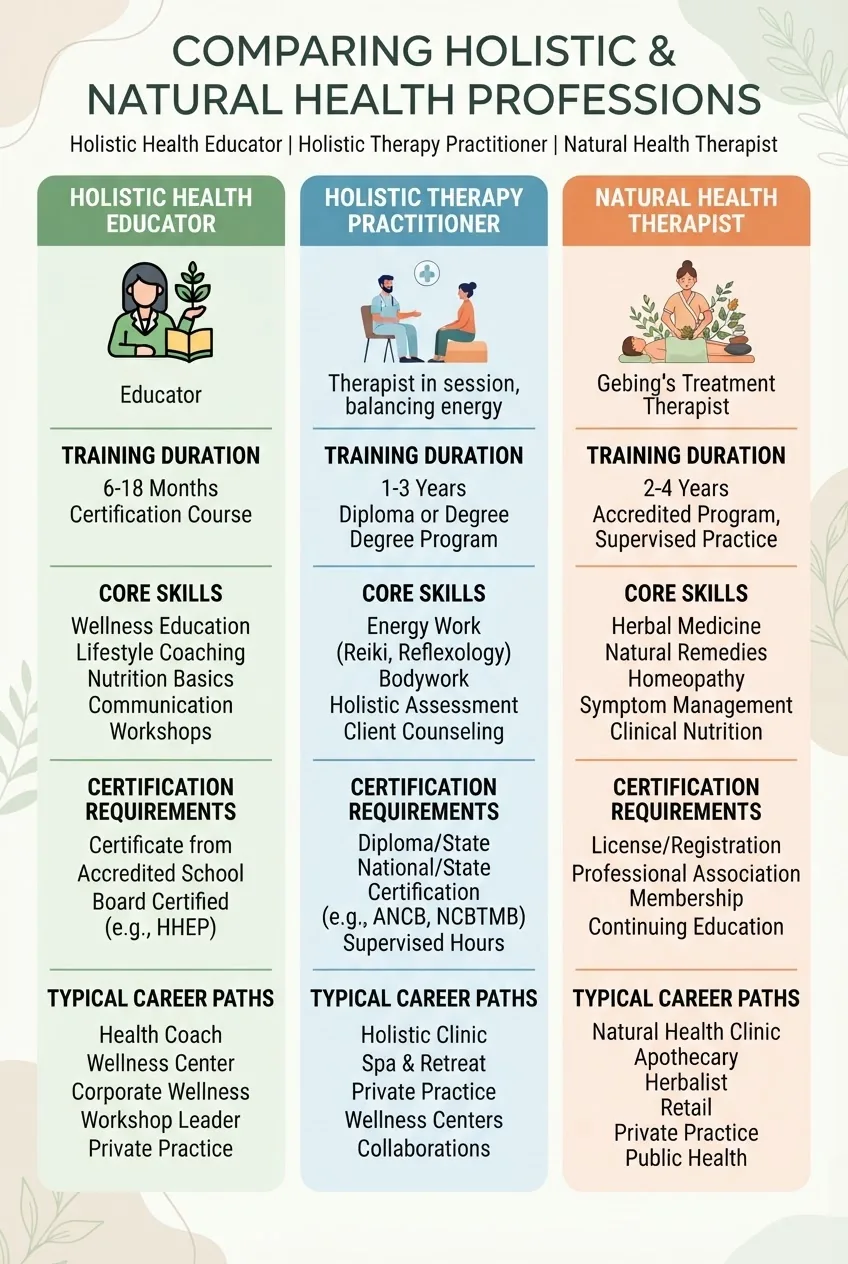
Related Practitioner Roles and Their Training Differences
| Role | Typical Training | Core Skills | Scope of Practice |
|---|---|---|---|
| Holistic Health Educator | 100–400 hours; emphasis on teaching methods & supervised practicum | Curriculum design, group facilitation, client education, basic assessment | Education, prevention, referrals (non‑therapeutic) |
| Holistic Therapy Practitioner | 300–1,200+ hours depending on modality; therapy-based clinical training | Hands‑on therapeutic techniques, therapeutic relationship skills | Direct therapeutic treatments (may require licensing) |
| Natural Health Therapist | Diploma to degree level; in-depth nutrition, herbal medicine, naturopathy | Clinical assessment, naturopathic treatment plans, diagnostic reasoning | Clinical treatment and prescription within local regulatory limits |
Concise distinctions: a holistic health educator is training-focused and intentionally limited in clinical scope — they teach, design programs and measure learning outcomes. A holistic therapy practitioner often provides therapeutic interventions and requires deeper clinical hours and sometimes registration. A natural health therapist typically has intensive training in nutrition and naturopathic methods and may function clinically within regulated boundaries. For specific nutrition tracks see the holistic nutrition certification.
Transition: with role distinctions clear, let’s look at concrete career pathways and how to build professional momentum after certification.
Career Opportunities and Professional Development
A certified Holistic Health Educator can apply skills across multiple settings and build a sustainable career path. Core employments include community health, corporate wellness, private practice, education and allied health support roles. Continuing education and networking are central to long‑term success.
- Community health centres and public health programs — design prevention workshops and monitor population outcomes.
- Wellness centres and spas — deliver educational series and group programs.
- Corporate wellness teams — implement employee wellbeing curricula and evaluate ROI with simple metrics.
- Private consultancy — one‑on‑one education packages, online course creation, and corporate training.
- Non‑profit and community outreach — grant‑funded education programs for at‑risk populations.
Actionable networking and professional development steps:
- Join one professional body and attend at least 2 conferences or webinars yearly.
- Set a 12‑month learning plan: 20–40 CE hours, including one supervised peer review every 6 months.
- Build referral relationships with licensed practitioners and document two formal referral pathways per quarter.
- Use outcome tracking tools (e.g., validated wellness questionnaires) to create at least one outcomes report per year for employers or clients.
For practical help with local collaborations and insurance‑aware referrals, see our guide to finding alternative practitioners in your area. If you plan to expand into coaching roles, consider combining your educator credential with specialist holistic wellness coaching training to widen employment options.
According to a 2024 industry summary by the National Center for Complementary and Integrative Health (NCCIH), demand for wellness education and preventative services continues to expand, particularly in corporate and community sectors. For employers, measurable outcomes and documented CE contribute heavily to hiring decisions; maintain a portfolio showcasing at least three documented program outcomes in your first year.
Transition: now that you know where the jobs are, here’s a tactical selection process to choose the right training program for you.
Choosing the Right Training Program for You
Follow these practical selection steps to choose a program that matches your goals, time and budget.
- Define your primary goal (1–2 days) — education, community work, corporate wellness or private practice. List three desired job titles and read three job ads to extract required skills and hours.
- Check accreditation & learning outcomes (1 week) — request the full syllabus, practicum requirements and the assessment rubric. Ask whether the program has articulation agreements with universities or recognised industry bodies.
- Compare practicum quality (1 week) — confirm minimum supervised hours, supervisor credentials and whether you will have recorded/assessed client sessions. Prefer programs requiring 40+ supervised hours and a minimum of 10 client cases.
- Evaluate delivery mode against your learning style (2–3 days) — for hands‑on skills choose blended delivery with in‑person practicums; for scheduling flexibility choose cohort‑based online formats with scheduled supervision.
- Verify post‑certification support (2–3 days) — check if they offer mentorship, job boards, or business setup support for at least 6 months after graduation.
- Confirm cost & refund/deferral policy (2–3 days) — compare total costs (tuition + practicum expenses + materials). Ensure there is a clear refund policy if supervised placements are unavailable.
- Speak to alumni & request outcomes data (2 weeks) — ask for alumni contact details and documented employment or program outcome stats for the last 2 cohorts. If unavailable, view this as a red flag.
Transition: during study and assessment you will meet common challenges; the next section provides tips and mitigation tactics.
Common Challenges and Tips for Success in Certification Programs
- Balancing work and study — Tip: schedule 6–12 hours weekly in fixed blocks; treat practicum hours like paid work with a signed schedule. I observed students fail when they treated practicum as optional—treat it as essential.
- Securing quality practicum placements — Tip: apply early and leverage instructor networks; ask the program to provide placement guarantees in writing. I once saw a cohort lose 30% of placements because students delayed applications.
- Preparing for practical assessments — Tip: record mock intakes and get supervisor feedback weekly. Use checklists (intake, consent, SMART goals) for every session until automated.
- Exam anxiety and portfolio completeness — Tip: map every learning outcome to evidence in your portfolio; use spaced retrieval (short, daily reviews) for exam prep.
- Navigating scope of practice questions — Tip: keep a written referral map and a short script explaining boundaries for clients; when in doubt, refer to a licensed clinician.
Transition: final section pulls together next steps and a quick checklist to validate readiness for certification and practice.
Conclusion and Next Steps to Become a Holistic Health Educator
Recap: you now have a practical roadmap — select an accredited program that includes at least 40 supervised hours, a detailed practicum, and clear assessment rubrics; document your client cases; and plan 20–40 hours of continuing education annually. Take action this week: request full syllabi from three programs, confirm practicum placement processes, and set up a simple client intake template.
Call to action: Start by shortlisting 2–3 programs and scheduling a discovery call with an admissions advisor. Your next step should be to compare supervised practicum hours and employer recognition — these two criteria most reliably predict early career success.
“Focus on measurable learning outcomes and real supervised practice — that is what employers ask for,” — Dr. L. Meyer, Holistic Education Lead.
Common mistakes and how to avoid them (from experience)
I’ve seen students choose the cheapest online course without practicum, then struggle to find paid work because employers requested supervised practice evidence. I advise: never compromise practicum quality for price. Another frequent error: failing to document client outcomes; keep simple pre/post measures for every client.
Checklist before enrolling
- Program provides a full syllabus and assessment rubrics.
- Minimum 40 supervised practicum hours and 10 client cases required.
- Evidence of third‑party accreditation or university articulation.
- Clear post‑certification support (mentorship/job board) for at least 6 months.
- Refund/deferral policy documented in writing.
When to call in a professional
Hire a professional educational advisor when you see ambiguous accreditation claims, unsupported practicum promises, or if you require credential recognition for regulated work. Consult a legal or regulatory expert if you plan to offer clinical treatments beyond education or to work in a jurisdiction with strict licensing rules.