
Exclusive holistic nutrition is a whole-person approach that integrates nutrition science, lifestyle, and therapeutic counseling; certification trains practitioners in evidence-informed diet, assessment tools, counseling techniques and practicum experience so they can deliver personalised nutrition plans and ongoing behavior-change support for clients.
What is Exclusive Holistic Nutrition?
Answer: Exclusive Holistic Nutrition is a focused discipline combining whole-food dietary principles, individualized assessment and integrative counseling to treat the person as an interconnected system, prioritising prevention, chronic-disease support and sustainable lifestyle change.
Term: holistic nutrition — a nutrition approach that considers physical, emotional, social and environmental factors affecting food choices and metabolic health.
Exclusive Holistic Nutrition emphasises whole-person nutrition and tailored interventions rather than one-size-fits-all diets. It draws on principles from functional nutrition (investigating root causes), integrative health (combining modalities), and behavioural counseling (supporting lasting change). Examples include creating anti-inflammatory meal plans while addressing sleep, stress and activity patterns.
A core distinguishing feature is the emphasis on a whole-person nutrition assessment that includes laboratory interpretation, lifestyle mapping and the use of evidence-informed dietary patterns (e.g., Mediterranean-style whole-foods emphasis) to support metabolic and mental well-being.
For a broader conceptual basis, see the site’s explainer of the holistic view and approach.
If you want deeper terminology, consult the holistic definition guide for precise language and distinctions.
Transition: Understanding how the approach is constructed helps explain what clinicians do day-to-day, which the next section covers.
How does the holistic approach to nutrition work in practice?
Answer: The holistic approach to nutrition integrates dietary science with lifestyle, mind-body factors and complementary modalities to create personalised, sustainable plans that address root causes and support long-term wellness.
Term: nutrition for holistic health — nutrient- and lifestyle-based strategies aimed at improving overall functioning, resilience and quality of life.
At its core the approach recognises the mind-body connection in nutrition: dietary patterns influence mood, sleep and inflammation, while stress and social context affect eating behaviour. Holistic practice commonly uses complementary nutrition modalities like food-as-medicine, targeted supplementation, and functional testing when warranted.
Key components include:
- Whole-food dietary emphasis: nutrient-dense, minimally processed foods aligned with individual preferences and cultural patterns.
- Mind-body integration: stress reduction, mindful eating and sleep hygiene are embedded in plans.
- Functional orientation: looking for root causes such as gut dysbiosis, nutrient deficiencies or metabolic dysfunction.
- Lifestyle integration: physical activity, social routines and environmental exposures are considered alongside diet.
Practical examples: a client with fatigue may receive dietary changes emphasising iron- and B-vitamin-rich foods, sleep-phase adjustments and targeted lab work; a client with IBS benefits from tailored elimination and reintroduction protocols plus stress-management coaching.
Holistic practitioners also coordinate with other professions—naturopaths, psychologists, GPs—to deliver integrative care where needed, keeping scope-of-practice and referral pathways clear.
For additional context on complementary modalities that often accompany nutrition work see the site’s pillar on holistic healing methods.
What Does a Holistic Nutritionist Do?
Answer: A holistic nutritionist assesses biological, lifestyle and psychosocial drivers of health, creates personalised dietary and lifestyle plans, implements behaviour-change strategies, monitors outcomes and collaborates with other clinicians.
Term: holistic nutritionist — a professional trained to apply whole-person nutrition principles, counselling skills and assessment tools to support client health (scope varies by certification and jurisdiction).
Core day-to-day activities:
- Comprehensive client assessment: medical history, food diaries, symptom timelines, sleep, stress and movement patterns.
- Evidence-informed dietary planning: meal templates, nutrient focus, elimination/reintroduction protocols.
- Laboratory interpretation: ordering or interpreting functional labs where certification or local regulation permits.
- Behavioural counselling: motivational interviewing, SMART goal-setting, relapse prevention.
- Education and follow-up: food literacy, cooking guidance and iterative plan adjustments based on outcomes.
How-to snapshot: Effective holistic nutritionists blend assessment (e.g., validated food-frequency or 24-hour recalls), functional thinking (identify patterns not just nutrients), and coaching methods (e.g., motivational interviewing) to translate plans into daily habits.
Transition: Training for these responsibilities is delivered through certification programs that combine science, counselling and practicum; the next section maps certification stages.
How is Exclusive Holistic Nutrition certification structured?
Answer: Certification typically follows staged requirements—prerequisites, core coursework in nutrition science and counseling, supervised practical training, an assessment or exam, and continuing education—aligned to accreditation standards when available.
Commonly referenced accrediting bodies and program examples include professional associations such as the National Association of Nutrition Professionals (NANP) and national education providers; government nutrition guidance like the Australian Dietary Guidelines provides foundational public-health standards that curricula reference.
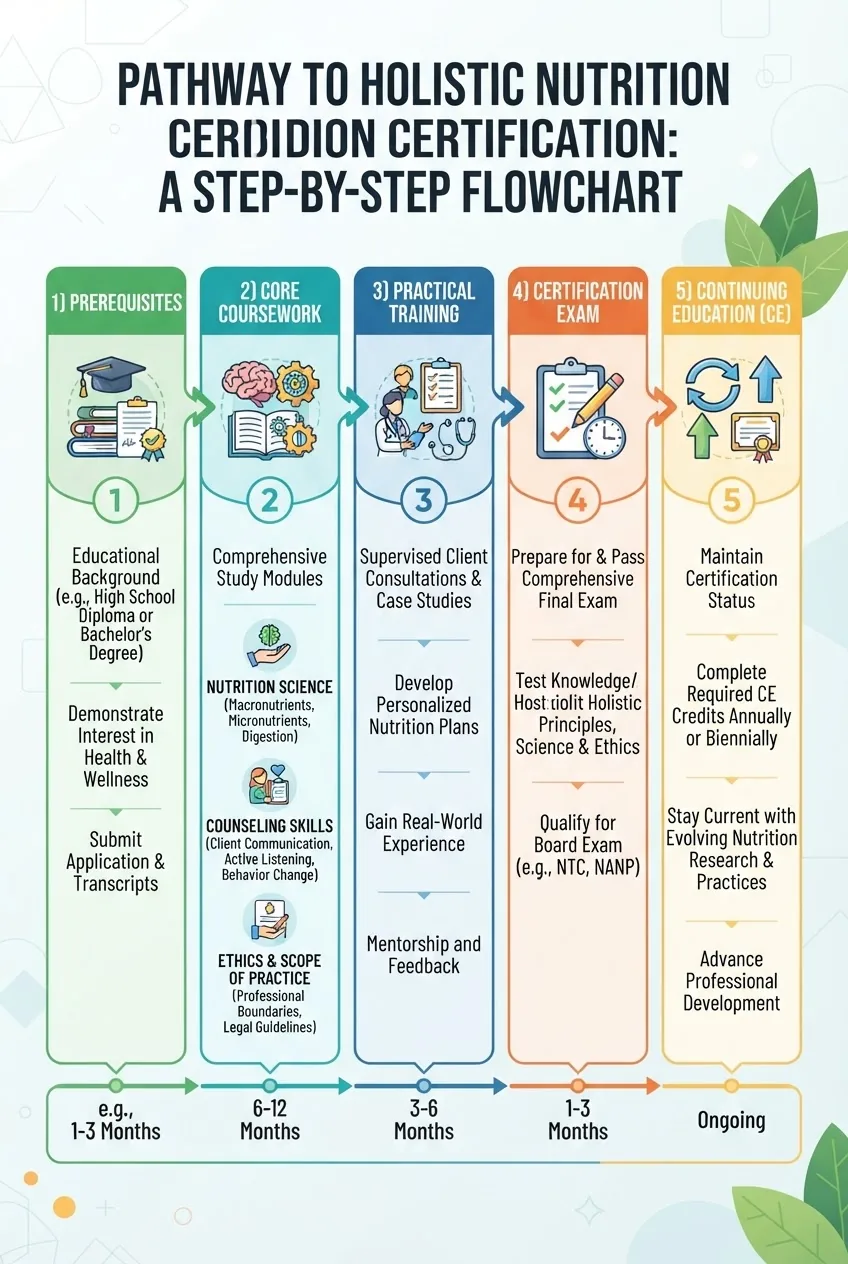
- Prerequisites — entry requirements often include a high-school diploma or prior health studies, and some advanced programs ask for undergraduate science credits.
- Core Coursework — foundational nutrition science (macro/micronutrients, digestion), integrative and functional nutrition, counselling skills, special-population nutrition and clinical reasoning.
- Practicum and supervised training — case studies, clinical placements or mentorship hours where students apply assessment frameworks and develop client plans under supervision.
- Assessment and certification — written exams, capstone projects or case portfolios that demonstrate competence in assessment, plan design and counselling.
- Continuing education — periodic CE requirements, ethics refreshers and specialty modules (e.g., maternal nutrition, mental health nutrition) to maintain credentialing.
Typical program durations vary from several months for certificate-level pathways to one- or two-year diploma courses; some institutions offer postgraduate-level nutrition degrees where statutory scope differs. Popular education providers include integrative and natural-nutrition schools as well as online offerings such as Institute for Integrative Nutrition (IIN), accredited diploma providers and university-affiliated programs.
Compare with health coaching paths: for readers weighing options, also review the online health coach certification.
For program-specific listings and degree options, see the guide to holistic nutritionist certification and programs.
Key Components of Holistic Nutrition Certification Programs
- Course modules — evidence-based nutrition science, lifecycle nutrition, pathology-linked nutrition and public-health frameworks.
- Practical training — supervised client hours, simulated cases and clinical placements that emphasise intake-to-outcome workflows.
- Clinical case studies — real-world problem-solving using the Whole Person Approach and integrative health models applied to chronic conditions.
- Ethics and scope — clear boundaries between nutrition counselling and medical practice, informed consent, record-keeping and referral protocols.
- Counselling skills — motivational interviewing, behaviour-change models, goal-setting and relapse prevention strategies.
- Foundations in lab literacy — interpreting common biomarkers (e.g., HbA1c, ferritin, vitamin D) and when to refer for medical investigation.
- Assessment tools — validated intake forms, food-frequency and 24-hour recall methods, symptom mapping and lifestyle inventories used by practitioners.
How to Choose the Right Certification Program
Answer: Choose a program based on accreditation, curriculum balance (science + counselling + practicum), program length, costs, delivery mode and recognised professional affiliations that match your intended scope of practice.
Use this comparison table to evaluate options:
| Factor | Pros | Cons |
|---|---|---|
| Accreditation / Recognition | Higher credibility, better referral networks | May limit alternative curriculum innovations |
| Program Length | Longer programs offer depth and practicum | Longer time and cost commitment |
| Costs & Fees | Investment in career; scholarships may exist | High fees for some accredited programs |
| Online vs In-person | Online: flexible; In-person: hands-on practice | Online may limit supervised clinical hours |
| Clinical Practicum | Essential for confidence and referrals | Harder to arrange in fully remote programs |
Practical selection checklist:
- Confirm accreditation or recognised professional affiliation.
- Review core curriculum for balanced science and counselling modules.
- Check practicum hours and supervisory arrangements.
- Compare costs including exam and membership fees.
- Contact alumni or read verified reviews about post-certification outcomes.
Transition: Once certified, the core counseling principles guide how you work with clients; the following section details those practices and offers an applied case study.
What are the principles and practices of holistic nutrition counseling?
Answer: Holistic nutrition counseling is client-centred, integrative and evidence-informed, combining motivational interviewing, personalised nutrition plans and outcome tracking to create sustainable health changes.

Term: holistic nutrition counseling — therapeutic conversations and interventions that use nutrition, behaviour-change techniques and lifestyle prescriptions to improve whole-person health.
Core counseling principles:
- Client-centred care: start with the client’s values, readiness and context rather than imposing prescriptive diets.
- Integrative plans: combine dietary recommendations with sleep, movement and stress-management strategies.
- Evidence-informed practice: apply current nutritional science and reference standards like national dietary guidelines where applicable.
- Motivational interviewing: use open questions, reflective listening and autonomy-support to elicit behaviour change.
- Iterative testing: monitor outcomes with validated metrics and modify plans responsively.
Real-world example: A 42-year-old client with metabolic syndrome worked with a certified holistic nutritionist who used a stepwise strategy—baseline labs, a Mediterranean-style whole-food meal plan, progressive exercise goals, sleep hygiene, and biweekly coaching. Over six months the client reduced HbA1c, lost weight and reported improved mood, tracked by validated scales.
Case study (detailed experience):
Client: “M”, 42, prediabetes, high stress, inconsistent sleep.
Intake & assessment tools used: 3-day food record, Perceived Stress Scale, sleep diary, baseline HbA1c and fasting lipids; intake framework taught in certification programs: symptom mapping + lifestyle matrix.
Intervention: tailored Mediterranean-style plan emphasizing legumes, vegetables, oily fish; guided meal prep; progressive walking plan; cognitive-behavioural elements addressing night eating.
Outcome: After 16 weeks M reduced HbA1c by 0.4%, improved energy and stabilised weight; continued long-term maintenance plans were developed with quarterly reviews.
Counseling methods include structured behaviour-change models (e.g., SMART goals, stages of change), regular outcome tracking using validated instruments and collaborative problem-solving to reduce barriers like time, budget or food access.
Evidence signals: A 2022 study published in Nutrients shows that whole-food, pattern-based interventions can improve mood and metabolic markers compared with standard advice.
Transition: The next section gives a clear step-by-step of what clients should expect during a counseling session.
What are the steps in a holistic nutrition counseling session?
Answer: Sessions follow a repeatable process: intake and data gathering, collaborative goal-setting, personalised plan creation, implementation support and outcome tracking with follow-up adjustments.
- Client intake — collect medical history, medications, food records, lifestyle and goals; obtain informed consent and identify red flags for referral.
- Lifestyle evaluation — assess sleep, stress, movement, social supports and environment using validated questionnaires and interviews.
- Personalised plan — co-create a nutrition and lifestyle plan with measurable, client-driven goals and an implementation timeline.
- Implementation & support — deliver tools: recipes, shopping lists, meal templates and brief coaching between sessions as needed.
- Follow-up & outcome tracking — measure progress with repeat labs, symptom tracking, and validated scales; adapt the plan and problem-solve barriers.
Documentation and safety: practitioners keep structured client notes, monitor for adverse effects and refer promptly if symptoms indicate medical care is needed.
Transition: Measurable benefits are a major reason clients choose holistic nutrition counseling; the next section reviews outcomes and the evidence supporting them.
What benefits and outcomes can clients expect from exclusive holistic nutrition counseling?
Answer: Clients commonly experience improved energy, better metabolic markers, symptom reduction in chronic conditions and enhanced mental well-being when nutrition plans are personalised and combined with lifestyle changes.
Documented benefits include:
- Improvements in glycaemic control and lipid profiles in metabolic conditions when dietary patterns and lifestyle are addressed.
- Reduced symptom burden in GI disorders via targeted elimination/reintroduction protocols and lifestyle adjustments.
- Enhanced mood and cognitive clarity linked to whole-food dietary patterns and reduced inflammation.
According to a 2024 industry report, many clients report measurable lifestyle improvements (e.g., sleep, energy) within 8–12 weeks under structured holistic programs; measurement methods vary by program. A 2022 study published in peer-reviewed journals indicates dietary pattern interventions can yield clinically meaningful mood and metabolic improvements.
Case evidence: The earlier case study of “M” shows how combined dietary and lifestyle changes can reduce HbA1c and increase energy. These outcomes are typical when programmes include assessment, coaching and consistent follow-up.
For more on broader medical context and benefits beyond nutrition see the site article on health advantages of holistic medicine.
Nutrition also plays a role in mental health care; see the piece on the holistic approach to mental health for interplay between diet and mental health interventions.
Transition: Certification opens career options and pathways for ongoing development; the final section outlines these opportunities and professional growth options.
What career paths and continuing education exist in exclusive holistic nutrition?
Answer: Career options include private-practice holistic nutritionist, integrative clinic practitioner, corporate wellness consultant, educator and specialised clinician roles; continuing education and networking strengthen clinical competency and referral pathways.
Common career options:
- Private practice holistic nutritionist or integrative nutrition consultant
- Clinician in integrative medicine or wellness centres
- Corporate wellness or workplace nutrition specialist
- Educator, curriculum developer or public-health advocate
- Specialist roles: maternal-child nutrition, sports nutrition within holistic frameworks
Ongoing professional development options:
- Advanced certifications in functional nutrition, integrative health coaching or clinical specialties
- Supervision and mentorship programs to increase clinical confidence and liability protection
- Professional association membership for standards, liability insurance and continuing education
- Workshops, conferences and peer networks to maintain currency with new evidence
For readers seeking professionals whose services might be covered by insurance, explore the guide to alternative practitioners with insurance.
If you’re considering adjacent roles, training in holistic wellness coach training may complement your nutrition credential.
Transition: Below is a concise summary and next steps if you’re ready to pursue training or book an appointment.
Conclusion
Exclusive holistic nutrition combines whole-person assessment, evidence-informed diet strategies and client-centred counseling to produce measurable health improvements. Certification ensures competency across science, counseling and practicum; counseling applies iterative, personalised plans. If you want to train, compare accreditation, practicum and curriculum; if you seek care, expect a detailed intake, tailored plan and outcome tracking.
Next steps: review accredited programs, speak to alumni, and schedule an initial consultation with a certified practitioner to experience the intake process firsthand.