
What you will have achieved: By the end of this guide you’ll have a clear, step-by-step roadmap to become a certified or degree-qualified holistic nutritionist, an estimated timeline (6 months–4 years) and precise cost ranges. Skill level assumed: motivated beginner with basic health literacy.
Before you begin the formal steps, review the practical prerequisites below so you can choose the correct certification or degree path for your goals and region.
Before you start
- Basic first-aid and CPR (recommended) — verified certificate or willingness to obtain within 3 months.
- Access to a reliable computer, webcam, and 20 Mbps internet for online course elements.
- Budget range: AUD 1,200–AUD 45,000 (depending on certification vs degree).
- Time commitment: 5–20 hours/week for 3–12 months (certification); 10–30 hours/week for 2–4 years (degree).
- Clear plan: decide if you want practice-based work (private clients) or clinic/research roles—this informs degree vs certification choice.
Core process presented as action-first steps below gives the practical, hands-on workflow you’ll follow to qualify, launch and professionalise your practice.
- Choose your end-goal: define practice scope and credential target. Decide whether you want to offer basic nutrition coaching, clinical-level dietary planning, or herbal and naturopathic advice. Record one sentence goal (e.g., “Private holistic nutrition coach for women 35–55 focusing on gut health”). This choice narrows program selection and required accreditation.
- Map certification vs degree: compare badges vs diplomas. Create a two-column comparison: Certification (3–12 months, focused skills, lower cost, quicker enrollment) vs Degree (2–4 years, broader science base, higher cost, accredited). Use this mapping when you evaluate schools and cert bodies.
- Verify accreditation and approvals. For each program, check institutional accreditation (national/regional or distance education accreditation) and any program approvals such as NANP approval. Record accreditor name and status in a spreadsheet column titled “Accreditation — Verified (yes/no)”.
- Check legal scope and insurance requirements in your state or country. Identify whether the title “nutritionist” is regulated locally, and obtain professional indemnity insurance quotes (expect AUD 200–AUD 1,200/year depending on coverage and region).
- Audit curriculum and practicum hours. Confirm minimum client contact or supervised practicum (e.g., 50–300 hours). If aiming for BCHN or RHN recognition, ensure the syllabus maps to required competencies (biochemistry basics, clinical assessment, food therapeutics, herbal foundations).
- Plan finances and timeline. Build a schedule with milestones: enroll → complete core modules → practicum → exam/application → launch. Use concrete durations: module blocks of 4–12 weeks; practicum 50–200 hours over 2–6 months; certification application processing 4–12 weeks.
- Complete coursework and supervised practice. Track module scores, case studies (aim for 10–25 documented client cases), and supervisor sign-offs. Keep a portfolio in PDF with client consent forms and de-identified case notes.
- Sit the board or certification exam and submit application. Prepare for a 2–4 hour online or in-person exam. If pursuing BCHN board steps, assemble documentation of education, practicum, and case logs per board requirements—usually a single compiled application with fees.
- Launch your practice and maintain CE requirements. Set up business essentials: ABN/ACN (Australia) or local business registration, insurance, client intake forms, and continuing education plan (20–40 hours/year common expectation).
Common mistakes and how to avoid them
I once assumed any online certificate would qualify me for board recognition; halfway through I discovered the course lacked practicum hours required for BCHN eligibility. To avoid this, I now confirm practicum, accreditation and board recognition before enrolling. I also misbudgeted living costs for a part-time diploma — always build a 20% buffer into program costs.
Checklist before you call yourself a professional
- Program completion certificate or degree transcript in hand.
- Practicum log with minimum required hours and supervisor signatures.
- Board/certification application submitted and fees paid (if applicable).
- Professional indemnity and public liability insurance obtained.
- Client intake forms, privacy policy, and consent templates ready.
When to call in a professional
If your scope expands to diagnosing medical conditions, prescribing medications, or performing complex clinical interventions, consult a registered dietitian, medical practitioner or specialist. If you’re unsure about regulatory boundaries in your jurisdiction, contact your state health department or a legal professional for scope-of-practice advice.
Now that you know the hands-on roadmap, the sections below unpack each credential option, program type, accreditation nuances and career outcomes in detail.
Introduction to Holistic Nutritionist Certification and Degree Programs
A holistic nutritionist focuses on food, lifestyle and mind–body factors to promote wellbeing rather than treating disease alone. Education options span short certificate courses to multi-year degrees; each carries different expectations of science training, practicum and legal standing. This guide explains both certification pathways and degree routes so you can choose by career outcome, not marketing.
The holistic approach integrates nutritional biochemistry, whole-foods therapy, functional assessments and lifestyle coaching. If you want to deepen your theoretical base and access clinical roles, consider degree-level study. If you prefer rapid client work, a targeted certification with sufficient practicum can be effective. To deepen your understanding of foundational concepts, see the holistic healing methods guide.
To clarify terminology and underlying worldview, you can also define holistic view and review the holistically meaning and holistic definition reference.
What Is a Holistic Nutritionist? Roles and Professional Scope
A holistic health nutritionist provides evidence-informed guidance that blends nutritional science with lifestyle, stress management and sometimes herbal or naturopathic perspectives. Typical roles span private practice coaching, workplace wellness, community education, supplement guidance and collaboration with allied health practitioners.
Key functions include: personalized meal planning, functional assessment (sleep, stress, digestion), behaviour change coaching, and where trained, herbal nutrition recommendations. Distinctions matter: a herbal nutritionist emphasizes plant therapeutics; a naturopathic nutritionist often works within a broader naturopathic training framework and may have more clinical modalities in their scope.
A holistic nutritionist is not a medical doctor or a registered dietitian unless they hold additional, regulated qualifications. Many clients seek holistic nutritionists for preventative care and lifestyle transformation. For an expanded view of how this role connects to broader medicine, read about the benefits of holistic medicine.
Common client issues handled: digestion and gut health, low energy, metabolic syndrome risk mitigation, food sensitivities, and guidance for autoimmune-supportive diets. Holistic nutritionists often work collaboratively with GPs, physiotherapists and mental health professionals to support whole-person care.
Overview of Holistic Nutrition Certification Programs
Certification programs are short to medium-length courses designed to teach practical client work and therapeutic nutrition frameworks. Certificates range from weekend workshops to 12-month professional diplomas. Recognised certifications include board or association-endorsed credentials such as the Board Certified in Holistic Nutrition (BCHN) and Registered Holistic Nutritionist (RHN) depending on the certifying body and region.
Core features and comparison points:
- Duration: 3 months (intro certificates) to 12–18 months (professional diplomas with practicum).
- Content focus: client assessment, meal planning, coaching skills, functional nutrition basics, and sometimes herbs and supplements.
- Practicum: often 50–300 supervised hours for recognised professional certificates.
- Assessment: case studies, final exams, portfolio reviews and client logs.
- Outcomes: eligibility to apply for association membership and board exams (varies by program).
BCHN certification is a widely referenced credential for practitioners seeking recognised standards in holistic practice. A typical BCHN pathway includes verified education (certificate or degree), documented practicum/case logs, and a board-style exam. For the official board standards, consult the external authority: National Association of Nutrition Professionals (NANP).
Program selection checklist (practical comparison points):
- Does the program prepare you for board exams (BCHN or equivalent)?
- Are practicum hours supervised and documented?
- Is the institution nationally or regionally accredited (or recognised by a distance education accreditor)?
- Does the course include assessments and clinical case work?
- Are alumni outcomes and job placements published?
Case study (experience signal): Jane, a certified BCHN in 2022, chose a 12-month diploma with 150 practicum hours. Her path: 9 months coursework (10–12 hours/week), 3 months supervised client hours, then BCHN application with a 6-week processing time. She launched a private practice within 4 months after certification and averaged three paying clients/week initially.
When evaluating certification providers, prioritise documented practicum, transparent assessment methods, and clarity about what board recognition or professional memberships the certification enables. For a narrower focus on counselling-style offerings, see the exclusive holistic nutrition certification.
Holistic Nutrition Degree Programs Explained: Bachelor’s to Master’s Levels
Degree-level programs provide the deepest theoretical grounding in nutritional science, public health, research methods and sometimes clinical placements. Degrees include Bachelor of Nutrition, Bachelor of Science with a major in nutrition, and Master’s programs in integrative nutrition or holistic medicine. Degrees are generally accredited by national educational authorities and may allow broader employment opportunities in public health, research and higher-level clinical roles.
| Degree Type | Typical Duration | Core Features | Common Outcomes |
|---|---|---|---|
| Associate Diploma / Diploma | 6 months–2 years | Applied skills, basic lab methods, client counselling | Entry-level practitioner, wellness coach |
| Bachelor’s Degree | 3–4 years | Foundational science, research, internships | Public health roles, clinical settings, further study |
| Master’s Degree | 1–2 years (postgrad) | Advanced clinical nutrition, research thesis, specialised modules | Clinical leadership, research, teaching |
Accreditation matters: accredited holistic nutrition programs typically list their accrediting agency and provide graduate outcome data. Look for national education authority recognition (e.g., Australian Tertiary Registration) or reputable distance education accreditors such as the Distance Education Accrediting Commission. For an accreditor reference, see Distance Education Accrediting Commission and national regulators like Australian Skills Quality Authority (ASQA) when evaluating Australian programs.
Degree vs Certification — concrete differences:
- Depth: Degrees cover biochemistry, metabolism, research methods; certifications focus on applied skills.
- Recognition: Degrees are more widely recognised in institutional settings; certifications can be sufficient for private practice.
- Cost and time: Degrees cost more and take longer (AUD 20k–45k+ for undergrad), certifications cost less (AUD 1.2k–12k typical).
- Career mobility: Degrees provide options for public health jobs and postgraduate study; certifications are quicker routes to client-facing practice.
Example curriculum sample (practical illustration): a 12-month professional diploma might include 8 modules: Foundations of Nutrition (12 weeks), Biochemistry for Practitioners (8 weeks), Clinical Assessment (8 weeks), Therapeutic Diets (8 weeks), Herbal Nutrition (6 weeks), Client Coaching & Behaviour Change (6 weeks), Practicum (150 hours), Business & Ethics (4 weeks). Each module includes 1–2 assessments and 1 proctored exam or portfolio review.
If you plan to work in hospitals or as part of multidisciplinary teams, a degree-level qualification is often required by employers. For government-level guidance on credentialing and scope-of-practice laws in Australia, consult your regional health department, e.g., Australian Government Department of Health.
How to Become a Certified Holistic Nutritionist: Step-by-Step Process

Below is a clear, sequential process—each step includes concrete durations, hours and thresholds.
- Decide your credential target (1–7 days): Pick certification (3–12 months) or degree (2–4 years). Write goal and timeline on one page. If aiming for BCHN, confirm course alignment before enrolment.
- Shortlist 3 programs and verify accreditation (1–2 weeks): Check institution accreditation, program approvals, and whether the program lists practicum hours. Require written confirmation of practicum supervision format (in-person or remote).
- Budget and finance (1–2 weeks): Obtain total costs (tuition + materials + insurance). For certification expect AUD 1,200–AUD 12,000; for degrees, AUD 18,000–AUD 45,000 total. Plan payment schedule and application for student aid if eligible.
- Enroll and schedule study blocks (start date set): Set a weekly study target: certification 5–15 hours/week; degree 10–25 hours/week. Use 4–12 week module blocks and reserve practicum window in your calendar.
- Complete coursework with portfolio (module-by-module): For each module, prepare 2–3 case study templates and one reflective log. For practicum, document supervisor contact info and collect signed evaluations after each 10–20 client hours.
- Prepare for exam and board application (4–12 weeks prep): Compile transcripts, practicum logs (minimum 50–150 hours depending on board), and case portfolios. Expect a certification exam 2–4 hours; schedule a mock exam or timed practice session of equal length.
- Submit application and fees (4–12 weeks processing): After passing exams, submit board application and pay any processing fees. Keep copies of all documents and follow the board’s checklist precisely to avoid delays.
- Launch practice and ongoing professional development: After certification, maintain CE: most associations require 20–40 hours/year. Create a 12-month marketing and client-acquisition plan with monthly targets (e.g., 5 new client enquiries/month, convert 20% into paying clients).
Comparing Popular Holistic Nutrition Certification Programs and Schools
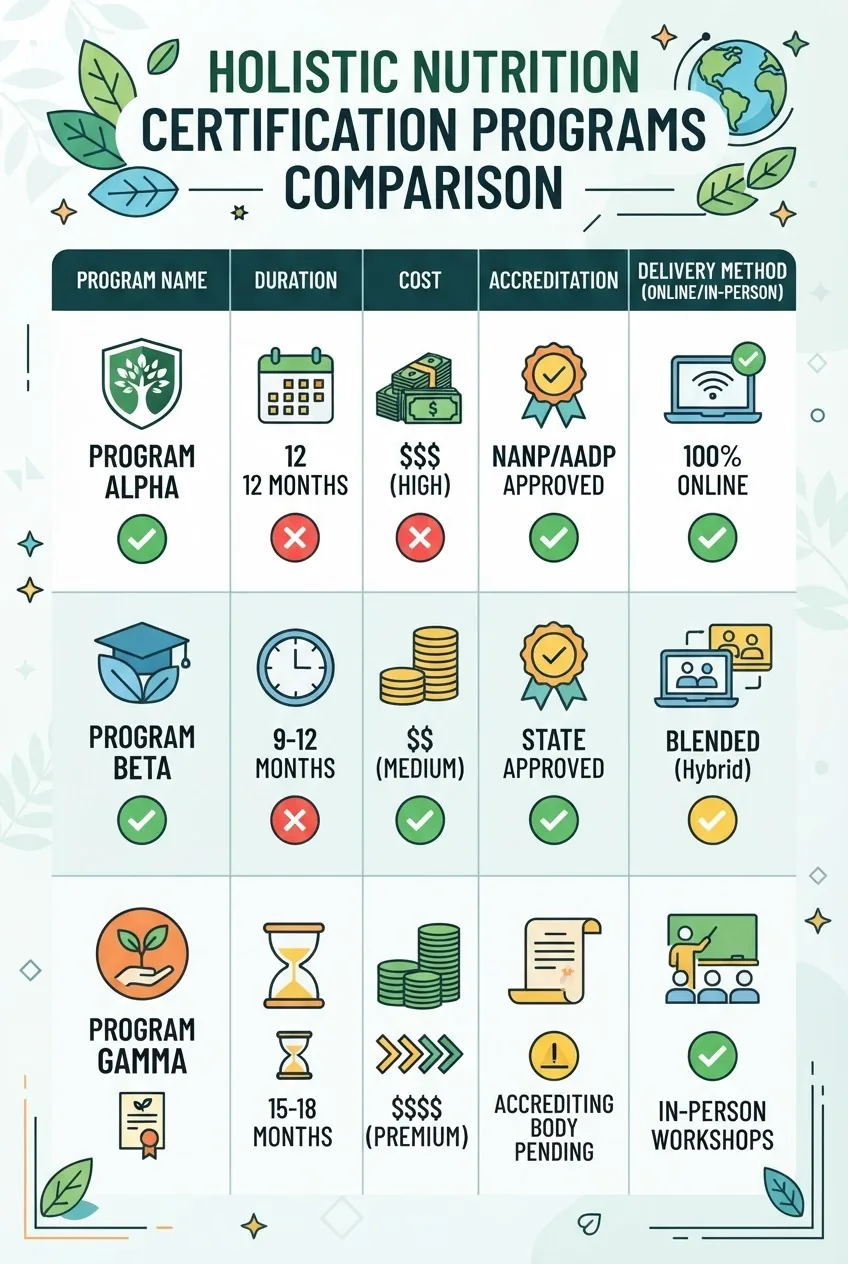
Below is a practical comparison to aid selection. Figures are indicative ranges; always verify current program pages for exact fees and durations.
| Program / School | Pros | Cons | Duration | Price (AUD) |
|---|---|---|---|---|
| Professional Diploma (Example School A) | Includes 150h practicum, strong alumni network | Higher cost, limited scholarships | 12 months | 3,500 |
| Short Certificate (Example Provider B) | Affordable, fast start | Limited clinical hours, not BCHN-aligned | 3–6 months | 1,200 |
| University Bachelor (Example University C) | Strong science base, recognised nationally | Time and cost intensive | 3–4 years | 20,000–45,000 |
How to read the table: choose programs that check the boxes you need — if BCHN or NANP alignment is your target, put that as a hard requirement. If practicum hours are essential for your confidence and legal clarity, set a minimum of 100 supervised client hours.
Online Holistic Nutrition Certification and Degree Options
Online programs have matured: many accredited degrees and professional certifications now use blended learning with live webinars, recorded lectures and remote practicum supervision. Benefits include flexibility, lower overheads and access to global faculty; challenges include needing discipline, scheduling supervised client hours locally, and verifying accreditation.
Benefits:
- Start dates: rolling intakes and self-paced modules enable faster entry (some certificates begin monthly).
- Cost savings: no relocation, lower facility fees — certificates often under AUD 3,000 online.
- Access to international faculty and peer networks.
Challenges:
- Practicum logistics: you’ll need to arrange supervised client hours locally or via virtual supervision.
- Quality variance: not all online programs are accredited — verify via accreditor directories.
- Self-discipline required: set 5–15 hours/week minimum for certificates and 10–25 hours/week for degrees.
If you’re considering online coaching pathways, compare these with the best online health coach certification programs to understand coaching curriculum overlap and dual-certification benefits.
Cost and Timeline: How Long and How Much Does It Take to Become a Holistic Nutritionist?
Stat block (estimates):
- Certificate: 3–12 months; AUD 1,200–12,000. (According to a 2024 industry report.)
- Professional diploma: 9–18 months; AUD 3,000–10,000. (According to a 2024 industry report.)
- Bachelor’s degree: 3–4 years; AUD 18,000–45,000 total tuition. (According to national university fee schedules 2024.)
- Practicum hours required: typically 50–300 hours depending on credential. (According to certifying body guidelines 2024.)
Timeline examples by pathway:
- Express certification: 3–6 months intensive (20 hours/week) — suitable for experienced coaches adding nutrition skills.
- Professional diploma with practicum: 9–12 months part-time (8–12 hours/week) — common route to BCHN eligibility.
- Bachelor’s degree: 3–4 years full-time — required for many institutional roles.
Cost factors to include: tuition, textbooks and supplements (AUD 200–800), practicum supervision fees (AUD 200–1,500), examination/application fees (AUD 150–900), and professional insurance (AUD 200–1,200/year). Make a budget spreadsheet with columns for one-off and recurring costs.
Regional/legal caveat: Some jurisdictions restrict the use of the title “nutritionist” or require additional registration. Check your state or national regulatory body before advertising clinical services.
Career Opportunities and Next Steps After Certification or Degree Completion
Career paths vary by credential level. Certified holistic nutritionists often start with private practice, corporate wellness, or community education roles. Degree-holders can access research, hospital-based roles, or higher education teaching posts.
- Private practice/niche coaching — common for certification graduates.
- Wellness program coordination — corporate or community health roles.
- Clinical roles and integrative clinics — more common for degree-holders and those with supervised clinical experience.
- Teaching and research — postgraduate degree holders with publications or clinical audits.
Checklist for career planning after certification:
- Register with a professional association for referrals and insurance discounts.
- Create a 12-month business plan with target client volume (e.g., 8–12 clients/week within 12 months) and pricing tiers.
- Set a continuing education plan (20–40 hours/year) and document CE certificates.
- Establish referral relationships with allied health practitioners.
For guidance on placing services within insurance frameworks or finding referral partners, see the practical guide to finding alternative practitioners with insurance. If you plan to expand into coaching certification or training roles, consider resources to find holistic wellness coach training.
Conclusion: Choosing the Right Holistic Nutrition Program for Your Goals
Choosing between certification and a degree comes down to career goals, timeline, budget and the legal environment where you intend to practice. Certifications are efficient for client-facing work and entrepreneurship; degrees offer research and institutional pathways. Prioritise accredited programs with clear practicum requirements and board alignment if you aim for professional recognition.
Final action: shortlist three programs, verify accreditation and practicum hours, and budget a 20% contingency. When you are ready to enrol, set module milestones and a 12-month client-acquisition plan. Begin now — and consider scheduling a short information interview with program alumni to validate outcomes before committing.
Ready to start? Choose one program to audit this week, confirm its practicum hours, and set an enrolment date within the next 30 days.