

Homeopathy for asthma uses individualized, highly diluted remedies selected for matching a person’s symptom pattern and subtle-energy profile to help reduce wheeze, cough and breathlessness while supporting overall resilience; remedies are chosen by similarity and adjusted over time alongside trigger management and conventional care.
Understanding Asthma and Its Symptoms
Answer: Asthma is a chronic respiratory condition marked by bronchial inflammation and reversible bronchospasm that causes wheezing, shortness of breath, chest tightness and cough; symptoms vary by trigger and severity and are managed through both symptom relief and long-term control strategies.
Term: Bronchospasm — a sudden constriction of the muscles in the walls of the bronchi that narrows airways and impedes breathing.
Asthma is fundamentally airway hyperresponsiveness plus inflammation. Common features include:
- Intermittent wheezing — high-pitched whistling on exhalation caused by narrowed airways.
- Shortness of breath — sensation of breathlessness or reduced airflow.
- Coughing — often worse at night or early morning, sometimes dry or productive.
- Chest tightness — perceived constriction often accompanying bronchospasm.
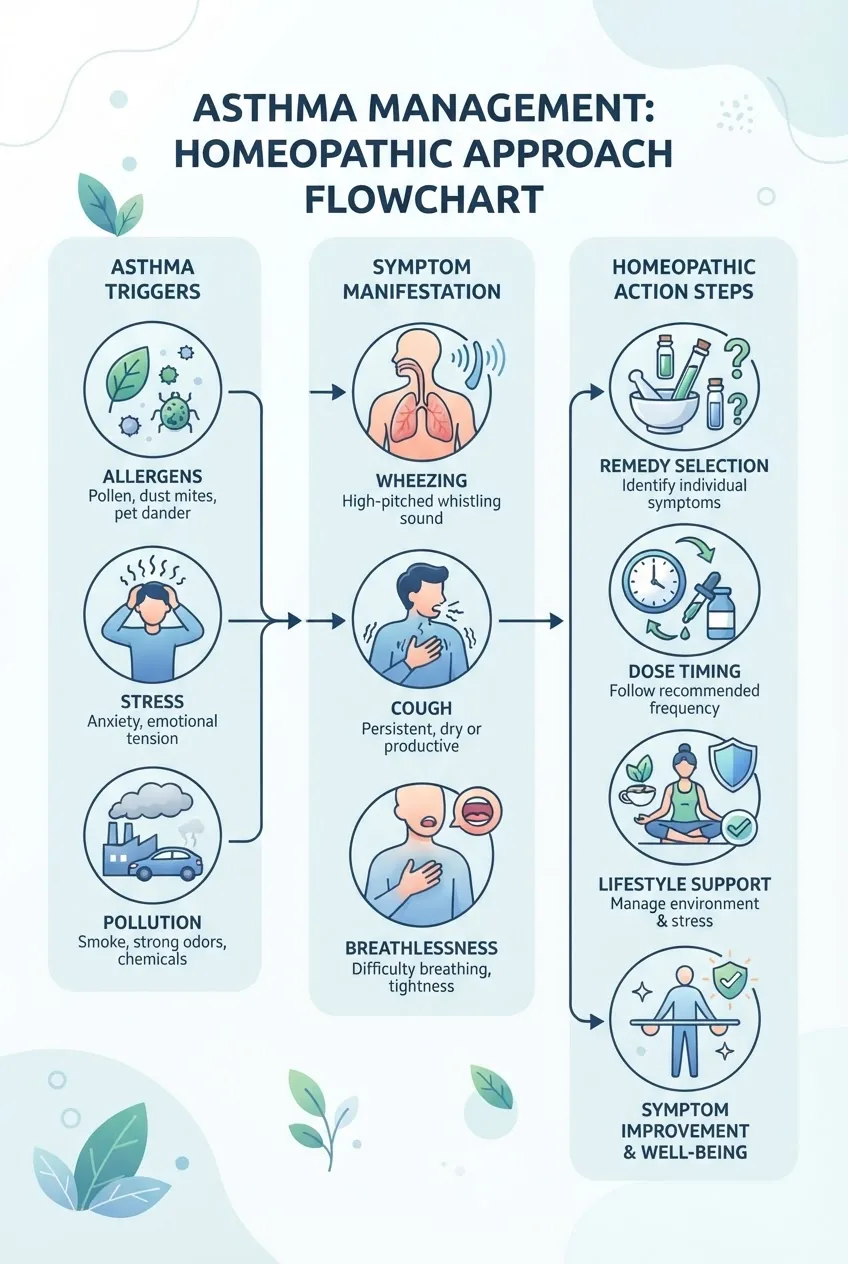
Triggers provoke bronchial inflammation or bronchospasm and commonly include inhaled allergens (pollen, dust mites, animal dander), irritants (tobacco smoke, pollution), respiratory infections, exercise, cold air, certain medications (aspirin/NSAIDs in sensitive individuals) and emotional stress.
Symptoms have acute and chronic patterns: acute exacerbations may rapidly progress to respiratory emergency, while chronic underlying inflammation increases baseline symptoms and exacerbation risk. According to a 2023 national asthma data report, exacerbation rates and emergency presentations remain significant in many populations, underlining the need for coordinated management strategies (source type: national data report).
In practical assessment, clinicians and homeopathic practitioners document symptom timing, triggers, sputum characteristics, positional effects (worse lying down or bending), and associated features such as anxiety or perspiration during attacks, because pattern details guide both conventional and homeopathic interventions.
Transition: Understanding these clinical patterns sets the foundation for how homeopathy selects and applies remedies, explained next.
Principles of Homeopathy in Asthma Treatment
Answer: Homeopathy treats asthma by matching a remedy that produces similar symptoms in healthy people (the law of similars) and administering it in potentized dilutions to stimulate the body’s healing vital force and restore balance rather than suppress symptoms alone.
Term: Law of similars — the homeopathic principle that “like cures like,” meaning a substance that causes certain symptoms in a healthy person can, when highly diluted, treat similar symptoms in a sick person.
Homeopathy approaches asthma through individualized case-taking and remedy selection based on the full symptom picture — respiratory signs and non-respiratory features (sleep, appetite, emotional state). Core concepts applied in asthma care include:
- Vital force: a homeopathic term for the organizing energy or self-regulating principle of the person; treatment aims to support this force.
- Law of similars: remedy choice relies on similarity between remedy provings and the patient’s symptom constellation.
- Dilution and potentization: remedies are diluted and succussed (potentized) to produce a chosen potency believed to carry therapeutic information.
- Individualized prescribing: two people with similar clinical asthma can receive different remedies depending on mental-emotional and physical symptom nuances.
- Holistic approach: attention to lifestyle, triggers, subtle-energy imbalances and constitutional tendencies alongside remedies.
Practical application in asthma includes careful initial evaluation, selection of a primary constitutional or acute remedy, and follow-up to adjust potency and dosing. Potentization is the process of serial dilution with vigorous shaking; Term: Potentization — preparing a homeopathic dilution by sequentially diluting and succussing a substance to create a chosen potency.
While homeopathy emphasizes non-suppressive, supportive care, it also recognizes acute pharmacologic interventions for emergencies. The roots of homeopathic methodology are described in classic texts and remain adapted by modern practitioners; see Dr Hahnemann’s foundational principles for a historical reference and context about individualized prescribing.
Clarifying scope helps patients choose therapies: compare differences between holistic and homeopathic medicine to understand how homeopathy’s remedy-focused system contrasts with broader holistic modalities.
Transition: With those principles in mind, the next section lists the specific remedies commonly used for asthma and how they map to symptom patterns.
Common Homeopathic Medicines for Asthma and Their Uses
Answer: Several well-documented homeopathic remedies — including Arsenicum album, Ipecacuanha, Antimonium tartaricum, and others — are traditionally used for distinct asthma symptom patterns; selection depends on wheeze quality, cough type, triggers, and concurrent emotional/constitutional signs.
Below is a practical, symptom-based list describing each remedy’s profile, typical indications in asthma, and common dosing approaches used by experienced homeopaths. This list is intended as a reference for discussion with a qualified practitioner and not as self-prescribing instructions.

For detailed information on purchasing these remedies, see our homeopathic medicine options.
| Remedy | Key symptom profile | Typical use cases & dosing notes |
|---|---|---|
| Arsenicum album | Rapid onset dyspnea, restless anxiety, burning chest, exhaustion, worse at night; often thin, anxious patients | Used for acute nocturnal asthma attacks with marked anxiety; low to medium potencies (30C) repeated hourly in severe acute episodes under practitioner guidance; observe response and taper. |
| Ipecacuanha (Ipecac) | Persistent, spasmodic cough with gagging or vomiting sensation, little expectoration, pallor | Helpful for paroxysmal cough and breathlessness with nausea; common acute potency 6C–30C, single dose and reassess; avoid frequent repetition unless advised. |
| Antimonium tartaricum | Severe rattling of mucus, difficulty expectorating, breathlessness with drowsiness or weakness | Used when chest is full of mucous and patient is weak; low to medium potencies (6C–200C) as directed by practitioner; monitor oxygenation if symptoms severe. |
| Natrum sulphuricum | Asthma worsens in damp weather, with cough and wheeze after exposure to dampness or sea air | Useful as chronic remedy for damp-related asthma; constitutional prescribing and medium potencies (30C–200C) on a spaced schedule. |
| Spongia tosta | Dry, croupy cough with inspiratory stridor, better with warm drinks, worse at night | Often used for bronchospasm with hoarse, barking cough and inspiratory difficulty; single doses of 30C during acute croupy episodes under supervision. |
| Aralia racemosa / Aralia quinquefolia | Asthma with rattling of mucus and a sense of weight on the chest, worse lying down | Selected for positional breathlessness and heavy chest; dosing individualized; often low potencies repeated until improvement. |
| Carbo vegetabilis | Air hunger, extreme weakness, desire to be fanned, belching, collapse-prone | Emergency supportive remedy in very weak, collapsed states with laboured breathing; used cautiously and always with medical oversight. |
| Belladonna | Sudden violent onset, hot skin, flushed face, throbbing headache accompanying bronchospasm | Short, intense attacks that come on suddenly; small, infrequent doses of low potency under practitioner direction. |
| Blatta orientalis | Asthma triggered by evening or night, with cough and mucous; may be related to damp or warm interiors | Used in chronic patterns with predictable nightly symptoms; prescribed constitutionally alongside environmental management. |
| Sambucus nigra | Episodes with inspiratory gasp, restlessness, sudden difficulty breathing when falling asleep | Useful for night-time gasping; acute 30C dose may be given once and reassessed; follow practitioner guidance. |
Dosing notes (general practitioner-guided framework):
- Begin with a single selected remedy (often 6C–30C for acute symptoms) and observe response for 24–72 hours.
- If partial improvement occurs, repeat sparingly (once every few hours to daily) under practitioner advice; if no change, reassess remedy selection rather than increasing frequency.
- For constitutional care, medium potencies (30C–200C) spaced weekly to monthly are commonly used to build resilience over time.
- Avoid concurrent self-medication with multiple remedies in acute severe episodes; always seek medical care for emergencies.
Selection is symptom- and person-specific. The step-by-step remedy selection process is discussed later as an E-E-A-T experience signal and practical workflow for clinicians and patients.
Transition: Remedy selection must align with trigger identification and lifestyle support to reduce episodes — the next section explains how homeopathy addresses triggers and symptoms.
How Homeopathy Addresses Asthma Triggers and Symptoms
Answer: Homeopathy addresses asthma triggers by tailoring remedies to the individual’s reaction patterns (allergen sensitivity, emotional triggers, pollution response) while recommending lifestyle, avoidance and subtle-energy balancing to reduce attack frequency and severity.
Term: Allergen response — the immune-mediated reaction that causes airway inflammation when exposed to a specific substance such as pollen or dust mite.
Homeopathic management of triggers follows a combined strategy:
- Precise trigger mapping through history and symptom diaries (time of day, location, activities, foods, weather).
- Acute remedy choice tailored to immediate symptom pattern (e.g., Ipecac for gagging cough, Spongia for barking cough).
- Constitutional remedy selection to modify chronic susceptibility and subtle-energy imbalance.
- Supportive lifestyle recommendations: allergen avoidance, indoor humidity control, stress reduction and breathing exercises.
How to identify personal triggers — a how-to approach:
- Keep a symptom-trigger diary for 4–8 weeks noting food, environment, activities and emotional state when symptoms occur.
- Look for patterns: seasonal flares suggest pollens; worse in damp suggests molds or Natrum sulphuricum tendency; exercise-only symptoms suggest exercise-induced bronchoconstriction.
- Share diary with both your homeopathic practitioner and medical provider to align environmental measures with safe pharmacologic plans (inhaler use, action plans).
Examples of integration in practice:
- A patient with pollen-triggered seasonal wheeze may use a constitutional remedy over months, acute Arsenicum album at night for sudden attacks, and implement pollen avoidance and nasal rinses.
- Someone whose asthma worsens with emotional stress might receive remedies that match anxiety-linked breathlessness and learn breathing retraining and stress-management techniques.
Subtle energies concept: homeopaths often assess a patient’s energetic pattern — e.g., sensitivity to temperature, emotional reactivity, and rhythm of symptoms — to select remedies that address both the respiratory complaint and the person’s broader vital force pattern, aiming for longer-term reduction in trigger sensitivity.
Transition: Recognizing benefits and limits is crucial — the following safety guidance outlines when conventional care is necessary and how to use homeopathy safely alongside it.
Safety Considerations and When to Seek Conventional Care
Answer: Homeopathy is generally low-risk when used appropriately, but any signs of respiratory emergency — severe breathlessness, cyanosis, rapid deterioration — require immediate conventional care; follow numbered safety guidelines and consult your doctor.
Be cautious and informed. Review potential side effects and safety for a fuller safety profile and contraindications before starting complementary treatment.
Numbered safety guidelines:
- Recognize emergency signs: severe, progressive breathlessness; inability to speak; bluish lips or face; collapsing or severe chest pain — call emergency services immediately.
- Use homeopathy as complementary care, not a replacement for prescribed inhalers, corticosteroids or emergency medications ordered by your physician.
- Always inform your prescribing medical practitioner when you start homeopathic remedies to ensure coordinated care and avoid confusion about symptom change.
- Avoid self-prescribing high-frequency doses of remedies during worsening breathlessness; consult a qualified homeopath or clinician.
- Regularly review your asthma action plan with a licensed healthcare professional; integrate homeopathy within that framework.
- Children, pregnant people, and those with severe or unstable asthma should consult both a homeopathic practitioner and their medical specialist before beginning any complementary treatments.
Evidence context and sources: systematic reviews of homeopathy for respiratory conditions report mixed results and limitations in trial quality; balanced summaries are available in peer-reviewed literature and public health guidance. For clinical guidance on asthma emergencies and long-term pharmacologic control, consult established resources such as the American Lung Association and national respiratory guidelines: American Lung Association asthma information and NHLBI asthma guidelines (source type: established medical organizations).
Transition: Clear coordination between homeopathy and conventional care optimizes safety and outcomes; the next section compares the approaches and offers practical integration steps.
Integrating Homeopathy with Conventional Asthma Treatments
Answer: Homeopathy can be integrated as a complementary layer to conventional asthma care—coordinate with prescribing clinicians, maintain controller medications as indicated, and use remedies for acute symptom patterns while monitoring objective markers like peak flow and oxygenation.
Understanding how homeopathy fits alongside mainstream pharmacology helps create balanced plans; read about allopathic medicine to see how conventional approaches differ and where they complement homeopathic care.
| Aspect | Conventional (Allopathic) | Homeopathic |
|---|---|---|
| Primary aim | Relieve bronchospasm, reduce inflammation, prevent exacerbations with inhalers and systemic drugs | Support vital force, reduce symptom sensitivity and address individual energetic pattern |
| Onset of effect | Rapid relief from bronchodilators; anti-inflammatory effect depends on medication | Often slower for constitutional effects; some acute remedies may provide rapid symptomatic relief in specific patterns |
| Evidence base | Strong evidence for inhaled corticosteroids and bronchodilators in control and prevention | Mixed evidence; systematic reviews note methodological limits; used as complementary therapy |
| Safety | Known side effects; monitoring required for systemic steroids and some drugs | Generally low toxicity; caution in substituting for emergency or essential pharmacologic therapy |
Practical integration steps (walkthrough):
- Share all current medications and action plan with both your homeopath and medical prescriber to avoid misunderstandings and ensure monitoring.
- Agree on objective outcome measures: symptom diaries, rescue inhaler usage, peak flow readings, and periodic review of lung function by a medical clinician.
- Use homeopathy for acute symptom patterns as an adjunct while maintaining controller medications (inhaled corticosteroids) unless instructed by the prescribing clinician to adjust therapy.
- Document changes and thresholds that would trigger re-escalation of conventional therapy or emergency care.
Authoritative guidelines: for evidence-based asthma management and when to escalate care consult national respiratory guidelines and patient resources — for example the American Lung Association and NHLBI — to align any complementary plan with recommended standards (source type: established medical organizations).
Transition: Choosing a qualified practitioner is essential for safe, individualized homeopathic asthma care; the next section explains how to find one.
Finding Qualified Homeopathic Practitioners for Asthma Care
Answer: Find a qualified homeopathic practitioner by verifying certification, clinical experience with respiratory cases, clear communication about treatment goals, and willingness to coordinate with your medical team; seek licensed or accredited professionals and check patient reviews and references.
Term: Professional certification — documented credentialing from an accredited homeopathic college or recognized regulatory body that indicates formal training and standards adherence.
How-to steps with tips:
- Identify credentials: look for practitioners who are registered with recognized national homeopathy associations or hold postgraduate training in homeopathic medicine.
- Ask about experience specifically with asthma and chronic respiratory conditions; request case summaries or anonymized outcome descriptions.
- Confirm scope of practice: does the practitioner work in integrative settings or coordinate with medical doctors? If you prefer medically-trained homeopaths, see our guide to qualified homeopathic medical doctors for standards and licensing expectations.
- Use local search resources and verified directories; begin with our find local homeopathic clinics guide to start consultations.
- Arrange a preliminary consultation to discuss your asthma history, current medications, and how the practitioner would integrate homeopathy with your existing asthma action plan.
- Check reviews and request references; ask about follow-up frequency, emergency procedures and how they handle worsening respiratory symptoms.
Regulation and safety: certification standards vary by country and region; ask about formal education, malpractice coverage and professional membership. Many practitioners will request collaboration with your primary medical physician for shared care and safety.
Transition: Patient experiences can illustrate common pathways and realistic expectations when combining homeopathy with asthma care.
Patient Experiences and Testimonials with Homeopathy for Asthma
Answer: Many patients report reduced attack frequency, improved tolerance to triggers, or better emotional coping after individualized homeopathic care, though outcomes are anecdotal and vary; testimonials can illustrate typical journeys without proving efficacy.
Below are anonymized, concise anecdotes that reflect reported experiences, intended to convey lived experience rather than clinical proof (experience signal included):
Case A (adult, seasonal): A 34-year-old with pollen-triggered wheeze reported fewer nocturnal attacks over two seasons after a constitutional remedy, local allergen control, and continued inhaled steroid use; observed reduced rescue inhaler use (anecdotal report).
Case B (child, exercise-induced): Parents described improved exercise tolerance in a 10-year-old after acute remedy support around activity and breathing retraining; child continued prescribed inhaler for prevention (anecdotal).
Case C (anxiety-linked asthma): A patient with stress-associated asthma reported fewer panic-driven attacks following remedies addressing anxiety combined with cognitive breathing techniques; medical therapy remained unchanged (anecdotal).
These testimonials highlight common themes: individualized remedy choice, integration with conventional meds, and lifestyle adjustments. For practical home-based measures that may complement homeopathic care, see helpful home remedy guides.
Transition: The final section summarizes key takeaways and invites informed next steps.
Conclusion: Homeopathy for asthma offers individualized remedy-based support that may reduce symptom frequency and empower trigger management when used alongside evidence-based conventional care; consult qualified practitioners, maintain prescribed inhaler regimens, and use objective monitoring. To begin, consult a registered homeopath, review your asthma action plan with your physician, and consider our resources on remedy sourcing and local clinics.
Start by reviewing our purchasing and clinic resources: homeopathic medicine options and explore local practitioners through our find local homeopathic clinics.