
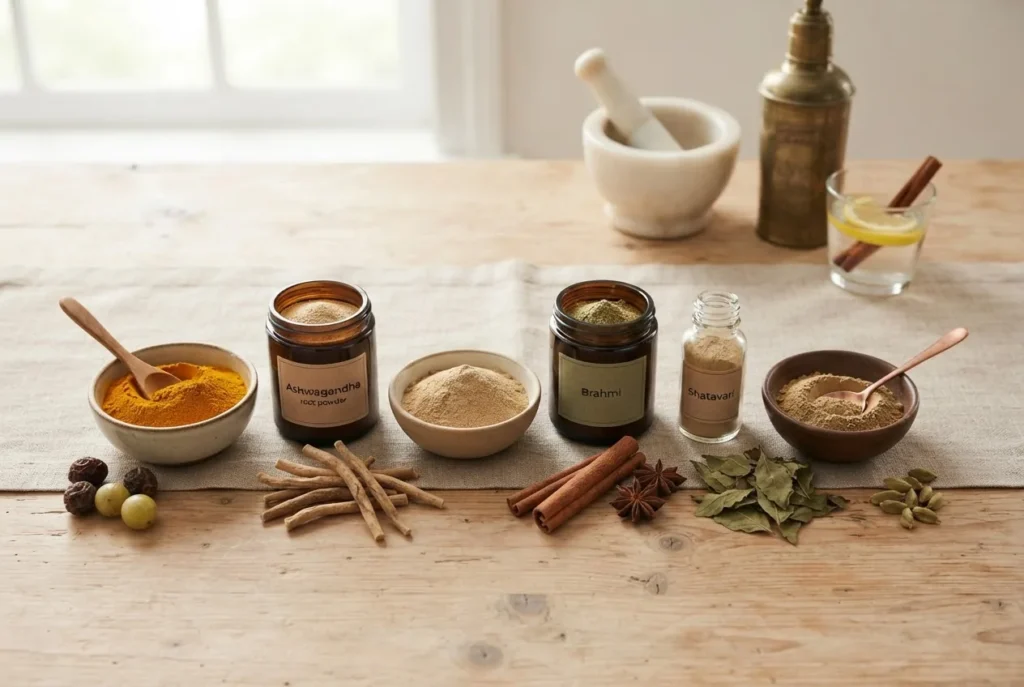
By the end of this hands-on guide you’ll be able to select, prepare, test and use high-quality ayurvedic herbs powder safely and incorporate them into daily supplements. Expect 3–6 hours of active work (drying and curing add passive time); the guide assumes beginner to intermediate kitchen and herbal skills.
Introduction to Ayurvedic Herbs Powder
This guide focuses on practical, repeatable methods for working with powdered herbs used in Ayurveda: sourcing, preparing, assessing quality, dosing and combining powders into herbal supplements. If you want foundational theory on the medical system behind these powders, see Ayurvedic supplements and herbal medicine. Below you’ll find explicit, hands-on steps and measurable thresholds so you can make informed choices and avoid common pitfalls.
Transition: First we identify the herbs most commonly sold and used as powders, so you can prioritise which to learn and try.
Common Ayurvedic Herbs Used in Powder Form
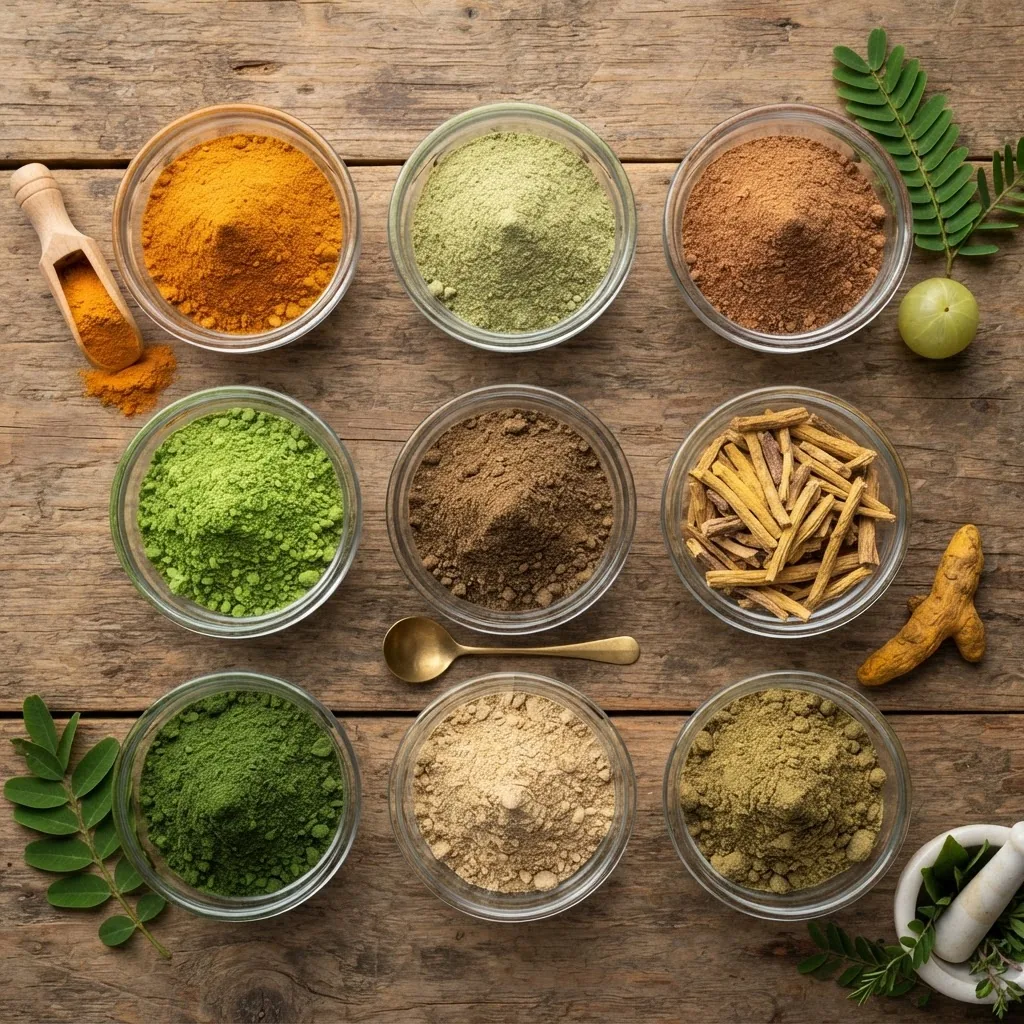
Below are 7 widely used powdered herbs, each described with properties, traditional and modern uses, typical dosage ranges and practical notes for beginners.
-
Ashwagandha (Withania somnifera)
Properties: Adaptogen, nervine, mildly warming. Common uses: stress resilience, sleep support, mild anabolic support. Typical powdered dose: 1–3 g daily; standardised extract equivalents vary. Practical tip: start at 500 mg daily and increase weekly while monitoring sleep and energy.
-
Turmeric / Curcumin (Curcuma longa)
Properties: Anti-inflammatory, antioxidant, pungent and warming when combined with black pepper (piperine) for bioavailability. Powdered dose: 1–3 g turmeric powder or 250–500 mg curcumin extract daily for targeted effects. Use with a fat source (e.g., milk or oil) to improve absorption.
-
Triphala (Amla, Haritaki, Bibhitaki)
Properties: Mild laxative, digestive support, tissue cleansing in Ayurveda. Typical powdered dose: 1–3 g at night for bowel regularity; smaller daily maintenance doses (500 mg–1 g) with warm water are common. Avoid high doses if diarrhoea or loose stools occur.
-
Brahmi (Bacopa monnieri)
Properties: Cognitive support, nervine tonic. Powdered dose: 300–1000 mg daily (leaf powder) or follow extract equivalence on product labels. Combine with warming spices (minor) if you tend to Vata imbalance.
-
Neem (Azadirachta indica)
Properties: Bitter, cooling, used topically and internally for detoxification and skin/immune support. Typical powdered dose for internal use is conservative: 250–500 mg daily; many practitioners prefer topical pastes for skin problems. Avoid prolonged high internal doses without supervision.
For topical hair uses, see Ayurvedic hair care herbs.
-
Licorice (Glycyrrhiza glabra)
Properties: Demulcent, adrenal support, anti-inflammatory. Powdered dose: 250–500 mg as part of formulas; do not exceed 2–4 g/day of whole root and avoid long-term high dosing if you have hypertension or low potassium.
-
Shatavari (Asparagus racemosus)
Properties: Rejuvenative for female reproductive system, cooling, nutritive. Powdered dose: 1–3 g daily mixed into milk or warm water. Often included in tonic blends; combine with practitioner guidance if pregnant.
For a more exhaustive selection including classic formulas and combinations, consult the complete herbal medicine list.
Transition: Having identified the common powders, we next group their benefits and how they fit into therapeutic categories—this helps when designing stacks or choosing a single herb.
Benefits and Therapeutic Properties of Ayurvedic Herbal Powders
Powdered herbs concentrate plant constituents in a dry, shelf-stable format that can be dosed, blended and transformed into teas, pastes and capsules. Below are grouped benefit categories with herbs that exemplify each effect.
Adaptogenic and Stress Resilience
Ashwagandha and licorice are classic adaptogens used to modulate stress response and support adrenal function. According to a 2023 clinical review published by a peer-reviewed journal, standardized root extracts of ashwagandha demonstrated reductions in stress biomarkers and improved sleep metrics in several trials. For targeted adaptogenic support, choose standardised extracts with documented withanolide content and follow dose ranges of 300–600 mg extract or 1–3 g root powder daily. peer-reviewed review on adaptogens
Anti-inflammatory and Joint Support
Turmeric powder and curcumin extracts are primary anti-inflammatory herbs; when paired with black pepper (piperine) and a dietary fat, absorption improves substantially. Clinical literature (2022–2024 reviews) shows curcumin reduces markers of inflammation in osteoarthritis and metabolic inflammation models. Use 500–2000 mg curcumin equivalents or 1–3 g turmeric powder combined with fat and piperine for symptomatic support.
Digestive & Detoxifying Actions
Triphala, ginger, and neem are used for digestion, gentle detoxification and maintaining bowel regularity. Triphala in powdered form at 1–3 g nightly promotes bowel tone and mucosal health. For deeper Panchakarma-style detoxification consult a trained practitioner—this connects to broader protocols like Ayurvedic detox and Panchakarma and retreat options such as Panchakarma Ayurvedic retreats.
Cognitive and Nervine Support
Brahmi (Bacopa) and gotu kola in powdered form support cognition and memory in traditional practice and have clinical support for improved memory indices in some trials. Typical brahmi powder dosing is 300–1000 mg/day; ensure product batch testing for purity.
General Wellness and Rejuvenation
Many powders—amla, shatavari, ashwagandha—are used as daily tonics. For holistic benefits and lifestyle integration, refer also to broader guidance on using herbs for systemic wellness like Ayurveda for wellness.
Transition: With benefits in mind, now learn how powders are produced so you can evaluate product labels and make your own powders with consistent quality.
Preparation and Production of Ayurvedic Herbs Powder
This section is the procedural core: a step-by-step, hands-on production workflow for making small batches of herbal powder and assessing commercial powders. If you want structured learning, consider formal training such as Ayurveda certification courses or Ayurvedic practitioner training.
Before you start:
- Scale (digital) accurate to 0.01 g
- Dehydrator or oven with thermostat capable of 35–50°C
- Mortar & pestle or stone grinder / spice grinder (high-speed)
- 50–200 mesh stainless steel sieve (for final micron sizing)
- Glass jars with airtight lids, tamper-evident seals and labels
- pH strips, moisture meter (optional), gloves and clean workspace
- Food-grade drying racks and breathable muslin for outdoor sun-drying (if used)
-
Identify and source botanical-grade raw material.
Action: Purchase whole dried plant parts from reputable suppliers or collect with proper identification. Quality thresholds: moisture content under 10% for roots and barks; herbs should be free from visible mould, foreign matter, or off-odours. For commercial products, request Certificates of Analysis (CoA) showing microbial limits, heavy metals and pesticide residues.
-
Clean and sort plant material.
Action: Remove stems, stones and extraneous material. Rinse delicate leaves if necessary and re-dry to <10% moisture—target 6–8% for long-term storage. Timing: allow 2–6 hours in a dehydrator at 35–40°C, or 6–24 hours depending on thickness.
-
Dry using controlled low heat to preserve constituents.
Action: Dry at 35–45°C for leaves and flowers; 40–50°C for roots and barks. Note: temperatures above 60°C degrade volatile oils and heat-sensitive actives. Measure moisture with a meter or perform a “snap test” for roots: properly dried roots snap rather than bend. Drying times: thin leaves 2–6 hours; thick roots 12–24 hours.
For deeper curriculum and samskara (processing) techniques, see Ayurvedic practitioner training.
-
Grind to target particle size.
Action: Use a low-speed grinder for brittle roots or a stone grinder for artisanal batches. Target particle fineness: 60–120 mesh (125–250 microns) for powders intended for tea and paste; 200–400 mesh (38–75 microns) for encapsulation and suspensions. Process in short bursts (5–10 seconds) and allow cool-down to prevent heat buildup.
-
Sieve and blend for uniformity.
Action: Sieve through the chosen mesh and regrind oversize material. For blended formulas, weigh components precisely (use mg/g accuracy) and mix in a tumbler or by folding technique for at least 5 minutes to ensure homogeneity. Label with batch number, date, botanical name, part used and mesh size.
-
Test purity and stability.
Action: For home batches, visual and smell inspection plus moisture checks are the minimum. For commercial assessment, require CoA covering microbial counts (total aerobic plate count <10^5 CFU/g), absence of E. coli/S. aureus, and heavy metal testing. Governmental standards and pharmacopeia give acceptance thresholds—see the regulatory resources below. Ministry of AYUSH
-
Package and store correctly.
Action: Use opaque, airtight glass jars or food-grade HDPE with desiccant packets for long-term storage. Storage conditions: cool (<25°C), dry (<60% relative humidity), away from light. Typical shelf life: 12–24 months depending on herb and moisture; record a best-before date based on moisture and sensory stability checks every 6 months.
-
Scale up safely for supplement production.
Action: When moving from kitchen batches to small commercial runs, implement standard operating procedures (SOPs) covering traceability, batch records, allergen declarations and third-party testing. Consider third-party labs for pesticide and heavy metal analysis. For formal practice or product sales, follow national pharmacopeia and training such as Ayurveda certification courses and local manufacturing regulations.
Transition: Once powders are prepared, correct dosing and safe use are essential—read the next section for practical dosing and safety steps.
How to Use Ayurvedic Herbs Powder Safely and Effectively
Follow these numbered, evidence-informed steps for dosing, combining powders and minimizing interactions. If you have chronic disease or are on medication, consult a clinician.
-
Start with small test doses.
Action: Perform a 3-day tolerance test at 250–500 mg daily for new powders, observing for GI upset, rash or changes in blood pressure. Increase gradually to therapeutic doses over 1–2 weeks.
-
Match herbs to your constitution (dosha) when possible.
Action: Use the basic dosha directions—cooling/clearing herbs for Pitta, warming/grounding herbs for Vata, light/drying herbs for Kapha—but always individualize. Consider a formal assessment via a dosha test guide to align selections.
-
Choose the right form: powder, capsule, tea or paste.
Action: Powders are flexible—mix into warm milk, ghee, oils or water depending on herb. Capsules are convenient for bitter or astringent herbs. For local applications (skin/hair), make pastes at 1:2 powder:liquid ratio. For absorption-sensitive herbs, take with a fat source (e.g., 1 teaspoon ghee or oil).
-
Observe timing and pairing rules.
Action: Take digestive aids (Triphala) at night; adaptogens (ashwagandha) with evening meals if sleep benefits desired. Check specific herb contra-indications and avoid mixing herbs that counteract each other’s energetics unless guided. For personalized combinations, visit Ayurveda wellness centers or consult an experienced clinician.
-
Dosage ranges to remember (practical thresholds).
Action: Roots & powders: 250 mg–3 g/day; potent extracts: 100–600 mg/day depending on standardisation. Do not exceed 3 g/day of most potent powders without professional supervision. For long-term tonic use (months), re-evaluate every 4–12 weeks.
-
Watch for interactions and side effects.
Action: Common interactions include anticoagulants with turmeric/ginger, licorice with antihypertensives, and immune-active herbs alongside immunosuppressants. If side effects occur (rash, nausea, dizziness), stop use and consult a clinician. Find a clinician via Find Ayurvedic doctor or refer to local integrated medicine services.
-
Adjust for dosha-specific guidance.
Action: For Kapha imbalance use lighter, drying herbs and lower doses; see Kapha dosha diet and health tips. For Pitta, avoid hot spices and strong stimulants; see Pitta Ayurveda diet guide. For Vata, favour warmed, grounding preparations; see Vata dosha diet and tips. For mixed constitutions, consult a practitioner and refer to Dosha types and herbal use.
Transition: Next, learn how to distinguish high-quality powders from adulterated or degraded products and how to store what you buy or make.
Quality, Sourcing, and Storage Tips for Ayurvedic Herbal Powders
Buying or producing safe, effective powders depends on supplier transparency and proper storage. Use this checklist when selecting products or judging your home batches.
Quality checklist for buying:
- Organic certification or audited supplier traceability for origin.
- Certificate of Analysis (CoA) showing microbial limits, heavy metals (lead, arsenic, cadmium), and pesticide screening (where relevant).
- Botanical identification: Latin binomial and plant part used on label.
- Processing details: drying temperature, solvent extraction (if any), and mesh size for powders.
- Third-party testing or GMP certification for commercial brands.
Storage and shelf life tips:
- Store in airtight opaque containers, with desiccant packs for hygroscopic herbs.
- Keep temperature under 25°C and relative humidity under 60% for best stability.
- Rotate stock: use oldest batches first; typical shelf life 12–24 months depending on herb and moisture.
- Label clearly with batch, date, mesh size and CoA references where available.
Regulatory and pharmacopeia references are useful for thresholds and test methods; see national guidance from ministries and pharmacopeia such as the Ministry of AYUSH for acceptable testing standards. Ministry of AYUSH and global monographs like the World Health Organization’s herbal documentation are helpful for suppliers and advanced users. WHO herbal monographs
Transition: Below is a focused comparison to help you decide between powders and other supplement forms.
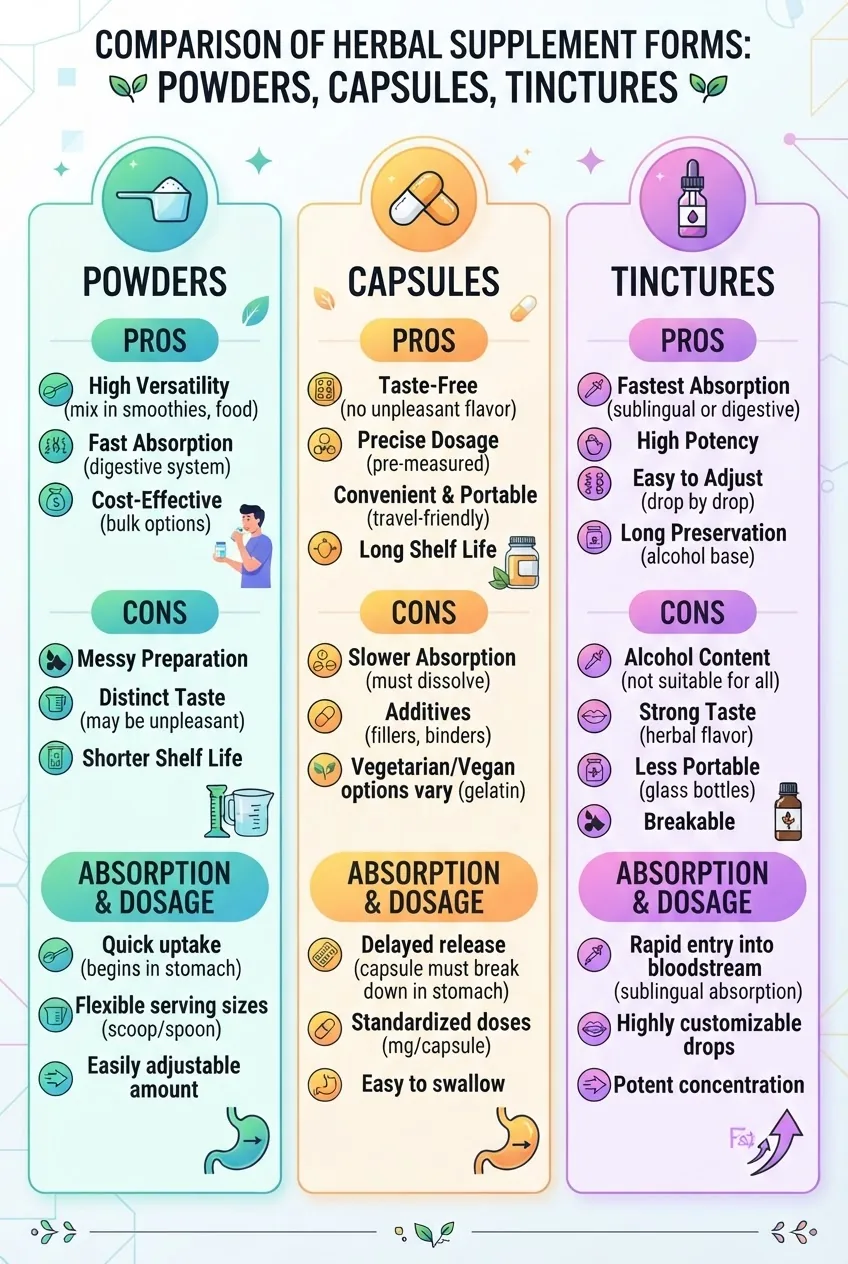
Differences Between Ayurvedic Herbs Powder and Other Herbal Supplements
| Form | Pros | Cons | Absorption/Use |
|---|---|---|---|
| Powder | Flexible dosing; easy to blend; low processing | Taste can be bitter; dosing less precise without scale | Use with food/fat for better absorption of lipophilic actives |
| Capsule/Tablets | Convenient dosing; masks taste; consistent dose | Less flexible; possible excipients; slower absorption | Good for bitter herbs; enteric coatings affect release |
| Tincture/Extract | Concentrated; fast absorption; small dose volume | Alcohol content may be unsuitable; more processing | High bioavailability; ideal for acute needs |
Transition: The following section helps you apply powders in daily rituals and wellness routines with simple examples.
Integrating Ayurvedic Herbal Powders Into Your Daily Wellness Routine
Use powders as functional ingredients in meals, rituals and targeted supplements. Small, repeatable practices yield the best results.
- Morning: 500 mg–1 g of adaptogen powder (ashwagandha) in warm milk or tea for resilience and energy modulation.
- Midday: 1 g turmeric blended into a fat-containing meal for anti-inflammatory support.
- Evening: Triphala 1–3 g with warm water for digestion and bowel regularity.
Powder combinations: create a morning “balance blend” made of 500 mg ashwagandha + 250 mg brahmi + 250 mg amla per serving. Start with half the suggested dose for two weeks to assess tolerance.
For weight management synergy, herbs can complement dietary strategies—see Ayurvedic diet tips for weight loss. For complementary hands-on therapies, combine herbs with external therapies like Ayurvedic massage and therapies. Also coordinate herbs with daily eating patterns using Ayurvedic diet principles.
Transition: Below are common misconceptions and troubleshooting steps from practitioner experience.
Common Misconceptions and Troubleshooting When Using Ayurvedic Herbal Powders
Q: “Natural means safe.”
Not always—natural herbs can cause allergic reactions, interact with drugs or contain contaminants. Always check CoAs and start low-dose tolerance tests. If you have liver disease or take anticoagulants, consult a clinician before starting concentrated powders.
Q: “More is better.”
Higher doses raise risk of side effects and interactions. Therapeutic ranges exist: many powders are effective at 250 mg–3 g/day depending on herb; exceeding typical ranges requires supervision.
Q: Troubleshooting off-odour or clumping
If a powder smells musty or clumps, check moisture (target <10%) and look for mould. Discard suspect batches. Store new batches with fresh desiccants and check humidity levels in your storage area.
Q: Allergic reaction or side effects
Stop immediately, note the product and dose, and seek medical advice for severe symptoms. For milder effects (nausea, headache), discontinue for 48 hours and reintroduce at lower dose under supervision.
Transition: Below are practitioner-tested common mistakes, a verification checklist and guidance on when to call a professional.
Common mistakes and how to avoid them (from practitioner experience)
I once stored a large batch of turmeric powder in a sunny cupboard; within months the taste weakened and mould developed because the jars weren’t airtight. Now I always use opaque glass jars with desiccant and label processing dates. I also used to grind continuously, overheating powders and losing volatile oils—now I run grinders in 8–10 second bursts and allow cool-down periods.
Checklist to verify your work
- Raw herb identified with Latin name and plant part recorded.
- Moisture measured <10% (roots/barks) or 6–8% (leaves).
- Particle size consistent with intended use (mesh documented).
- Batch labelled with date, lot number and CoA references if purchased.
- Stored in airtight, opaque container with desiccant at <25°C.
- Initial tolerance test completed (3 days at low dose).
When to call in a professional
Seek a qualified practitioner for chronic conditions, pregnancy, breastfeeding, use alongside prescription medications, or when planning intensive detox (Panchakarma). Local clinics and directories can help you find supervised care—consider searching for a trusted clinician or clinic if unsure: Find Ayurvedic doctor or Ayurveda wellness centers.
Transition: Finally, if you want to deepen your knowledge, here are resources and steps to continue safely.
Conclusion and Further Resources
By now you should be able to select quality ayurvedic herbal powder, make small artisanal batches, test for basic quality metrics, dose safely and integrate powders into daily routines. Keep records, perform tolerance tests and prefer suppliers who provide transparent CoAs and good manufacturing practices.
Next steps: explore formal texts and authoritative works if you want to study classical formulations in depth—see Ayurveda books and texts for recommended reading and canonical sources.
Final CTA: Start with one herb (e.g., ashwagandha or turmeric), perform the 3-day tolerance test, and document results. If you plan to sell products or treat complex conditions, undertake accredited training and lab testing first.