

Integrative medicine Northwestern combines conventional medical care with evidence-based complementary therapies to create individualized treatment plans addressing root causes, symptom control, and wellness goals; the program emphasizes multidisciplinary teams, patient-centered planning, and measurable outcomes across chronic and complex conditions. This overview explains program scope, treatments, and patient flow.
What is Integrative Medicine at Northwestern?
Answer: Integrative Medicine at Northwestern is a coordinated clinical approach that blends conventional Western care with evidence-based complementary therapies to treat the whole person—biological, psychological, and social factors—while collaborating with specialty teams to support symptom control, chronic disease management, and prevention.
Term: Integrative medicine is defined as coordinated care that combines conventional medical treatments with complementary therapies to address whole-person health, not merely symptoms.
Northwestern’s integrative model is anchored in shared decision-making and co-management: conventional specialists (e.g., oncologists, cardiologists, primary care physicians) remain responsible for disease-specific treatments while integrative clinicians offer complementary modalities such as acupuncture, nutrition, mind‑body therapy and targeted functional testing. The program frames these services within evidence evaluation and safety screening to avoid contraindications with standard treatments.
The program language often overlaps with other descriptors; for clarifying terminology and positioning within the wider landscape of care, see the pillar page on alternative terms for Western medical practices.
Integration occurs at three practical levels:
- Clinical collaboration: integrative clinicians consult with treating specialists on safety and therapy sequencing.
- Individualized planning: care plans incorporate patient priorities, biomarker data, and lifestyle interventions.
- Evidence review: therapies are selected based on current literature and institutional guidelines.
Northwestern’s program emphasizes measurable goals (symptom scales, lab markers, functional status), documentation of outcomes, and coordination with primary and specialty teams to reduce redundancy and ensure safety.
Overview of Northwestern’s Integrative Medicine Program
Answer: The program is a multidisciplinary clinic within the Northwestern health system that provides individualized assessments, combines functional medicine principles with complementary therapies, runs clinician-led group programs, and integrates research and education into clinical practice.

The program mission centers on whole-person care delivered by a multi-specialty team; operationally it includes intake assessments, functional laboratory evaluation, personalized treatment plans, and outcome tracking. Below are the program highlights at a glance.
- Multidisciplinary team of physicians, nurse practitioners, licensed acupuncturists, registered dietitians, psychologists, and care coordinators.
- Clinical services include acupuncture, nutrition counseling, functional lab testing, mind‑body therapies, and guided lifestyle plans.
- Patient evaluation uses extended intake visits, validated symptom instruments, and targeted lab panels to inform root-cause approaches.
- Individualized care plans that coordinate with subspecialists and set specific measurable goals.
- Education and research components that feed clinical protocols and continuous quality improvement.
- Access options include in-person clinics, group classes, and telehealth follow-up.
History and Mission of Northwestern’s Program
Answer: Founded as a response to patient demand for integrated care and institutional interest in evidence-based complementary therapies, the program’s mission is to combine rigorous scientific evaluation with compassionate, whole-person care to improve outcomes and quality of life.
Historically, Northwestern expanded integrative services in the 2000s as part of broader academic medicine trends to bring complementary practices under institutional oversight. The program’s stated goals are:
- Provide safe, evidence-informed complementary therapies alongside standard treatments.
- Develop individualized, measurable care plans for chronic and complex conditions.
- Train clinicians in integrative approaches and evaluate outcomes through research.
Academic affiliations support peer-reviewed study of selected modalities and ensure that clinical protocols align with evolving evidence. According to institutional program summaries, the mission emphasizes safety, collaborative care, and measurable patient-centered results.
Key Team Members and Practitioner Credentials
Answer: The program team includes board-certified physicians with additional integrative or functional medicine training, licensed acupuncturists, registered dietitians, clinical psychologists, and nurse practitioners coordinated by care navigators to deliver comprehensive care.
Term: Functional medicine specialist refers to a clinician trained to use systems-based assessments and targeted testing to identify upstream contributors to disease.
Typical practitioner credentials and roles:
- Physicians: board-certified in their specialty (e.g., internal medicine, oncology) with fellowship or additional certification in integrative medicine or functional approaches.
- Functional medicine practitioners: clinicians who use systems biology concepts and extended laboratory assessments to build personalized treatment plans.
- Licensed acupuncturists: credentialed to provide acupuncture and related procedures, with documentation of state license.
- Registered dietitians/nutritionists: credentialed RDNs delivering medical nutrition therapy and functional nutrition plans.
- Clinical psychologists and behavioral health providers: licensed professionals delivering CBT, biofeedback, and stress-management therapies.
- Nurse practitioners and physician assistants: help coordinate follow-up, medication reconciliation, and telehealth visits.
For readers curious about practitioner education pathways, consult resources on alternative medicine degree programs.
Practitioners follow institutional credentialing processes; many hold nationally recognized certifications in integrative medicine, acupuncture, or functional nutrition in addition to state licensure. Roles are defined to maintain collaborative relationships with primary care and specialty teams—practitioners document care plans in shared electronic health records to maintain continuity.
Treatments Offered in Northwestern’s Integrative Medicine Program
Answer: Northwestern offers a suite of evidence-based complementary therapies—acupuncture, nutritional counseling, mind‑body therapies, herbal and supplement guidance, manual therapies, and targeted functional laboratory testing—bundled into individualized treatment plans accessible both in clinic and via telehealth.

The program emphasizes safety checks, drug–supplement interaction screening, and coordination with treating specialists before initiating any complementary therapy. Below is a detailed list of modalities and brief descriptions of how they are used clinically.
- Acupuncture
Licensed acupuncturists deliver acupuncture for pain, chemotherapy-associated nausea, and some chronic symptom syndromes; sessions are scheduled with medical oversight, and protocols are adapted to patient comorbidities and concurrent therapies.
See related approaches in alternative therapies for pain management.
- Nutritional Counseling and Functional Nutrition
Registered dietitians perform comprehensive dietary assessments, design therapeutic diets, and, when indicated, order targeted food-sensitivity or micronutrient testing. Nutritional plans support metabolic health, autoimmune conditions, and cancer recovery.
Practitioner training paths are described in alternative medicine degree programs.
- Mind‑Body Therapies
Psychologists and trained facilitators deliver meditation, mindfulness-based stress reduction (MBSR), cognitive-behavioral techniques, guided imagery, and group-based resilience training to target stress, anxiety, and chronic pain.
For expanded options see mental health alternative treatments.
- Herbal Medicine and Supplements
Clinicians provide evidence-based recommendations on herbs and nutraceuticals, with explicit checks for interactions with prescription drugs and chemotherapy; recommendations include dosing, sourcing, and monitoring plans.
- Functional Laboratory Testing
Targeted testing may include expanded metabolic panels, micronutrient assays, stool microbiome testing, and hormonal profiles; results are interpreted within systems biology frameworks to identify root drivers.
- Physical and Manual Therapies
Therapies such as massage, physical therapy, and osteopathic techniques are integrated when indicated to improve mobility, pain, and recovery from surgery or treatment.
See targeted approaches in alternative therapies for asthma and allergies.
- Integrative Oncology Support
For patients receiving cancer therapy, integrative oncology services focus on symptom control (nausea, fatigue, neuropathy), nutritional optimization, and psychosocial support, coordinated with oncology teams to avoid contraindicated supplements.
Example disease-focused options are described in alternative medicine for prostate cancer and holistic alternative treatments for ovarian cancer.
- Chronic Pain and Neuromodulation
Chronic pain care integrates acupuncture, behavioral approaches, movement therapy and targeted injections when appropriate, following evidence-based algorithms and safety checks.
Further options at a systems level are summarized in alternative therapies for pain management.
- Respiratory and Allergy Adjuncts
Adjunctive strategies for asthma and allergic disease—such as breathing retraining, dietary adjustments, and certain supplements—are applied in coordination with pulmonology/allergy teams.
See alternative therapies for asthma and allergies for more detail.
- Telehealth and Group Programs
Many clinics offer remote consultations, guided group programs for stress reduction or lifestyle change, and remote monitoring to maintain continuity between visits.
For condition-specific integrative options beyond Northwestern’s scope, readers can review resources such as cancer natural cures or diagnostic-specific guides provided in the sibling articles list.
Functional Medicine at Northwestern
Answer: Northwestern’s functional medicine approach focuses on systems biology and root-cause analysis—using detailed history, targeted testing, and personalized interventions—to complement conventional treatments rather than replace them.
Term: Systems biology is an approach that studies interactions among biological systems (genes, metabolites, organs) to understand disease mechanisms rather than isolated symptoms.
Functional medicine at Northwestern differs from conventional care primarily in scope of assessment and emphasis on upstream drivers:
- Longer intake visits and comprehensive history to identify contributing factors (diet, exposures, microbiome, sleep, stress).
- Targeted lab testing to identify treatable biochemical imbalances rather than broad screening tests only.
- Personalized, phased plans that include lifestyle, dietary, supplement, and procedural interventions.
Comparison points:
| Aspect | Functional Medicine | Conventional Medicine |
|---|---|---|
| Focus | Root causes, systems interactions | Disease diagnosis and guideline-based treatment |
| Assessment | Extended history, functional labs | Problem-focused testing |
| Treatment | Lifestyle, nutrition, supplements, targeted therapies | Pharmacotherapy, procedures, surgery |
| Evidence base | Growing literature; individualized evidence rationale | Large-scale randomized trials and guideline support |
Systems biology and functional nutrition enable targeted interventions (e.g., correction of micronutrient deficits, gut microbiome modulation) that may improve outcomes when integrated with conventional care. Clinicians document rationale and measurable endpoints to track effectiveness.
Mind-Body Integration Therapies
Answer: Mind‑body therapies at Northwestern—meditation, yoga, MBSR, CBT, and biofeedback—are applied to reduce stress, improve coping, and attenuate symptoms such as chronic pain, insomnia, and anxiety, often within structured group programs.
Term: Mind‑body therapies are interventions that use cognitive, behavioral, and physical practices to influence mental and physiological processes.
How they are used clinically:
- Short intake to assess mental health needs and contraindications.
- Structured skills training (MBSR or CBT) delivered in individual or group formats.
- Integration with physical therapies and medication management when needed.
Quick how‑to overview for patients starting at-home practice:
- Begin with 5–10 minutes daily guided meditation to build attention and reduce reactivity.
- Use progressive muscle relaxation before bed to reduce insomnia symptoms.
- Incorporate gentle movement (yoga or tai chi) 2–3 times weekly to improve mobility and mood.
- Track symptom changes weekly and share with your clinician to adjust approaches.
For broader alternatives to psychotherapy and additional modalities, see mental health alternative treatments.
Patient Experience and Treatment Process
Answer: Patients begin with an extended consultation and assessment, receive a coordinated individualized treatment plan, undergo staged therapies with safety monitoring, and follow scheduled outcome evaluations—supported by care navigators and telehealth as needed.
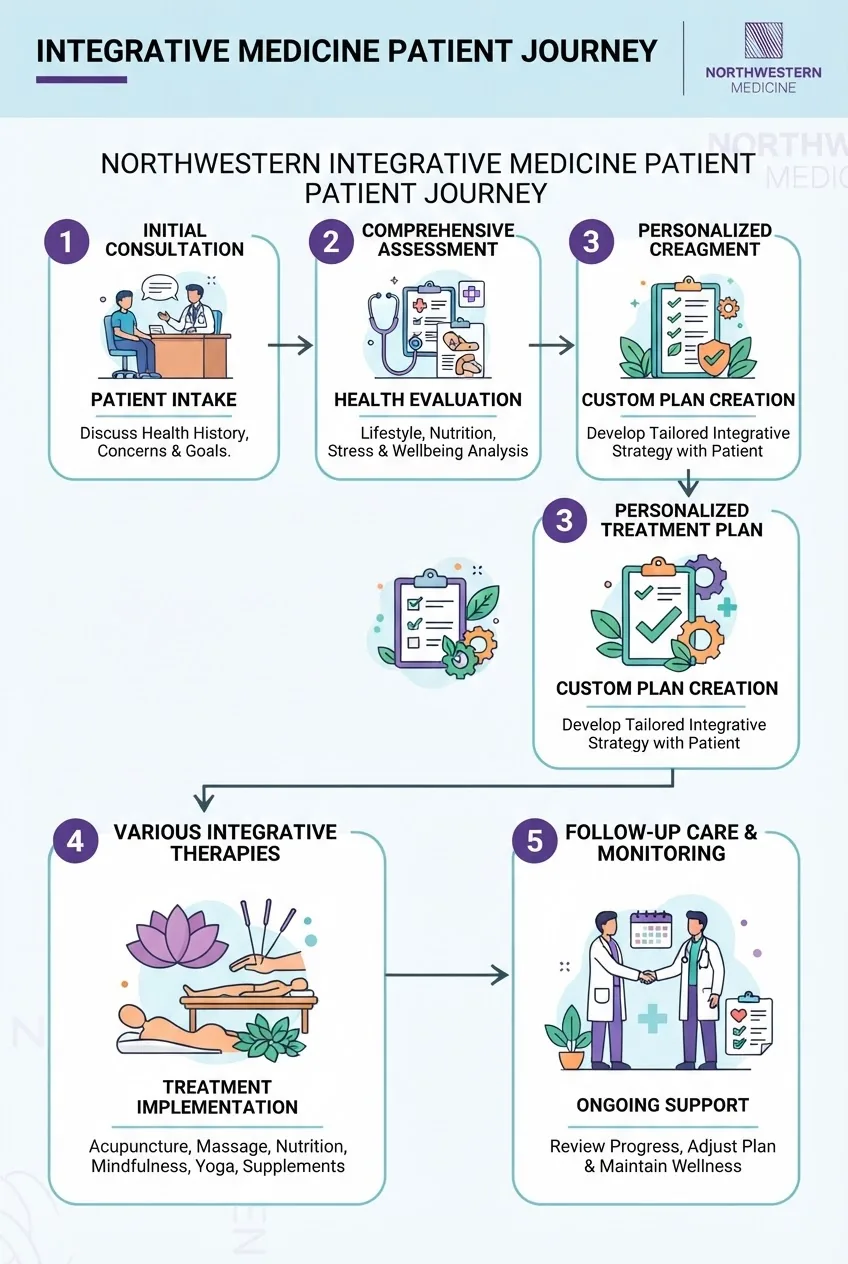
- Referral or self‑referral and intake scheduling: Patients are referred by a treating clinician or book directly; administrative staff confirm insurance and scope of services.
- Initial consultation (60–90 minutes): A comprehensive history, medication and supplement review, symptom scales, and goal setting. Functional testing may be ordered.
- Interdisciplinary case discussion: The integrative clinician reviews the case with relevant specialists to ensure safety and alignment.
- Personalized treatment plan: A phased plan with prioritized interventions, expected timelines, measurable endpoints, and patient education materials.
- Therapy initiation: Schedule acupuncture, nutrition visits, mind‑body classes, or procedures; all interventions include documented safety checks for interactions with ongoing medical treatments.
- Follow-up and monitoring: Regular follow-up visits (telehealth or in-person) assess symptom scales, lab markers, and adherence; plans are adjusted as needed.
- Outcome evaluation: Pre-specified metrics (pain scales, fatigue scores, lab improvements) measure progress at 3–6 month intervals.
An anonymized case example illustrating workflow:
Case: A 56-year-old patient with chronic fatigue and insulin resistance underwent a 90-minute intake, targeted micronutrient and hormonal testing, and a coordinated plan with endocrinology. Within six months, objective HbA1c improved by 0.6 points and self-reported energy rose by two points on a 10‑point scale; care included diet changes, circadian sleep adjustments, and tailored supplements. (Outcome summary anonymized for privacy.)
According to a 2024 industry report, patient demand for integrative services is rising, driven by desire for holistic symptom control and lifestyle interventions; institutional programs increasingly document patient-reported outcome measures to quantify benefit.
Insurance, Costs, and Accessibility
Answer: Insurance coverage for integrative services varies widely—some services (e.g., dietitian visits, behavioral health) are commonly covered, while acupuncture, extended functional testing, and supplements are often out-of-pocket; Northwestern provides billing estimates and offers telehealth and group options to improve access.
Key points:
- Insurance coverage depends on plan specifics; many medical insurances cover integrative consultations when medically indicated, but coverage for procedures like acupuncture varies.
- Functional lab tests and supplements frequently require out-of-pocket payment or separate billing; patients receive pre-visit financial estimates.
- Telehealth follow-ups and group classes can reduce cost and improve access.
- Financial counseling and payment plans may be available for extended programs.
Patients are advised to verify benefits with their insurer and obtain prior authorizations where required; clinicians document medical necessity to support coverage when possible.
Northwestern’s Program in Context: Integrative vs Conventional and Functional Medicine
Answer: Northwestern’s integrative program complements conventional care by adding functional assessments and evidence‑based complementary therapies while maintaining collaboration with specialist teams; benefits include personalized care and improved symptom management, limitations include variable insurance coverage and evolving evidence for some modalities.
The table below summarizes key comparative considerations:
| Dimension | Integrative/Functional | Conventional |
|---|---|---|
| Goal | Whole-person health, root causes | Disease control, acute management |
| Approach | Systems biology, lifestyle, adjunctive therapies | Guideline-driven pharmacologic/procedural care |
| Evidence | Variable—growing trials for specific modalities | Extensive clinical trials and guidelines |
| Risks | Interactions, variable regulation of supplements | Procedure and medication-related adverse events |
Benefits of Northwestern’s integrative approach include:
- Personalized plans that can reduce symptom burden and improve function.
- Multidisciplinary oversight to enhance safety and coordination.
- Focus on prevention and lifestyle that may reduce long-term morbidity.
Limitations include:
- Evidence for some complementary interventions remains emerging; clinicians prioritize therapies with higher-quality evidence.
- Insurance variability can limit access for some patients.
For authoritative guidance on safety and evidence, the program references national resources such as the NCCIH and peer-reviewed clinical trials; for program-specific details see Northwestern Medicine program details.
Summary and Future Directions of Integrative Medicine at Northwestern
Answer: Northwestern’s integrative medicine program aims to expand evidence-based complementary care, integrate research into practice, and improve patient outcomes through multidisciplinary coordination, measured protocols, and targeted functional approaches.
Current and future directions include:
- Expanding clinical trials to evaluate multimodal interventions and publish outcomes in peer-reviewed journals.
- Refining patient-reported outcome measures and EHR integration for better longitudinal tracking.
- Scaling group programs and telehealth to improve access and cost-effectiveness.
- Developing clinical decision support tools to reduce risk of supplement–drug interactions.
According to a 2023 peer-reviewed review, integrative approaches show promising benefits for symptom management in select conditions when supervised by trained clinicians; Northwestern’s emphasis on research and practitioner credentialing aims to contribute to this evidence base. For advanced oncology adjuncts and evolving modalities, readers may explore potential alternatives to radiation therapy in academic discussions and integrative oncology literature.
Contact the clinic through Northwestern Medicine channels for current referral processes, expected wait times, and program availability; clinicians recommend discussing integrative options with your treating specialist to ensure safe coordination of care.
Takeaway: Northwestern’s integrative program is an evidence-minded, multidisciplinary service designed to complement standard care by addressing root causes, improving symptom control, and supporting long-term health through personalized, measurable treatment plans. To explore services or request a consultation, contact the clinic directly through Northwestern Medicine.