By the end of this guide you will be able to run an evidence-informed, practical daily routine of mindfulness activities at work, reset your focus in 2–10 minute windows, and integrate discreet exercises across common office situations — this takes 20–60 minutes to set up and assumes a beginner to intermediate comfort with short guided practices.
This hands-on guide gives step-by-step workflows, clear timings, and workplace-tailored adjustments so you can practice immediately at your desk or between meetings.
Introduction to Mindfulness Activities at Work
This section defines what you will use at work and why those activities matter. When I say mindfulness activities at work I mean short, structured practices—breathing techniques, sensory grounding, micro-meditations, and gentle movement—that reduce acute stress and restore cognitive resources while you remain in or near your workspace.
Mindfulness is the intentional, non-judgmental awareness of present-moment experience. In a workplace context, that translates to techniques that fit into typical office constraints: limited time, need for discretion, and repeated interruptions. The main benefits are clearer mental focus, reduced physiological stress responses, better emotional regulation, and improved task-switching efficiency.
Research and practitioner reports show that short, regular practice—micro-breaks of 60–600 seconds—produce measurable reductions in perceived stress and help restore attention between cognitively demanding tasks. These activities can be done alone, in small groups, or facilitated by an organisation-wide program.
Before you dive into the step-by-step activities, you should understand how these practices differ from a formal meditation retreat: they are shorter, context-sensitive, and prioritise recharging and performance recovery. Below you’ll find practice templates, schedules, and the specific situations in which each technique gives the best return on time invested.
Mindfulness exercises for anxiety and meditation benefits for mental health explain the longer-form pathways and clinical context for techniques referenced below.
Transition: Next we’ll map common workplace stressors that make these activities necessary so you can match techniques to triggers.
Common Workplace Stressors and the Need for Mindfulness
Workplace stressors are the everyday events that drive the need for repeated, short resets. Typical triggers include tight deadlines and workload pressure, frequent interruptions from colleagues or messages, performance anxiety before presentations, emotional labour in client-facing roles, and chronic high cognitive load that leads to burnout symptoms.
Physiologically, these stressors activate the sympathetic nervous system, producing shallow breathing, increased heart rate, and narrowed attention. Practicing simple mindfulness techniques in-situ reduces sympathetic arousal and increases parasympathetic tone, supporting emotional regulation and clearer decision-making.
Stat block: According to a 2023 industry report by a workplace wellbeing research group, approximately 52% of employees report frequent workplace stress; a 2022 survey by a national mental health organisation found that one in three workers report decreased productivity due to stress. (Source types: 2023 industry report; 2022 national survey)
Emotional regulation issues manifest as irritability, difficulty concentrating, or decision avoidance. Burnout symptoms can include exhaustion and cynicism; mindfulness activities target those early warning signs by interrupting reactive cycles and restoring attention.
For many people, the challenge is not that mindfulness doesn’t work — it’s that practices are not matched to the workplace environment. This guide emphasises discreet timing, short durations, and techniques that are workplace-appropriate so you can apply them without disrupting co-workers or visible downtime.
Transition: With the stressors mapped, the next section gives a concise overview of the most effective mindfulness techniques you can use at work.
Effective Mindfulness Techniques at Work: Overview
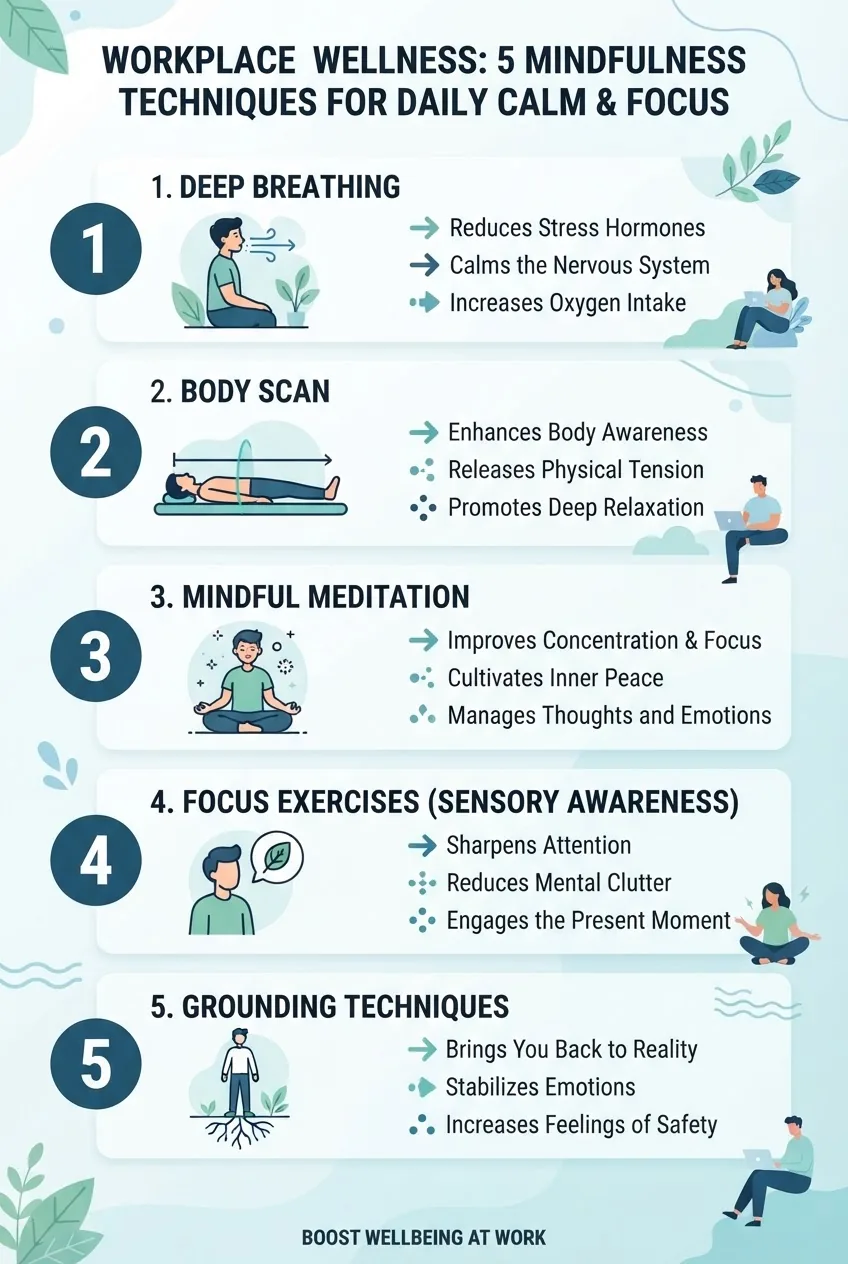
- Mindful breathing — Simple inhalation/exhalation awareness or box breathing to lower heart rate and quickly downshift stress physiology. Use 4–6 second cycles for 1–5 minutes during transitions.
- Body scan — A brief progressive attention sweep (head to toes or localized neck/shoulders) to release tension held in the body. 3–10 minutes helps relax musculoskeletal tension after prolonged sitting.
- Guided micro-meditation — Short guided scripts (2–5 minutes) that focus on breath, sound, or visualisation; effective for re-focusing attention after meetings.
- Mindful movement and desk stretches — Gentle seated stretches and mobility moves that re-balance posture and send a recovery signal to the brain; best used after 45–90 minutes of sitting.
- Mental grounding and sensory awareness — Five-senses grounding and 5-4-3-2-1 techniques to anchor attention during overwhelming moments; immediate distraction management tool.
- Focused-attention or open-monitoring drills — Short focus sprints (e.g., 10-minute Pomodoro-style focused work) with a mindful countdown or breath anchor to strengthen sustained attention.
- Cognitive reframing via journaling — One-minute expressive notes or a single-sentence “what I control” log to reduce rumination and clarify next actions.
- Progressive muscle relaxation (brief) — Tense-and-release cycles for major muscle groups in 3–5 minutes to counteract acute tension, especially before presentations or calls.
- Compassionate self-talk — Short, scripted self-statements to reduce self-criticism and anxiety affecting performance; useful pre- and post-feedback.
Each technique trades off time, visibility, and physiological depth. For example, seated breath focus gives fast autonomic relief with minimal visibility; a 10-minute body scan yields deeper relaxation but is less discreet. Choose techniques based on the trigger and your environment — the next section shows how to do these at your desk.
Transition: Now you’ll get concrete step-by-step procedures for 8–10 desk-friendly mindfulness activities with exact timings and cues.
Step-by-Step Mindfulness Activities to Do at Your Desk
Before you start: simple prerequisites and tools you may want.
- Quiet headset or earbuds (for guided audio) or phone on silent with timer.
- A chair with back support and flat feet on the floor; adjustable desk if available.
- Timer app with interval settings (set to 2, 3, 5, 10 minutes).
- Notebook and pen for one-line journaling prompts.
- Optional: small object to hold for sensory grounding (smooth stone, stress ball).
-
Box breathing — 2 minutes
Steps:- Set timer to 2 minutes.
- Sit upright, feet flat, hands resting. Inhale quietly for 4 counts through the nose.
- Hold for 4 counts.
- Exhale slowly for 4 counts through the mouth or nose.
- Hold empty for 4 counts. Repeat for 8 cycles.
Why it works: regulates breath-to-HR coherence and reduces immediate anxiety. Use before calls or post-meeting to reset attention. For deeper effect use 5-count box if you can spare 3–4 minutes.
-
Seated body scan — 5–8 minutes
Steps:- Set timer to 5 or 8 minutes and close eyes if comfortable.
- Begin at the crown of the head: notice tension, soften jaw and forehead.
- Move attention down neck, shoulders (drop shoulders away from ears), arms, hands.
- Scan chest, abdomen, hips, thighs, knees, calves, feet, noticing sensations without judgment.
- On any tight spot, breathe into that area for three full breaths and imagine release on each exhale.
Office tip: keep eyes open if privacy limited and use peripheral gaze; 5 minutes is effective when time is tight.

-
2-minute guided reset — 2 minutes
Steps:- Use a short guided audio or script. Set timer to 2 minutes.
- Follow these simple cues: “Breathe in for two, out for three. Notice your feet on the floor. Let a single thought go.”
- Open eyes, take two grounding breaths, and return to task.
Note: For more scripts see quick mindfulness meditation scripts.
-
3-minute breath awareness — 3 minutes
Steps:- Timer to 3 minutes. Sit with spine lengthened.
- Place one hand on belly, one on chest. Track the inhalation depth and the exhale length.
- When attention wanders, label the thought “thinking” and return to breath. Repeat until timer ends.
Office tip: This is a discreet desk meditation; for more variations see short mindfulness meditations.
-
Sensory grounding (5-4-3-2-1) — 1–2 minutes
Steps:- Notice and name 5 things you can see (scan desk).
- Name 4 things you can touch (chair, keyboard, pen, shirt).
- Name 3 things you can hear (fan, distant voices, your breathing).
- Name 2 things you can smell (coffee, soap) or imagine smells if none present.
- Name 1 thing you can taste (breath or sip water).
Use when anxiety spikes or distraction is high. This is fully discreet and immediate for emotional regulation.
-
Chair stretches and mindful movement — 3–6 minutes
Steps:- Sit tall, inhale and reach arms overhead, exhale fold forward over thighs (seated forward fold) — 3 breaths.
- Neck stretch: tilt right ear toward shoulder for 5 breaths, then left.
- Shoulder rolls: 10 slow rolls back, 10 forward.
- Seated spinal twist: left hand on right knee, twist gently for 5 breaths; repeat other side.
Office tip: make movements slow and deliberate; coordinate breath on movement to increase parasympathetic activation.
-
Single-sentence journaling — 2 minutes
Steps:- Open notebook. Set timer to 2 minutes.
- Write one sentence: “The next action I will take is…” or “One thing I can control right now is…”
- Close notebook. Proceed with the clarified action.
Why it works: converts diffuse stress into a single actionable priority reducing rumination.
-
Progressive muscle release (upper body) — 3 minutes
Steps:- Clench fists and tense forearms for 5 seconds, then release for 10 seconds.
- Shrug shoulders tightly for 5 seconds; release for 10 seconds.
- Clench jaw lightly (not to pain) for 5 seconds; release fully. Breathe slowly for one minute.
Best before a presentation or after a stressful call to reduce somatic tension.
-
Compassionate self-talk script — 1 minute
Steps:- Silently or aloud, repeat three phrases: “I am doing my best right now,” “One step at a time,” “This feeling will pass.”
- Breathe slowly between phrases. Use before feedback or after a mistake to reduce threat reactivity.
Use sparingly and privately; effective for reducing negative self-evaluation that drains performance.
-
Two-minute breathing and visualization — 2 minutes
Steps:- Breathe in for 3, out for 5. On each inhale imagine collecting tension; on each exhale imagine it leaving your body.
- For the last 30 seconds, visualise a task completion snapshot: what success looks like, next immediate step, and the first physical action.
This pairs physiological down-regulation with cognitive priming for productive return to work. For more breathing patterns and longer scripts, visit breathing meditation exercises.
Transition: The next section explains how to schedule these resets across the workday so they sustainably restore your mental energy.
Using Mindfulness Breaks to Reset Your Mental Energy
Short, well-timed mindfulness breaks act like cognitive “recharging” for attention and self-regulation. The aim is to strategically place micro-practices so they interrupt stress escalation and restore focus before performance declines.
Here are numbered, practical timing techniques to implement immediately:
- Schedule micro-breaks every 60–90 minutes. Research-informed cycles suggest attention declines after ~60–90 minutes of concentrated work; a 2–5 minute practice here yields strong focus restoration.
- Use transitional triggers. Place a 1–3 minute breathing exercise immediately after meetings, long calls, or intense email sessions to reset before the next task.
- Apply pre-deadline pacing. When approaching a deadline, take a 3–5 minute body-scan or chair stretch to reduce adrenaline and improve clarity for the final push.
- Keep an emergency toolkit. A one-minute grounding or box-breath script accessible on your phone is useful for sudden spikes in anxiety or confrontation.
- Use the Pomodoro mindfully. Work in 25/50 minute sprints, then use the break for a short mindful movement or breathing drill rather than checking email to maximize recovery.
- End-of-day decompression. A 5–10 minute seated body scan, compassionate self-talk and single-sentence journaling helps separate work from home life and supporting work–life balance.
Timing thresholds: prefer 1–3 minute interventions when you need instant relief and 5–10 minute practices when you can block time (e.g., pre-lunch or after deep work). Use visual cues on your calendar or a smartwatch reminder for consistency.
Transition: Different work settings require adapted practice choices; the section that follows shows how to use the techniques above in remote, open-plan and high-stress roles.
Practical Tips for Integrating Mindfulness into Different Work Environments
Mindfulness strategies must be tailored to environmental constraints: remote work, open-plan offices, cubicles, customer-facing settings, or high-stress frontline roles. Below are concrete approaches for each environment, with dos and don’ts.

Remote and hybrid workers
Advantages: privacy and flexibility. Use video-off 3–5 minute guided resets between meetings. Schedule a standing stretch break at 60–90 minute intervals. Keep a “do not disturb” focus block for one 25–50 minute deep work session each morning, and use mindful breathing at the end of the session to transition.
Tip: integrate brief walks outside for sensory grounding on longer days — sunlight and movement enhance parasympathetic recovery.
Open-plan and noisy offices
Constraints: low privacy and visual exposure. Use discreet practices: 1–2 minute breath awareness, sensory grounding, or single-sentence journaling. Use headphones with neutral ambient tracks for subtle privacy. If appropriate, organise a rotating quiet hour with your team.
Cubicles and shared spaces
Do brief seated body scans with eyes open and peripheral gaze. Do light neck and shoulder mobility at your desk to avoid appearing disengaged. Use manager-approved micro-breaks to normalise mindfulness across the team.
Customer-facing and high-stress jobs
Focus on two real-time tools: 30–60 second grounding and controlled exhale breathing. These are quick, reduce visible anxiety and can be done while standing. Encourage micro-recovery rituals between customer interactions, like a handwash with three mindful breaths.
For integrating movement-friendly practices alongside mindfulness, consider adding yoga sequences when privacy allows. See the yoga challenge for stress reduction for a structured approach that complements desk-based mindfulness.
Transition: Tools and apps can help with reminders, guided practices and building consistency — the next section compares popular options.
Mindfulness Tools and Apps for Workplace Stress Management
Below is a compact comparison of five widely used apps and tools with features, pros and cons to help you pick one that fits an office workflow. Rows use zebra striping for readability.
| Tool / App | Key Features | Pros | Cons |
|---|---|---|---|
| Headspace | Short guided meditations, workplace packs, reminder timers | Beginner-friendly, branded workplace programs | Subscription cost; some content longer than micro-break slots |
| Calm | Breathing exercises, sleep stories, ambient soundscapes | High-quality audio, good for decompression | Less focus on short workplace drills |
| Insight Timer | Large library, free guided meditations, timer modes | Free options, community features | Overwhelming choices; variable quality |
| Breathe+ / Simple Timer | Customizable breath timers, interval settings, haptic cues | Excellent for discreet breathing practices and reminders | Limited guided content |
| Pause/Focus apps (Pomodoro) | Work/rest scheduling, focus timers, task lists | Integrates mindfulness breaks into work rhythm | Less content for relaxation; needs manual mindfulness pairing |
App selection scenario: If you need discreet physiological regulation during calls, choose a breath-timer app or wearable haptics that cue box breathing. If you want a library of short guided meditations for lunchtime, choose Headspace or Insight Timer. For teams, workplace-licensed subscriptions can be rolled out centrally for consistency.
Transition: Measuring the real impact of these practices helps justify time and resources — the next section summarises research and measurable outcomes.
Measuring the Impact of Mindfulness Activities on Work Performance and Stress
Measuring impact requires a mix of subjective and objective indicators: self-reported stress (validated scales), task performance metrics, absence rates, and wellbeing surveys. Short-term outcomes include reduced perceived stress and improved momentary focus; long-term outcomes include lower burnout risk and improved job satisfaction.
Several recent peer-reviewed studies and systematic reviews have evaluated workplace mindfulness programs and found modest-to-moderate effects on stress reduction and attention. For accessible summaries and evidence, review peer-reviewed research in occupational health and mindfulness journals.
Representative external sources:
- A recent systematic review and meta-analysis of workplace mindfulness interventions (peer-reviewed journal).
- American Psychological Association guidance on workplace stress (mental health organisation).
- WHO fact sheet on mental health at work (governmental workplace health guidance).
Practical measurement plan you can adopt this week:
- Baseline survey (week 0): 5-question perceived stress scale, one productivity self-rating, and one short fatigue rating. Record baseline.
- Intervention period (4–8 weeks): introduce micro-practices (60–90 minute cadence) and tools, track adherence with a simple daily checklist.
- Midpoint check (week 2–4): quick pulse survey on perceived stress and cognitive clarity.
- Post-intervention assessment (week 8): repeat baseline measures and compare; track any reduction in self-reported errors, sick days or unresolved task backlog.
When interpreting results, consider natural variability and work-cycle effects (e.g., seasonal deadlines). If stress reduction is partial, complement with workplace process changes (workload management) or escalate to specialised supports.
Transition: Practitioners often encounter predictable obstacles — the next section lists common challenges and concrete fixes.
Common Challenges and How to Overcome Them When Practicing Mindfulness at Work
- Distractions and interruptions: Use micro-practices that accept interruptions (box breathing, grounding). If I’m interrupted mid-scan I stop, note “interrupted,” and do a 30-second re-anchor — forcing continuation often increases frustration.
- Skepticism or perceived time waste: Frame practices as productivity tools. I used to skip breathing between meetings until I timed my recovered minutes; a 2-minute reset saved me 5–10 minutes of refocusing after long calls.
- Time constraints: Prioritise 60–90 minute break scheduling; even 60 seconds of breath practice before a critical call can materially lower physiological arousal.
- Consistency challenges: Use calendar nudges and pairing (after coffee, before lunch). When I relied on memory, I lost momentum; calendar cues and a visible checklist increased adherence to five sessions per week.
- Perceived ineffectiveness: Different techniques have different timelines. Quick breath techniques reduce immediate reactivity; deeper benefits like emotion regulation need repeated practice over weeks. If outcomes lag, measure adherence and vary technique type and duration.
- Need for clinical support: Mindfulness complements but does not replace medical care. If symptoms include panic attacks, severe depressive symptoms or functional impairment, consult healthcare professionals and consider medication options as appropriate — see medication options for anxiety.
Transition: Scaling these practices to teams requires leadership and program design — the next section covers cultural approaches.
Encouraging Mindfulness Culture Within Teams and Organizations
A supportive culture normalises short resets, reduces stigma, and encourages mutual accountability. Leadership endorsement, simple guidelines, and time-backed policies (e.g., protected focus time, brief daily team mindfulness at 9:00) shift norms.
Practical examples: a team can introduce a single 90-second breathing moment at the start of daily stand-ups, or provide a weekly 10-minute guided session that employees can join remotely. Track uptake with voluntary sign-ins rather than mandatory attendance to respect autonomy.
Frameworks: adopt established workplace mental health frameworks (psychological safety, reasonable accommodations, workload management) when integrating mindfulness so practices complement systemic change rather than act as band-aids.
Transition: below is a closing summary of long-term benefits and clear next steps.
Conclusion: Long-term Benefits of Mindfulness Activities at Work
Sustained use of workplace mindfulness activities produces measurable improvements in sustained attention, lower perceived stress, and improved emotional resilience. Over weeks to months, teams report better communication, fewer reactive conflicts, and increased capacity for focused work.
Start small: pick one or two discreet techniques, schedule them into your day, and measure adherence and outcomes after 4–8 weeks. If you want to deepen your practice, combine short workplace activities with longer weekly sessions or group programs to reinforce the habit.
Call to action: Implement one 2–5 minute practice today—set a calendar reminder for a single micro-break after your next meeting—and track how it affects your next task’s clarity and pace.
Common mistakes and how to avoid them
I’ve observed these recurring failures in workplace roll-outs and how I corrected them:
- I scheduled long trainings but no micro-practice: Staff attended a 1-hour workshop but didn’t change daily behaviour. I fixed this by adding calendar reminders and 1-minute guided audio to the first week, yielding measurable practice rates.
- I assumed everyone would use the same technique: I recommended body scans for all; frontline staff couldn’t implement them. After offering a menu of discreet options (box breathing, grounding), adherence increased.
- I treated mindfulness as a cure-all: When someone had severe anxiety, I expected mindfulness would resolve it. It didn’t; we added clinical referral pathways and saw better outcomes when practices complemented professional care.
Quick checklist
- Have you chosen 1–3 techniques to pilot this week?
- Are timers and reminders set for 60–90 minute intervals?
- Do you have at least one discreet practice for public settings?
- Is there a measurement plan (baseline and 4–8 week follow-up)?
- Is there a referral path for clinical support if needed?
When to call in a professional
If stress symptoms include persistent sleep disruption, worsening mood, panic attacks, or significant impairment in work function, contact certified mental health professionals. Use mindfulness as a complementary approach — not in place of clinical care — and escalate when workplace adjustments and self-directed practices do not produce improvement within 4–8 weeks.