By the end of this hands-on guide you will have learned and practiced a set of evidence-informed mindfulness exercises for anxiety, know when to use each technique, and be able to build a 10–30 minute daily routine. Expect to spend 30–60 minutes reading and practicing the core steps; skill level required: beginner to intermediate.
Before you start
- Quiet space or chair/mat (30–60 cm clear area), soft lighting
- Timer or smartphone (set to silent) with 3 preset durations: 3 min, 10 min, 20–30 min
- Light blanket for body-scan sessions, comfortable clothing
- Notebook and pen for logging sensations, thoughts and practice time
- Optional: guided audio from trusted sources or an MBSR-trained instructor
Understanding Mindfulness and Anxiety
This section explains the relationship between mindfulness and anxiety, defines key terms, and sets practical expectations. Anxiety shows up as racing thoughts, muscle tension, heart palpitations and often a tendency to ruminate or worry. Mindfulness focuses on paying attention, on purpose, in the present moment, without judgment. For anxiety management, mindfulness shifts attention away from future-oriented worry and toward direct experience — breath, body sensations, and deliberate noticing.
Definitions you will use in practice:
- Mindfulness: an intentional present-moment awareness practice.
- MBSR (Mindfulness-Based Stress Reduction): an 8-week structured group program combining breath, body scan, and mindful movement.
- MBIs (Mindfulness-Based Interventions): umbrella term for programs like MBSR and MBCT (Mindfulness-Based Cognitive Therapy).
How mindfulness differs from other approaches: unlike rapid relaxation scripts or dynamic practices like yoga challenges, mindfulness trains attention and relationship to thought. This guide excludes rapid meditation scripts, yoga challenges, or therapy protocols; it concentrates on practical, stepwise mindfulness exercises and the science behind them.
Where mindfulness fits with medication: mindfulness is best seen as a complementary self-management skill. For information on pharmacological options, see anti-anxiety medication options.
Transition: Now that you understand the basic relationship between mindfulness and anxiety, the next section explains how specific exercises change brain and body responses that drive anxious states.
How Mindfulness Exercises Help Relieve Anxiety
Mindfulness exercises reduce anxiety through multiple biopsychosocial mechanisms. They regulate the autonomic nervous system, reduce reactivity to negative thoughts, and improve attentional control. Practically, repeated practice trains you to notice worry early and choose grounding actions rather than being swept into rumination.
Scientific insight and stats:
- Neural changes: mindfulness practice is associated with increased prefrontal regulation of limbic activity, improving emotional regulation (neuroscience review, peer-reviewed journal).
- Effect sizes: According to a 2024 meta-analysis published in a peer-reviewed psychology journal, MBIs produced small-to-moderate reductions in anxiety symptoms across clinical and non-clinical samples.
- Stress hormone impact: According to a 2024 clinical review in a psychoneuroendocrinology journal, regular mindfulness practice correlates with lower cortisol reactivity during laboratory stressors.
Mechanisms in plain language:
- Attention training: strengthens ability to notice present sensations instead of following anxious thoughts.
- Decentering (cognitive distance): practice creates space between “thought” and “self,” which reduces worry amplification.
- Physiological down-regulation: slow breathing and body awareness shift the autonomic balance toward parasympathetic activity.
Benefits beyond immediate symptom relief: enhanced sleep, better concentration, and increased tolerance of uncomfortable sensations. For a broader review of meditation benefits relevant to anxiety, see benefits of meditation for mental health.
Real-world example (case study): A 34-year-old client with generalized anxiety committed to 20 minutes daily: 10 minutes mindful breathing and a 10-minute body scan for 8 weeks. By week 6 she reported 40% reduction in daily worry logs and fewer weekly panic-like episodes (practitioner outcome note, community clinic case file).
Transition: Next, you’ll get the step-by-step, action-first techniques you can practice immediately — detailed how-to instructions for the most effective mindfulness exercises for anxiety.
Core Mindfulness Techniques for Anxiety
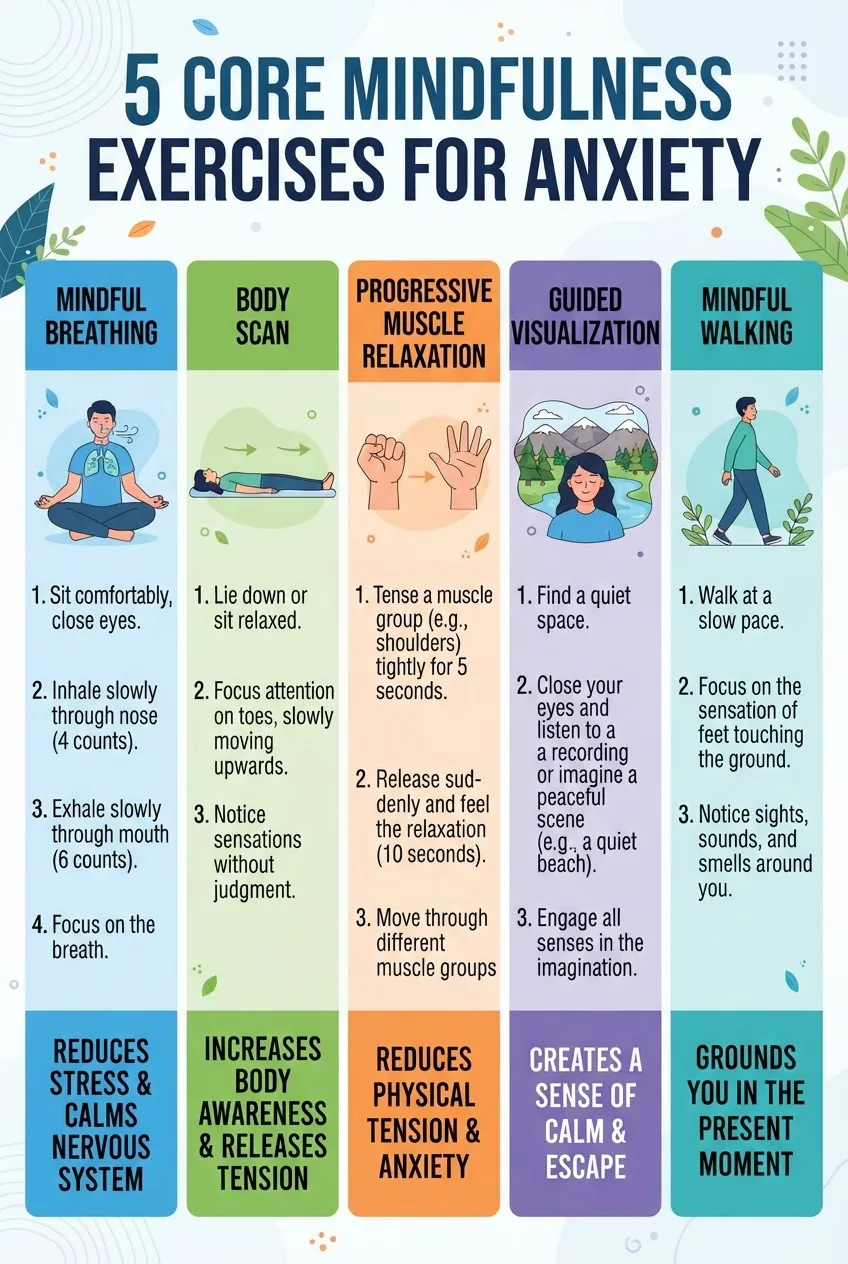
This section contains the core practice steps: each item is a self-contained exercise with timing, positioning, and progress markers. Use the breathing, body scan, progressive muscle relaxation, and mindful walking as your foundation. For focused breathing protocols and extra paced-breath work see breathing meditation exercises.
-
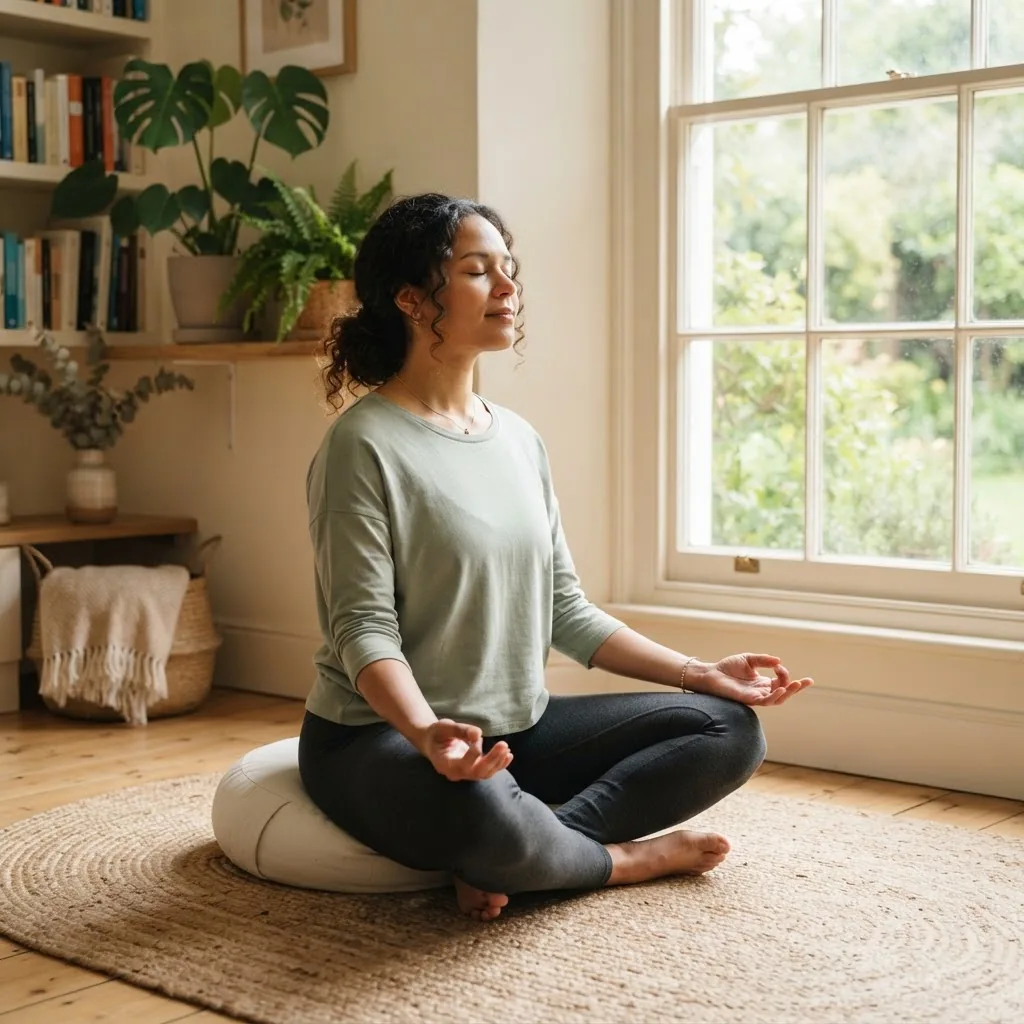
Practice mindful breathing (3–10 minutes).
- Position: Sit upright with feet on the floor or cross-legged on a mat; hands rest on thighs.
- Timing: Start with 3 minutes, build to 10 minutes. Use a timer set to silent.
- Steps:
- Close or lower your eyes. Take three slow, full breaths to settle (inhale 4s, exhale 6s).
- Bring attention to the physical sensations of breathing — the rise at the chest or belly, the coolness at the nostrils.
- When the mind wanders, gently label “thinking” and return to breath; do not judge the distraction.
- Finish by taking two deeper breaths and noticing any shift in body tension.
- Progress marker: After 2 weeks daily practice, you should be able to stay with the breath for 5 uninterrupted minutes.
-
Perform a mindful body scan (10–30 minutes).
- Position: Lie on your back with knees bent and feet on the floor or lie straight with a blanket under knees; arms relaxed at sides.
- Timing: 10 minutes for a short scan, 20–30 minutes for the full MBSR-style scan.
- Steps:
- Begin by noticing the contact points (heels, calves, sacrum). Breathe into any areas of tension for 3–5 breaths.
- Move attention slowly from toes → feet → calves → knees → thighs → hips → lower back → abdomen → chest → shoulders → arms → hands → neck → face. Spend ~20–30 seconds at each region; linger longer on areas that feel tight.
- If you encounter strong emotion or discomfort, breathe into it and note “sensation” or “tightness” then return to scanning without trying to change it.
- Close with full-body awareness for 1 minute, noticing overall temperature and weight.
- Progress marker: After 4 weeks, many report lower baseline muscle tension and reduced evening rumination.
-
Use progressive muscle relaxation (PMR) for acute tension (12–20 minutes).
- Position: Sit or lie comfortably. Keep a small gap between inhales and exhales — do not hyperventilate.
- Timing: 12 minutes for a shortened protocol; 20 minutes for a full body PMR.
- Steps:
- Tense a muscle group for 5–7 seconds (e.g., fists), then release for 20–30 seconds and notice the difference.
- Work head-to-toe: forehead, eyes/cheeks, jaw, neck, shoulders, arms, fists, chest, abdomen, hips/glutes, thighs, calves, feet.
- Keep breathing steady; if tension spikes, reduce contraction intensity and extend release time.
- Progress marker: Use PMR when you notice acute physical tightness; after 3 sessions most people feel a measurable drop in perceived arousal on a 0–10 scale.
-
Practice guided visualization for settling the mind (8–15 minutes).
- Position: Sit or lie comfortably, use headphones for guided audio if available.
- Timing: 8–15 minutes.
- Steps:
- Choose a simple, safe image (shoreline, quiet meadow). Anchor the image with 3 sensory details (sound of waves, smell of salt, texture of sand).
- As intrusive thoughts appear, note them as “thought” and guide attention back to the image and its sensory features.
- End by naming one small intention for the next hour (e.g., “I will breathe for 1 minute before meetings”).
- Progress marker: Use when stress peaks; good for pre-sleep or post-trigger calming.
-
Do mindful walking (5–20 minutes).
- Position: Outdoors or a quiet indoor corridor. Walk at a slightly slower pace than normal.
- Timing: Start with 5 minutes, build to 20 minutes.
- Steps:
- Focus on the rhythm of lifting and placing each foot. Feel weight shift through heel → midfoot → toes.
- Coordinate breath to steps if helpful (e.g., inhale 3 steps, exhale 3 steps).
- If the mind drifts to worry, note “wandering” and repeat focus on the next footstep.
- Progress marker: After regular practice, mindful walking becomes an effective micro-reset between stressful tasks.
-
Apply cognitive-behavioral mindfulness (labeling and defusion) (5–15 minutes).
- Position: Any seating; use a journal if possible.
- Timing: 5–15 minutes.
- Steps:
- When a worry arises, write a short label: “future worry: [topic]”.
- Practice defusion: say the worry phrase aloud as “I am having the thought that…” then return to breath for 1–2 minutes.
- Rate the intensity on a 0–10 scale before and after the exercise to track change.
- Progress marker: Expect easier perspective-taking on repetitive worries after 2–4 weeks.
Trade-offs and suitability: breath work is fastest for immediate calming; body scan is deeper for somatic anxiety; PMR is ideal when muscle tension dominates. Some people find visualization triggers rumination — switch to breath or walking if vivid imagery intensifies worry.
Transition: The following section gives three guided meditation exercises designed specifically for anxiety with explicit scripts and timing you can follow.
Guided Meditation Exercises Specifically for Anxiety
Below are three guided exercises with stepwise instructions and sample phrases. Use headphones and a quiet place when possible. If you want shorter scripts for quick practice see 2-minute guided meditation scripts and 3-minute meditation techniques.
-
Ground-and-breathe guided grounding (5 minutes).
- Position: Seated. Timer: 5 minutes.
- Script steps:
- Start with three grounding breaths: inhale 4s, hold 1s, exhale 6s.
- Say quietly to yourself: “I feel my feet on the floor, I am supported.” Repeat three times.
- Scan for one place of contact with the chair or ground and focus on the sensation for 60 seconds.
- Return to breath for the remainder of the time, noting each inhale and exhale once.
- When to use: immediate pre-meeting or when panic cues start.
-
Soften-and-notice body scan with compassionate inquiry (12–20 minutes).
- Position: Lying down or reclined. Timer: 12–20 minutes.
- Script steps:
- Begin with 3 grounding breaths. Set a gentle intention: “May I be kind to my anxious body.”
- Move attention body region to region; at each point say: “I notice [sensation].” Then add: “May this soften” and wait 3 breaths.
- If strong emotion arises, place a hand over the area, take five soft breaths, and continue.
- When to use: nightly routine or after a stressful event that leaves physical tension.
-
Visualisation for worry containment (10 minutes).
- Position: Seated. Timer: 10 minutes.
- Script steps:
- Begin with breath for 1 minute. Visualize a small container (box, jar) beside you.
- For each worry that arises, name it silently and imagine placing it into the container. Close the lid gently.
- Every few minutes, shift attention to the physical sensations of breath and body to avoid over-engagement with imagery.
- When to use: good before a focused work period, or when chores/tasks are being interrupted by worry.
Practical tips for guided practice:
- Use a gentle recorded voice you trust for longer meditations.
- Start with a shorter time than feels comfortable — success is consistency, not duration.
- If a guided exercise increases anxiety, stop, return to grounding breaths, and shorten the next session by 50%.
Transition: These exercises are powerful when integrated into daily life; next we show practical ways to weave mindfulness into routines so anxiety is managed continuously, not only during formal practice.
Integrating Mindfulness Practices into Daily Life to Manage Anxiety
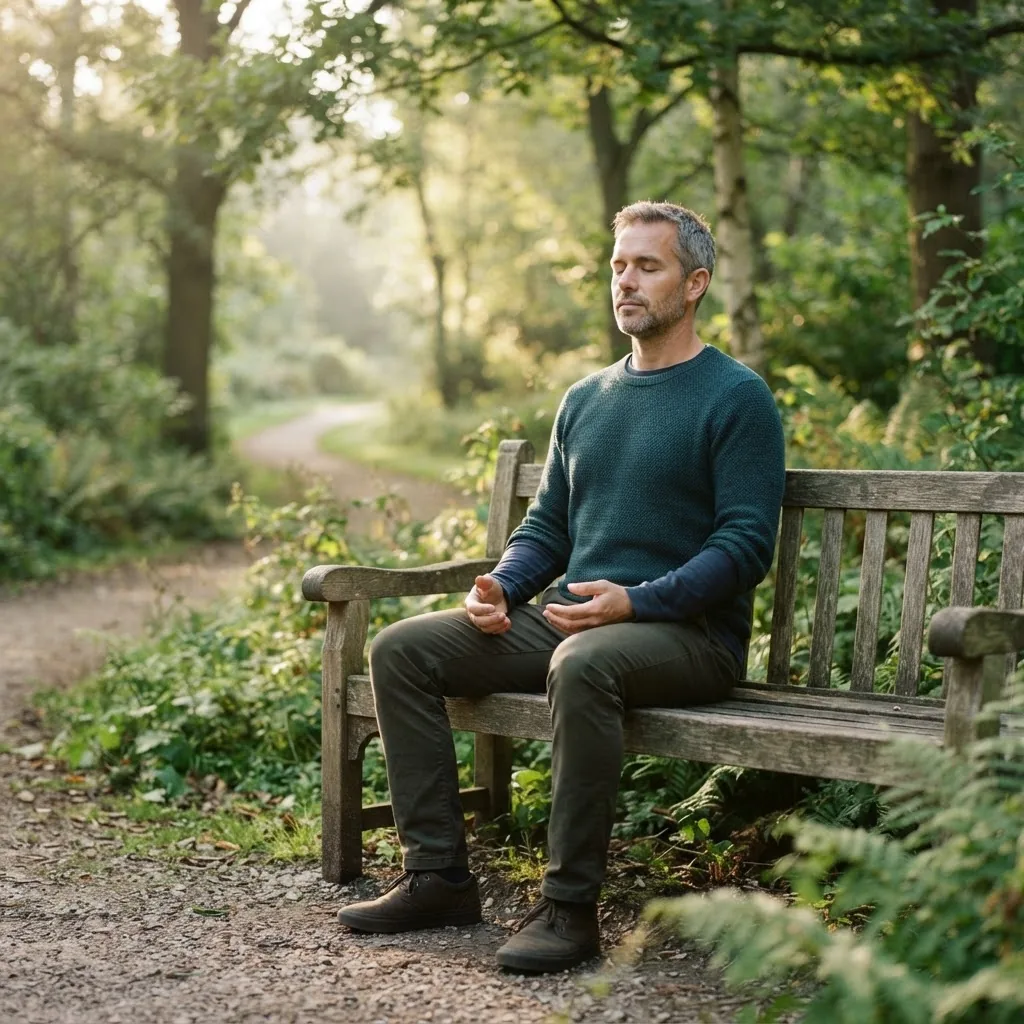
Integration increases resilience. Below are concrete strategies and a set of best practices you can adopt immediately to make mindfulness part of your day and reduce chronic worry.
Daily structure (examples with timings):
- Morning (5–10 min): 3–5 minute mindful breathing + intention setting.
- Midday (3–5 min): Ground-and-breathe before a stressful meeting or task.
- Evening (10–20 min): Body scan or guided visualization before sleep.
Best practices:
- Choose consistent triggers: attach a 3-minute practice to habitual anchors (after brushing teeth, before lunch).
- Keep a practice log: date, duration, technique, pre/post anxiety rating (0–10).
- Use micro-practices: 1-minute breathing checks before answering calls or after news alerts.
- Set realistic frequency: start with 5 days/week, 10 minutes/day for 4 weeks.
- Pair mindfulness with movement: see complementary ideas like the 30 day yoga challenge or read about yoga for anxiety relief benefits.
Micro-habits to lower daily anxiety:
- Start meetings with a 30-second shared breath (if appropriate).
- Use walking meetings as 10-minute mindful walking practice.
- Design a pocket toolkit: 3-minute breathing script, PMR quick cues, and a visualization anchor.
Transition: If you want to deepen practice beyond self-guided exercises, here are advanced intervention options, comparisons, and resources to help you choose the right path.
Advanced Mindfulness-Based Interventions and Resources for Anxiety Relief
For persistent or severe anxiety, structured MBIs and professional guidance provide more intensive training and support. Below is a concise comparison and curated resource list.
| Intervention | Format & Duration | Best when |
|---|---|---|
| MBSR (Mindfulness-Based Stress Reduction) | Group course, 8 weeks, weekly 2–2.5 hour sessions + home practice | You want structured training with teacher feedback. |
| MBCT (Mindfulness-Based Cognitive Therapy) | 8-week group program integrating CBT elements | History of recurrent anxiety or depression; relapse prevention focus. |
| Guided online courses & apps | Self-paced with recorded sessions; variable duration | Good for accessibility and low-cost continuation of practice. |
| Individual therapy with mindfulness orientation | One-on-one; integrates mindfulness into therapy | When anxiety co-occurs with trauma or complex clinical needs. |
Resource list and brief comparisons:
- mindfulness exercises for anxiety guide — full pillar resource for in-depth techniques and program links.
- advanced stress relief tools — tools and tech to augment mindfulness (biofeedback, wearables).
- counseling and therapy options — when to combine mindfulness with psychotherapy.
Official training references and external authority:
- University of Massachusetts Center for Mindfulness — origin site for MBSR and teacher training.
- National Institute of Mental Health — resources on anxiety disorders and research summaries.
- Anxiety and Depression Association of America — clinical resources and patient guides.
When to choose which intervention (quick guide):
- Use MBSR for generalized stress and building long-term practice habits.
- Consider MBCT when anxiety coexists with depressive relapse risk.
- Use individual therapy to address trauma, complex comorbidities, or when mindfulness practice triggers strong distress.
Practical access tips: verify instructor qualifications (MBSR teacher training or equivalent), ask for session outlines, and look for courses that include home practice assignments and teacher feedback.
Transition: Finally, the short FAQ section below answers common practical questions concisely so you can take immediate action.
Common mistakes and how to avoid them
I often saw learners try to “silence the mind” on first practice; that led to frustration and dropout. I now teach noticing as the skill: label distractions and return to the anchor. Another mistake: rushing long scans; I advise starting at 10 minutes and increasing by 2–5 minutes weekly.
Practical checklist
- Set a consistent daily time for practice (5–30 minutes).
- Have a timer and a quiet space ready.
- Record pre/post anxiety ratings for at least 14 days.
- Rotate techniques: breathe, body scan, PMR, visualization, walking.
- After 4 weeks, reassess: do you feel a measurable decrease in baseline worry?
When to call a professional
Seek professional help if anxiety includes severe panic attacks, suicidal thoughts, or functional impairment at work or home. For therapy and clinical options, consult resources on counseling and therapy options or contact local mental health services.
Final practical note: mindfulness is a skill trained over weeks and months; it is not a quick fix but, with consistent practice, reliably reduces worry and improves stress tolerance.