Naturopathic doctor training: by the end of this guide you’ll know the exact step-by-step pathway to become a licensed ND, realistic timelines (typically 6–8 years end-to-end), and the entry skill level required (bachelor’s or equivalent, science background recommended).
This hands-on guide assumes you are a motivated undergraduate or career-changer ready to commit to multi-year clinical training. Read through the “Before you start” checklist and follow the numbered steps to map your path precisely.
What Is a Naturopathic Doctor?
Naturopathic Doctor (ND) refers to a clinician trained in systems of primary care that combine modern clinical diagnostics with natural therapies and prevention-focused care. NDs complete accredited naturopathic medical school curricula emphasizing clinical reasoning, physical examination, laboratory interpretation, and therapeutic decision-making within the scope of naturopathic medicine.
The term naturopathic physician is used in jurisdictions where NDs hold primary care credentials similar in presentation (history, exam, diagnosis) to allopathic doctors, though training philosophy and legal scope often differ. “What is an ND?” usually centers on three differences: training model (holistic and therapeutic order), treatment toolbox (nutrition, lifestyle, botanical, physical modalities, sometimes prescription medicines), and scope of practice as defined by regional licensing.
Many NDs present themselves as a holistic doctor or natural medicine doctor, focusing on root-cause assessment, preventative plans, and individualized therapies. They commonly integrate laboratory testing, evidence-based nutrition, and patient-centered counseling into care plans.
Common modalities encountered in ND practice include clinical nutrition, lifestyle coaching, physical medicine, and botanical supplements. For an extended primer on how NDs commonly incorporate supplements into care, see herbal supplements and natural medicine uses.

As a practitioner-focused definition: an ND is trained to evaluate health through biomedical and lifestyle lenses, provide conservative therapeutic interventions, and coordinate care with other health professionals where appropriate. Naturopathic medicine is distinct from informal “herbalist” training because it requires structured clinical education and supervised patient care.
Transitioning to the training pathway: the next section gives a step-by-step plan from undergraduate through licensure.
Training Path to Become a Certified Naturopathic Doctor
This section is structured as a precise, sequential workflow you can follow. Expect to spend 6–8 years total: 3–4 years undergraduate (if needed) + 4 years in an accredited naturopathic medical school; time varies by prior credentials and part-time study options.
Before you start
- Bachelor’s degree or 90+ quarter/60+ semester credit hours in science prerequisites (biology, chemistry, anatomy) where required.
- Basic tools: reliable laptop, access to clinical shadowing sites, budgeting plan for tuition (see cost FAQ below), and time to commit 40+ hours/week during clinical years.
- Documentation: academic transcript, letters of recommendation (2–3), CV/resume, and personal statement highlighting healthcare commitment.
- Licensing research: decide target practice region and review local scope of practice before enrolling.
Core steps below use bolded action-first openings so you can tackle each item as a discrete milestone.
-
Confirm prerequisites and academic readiness.
Check the specific naturopathic medical school requirements for any program you target. Most accredited schools expect undergraduate coursework in biology, general chemistry, organic chemistry or biochemistry, and human anatomy/physiology. If you lack these, plan 1–2 semesters to complete them. Typical GPA thresholds: 3.0+ overall, 3.2+ science recommended.
-
Choose accredited programs and apply.
Target schools recognized by the North American accreditor (Council on Naturopathic Medical Education, CNME) or regional equivalents. Application cycles mimic medical schools—prepare for interviews, submit official transcripts, and demonstrate clinical exposure (50–200 hours of shadowing commonly expected). Popular accredited naturopathic schools in North America, Australia, and Europe vary; always verify current accreditation on the school’s site and accreditor listings.
-
Secure funding and create a financial plan.
Estimate tuition (often AU$20k–40k/year or US$15k–35k/year for private schools) and living costs. Apply for student loans, scholarships, and part-time clinical assistant roles during preclinical years. Track tuition and living costs with a three-year budget plan for the 4-year ND program horizon.
-
Complete the ND curriculum (year-by-year focus).
Naturopathic doctor degree programs typically run four years. Years 1–2 emphasize biomedical sciences (pathophysiology, biochemistry, microbiology), clinical skills (history-taking, physical exam), and foundational naturopathic therapeutics (nutrition, botanical medicine overview). Years 3–4 move into supervised clinical rotations across specialties (women’s health, pediatrics, endocrinology) with 1,000+ clinical hours required in many programs.
Example student progression: Year 1—foundations + 12 credit hours; Year 2—systems pathology + 15 credits; Year 3—integrative therapeutics + supervised clinical practice 200–400 hours; Year 4—intensive clinic internship with 400–600 clinical hours and case-management responsibilities. According to a 2024 NBOME program summary, most accredited ND programs require at least 1,200 clinical training hours (source type: accreditor program summary, 2024).
-
Pass national board examinations.
After completing an accredited ND degree, candidates must pass board exams set by national bodies—commonly the National Board of Osteopathic Medical Examiners equivalent for naturopathy is the NBOME’s NPLEX or successor exams in jurisdictions that recognize them. Plan for a 3–6 month dedicated study window and use official practice exams. According to a 2023 licensing report, first-time pass rates range by cohort (source type: NBOME annual pass-rate report, 2023).
External authoritative reference: National Board of Naturopathic Medical Examiners (NBOME).
-
Apply for regional licensure and meet local requirements.
Licensing varies: some states/provinces recognize NDs as primary care providers with defined prescribing rights, others limit practice to non-prescription therapies. Prepare to submit diploma, official transcripts, background checks, and exam scores to the licensing board in your target region. Consult the regional health department or licensing board for updated statutes before making educational commitments.
External authority for jurisdictional guidance: World Naturopathic Federation and your local government health department site for legal requirements.
Canada naturopathy certification requirements should be consulted by Canadian candidates.
-
Establish supervised practice and complete mentorship hours.
Many licensing boards require post-graduate supervised practice or mentorship (100–500 hours depending on the jurisdiction). Arrange mentorship with a licensed ND or integrative clinic and document case logs. Keep detailed clinical records and case studies, which will support advanced credentialing or specialty training.
-
Pursue optional postgraduate residencies or specialty training.
Residencies (1–2 years) deepen clinical skills in areas like integrative oncology, endocrinology, or pediatrics. If you plan to specialize in areas such as natural cancer care, consider integrated training and collaboration with oncologists. For career pathways in integrative oncology, see natural cancer treatments and herbal remedies.
-
Set up clinical practice and credentialing.
Decide on private practice vs joining a multidisciplinary clinic. Apply for provider numbers, professional indemnity insurance, and establish referral relationships with MDs and allied health professionals. Track continuing education (CE) units—licensure usually requires 20–50 CE hours annually.
For business and referral questions, include local insurance considerations and billing codes early in your practice plan; see insurance coverage for naturopathic doctors.
-
Maintain certification and ongoing professional development.
Renew licensure per your board’s cycle (commonly every 1–3 years) and meet continuing education requirements. Join professional associations for access to peer-reviewed practice guidelines and updated scope-of-practice interpretations. Use peer-reviewed journals and association statements when implementing new therapeutic approaches.
-
Consider advanced qualifications or academic roles.
Options include research degrees (MSc/PhD), postgraduate diplomas in integrative disciplines, or teaching positions at naturopathic colleges. These paths enhance authority for academic or hospital-integrated roles.
Practical note: if you are comparing herbalist or botany-focused training with ND clinical training, review programs focused on botanical science separately. For background in botanical sciences, consult the botany and herbalism training overview and plan any supplementary coursework accordingly.
Real student example: a candidate with a biology BS completed two preclinical years while working part-time, then took 6 months to study for boards—total time to license: 7 years from the start of undergraduate studies.
Naturopathic Doctor Degree: On-Campus vs Online Options
Choosing between an in-person naturopathic medicine degree and an online route matters for accreditation, clinical hours, and eligibility for licensure. Below is a compact comparison table with practical pros/cons, accreditation considerations, and probable outcomes.
| Feature | On-Campus ND Degree | Online ND Degree / Hybrid |
|---|---|---|
| Clinical Hours | Integrated supervised clinic hours onsite (1,000–1,500+ hours standard). | May include virtual coursework plus local supervised placements; verify clinical hour equivalence with license board. |
| Accreditation | Typically CNME or national accreditor-recognized; widely accepted by licensing boards. | Fewer fully online ND degrees hold full accreditation; hybrid programs can be acceptable if clinical components meet accreditor standards. |
| Learning Experience | Hands-on physical exam labs, live peer interactions, on-site mentorship. | Flexible for working students; risk of reduced hands-on practice unless local partnerships exist. |
| Licensing Outcomes | Graduates typically eligible for standard licensure exams without extra documentation. | Eligibility may require proof of supervised clinical hours and program accreditation; some boards disallow fully online degrees. |
| Cost and Time | Often higher living costs due to relocation; structured schedule can shorten completion time. | Lower relocation cost but potential extended timeline if part-time; verify total credit load and clinical placement availability. |
Key considerations when evaluating online programs:
- Confirm CNME or equivalent accreditation and explicit licensure acceptance in your target jurisdiction.
- Map how clinical skills labs and patient care hours are delivered and who supervises them locally.
- Ask for alumni licensing outcomes and first-time board pass rates—request documented statistics from the program (source type: program outcome report, 2023 or 2024).
If you specifically seek an online naturopathic degree, many programs offer hybrid models where didactic coursework is delivered online but clinical rotations are in-person. Fully remote ND degrees are rare and may limit your ability to sit for licensing exams in many regions.
Transition sentence: having chosen a program, the next section explains how long each stage takes in a timeline you can follow.
Duration and Timeline for Becoming a Naturopathic Doctor
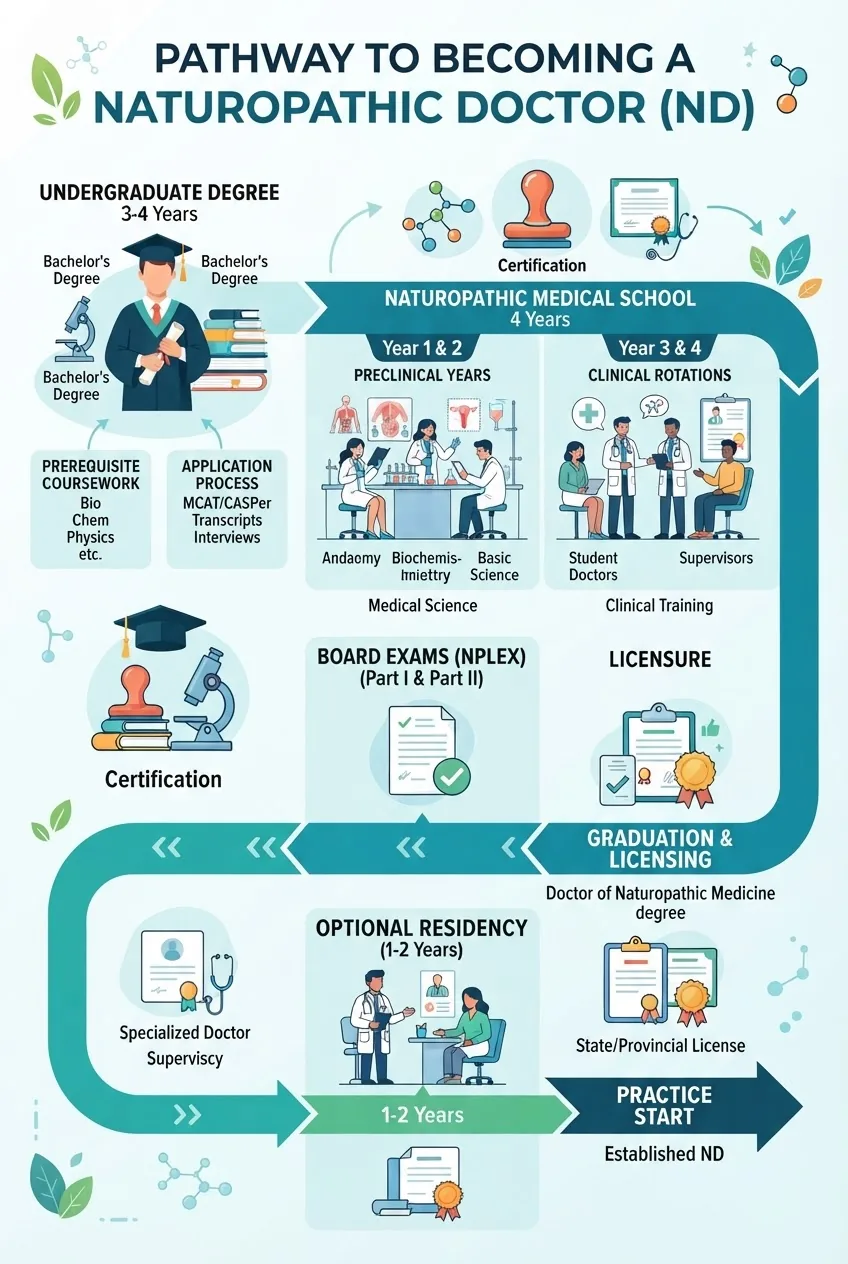
Typical timeline (median pathway):
- Undergraduate prerequisites: 0–4 years depending on prior education (target: 90+ quarter/60+ semester credits in sciences).
- Admissions cycle: 6–12 months for applications, interviews, and acceptance.
- Naturopathic medical school: 4 years full-time (approx. 48 months) with cumulative clinical hours ≥1,000 depending on program.
- Board preparation and exams: 3–6 months intensive study following graduation.
- Licensure processing: 1–6 months depending on board verification, background checks, and residency requirements.
- Optional residency/specialty: 1–2 years (if pursued).
Minimum realistic timeline for someone entering directly after an appropriate bachelor’s: 4 (ND program) + 0.5 (boarding) + 0.5 (licensure) = ~5 years to practice in jurisdictions that allow immediate licensure post-graduation. Most students should plan 6–8 years total to account for prerequisites, part-time study, or residency choices.
Practical milestones to schedule into a calendar:
- Start prerequisites by January or August semester to match application deadlines.
- Take admissions exams/interviews in the academic year before matriculation.
- During Year 3 of ND school, schedule clinical rotations 6–12 months in advance to secure preferred specialty sites.
Certification, Licensing, and Scope of Practice for Naturopathic Doctors
Certification and licensing are the two governance layers you must satisfy to practice as a recognized ND. Certification (board exams) demonstrates clinical competence; licensing grants legal permission to practice within a regulatory framework.
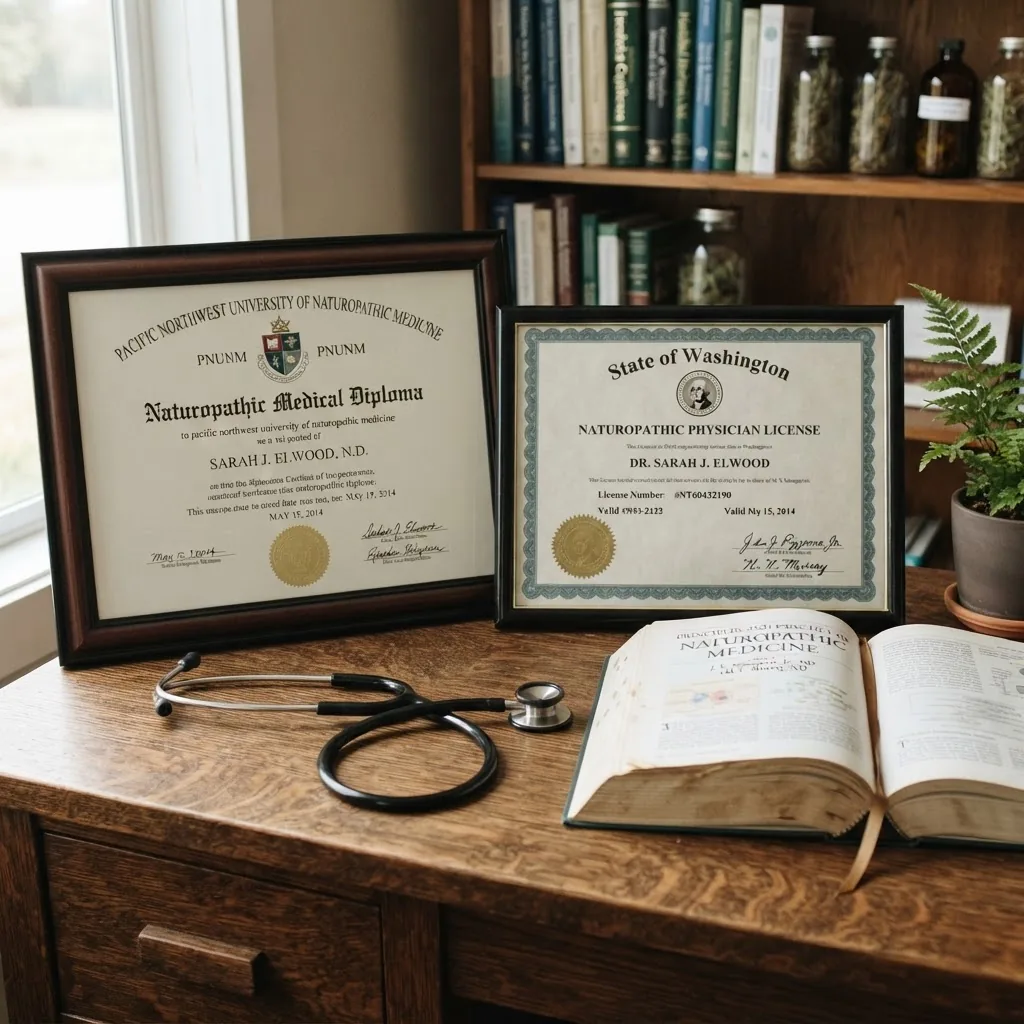
Key points about certification and licensing:
- Board exams: Many jurisdictions require passing a national board exam (commonly administered or endorsed by NBOME). Check this resource: https://www.nbome.org for current exam formats and study materials.
- Licensing boards: Each state/province/territory defines scope of practice (prescribing rights, ordering diagnostics). Refer to national and regional licensing boards; for international coordination use World Naturopathic Federation as an international reference.
- Regional variability: Some U.S. states and Canadian provinces license NDs with defined prescriptive authority; others permit limited practice or no statutory recognition. According to a 2024 regulatory summary published by several state boards (source type: compiled licensing board summary, 2024), about 15 U.S. states provide ND licensure with varying controlled substance restrictions.
- Documentation: Typical licensure package includes diploma, official transcripts, exam scores, two professional references, and background checks. Turnaround time: 4–12 weeks once submitted in many jurisdictions (source type: licensing board processing data, 2023).
Scope of practice considerations (bullet points for clarity):
- Prescribing rights: Vary widely—some regions allow limited prescription privileges; others restrict to non-prescription modalities. For detailed prescribing rights by jurisdiction see can naturopathic doctors prescribe medication?
- Lab orders and diagnostics: Many licensed NDs can order labs and imaging within scope of practice; checks with local boards are essential.
- Primary care and referral: In licensed jurisdictions, NDs may function as primary care providers and must know referral thresholds for specialist care.
- Insurance and billing: Eligibility for insurance reimbursement differs; check local insurer policies and professional association guidance. For payor details see insurance coverage for naturopathic doctors.
Case study reference: A licensed ND in Oregon reported finishing a CNME-accredited program, passing national boards on first attempt, and receiving state licensure within 10 weeks after submission (source type: practitioner case study, 2023). Case studies like this illustrate typical timelines but expect variation.
Caveats and trust signals: Online-only ND degrees may not be recognized for licensure in all jurisdictions—always verify before enrollment. Regional laws change—use up-to-date government health department resources when planning (source type: government health department notice, 2024).
Naturopathic Doctor vs MD: Key Differences Explained
Below is a concise side-by-side comparison to clarify training pathways, scope, and practice orientations between an ND vs MD.
| Aspect | Naturopathic Doctor (ND) | Medical Doctor (MD/DO) |
|---|---|---|
| Philosophy | Holistic, prevention-focused, therapeutic order model. | Disease-focused, evidence-based, procedural and pharmacologic interventions. |
| Training length | 4 years post-bachelor ND program plus licensure; many require residency for specialties. | 4 years medical school + 3–7 years residency depending on specialty. |
| Clinical experience | Extensive supervised clinic hours focused on integrative care; less procedural training. | High-volume hospital and surgical training during residency with procedural competencies. |
| Prescriptive authority | Varies by jurisdiction; may be limited or comprehensive where statute allows. | Licensed to prescribe a full range of medications where regulated as MD/DO. |
Explanation paragraphs: while both professions assess, diagnose, and manage patient care, the clinical lens differs. MDs receive deep hospital-based and specialty procedural training, while NDs emphasize lifestyle, nutrition, and conservative natural therapies alongside biomedical assessment. The question “is an ND a real doctor?” depends on legal recognition: where NDs are licensed, they are legally recognized as doctors within their scope—see the certification section for jurisdictional detail.
Career Opportunities and Specializations for Certified NDs
After licensure, NDs have a range of career paths and specializations. Below are concrete options with short profiles and typical practice settings.
- Primary care clinician (private practice): Run a solo or group clinic; typical startup costs AU$15k–30k for equipment and initial operating expenses. Average patient load target: 20–30 consults/week in year one to achieve sustainability.
- Integrative oncology specialist: Collaborate with oncologists to provide supportive care, symptom management, and quality-of-life strategies; requires postgraduate training and familiarity with oncology protocols. For training resources, see natural cancer treatments and herbal remedies.
- Nutrition and metabolic health clinician: Focus on diabetes, obesity, and metabolic syndrome using testing and individualized nutrition plans. Many NDs co-manage with dietitians or refer to a holistic dietitian.
- Women’s health and fertility: Provide hormone management, prenatal counseling, and fertility support; often work with reproductive specialists.
- Pediatrics and family practice: Offer developmental, nutritional, and preventative care across life stages.
- Academic or research roles: Teach at naturopathic schools or participate in clinical research; advanced degrees helpful.
- Corporate or consultant roles: Wellness program design, telehealth services, and occupational health consulting.
NDs also routinely employ botanical dietary supplements benefits and capsule herbal supplements benefits as part of treatment plans where appropriate, always checking for drug-herb interactions via evidence-based tools.
If you’re preparing to start a clinic, a practical first-year checklist includes registering a business, obtaining professional indemnity insurance, securing a clinical space, budgeting for marketing, and establishing a triage and referral policy. For locating clinics or career placement, see finding certified naturopathic clinics near me.
Common Misconceptions about Naturopathic Doctors
The following myth vs fact statements address frequent misunderstandings.
- Myth: NDs are not “real doctors.” Fact: Where licensed, NDs are legally recognized and hold doctor-level qualifications in naturopathic medicine; the title “doctor” reflects clinical doctorate-level training, though scope of practice is governed by regional law.
- Myth: NDs only use herbs and avoid diagnostics. Fact: Most accredited ND programs teach diagnostics, laboratory ordering, and evidence-based integration of natural therapies with conventional care.
- Myth: All ND programs are available fully online. Fact: Fully online ND degrees are rare and often not accepted for licensure; accredited programs include significant supervised clinical hours, frequently on-campus or in partnered clinics.
- Myth: NDs can prescribe any medication everywhere. Fact: Prescriptive authority varies; in some regions NDs have limited to full prescribing rights, in others none. Check local boards for definitive rules.
Hands-On Guide: Common mistakes and how to avoid them
From personal practitioner experience:
- I once assumed online coursework would automatically cover clinic hours; it did not, and I had to arrange local preceptor placements late. Avoid this by confirming supervised clinic logistics before enrolling.
- I underestimated board preparation time—planning only four weeks was insufficient. Allocate 3–6 months for focused study with practice exams.
- I delayed checking state licensing statutes until after graduation; one program’s curriculum required an extra clinical log for my state. Check your target state/province licensing rules up front.
Final checklist before you call yourself an ND
- Graduated from an accredited ND program (confirm CNME or recognized accreditor).
- Completed required supervised clinical hours (documented case logs).
- Passed national board exams required by your licensing board.
- Submitted licensure application with all supporting documents and background checks.
- Secured professional indemnity insurance and any required provider numbers.
When to call in a professional
If you encounter ambiguous accreditation status, inconsistent clinical-hour reporting from a program, or conflicting licensing advice, contact your regional licensing board or an experienced ND mentor before proceeding. For exam or board disputes, contact NBOME or your national board directly.
Closing summary: by following the practical steps above—confirm prerequisites, choose accredited programs, document clinical hours, pass boards, and apply for licensure—you can navigate the ND pathway in a predictable, evidence-informed way. If you are ready to start, review program accreditation statements and licensing statutes now; then schedule your first prerequisite coursework or application timeline.
Call to action: If you want a quick assessment of your pathway, compile your transcripts and target jurisdiction and consult an admissions advisor at an accredited naturopathic school or contact your regional licensing board for tailored guidance.