
By the end of this hands-on guide you will have a clear, actionable plan to find, evaluate, and use leading journal complementary and alternative medicine resources for literature reviews, evidence summaries, or research submission. Estimated time: 60–120 minutes for practical setup and a weekly 2–6 hour routine for ongoing literature tracking. Skill level: intermediate (comfortable with basic academic search tools and critical appraisal).
Before you start
- Access: institutional library login or an account on PubMed/Scopus and a reference manager (Zotero or EndNote).
- Tools: spreadsheet (Excel/Google Sheets) for tracking, Zotero/EndNote for citations, PDF reader, and a note-taking app.
- Knowledge: familiarity with basic research designs (RCT, cohort, case series) and statistics at an interpretive level.
- Account setup: free accounts on PubMed and Google Scholar alerts; consider ResearchGate for author contact.
Transition: With that setup complete, we begin by framing what these journals cover and why a targeted approach to CAM literature will save you time and improve evidence-based decisions.
Introduction to Journal Complementary and Alternative Medicine
Complementary and Alternative Medicine (CAM) refers to a group of health care approaches developed outside of mainstream Western medicine, including herbal medicine, acupuncture, mind–body therapies, manual therapies, and traditional systems such as Ayurveda and Traditional Chinese Medicine. Journals dedicated to CAM publish peer-reviewed scientific research, reviews, clinical trials, systematic reviews, and case reports that test safety, efficacy, mechanisms, and real-world implementation of these therapies.
Why a journal-focused strategy matters: CAM literature is multidisciplinary—spanning pharmacology, clinical trials, psychology, ethnobotany, and public health—so targeted journals help you find methodologically relevant work faster. Many CAM journals also publish integrative health research linking alternative interventions with conventional care models.
If you want broader terminology, definitions, and an integrative-care framework before proceeding, see CAM and Integrative Care for the site’s pillar overview of CAM terms and care models.
How journals fit into evidence-based practice: CAM journals can be both sources of novel clinical research and fora for methodological debate about how to adapt randomized controlled trials, pragmatic trials, and qualitative methods to complex interventions. Expect a spectrum from highly controlled efficacy trials to pragmatic, real-world outcome studies.
Transition: Next, review the top journals you should track and why each one matters for specific CAM research questions.
Top Journals for Complementary and Alternative Medicine Research
- Journal of Complementary and Alternative Medicine — This eponymous journal publishes original research, systematic reviews, and commentaries on CAM interventions, mechanisms, and health policy. Indexed in several databases; typical publication frequency: monthly. Look for articles on clinical trials and policy analysis; editorial boards often include clinicians and translational researchers.
- Journal of Alternative and Complementary Medicine — One of the oldest CAM journals, focused on clinical research, translational studies, and teaching innovation. Impact metrics vary by year; frequently cited for acupuncture, herbal clinical trials, and integrative oncology pilot studies.
- BMC Complementary Medicine and Therapies — An open access journal (BioMed Central) publishing basic science, clinical trials, and methodology papers. Useful for researchers who need rapid open access dissemination and for systematic reviewers because of its clear data availability statements.
- Complementary Therapies in Medicine — Publisher: Elsevier; emphasis on clinical and health services research, pragmatic trials, and implementation studies. Often indexed in Scopus and PubMed; useful for health-services-oriented CAM research.
- Integrative Medicine Research — Focuses on integrating CAM with conventional care, translational studies, and mechanistic research. Increasingly popular for workplace wellness and integrative clinical pathway reports.
- Evidence-Based Complementary and Alternative Medicine (eCAM) — Emphasizes methodological rigor, systematic reviews, and meta-analyses that test CAM efficacy against evidence-based standards.
- Journal of Ethnopharmacology — Strong on phytomedicine and traditional remedies with pharmacological assays and clinical correlation studies; essential for herbal medicine researchers.
- Phytomedicine — Focused on pharmacology of plant-based medicines, clinical trials, and safety profiles; often cross-referenced in systematic reviews and meta-analyses.
- Acupuncture in Medicine — Specialty journal for acupuncture research, mechanisms, and clinical trials; frequently referenced in guideline discussions and consensus statements.
- Explore: The Journal of Science and Healing — Cross-disciplinary coverage of mind–body medicine, integrative approaches, and translational research.

How I choose which journals to track: prioritize 1) indexing in PubMed or Scopus, 2) clear peer-review and ethical policies, 3) relevance to your clinical question (e.g., acupuncture vs herbal medicine), and 4) availability (open access or through your institution). For indexing checks use PubMed and Scopus search pages for the journal title — journals indexed in these databases are more discoverable and commonly used in systematic reviews.
Transition: Having identified target journals, learn how research standards and editorial policies determine which studies are publishable and trustworthy.
Understanding Research and Publication Standards in CAM Journals
High-quality CAM research adheres to conventional scientific standards while addressing unique challenges—complex interventions, individualized treatments, and cultural practices. Below I walk through the publication lifecycle and the specific standards and safeguards that journals apply to ensure credibility.
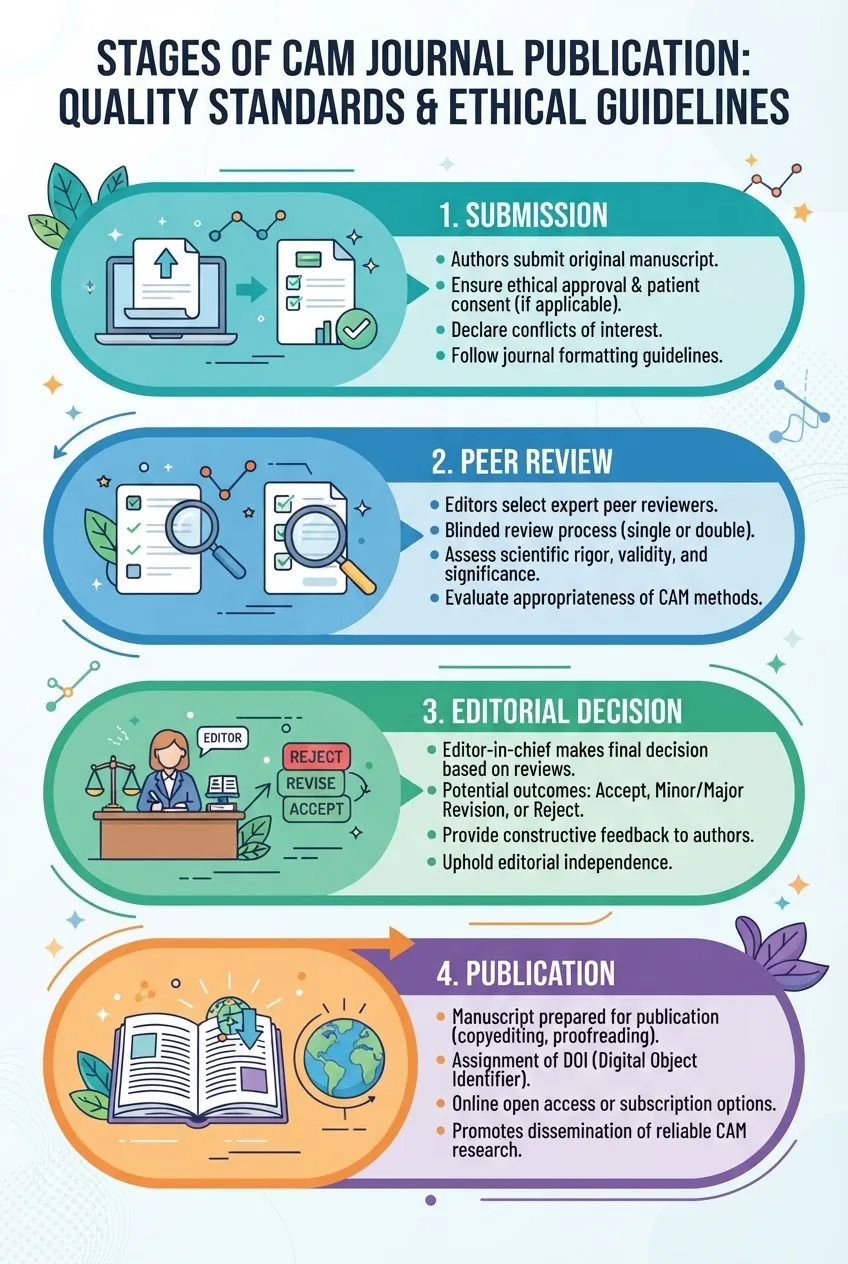
1. Submission: baseline checks and ethical declarations
- Authors must provide ethics approvals, trial registration numbers for clinical trials (e.g., ClinicalTrials.gov), and conflict-of-interest disclosures.
- Many journals now require data-sharing statements and trial protocols attached as supplements; this improves transparency for CAM studies where interventions vary by practitioner.
- Journals often ask for adherence to reporting guidelines (CONSORT for RCTs, PRISMA for systematic reviews, STROBE for observational studies).
2. Peer review process: the quality check
Peer review acts like a quality control gate. For CAM journals this typically involves at least two external reviewers with content and methodological expertise. Reviewers evaluate study design, sample size calculation, statistical methods, control conditions (e.g., sham acupuncture designs), and the plausibility of claimed mechanisms.
- Double-blind RCTs are preferred for efficacy claims; for complex or individualized therapies, pragmatic trials and mixed-methods studies may be appropriate when justified.
- Registered trials and a priori statistical analysis plans reduce publication bias and p-hacking; insist on trial registration and provide registry ID in the manuscript.
3. Editorial decision and ethics
Editors weigh reviewer feedback, scope fit, and ethical compliance. Journals have policies on human-subjects protection, informed consent, and authorship. Many CAM journals follow the Committee on Publication Ethics (COPE) guidelines. When evaluating manuscripts, watch for:
- Incomplete reporting of adverse events in herbal trials — this is a red flag requiring clarification.
- Unregistered trials or post-hoc subgroup claims without correction — may lead to rejection or request for reanalysis.
4. Publication and post-publication transparency
After acceptance, CAM journals often require data deposition or at least a data-availability statement. Post-publication, look for corrections, expressions of concern, or retractions—these are part of the self-correcting nature of science. For impact assessment, consider both citation metrics and alternative metrics (Altmetric scores) showing public engagement.
Research methodology standards specific to CAM
- Randomization and allocation concealment: essential for internal validity; describe random sequence generation and concealment method in detail.
- Blinding: When practitioner or patient blinding is impossible (e.g., manual therapies), use blinded outcome assessors and objective endpoints where possible.
- Standardization vs individualization: For individualized treatments (e.g., TCM herbal formulas), report diagnostic criteria, treatment algorithms, and core components so others can reproduce the intervention.
- Sample size and power: Aim for 80% power and alpha 0.05 for primary outcomes; show calculations and expected effect sizes based on pilot data or literature.
- Adverse event reporting: Quantify and report harms with denominators, timing, and severity grading.
Reproducibility and statistical integrity
CAM research faces reproducibility challenges: heterogeneous interventions and small pilot studies. To strengthen reproducibility, journals increasingly expect pre-registered protocols, raw data availability, and where possible, multi-center replication. For statistics, require transparency in primary vs secondary outcomes and report confidence intervals, effect sizes, and exact p-values.
Example of a notable CAM study and standards applied: A randomized trial comparing acupuncture, simulated acupuncture, and usual care for chronic low back pain (Cherkin et al., 2009, Archives of Internal Medicine) used randomized allocation, multiple arms including a sham control, and predefined primary outcomes—an example of how CAM trials can meet high methodological standards.
Transition: With standards clear, the next section provides step-by-step actions for accessing and using CAM journals effectively.
How to Access and Use Complementary and Alternative Medicine Journals Effectively
This section is the practical core: follow these numbered steps to set up your literature flow, perform searches, manage citations, and access full texts. Each step begins with a bold action phrase and includes exact settings, timings, and thresholds.
- Set up database accounts and alerts. Create accounts on PubMed (free) and Google Scholar (free). In PubMed, set up an automated My NCBI alert: use the search string “complementary therapies OR alternative medicine OR integrative medicine” and the specific journal name to receive weekly updates. Frequency: weekly; expected emails: 5–20 results/week depending on filters.
- Build precise search queries with MeSH and Boolean operators. Example PubMed query for acupuncture in chronic pain: (“Acupuncture Therapy”[MeSH] OR acupuncture[tiab]) AND (“Chronic Pain”[MeSH] OR “chronic pain”[tiab]); apply filters: Publication date last 5 years, Clinical Trial, Humans. Time to run: 2–10 minutes per query. Use similar Boolean logic in Scopus for broader indexing.
- Use database filters deliberately. In PubMed apply filters: Article types (Randomized Controlled Trial), Text availability (Free full text) for open access, and Publication date (last 5 years). In Scopus apply subject area filters (Medicine; Pharmacology; Complementary Medicine). Expected false positives: refine keywords using NOT operator to exclude unrelated fields.
- Create and maintain a citation library. Use Zotero or EndNote. Workflow: import search results in batches (50–200 records), tag by topic (e.g., “acupuncture_pain”), and attach PDFs. Backup weekly. Zotero suggested settings: sync full-text PDFs, enable duplicate detection, and use group libraries for team sharing.
- Access full texts: prioritize open access and institutional routes. For paywalled articles, try: 1) your institutional library proxy, 2) the journal’s open access options (article processing charges listed on publisher pages), 3) contacting corresponding author via ResearchGate or email, or 4) using interlibrary loan (typically 3–7 business days). Always record access date and route in your spreadsheet.
- Assess article quality quickly with a 5-point rapid appraisal. Score each article 0–5 on: randomized allocation (1), blinding or objective outcomes (1), sample size/power (1), registered protocol (1), adverse event reporting (1). Use a threshold: include in evidence table only articles scoring 3+ for consideration in systematic reviews.
- Extract data into standardized tables. Key fields: citation, population, intervention details (dose, frequency), comparator, primary outcome(s) with effect sizes and CIs, adverse events, funding source, trial registration. Time per article: 10–20 minutes for RCT; 5–10 minutes for observational.
- Track impact and updates with alerts and citation watches. Use Altmetric or PlumX (if available) for high-interest articles and set Google Scholar alerts for author names to catch follow-up work. Re-run systematic queries every 6 months for living reviews.
- Link journal use to education and career pathways. If you plan to integrate journal reading into formal study, consider related programs such as alternative medicine degree programs, which often teach advanced literature appraisal and research methods.
Transition: With these steps in place you can systematically harvest CAM evidence. The next section describes the most active research topics and emerging trends you’ll encounter.
Key Research Topics and Trends in Complementary and Alternative Medicine Journals
CAM journals reflect evolving clinical priorities and methodological innovation. Below I outline major topic areas, examples of active research, and where trends are moving in 2024–2026.
Integrative medicine research: looks at combining CAM with conventional care for chronic conditions, perioperative recovery, and cancer supportive care. Studies often evaluate patient-reported outcomes, health service utilization, and cost-effectiveness.
Herbal medicine and phytotherapy: continues to attract pharmacological and clinical research, particularly standardization of extracts, dose-response trials, and safety profiles. Ethnopharmacology journals provide mechanistic studies that feed into clinical trial development.
Mind–body therapies: robust growth in studies on mindfulness-based interventions, yoga, and cognitive approaches for chronic pain, anxiety, and sleep. Expect RCTs with active control arms and mechanistic work using biomarkers (e.g., cortisol, inflammatory markers).
Acupuncture and manual therapies: continued RCTs and pragmatic trials for musculoskeletal pain and postoperative recovery. Methodological focus is on sham controls, blinding strategies, and treatment standardization.
Clinical trials in CAM: are moving toward larger multi-center pragmatic designs and adaptive trials that accommodate individualized treatment plans; journals increasingly demand pre-registration and clear primary endpoints.
Examples of focused research topics (with related practical literature):
- Complementary oncology: supportive interventions for symptom control and quality of life in cancer care; for specific patient-focused evidence see research on alternative medicine for prostate cancer.
- Mental health: trials comparing mindfulness and other approaches to standard therapy — see reviews on mental health alternative treatments.
- Respiratory conditions: trials and case series for inhaled herbal therapies and breathing-based practices — see alternative therapies for asthma and allergies.
- Pain management: non-pharmacologic approaches such as acupuncture, manual therapy, and mindfulness — practical summaries can be found in effective alternative therapies for pain management.
- Advanced cancer care: investigations into integrative approaches that complement or reduce reliance on radiation therapy — related resources: alternative to radiation treatment.
- Women’s health and oncology: herbal and lifestyle interventions for ovarian cancer survivorship — see natural and holistic alternative treatment for ovarian cancer.
- Medical cannabis research: dose, formulation, and therapeutic use across conditions — see topical coverage in medical cannabis and therapeutic use.
Trend highlights for publishers and readers (2024–2026):
- Greater emphasis on open data and reproducibility; journals increasingly require data availability statements (According to a 2024 industry report on publishing practices).
- Growth of hybrid trials that combine quantitative outcomes with qualitative process evaluations to capture complex CAM interventions.
- Increased cross-indexing in mainstream databases (PubMed/Scopus), improving discoverability and citation rates for CAM research.
Transition: To support work in these topic areas you’ll want curated resources, funding guidance, and professional networks—covered in the resources section next.
Resources for Researchers and Practitioners Interested in CAM Journals
Below are reliable resources for finding literature, securing funding, collaborating, and staying current. Each entry includes how I use it in practice.
- PubMed (NIH) — Free literature database indexing many CAM journals and biomedical literature; use MeSH terms and filters. External authority: PubMed.
- Scopus — Broad indexing and citation analytics; useful for impact assessment and author networks. External authority: Scopus.
- National Center for Complementary and Integrative Health (NCCIH) — Funding announcements, research frameworks, and clinical practice resources. External authority: NCCIH.
- Research grants and funding portals — Monitor NIH/NCCIH calls, regional health research councils, and philanthropic sources. I keep a rolling spreadsheet with application deadlines and required documents, updating monthly.
- Professional networks and conferences — Join societies and attend conferences (e.g., international integrative medicine meetings) for collaboration and to identify special-issue opportunities.
- Institutional resources — Your university or hospital library typically provides interlibrary loan, publisher negotiation, and training on systematic review tools. For clinical application of research, consult practical guides like alternative health care center services and benefits.
- Professional certification and training — For clinicians integrating evidence into practice, look to certification programs; for example, board credentials in integrative medicine are helpful when applying research in clinical settings: board certified integrative medicine.
Transition: Despite these resources, CAM journal publishing faces ongoing challenges and opportunities—covered next with practical implications for authors and readers.
Challenges and Future Directions in CAM Journal Publishing
The field’s future depends on addressing reproducibility, bias, funding constraints, and embracing digital transformation. Below I outline the key challenges and specific future directions with practical recommendations.
Research bias and heterogeneity: CAM interventions are diverse and culturally rooted, which creates heterogeneity in study designs and outcomes. This can inflate between-study variance in meta-analyses and complicate guideline development. Recommendation: standardize core outcome sets for common conditions and require detailed intervention reporting.
Funding limitations: CAM research often relies on small grants or institutional funding. This constrains sample sizes and multi-center replication. Recommendation: pursue collaborative grants and phased funding (pilot → definitive trial) and transparently report pilot-study limitations.
Reproducibility crisis and transparency: Some CAM fields have historically published small, single-center studies with limited data sharing. Journals shifting to require data deposition, pre-registered protocols, and adherence to reporting guidelines will improve trustworthiness. According to a 2024 industry report on scientific publishing, mandatory data availability statements are becoming standard in high-tier journals.
Digital transformation: Open access, preprints, and post-publication peer review are reshaping dissemination. Preprints accelerate visibility but require cautious interpretation. Journals are experimenting with registered reports to lock in methods before data collection—this is promising for CAM trials with complex interventions.
Multidisciplinary collaboration: The future will favor teams combining clinical practitioners, statisticians, qualitative researchers, and cultural experts to design rigorous, context-sensitive CAM studies. Practical step: include statisticians at protocol stage and plan sample sizes for 80% power to detect clinically meaningful differences.
Transition: The hands-on portion below summarizes step-by-step actions to implement these practices in your own research or practitioner work.
Step-by-step implementation checklist (core hands-on steps)
- Identify 5 target journals within 30 minutes: choose one specialty journal (e.g., acupuncture), one open access (e.g., BMC Complementary Medicine and Therapies), two general CAM journals, and one mainstream journal that occasionally publishes CAM-relevant studies.
- Create PubMed alerts and Google Scholar notifications (10–20 minutes). Set frequency to weekly for PubMed and “as-it-happens” for Google Scholar if monitoring a high-priority author.
- Build a Zotero library and tag system in 60 minutes: create tags like “RCT_pain_2024” and “herb_toxicity”.
- Run focused searches using MeSH and Boolean logic (15–45 minutes per topic). Save search strings in a document with date and filters used.
- Appraise quickly with the 5-point checklist and add eligible articles to your extraction spreadsheet (10–20 minutes per article).
Common mistakes and how to avoid them
I’ve made these errors in early projects and learned practical workarounds:
- Failing to pre-register a trial — I once lost months when reviewers asked for a protocol; always register on ClinicalTrials.gov before recruitment.
- Overreliance on single databases — I missed key trials when I searched only PubMed; I now always include Scopus and regional indexes and check trial registries.
- Ignoring adverse events in extraction — early on I summarized only benefits; now I extract harms as a mandatory field and score articles lower if harms are poorly reported.
- Not recording search dates and filters — I had irreproducible search results later; I now log search strings, filters, and dates in a single master file.
Final checklist before using or publishing CAM evidence
- Target journals identified and alerts set.
- Search strategies documented with dates and filters.
- Citation library with PDFs and tags updated weekly.
- Rapid appraisal score applied; only include ≥3 in evidence tables.
- Protocol registration (for trials) and trial registry ID included.
- Data availability and adverse events clearly documented.
When to call in a professional
If your project requires advanced statistical modelling, multi-center trial coordination, regulatory compliance for herbal products, or manuscript submission to a high-impact journal, consult a biostatistician, clinical trials unit, or an experienced research methodologist. Expect hourly rates for consultants to vary widely; budget for 10–40 hours of support for full trial design and analysis planning.
Transition: Below are concise answers to common reader questions to help with immediate uncertainties.