
By the end of this guide you will understand the exact certification pathways, the training curriculum you need, and a clear timetable to become a practicing holistic life coach — achievable in 3–12 months depending on practicum hours and program intensity. This guide assumes you have intermediate people-skills and basic wellness knowledge.
What Is a Holistic Life Coach?
Holistic life coach describes a professional who supports clients across life domains — mental, physical, social and spiritual — using a mind-body-spirit approach to set goals and build habits. Rather than prescribing medical treatment, a holistic life coach acts as a guide, combining motivational interviewing, values clarification, goal-setting and practical wellness planning.
Practically, a session might begin with a 10–15 minute intake (current medications, sleep, stressors), a 30–40 minute coaching conversation using open questions and reflective listening, and a 10–15 minute action-plan creation. For example: a client struggling with burnout may use a 6-week plan combining sleep hygiene, boundary-setting exercises, and a daily 5-minute grounding practice tracked through a shared “wellness action plan.”
Holistic coaches draw on counseling techniques without performing therapy: they prioritize client-centered coaching, systems thinking and lifestyle design. These ideas rest on a broader set of benefits of holistic approaches that promote resilience and long-term behaviour change. For foundational vocabulary see holistic view definition and holistic health terminology.
Holistic life coaching often overlaps with wellness coaching, integrative health coaching and lifestyle consulting, but remains distinct from regulated medical practice: coaches support behaviour change and goal attainment, while medical diagnosis and treatment remain within healthcare professions.
Transition: knowing what a holistic life coach does leads directly into how certification validates those skills and what to look for when assessing programs.
Understanding Holistic Life Coach Certification
Holistic life coach certification is a credential awarded by private schools, coaching institutes or associations after completion of a defined curriculum and assessment. Certification requirements vary widely; the distinction between certification and accreditation matters for credibility and client trust.
Key certification elements you will encounter:
- Core curriculum — hours of coaching skills, ethics, philosophy, and practical tools (commonly 60–150 training hours).
- Practicum — supervised coaching hours with real clients (often 20–60 hours required for certification).
- Assessment — written exams, recorded coaching sessions and case study submissions.
- Continuing education — annual or biennial hours to retain active credentialing (commonly 10–30 hours per cycle).
- Scope of practice — clear boundaries: coaching vs medical/therapeutic practice; many programs include referral protocols and collaboration skills.
- Accreditation status — whether an independent body has reviewed the program against a standard (see below).
Certification bodies can be trade schools, independent institutes, or national coaching associations. For international standards and a model ethical framework, consider the International Coaching Federation’s core competencies as a benchmark — International Coach Federation (ICF). Government guidance on vocational education or health workforce credentialing is useful when programs claim vocational recognition — see national health education standards.
Examples of certification requirements (typical ranges):
- Program length: 3–12 months (intensive tracks 6–12 weeks; comprehensive diplomas 6–12 months).
- Training hours: 60–150 contact hours (plus 20–60 practicum hours).
- Cost range: AUD/USD 1,000–6,000 depending on accreditation, mentor support and practicum inclusion — according to a 2024 industry report, median program cost sits near standard mid-market fees.
- Assessment: recorded practicum reviews, written exams, and submission of client case studies for review.
Accreditation (brief definition): an external, independent review process by an accrediting body that verifies a program meets set standards. Accreditation is not the same as certification: programs award certificates; accrediting bodies approve programs. Look for third-party review or alignment with recognized competencies.
Transition: with those definitions, next we compare program types, delivery formats and the trade-offs you must weigh when choosing a training provider.
Types of Holistic Life Coach Certification Programs
Programs fall into three broad categories: fully online, in-person (often workshop-based), and hybrid. Separately, each program may be accredited by a recognized board or remain industry-certified by the provider alone.
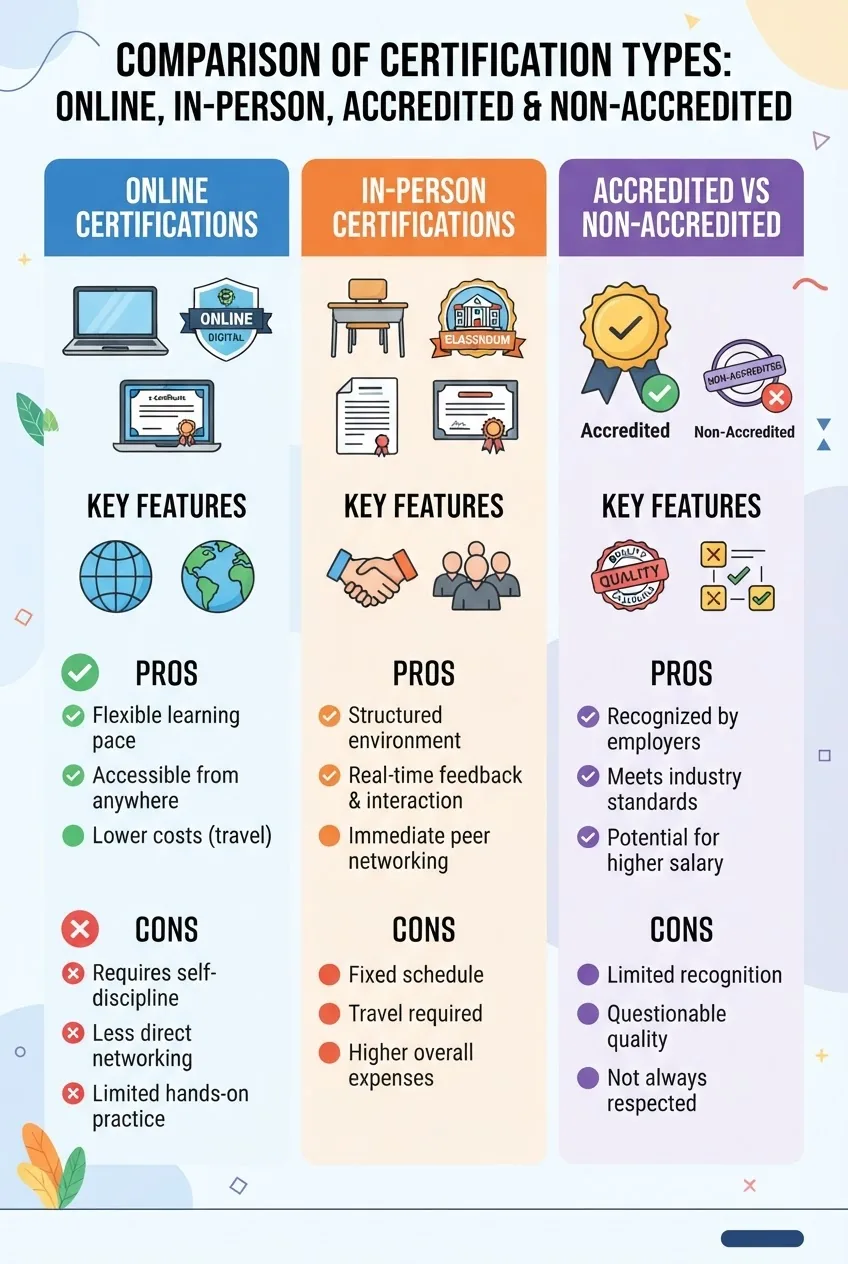
Online vs. In-Person Holistic Life Coach Certifications
Online programs offer flexibility, modular learning and often lower overheads. In-person trainings provide experiential learning, immediate role-play and networking. Hybrid formats combine recorded modules with live practicums to capture both benefits.
| Format | Typical Advantages | Typical Drawbacks |
|---|---|---|
| Online | Self-paced modules, recorded demos, broader instructor access | Fewer live practice hours unless scheduled; requires self-discipline |
| In-Person | Intensive role-play, peer feedback, immersive community | Higher cost, travel/time commitment, limited cohort sizes |
| Hybrid | Best of both: flexible theory with scheduled practicum | Scheduling live components can be complex for global students |
Accredited vs. Non-Accredited Certifications
Accreditation signals that an independent body has reviewed the program against standards. Non-accredited certifications can still be rigorous, but recognition can vary among employers and referral partners.
| Type | What it means | When to choose |
|---|---|---|
| Accredited | Reviewed by a body (e.g., ICF-aligned standards or national vocational authorities) | If you want stronger credential recognition for corporate contracts or referrals |
| Non-Accredited | Issued by providers without third-party review; may be niche-focused | When curriculum specialization (e.g., spiritual coaching) matters more than formal recognition |
For readers who want a focused look at remote learning providers, see our roundup of the best online certification courses. If your interest is nutrition-specific, review the distinctions in our holistic nutrition coaching certification guide.
Transition: with the program types clear, follow the step-by-step pathway to becoming certified and building your practice.
How to Become a Certified Holistic Life Coach: Step-by-Step Guide
Before you start
- Prerequisites: valid ID, basic first-aid certification recommended for in-person client work, and 1–2 letters of reference if required by the program.
- Tools: laptop with webcam, reliable internet (min 25 Mbps for live practicums), digital notebook or client management tool (e.g., practice management or simple spreadsheet).
- Materials: intake form template, consent and confidentiality forms, sample wellness action plan template, recording consent forms for coaching sessions.
- Time commitment: plan for 4–12 hours per week during a 3–12 month program; reserve 1–3 evenings per week for live sessions or practicum meetings.

- Research and shortlist accredited programs. Identify 3–5 programs that match your schedule and budget. Verify accreditation status or alignment with ICF standards. Check program length (target 60–150 training hours) and practicum hours required. Look for published learning outcomes and sample module lists.
- Confirm scope and legal boundaries. Read the program’s scope of practice and refund/cancellation policy. Confirm the program clarifies that coaching is not clinical therapy and includes referral procedures. If you anticipate working with those on medications or complex diagnoses, ensure the curriculum covers collaboration with health professionals.
- Apply and prepare documentation. Submit applications, references and any needed pre-course assignments. Budget for program costs and any additional fees (mentorship sessions, assessment fees). Typical application lead time: 1–4 weeks.
- Complete core training modules. Engage with modules on coaching ethics, active listening, motivational interviewing, values work, lifestyle assessment, and the mind-body-spirit framework. Expect to log 60–120 contact hours. Take detailed notes and practice skills weekly in peer triads for 30–60 minutes per session.
- Practice coaching in a supervised practicum. Arrange to complete 20–60 supervised coaching hours with feedback. Use a structured client intake form, a 3-part session structure (intake 10–15 min, coaching 30–40 min, action plan 10–15 min), and submit 2–3 recorded sessions for mentor evaluation. If you struggle to find practicum clients, consider community swap groups or low-cost clients; more on this later.
- Complete assessments and case studies. Prepare and submit written case studies (often 2–5 pages), recorded coaching sessions, and any required exams. Use a score rubric: clarity of goals, use of coaching tools (wheel of life, SMART goals), ethical handling, and measurable client outcomes.
- Receive credential and register with professional bodies. After verification, receive your certificate. Consider registering with a professional organization (eg. ICF or national coaching association) to enhance credibility; review their membership requirements and continuing education expectations.
- Set up practice systems and insurance. Create client intake and informed consent templates, privacy policy, and consider professional indemnity insurance. For Australian practitioners, check local requirements for business registration and health service disclaimers. Set session pricing aligned to your market (entry-level AUD/USD 60–120 per 50–60 minute session, mid-range AUD/USD 120–250, depending on niche and experience).
- Launch and market your service ethically. Build a website, define clear service packages (single session, 6-week plan, 12-week transformation), and set measurable package outcomes. Use referral agreements with allied practitioners and document those partnerships.
- Pursue continuing education and supervision. Plan for 10–30 hours of continuing education per recertification cycle; schedule monthly supervision or peer review sessions to audit outcomes and ethical practice.
Real-world example: I trained with a 9-month hybrid program that required 80 contact hours and 40 practicum hours. I logged two 45-minute recorded sessions per month, received mentor feedback within 10 business days, and completed two submitted case studies. The total cost including mentor hours was AUD 3,200. This pathway took me about 10 months from application to credential.
Transition: now that you have procedural clarity, review the curriculum components and the specific skills you will acquire during training.
Curriculum and Skills Covered in Holistic Coach Training
Holistic coach training typically blends practical coaching skills with wellness science and mind-body integration. Programs are structured around core modules, each with measurable learning objectives and practice hours.
Common curriculum modules and modules’ typical hour allocations (example curriculum):
- Foundations of Holistic Coaching — 10–20 hours: history, principles, scope of practice, ethics and referral protocols.
- Coaching Skills & Techniques — 20–40 hours: active listening, powerful questioning, motivational interviewing, solution-focused techniques, Socratic questioning, and session structuring.
- Mind-Body Integration — 8–16 hours: breathwork basics, stress physiology, grounding practices, and somatic awareness exercises used as coaching adjuncts.
- Wellness Planning & Behaviour Change — 10–30 hours: SMART goals, habit stacking, relapse prevention, and creating a personalized wellness action plan.
- Practicum & Supervision — 20–60 hours: real-client coaching, recorded sessions, mentor feedback, peer observations and reflective logs.
- Business, Ethics & Boundaries — 6–12 hours: client intake systems, data privacy, informed consent, insurance, pricing and service packaging.
- Specialty Modules — varies: spiritual coaching, career transition, trauma-informed coaching basics (not therapy) and basic nutrition principles if included.
Key skills you will develop:
- Communication — deep listening, empathic reflection, summarising, and concise feedback.
- Coaching Techniques — goal-setting, scaling questions, behavioural experiments, and accountability frameworks.
- Assessment Tools — intake forms, the Wheel of Life, readiness rulers, and validated wellness questionnaires.
- Ethical Decision-Making — boundary setting, when to refer, mandatory reporting obligations if relevant.
- Practical Business Skills — client management, basic bookkeeping, online presence and marketing strategy.
Training frequently includes taught tools such as the “wellness action plan” template, a 6-step intake framework (presenting issue, history, values, goals, strengths, and action), and a supervision log template. These tools give measurable structure to coaching sessions and are required evidence for many certification assessments.
Transition: after mastering curriculum and skills, many coaches choose particular career paths where certification enhances opportunities.
Career Opportunities and Benefits of Certification
Becoming a certified holistic life coach opens multiple career pathways: private practice, corporate wellbeing programs, community health initiatives, retreat facilitation, and partnership with allied health professionals.
Benefits of certification include:
- Greater client trust and clearer marketing credibility.
- Eligibility for professional directories and insurance panels in some markets.
- Access to supervision networks and referral partnerships.
- Structuring your service around measurable outcomes that attract corporate or health-referral contracts.
According to a 2023 coaching industry report, demand for coaching services (including wellness and holistic niches) grew year-over-year, with corporate wellbeing budgets increasing and more clients seeking integrated lifestyle support. For evidence-based outcomes, academic reviews indicate coaching improves self-efficacy and behaviour change adherence — see a systematic review on health coaching outcomes available via PubMed Central.
Case study reference (practitioner experience): a coach with a 12-week stress-management program reported 60% of clients improving sleep scores by at least 2 points on a 10-point scale after 8 weeks when measured with a simple sleep questionnaire. I track outcomes monthly and adjust my frameworks based on aggregated client results — this practice drove a 30% referral uplift in year two.
Practical ways to connect clients to broader services (including insurance-eligible care) are discussed in our guide to finding alternative holistic practitioners.
Transition: with career possibilities clear, you need selection criteria to choose the right certification program for your goals.
Choosing the Right Holistic Life Coach Certification Program
Deciding between programs comes down to cost, accreditation status, schedule flexibility, and practical experience offered. Make a selection using a checklist that balances immediate needs with long-term recognition.
Checklist for program selection:
- Does the program publish contact/practicum hours and assessment criteria?
- Is the curriculum aligned with recognized competencies (e.g., ICF) or reviewed by an external body?
- What are total costs including assessments, mentor sessions and recertification fees?
- Is there a clear scope of practice and referral network taught in the curriculum?
- Are delivery formats compatible with your schedule (evening live sessions, weekend intensives, or fully asynchronous)?
- Does the program provide templates and business set-up guidance if you plan to go private practice?
Practical selection tactic: request a syllabus and the names of recent graduates; ask for sample assessment rubrics and whether alumni serve as practicum clients. When in doubt about hands-on hours, prioritise programs that guarantee at least 20 supervised client coaching hours as part of the course.
Transition: before you begin training, review common mistakes I’ve observed and methods I used to avoid them.
Common mistakes and how to avoid them
I once enrolled in a cheap online course that offered minimal practicum; I struggled to convert theory into practice. To avoid this, I now require programs to include at least 20 supervised coaching hours and recorded feedback loops. I also set a practicum schedule of two 60-minute coaching practices weekly during training to build habit and confidence.
Other mistakes I’ve seen and corrected:
- Choosing programs purely on price — I learned to value mentor feedback and live supervision over the lowest entry fee.
- Skipping business setup — I initially delayed liability insurance and lost a contract opportunity; now I secure indemnity insurance before client intake.
- Neglecting measurable outcomes — I track client scores (sleep, stress, activity) at baseline, 6 weeks and 12 weeks to show progress and inform referrals.
Final checklist before you graduate
- All required contact and practicum hours completed and documented (enter exact hours in your log).
- Two recorded sessions submitted and feedback received from a mentor.
- Two case studies written, each with baseline and outcome measures.
- Client intake, consent and privacy templates completed and saved to secure storage.
- Professional indemnity insurance in place and business registration checked.
- Continuing education plan scheduled (10–30 hours per recert cycle).
When to call in a professional
- Refer to a mental health clinician immediately when clients present active suicidal ideation, psychosis, or unmedicated severe depression — coaching is not a substitute for clinical care.
- Consult a registered dietitian or medical practitioner for complex nutrition, medication interactions or chronic disease management.
- Engage a legal or business advisor when drafting client contracts or navigating local regulatory obligations for health-related services.
Conclusion — key takeaways: certification validates coaching competence but varies in recognition; prioritise programs with supervised practicum, clear assessment rubrics and alignment with professional standards. If you’re ready, select a program, book your practicum slots, and schedule monthly supervision. Ready to start? Review program syllabi, confirm practicum hours, and plan 4–12 hours weekly for study and practice.