
Holistically meaning describes assessing or treating someone by considering their whole life context—physical, mental, emotional, social and environmental factors—rather than isolated symptoms; it signals actions taken in service of the whole person to support balanced, sustained health and resilience across systems and relationships.
What Does Holistically Meaningly? Detailed Explanation
Answer: Holistically meaning refers to acting or thinking in a way that considers the whole system—often the complete person—so that interventions address multiple interconnected factors rather than a single isolated issue.
Term: Holistically — the adverb form of holistic; describes how something is done with whole-system attention.
Used as an adverb, “holistically” modifies verbs to show that an action applies to a whole rather than parts: a clinician assesses a patient holistically, a treatment plan is designed holistically, or someone approaches lifestyle changes holistically. This adverbial use emphasizes method and orientation.
- Holistically defined: considering all relevant dimensions together (biological, psychological, social, environmental).
- Meaning of holistically: how choices are made or applied with attention to whole-system impacts.
- Adverbial form of holistic: used to describe manner or approach (e.g., “We treat holistically.”).
- Usage examples: “The team evaluated her sleep, stress, diet and environment holistically.”
When you see “holistically” attached to a clinical process, it indicates any assessment, diagnosis, or intervention intentionally integrates multiple domains. That integration aims to reduce fragmented care and strengthen durable outcomes by aligning treatments with a person’s broader life systems.
Common confusions arise because “holistic” is sometimes used loosely—marketing vs. clinical practice differ. To parse use, ask: Does the action consider multiple domains? Does it connect symptoms to lifestyle and context? If yes, the use is truly holistic.
Transitioning to formal definitions clarifies how dictionaries and health bodies describe “holistic” and “holistically” in plain language and clinical terms.
Defining Holistic: Dictionary and Simple Definitions
Answer: Dictionary definitions describe “holistic” as relating to or treating the whole system; simple definitions reframe this as “looking at the whole person, not just parts,” often supported by examples across health domains.
Term: Holistic — relating to or concerned with complete systems rather than individual parts.
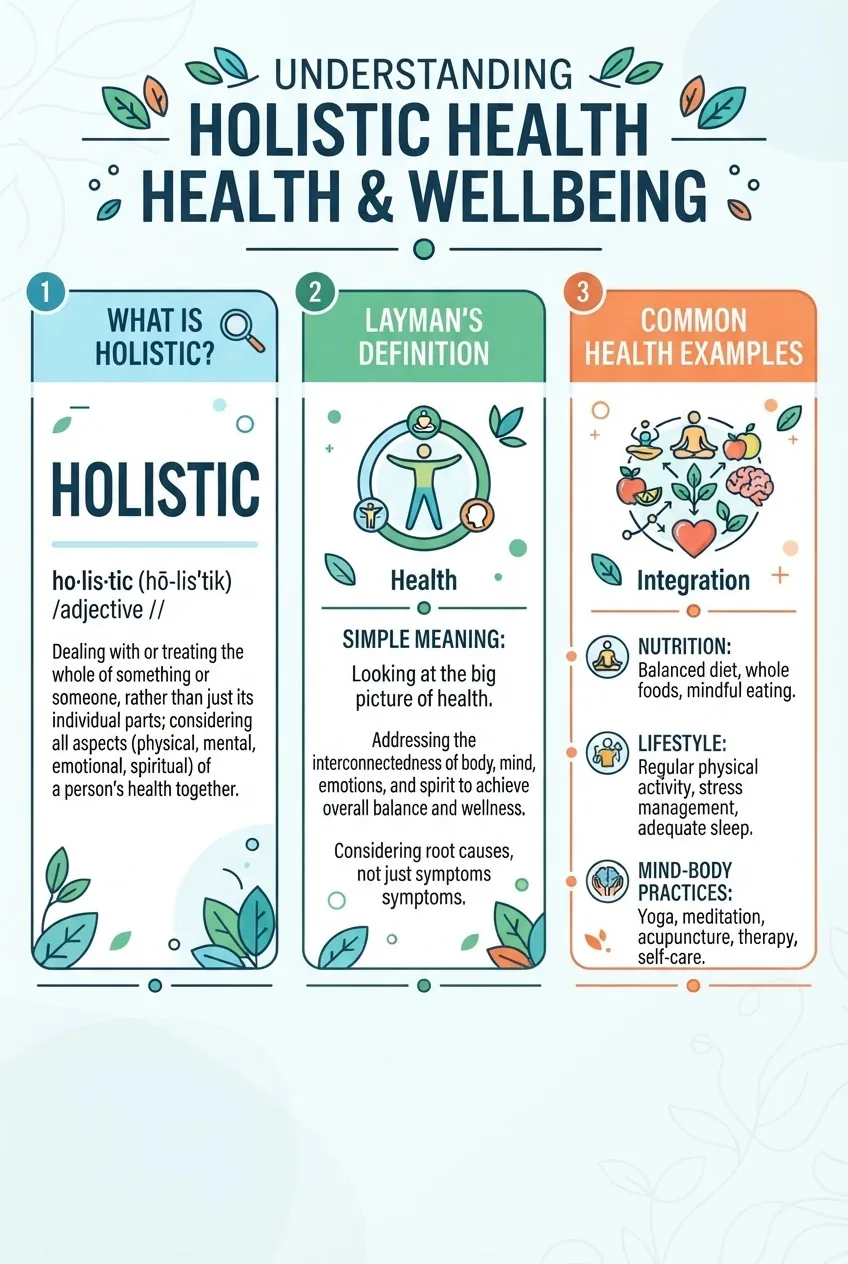
Standard dictionary entries emphasize completeness. For example, Merriam-Webster defines holistic as “relating to or concerned with complete systems rather than with the analysis of, treatment of, or dissection into parts”; Cambridge Dictionary frames it as “considering something as a whole rather than as separate parts.”
Simple holistic definition summary:
- Holistic def (one-liner): Treat or understand the whole person and their context.
- What does the term holistic mean (plain): Don’t just fix the symptom—consider sleep, nutrition, stress, relationships, and environment together.
- Holistic definition meaning: Integration of multiple domains for coordinated action and outcome.
Definitions differ slightly by source because disciplines use the term with different emphases: philosophy stresses systems thinking; medicine stresses whole-person care; wellness industries sometimes use “holistic” as a catch-all. When precision matters, rely on clinical or organizational definitions rather than marketing uses.
Transition: With dictionary clarity in place, we can illustrate how a holistic view looks and behaves in everyday health examples.
Holistic View Definition and Practical Examples
Answer: A holistic view means seeing a person’s health as an integrated puzzle of biological, psychological, social and environmental pieces that interact—practical examples show how different pieces connect and guide whole-person decisions.
Term: Holistic view — an outlook that examines and links multiple domains affecting wellbeing rather than isolating variables.

Real-life examples demonstrate how a holistic view changes assessment and action. Below are practical, numbered scenarios showing direct contrast to reductionist responses:
- Chronic back pain: Reductionist: prescribe pain meds for symptom relief. Holistic view: assess posture, ergonomics, stress levels, sleep quality, movement patterns and mood; combine physical therapy, sleep hygiene, stress reduction and workplace adjustments.
- Insomnia: Reductionist: prescribe sleep medication. Holistic view: review caffeine, screen use, anxiety, circadian cues, medication side effects, social schedule; recommend behavioral and environmental changes plus targeted therapy if indicated.
- Type 2 diabetes risk: Reductionist: focus only on blood glucose numbers. Holistic view: review diet, activity, sleep, psychosocial stress, community food environment, and medication side effects to create a sustainable plan.
- Mood changes: Reductionist: prescribe antidepressants solely. Holistic view: explore relational stressors, nutrition, physical activity, medical contributors (thyroid, micronutrients), sleep, and therapy options to create layered support.
- Pediatric growth concerns: Reductionist: test growth hormone only. Holistic view: screen nutrition, family routines, psychosocial factors, chronic illness, and community resources before specialized referrals.
These examples show the whole-person approach: integrate multiple inputs, prioritize safety, and sequence interventions so one action supports others—rather than applying isolated fixes that may ignore root causes or context.
Transition: Next we apply these ideas to clinical and healing contexts to show how terminology maps to models and practice.
Holistic Meaning in Health and Healing Contexts
Answer: In health and healing, holistic meaning is operational—teams assess physical, mental, social and environmental domains, integrate therapies, and coordinate care so that treatments align with a person’s broader life context and long-term goals.
Term: Whole-person approach — a care model that explicitly addresses multiple domains of health and coordinates interventions across disciplines.
Within healthcare, holistic meanings vary by model. “Integrative health” often refers to combining conventional care with evidence-informed complementary therapies; “whole-person care” is a broader delivery model emphasizing coordination across domains; “holistic medicine” historically refers to treatments grounded in whole-system thinking.
Clinical frameworks that embody holistic meaning include biopsychosocial models, patient-centered medical homes, and integrative medicine centers. According to a 2023 World Health Organization report summarizing whole-person care frameworks, many health systems are moving toward integrated service delivery that addresses social determinants alongside clinical treatments (WHO).
Brief case study references (concise):
- Case A — Multidisciplinary pain clinic: Combines physiotherapy, cognitive behavioral therapy and medication reviews; outcomes show better function than single-modality care (according to multiple academic program evaluations published in peer-reviewed journals).
- Case B — Integrated diabetes program: Nutrition counseling, community food access interventions and mental health support reduced A1C variability where social factors were addressed alongside medical therapy (observational program data reported by health services).
Understanding the difference between terms helps clinicians and patients align expectations:
| Term | Core focus | Typical example |
|---|---|---|
| Holistic medicine | Whole-person therapeutic approaches | Combining lifestyle, supplements and conventional care |
| Integrative health | Evidence-informed blending of modalities | Conventional medicine plus acupuncture for pain |
| Whole-person care | Care coordination across domains | Medical, social and behavioral services coordinated |
Because terminology shifts across disciplines, consult reputable sources for definitions: medical dictionaries, organizational frameworks and peer-reviewed literature. For a focused look at benefits that follow from these models, see research summaries on benefits of holistic medicine.
Other practical resources and certifications align with holistic applications (nutrition, coaching, mental health); for example, details on credentialing for nutritional practice are available at holistic nutrition certification.
For clarification about how meaning maps to specific healing modalities, consult the pillar guide on holistic healing methods.
Transition: With health-specific definitions clear, the next section answers common questions readers have about using the term and applying holistic thinking.
Common Questions About the Term Holistic and Holistically Meaning
Answer: Common questions focus on operational differences (holistic vs integrative), application in clinical settings, timelines for benefit and how to find trustworthy information; concise answers below explain practical distinctions and next steps.
Below are clear, authoritative answers to frequent reader queries that help translate definition into usable knowledge.
What is meant by holistic? A holistic approach treats or assesses multiple interacting factors affecting wellbeing—physical, mental, social and environmental—rather than isolating a single symptom or organ. This integrates care decisions so interventions support each other and address root causes.
How is holistic different from integrative health? Integrative health specifically blends conventional medical care with evidence-informed complementary therapies; holistic is broader and denotes whole-system focus that may or may not include complementary modalities.
How to apply holistic meaning? Start by mapping domains affecting the issue (sleep, nutrition, stress, relationships, environment), prioritize modifiable factors, sequence low-risk interventions, and coordinate across providers if needed.
How long to see benefits? Timelines vary by condition: some lifestyle changes show measurable effects in weeks; systemic or chronic conditions may need months of coordinated care. Use objective markers to track progress and adjust plans.
How to deal with differing definitions? Compare sources: dictionaries for lexical meaning, WHO or peer-reviewed frameworks for clinical definitions, and program evaluations for outcome data. Prefer context-specific definitions (clinical vs. wellness marketing).
Transition: The following section explains how to put a holistic perspective into daily health practices with stepwise guidance.
How to Apply a Holistic View in Daily Health Practices
Answer: Apply a holistic view by assessing multiple life domains, prioritizing low-risk foundational changes, creating aligned routines, tracking outcomes, and iterating—this transforms ad-hoc choices into integrated daily practices that support whole-person health.
Term: Holistic health models — structured frameworks that guide whole-person assessment and intervention across domains such as nutrition, movement, sleep and psychosocial needs.
- Map domains: List physical, emotional, social, environmental and spiritual factors affecting your concern. Example: for fatigue note sleep duration, stressors, diet, medications, and workload.
- Prioritize groundwork: Implement high-impact, low-risk steps (sleep routine, hydration, gentle movement). These often change symptom trajectories quickly and support other interventions.
- Sequence interventions: Introduce one major change for 2–6 weeks, measure subjective and objective markers, then add or modify. This reduces confounding and helps identify what works.
- Coordinate care: Share a concise whole-person summary with providers so treatments align (medication reviews, therapy, nutrition). For help finding alternative holistic practitioners can guide locating aligned providers.
- Educate and certify: If you want deeper knowledge, consider formal training such as a holistic health coach certification or local programs like holistic wellness coach training.
- Use credible sources: Rely on clinical guidelines, organizational statements, and peer-reviewed literature rather than unverified claims.
Practical tips:
- Keep a one-week health map (sleep, mood, meals, movement) to identify patterns.
- Use short objective measures (sleep hours, step count, mood scale) to monitor progress.
- When adding supplements or therapies, document effects and possible interactions with medications; consult clinicians when in doubt.
Transition: The final section summarises why understanding ‘holistically’ matters and offers takeaways you can use immediately.
Summary: Why Understanding Holistically Meaning Matters for Health and Wellness
Answer: Knowing what “holistically” means helps you choose coordinated care, prioritize interventions that interact positively, avoid fragmented treatment, and pursue sustainable health improvements that reflect your full life context.
Key takeaways:
- Holistically = acting with whole-system awareness (physical, mental, social, environmental).
- A whole-person approach reduces unintended consequences of isolated treatments and improves alignment with life goals.
- Use reputable definitions (dictionaries, WHO frameworks, peer-reviewed studies) when evaluating claims about holistic practices.
- Simple application steps—map domains, prioritize foundational changes, sequence and measure—turn the concept into action.
If you want to explore holistic frameworks and well-being models in depth, review resources on the holistic approach to well-being, which connects definitions to practical models and programs.
Final CTA: Use this guide to frame conversations with your providers, design your daily routines with broader context in mind, and follow curated resources above to deepen your practice of whole-person health.