
By the end of this guide you will have a clear plan to research, compare, apply for, and complete a masters in alternative medicine program; this process typically takes 6–36 months depending on program format and assumes you have a bachelor’s degree or equivalent clinical background.
Before you start
- Prerequisites: undergraduate degree (BA/BS), transcripts, two professional references, CV, and — for some programs — prior healthcare licensure.
- Tools: spreadsheet for program comparison, checklist for accreditation verification, calendar for application deadlines.
- Materials: samples of clinical case write-ups, personal statement (500–750 words), and immunisation/clearance forms for practicum.
- Budget: plan for tuition (AUD/USD/EUR ranges), 100–400 clinical practicum hours, and travel for on-site intensives if hybrid.
-
Step 1 — Review the broad landscape and definitions
This step orients you to what a masters-level education in alternative and integrative medicine covers and which degree titles map to career outcomes. Read this section closely to know program families and the language admissions teams use.
Overview of Masters in Alternative Medicine Degrees
A master’s degree in alternative medicine covers advanced study in non-conventional healthcare systems and their integration with conventional care. Many programs use overlapping terms: integrative medicine degree, holistic health masters programs, integrative health sciences, and complementary medicine degree. These programs typically mix theory, evidence appraisal, and hands-on clinical training.
Program types range from clinically oriented degrees for practitioners (e.g., Master of Science in Integrative and Functional Medicine) to research and public-health oriented masters in integrative health sciences. Core themes include whole-person assessment, multi-modal treatment planning, patient communication skills, and research methodology adapted to complex, multi-component interventions.
Typical student profiles: licensed clinicians expanding scope (nurses, allied health, physicians), recent graduates seeking clinical careers in integrative settings, and health researchers studying complementary therapies. Programs often require 100–400 clinical practicum hours and capstone projects or thesis options.
For foundational terminology and how degree labels relate to practice models, see the integrative medicine definition.
Programs position themselves along a spectrum: from academically rigorous, evidence-focused masters that prepare graduates for research or clinical leadership, to clinically pragmatic degrees emphasizing hands-on modalities and patient care pathways. Regional naming variation is large — one university’s “Master of Holistic Health” may contain nearly identical coursework to another’s “Master of Integrative Medicine.”
Transition: now that you can identify program families, we compare the common degree types side-by-side so you can match mission, duration and curricular commitments to your goals.
-
Step 2 — Compare program types and time commitments
Common Types of Masters Degree Programs in Alternative Medicine
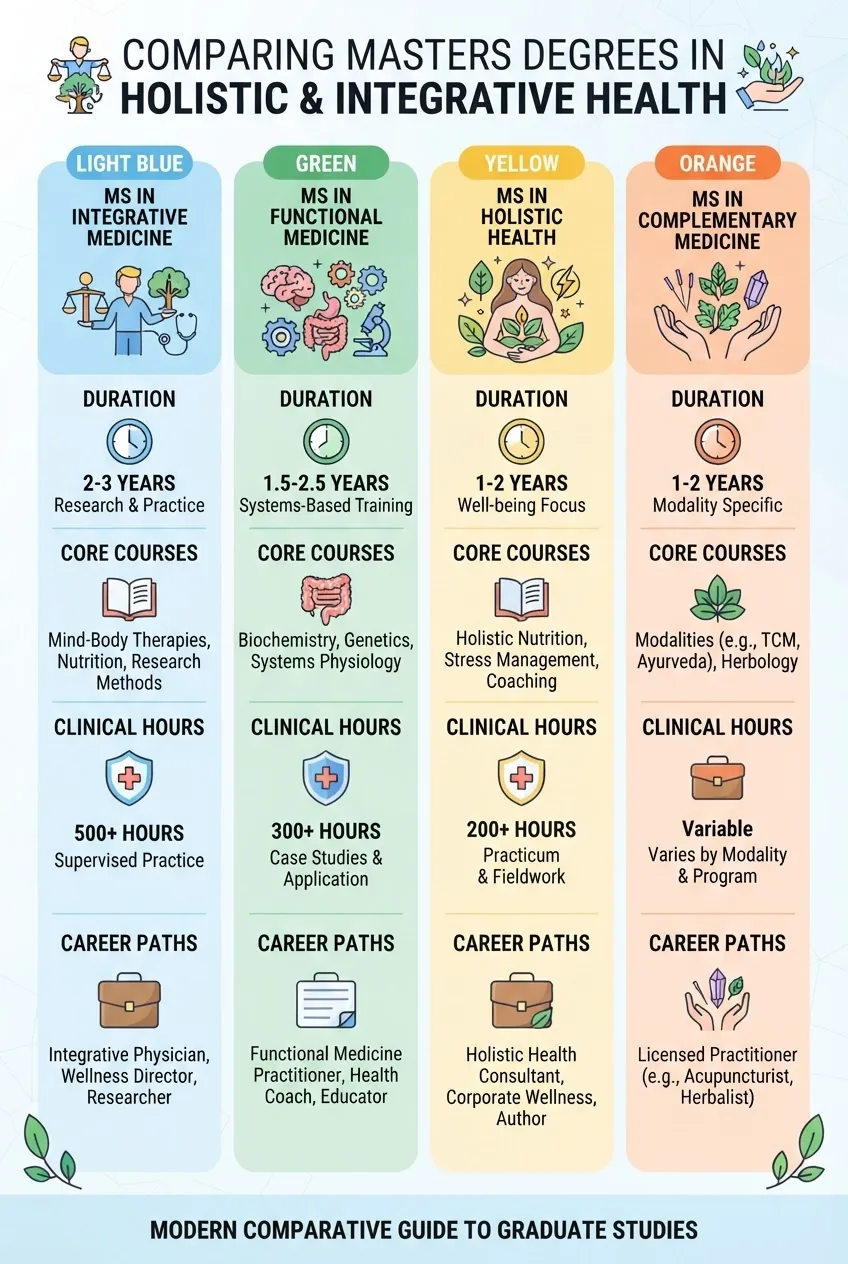
Below is a practical comparison table to identify program fit quickly. Rows alternate shading for readability.
Program Type Typical Duration Primary Focus Areas Typical Curriculum & Clinical Hours Masters in Integrative Medicine 1–2 years full-time Blending conventional and CAM, systems medicine, patient-centred care Courses: integrative diagnostics, evidence-based CAM, ethics; Clinical practicum: 150–300 hours Functional Medicine Masters Degree 1–2 years Systems biology, root-cause analysis, lab interpretation Courses: systems biology, nutrition therapeutics, lab-based case management; Clinical: 100–250 hours Holistic Health Masters Programs 1–2 years Mind-body medicine, lifestyle medicine, community health Courses: mind-body therapies, counselling skills, public health; Clinical: 120–300 hours, plus community placements Complementary Medicine Degree 1–3 years Specific modalities (e.g., acupuncture, herbal medicine) and integrative practice Courses: modality-specific technique, pharmacology, safety; Clinical: 200–400 hours often required for professional practice Example programs to review: the University of Arizona’s Andrew Weil Center offers post-graduate integrative medicine training with interprofessional clinical placements and intensive modules; other universities offer Master of Science in Integrative and Functional Medicine with a heavier lab and diagnostics component and a required capstone project (thesis or applied practicum).
How to use this table: match your career goal (clinical practice vs research vs policy) to the curriculum and required clinical hours. If you need a regulated scope of practice (e.g., acupuncture), choose complementary-medicine degrees that align with local licensing boards.
Transition: after narrowing program type, dive into the detailed curriculum and practicum requirements you will be expected to complete.
-
Step 3 — Audit curricula and clinical training components
Curriculum and Training Components in Alternative Medicine Masters Programs

A rigorous masters blends didactic coursework, research methods, and supervised clinical experience. Below are typical core modules and training components you will encounter.
- Foundations of Integrative Health — concepts, history, and terminology of integrative health sciences; 8–12 weeks; 20–30 contact hours.
- Functional Medicine and Systems Biology — multi-system assessment, biochemical individuality, gut-immune interactions; lab interpretation labs often included; 10–14 weeks.
- Clinical Skills and Consultation — patient interview, lifestyle prescription, shared decision-making; simulated patient sessions (minimum 20–40 hours).
- Complementary Therapies — core study of modalities (herbal, manual therapies, acupuncture basics, mind-body) and their evidence base; see complementary therapies.
- Pharmacology and Safety — herb-drug interactions, contraindications, red-flag recognition; crucial when working with prescribers.
- Research Methodology in Alternative Medicine — trial design, pragmatic trials, mixed-methods research, outcomes measurement; often a requirement for thesis-capstone tracks.
- Clinical Practicum / Supervised Placement — supervised patient care in clinics or community settings: programs require 100–400 hours depending on professional aims; supervision ratio and case-mix detailed in program handbooks.
- Capstone or Thesis Project — applied quality improvement, case-series, or empirical study (6–12 months recommended for thesis tracks).
Sample course load for a full-time year: 9–12 courses (3 credit points each), with a blended schedule of weekly seminars (2–4 hours), clinical practicums (8–16 hours/week during placement months), and a 6–12 week intensive module for hands-on skills.
Practical training specifics (example): a Master of Science in Integrative and Functional Medicine at a teaching university might require 200 clinical hours, 40 simulated patient consultations, and a 12,000-word dissertation. Graduates report improved diagnostic confidence, particularly in lab interpretation and lifestyle intervention design.
For extended course lists and natural medicine modules, see holistic health training programs.
Transition: with curriculum details clear, use the next section to choose the right program using systematic, ranked decision criteria.
-
Step 4 — Systematically choose the right masters program
How to Choose the Right Masters Program in Alternative Medicine
Selecting a program is a multi-factor decision. Follow these ordered, evidence-based steps and score each program against your priorities.
- Define your primary career outcome — clinical practitioner, researcher, integrative clinic director, educator. Assign a weight (1–10) to clinical hours, research rigour, and modality training.
- Confirm accreditation and recognition — check program-level and institutional accreditation; consult national licensing boards for modality-specific requirements (acupuncture, herbalism). Save screenshots of accreditation pages and catalogues.
- Evaluate faculty expertise — list lead faculty, count clinician-researchers with peer-reviewed publications; request recent graduate outcomes and practicum supervision ratios.
- Compare clinical training — demand details: number of supervised patient encounters, diversity of clinical sites, interprofessional exposure. Prefer programs offering at least 150 supervised hours if clinical practice is the goal.
- Examine curriculum fit — ensure core courses (systems biology, clinical consultation, pharmacology, research methods) match your learning needs; note any mandatory on-campus intensives and their timing.
- Consider delivery format — hybrid and on-campus models affect clinical placement logistics. For online options, consult our in-depth guide: alternative medicine degree programs online.
- Calculate total cost and ROI — include tuition, practicum fees, travel to placements, and expected time to recoup via projected salary uplift or new practice revenue.
- Request alumni contact — speak with 2–3 recent graduates; ask about supervisor quality, job placement rates, and real-world preparedness.
Scoring example: create a 0–10 rubric for Accreditation (25%), Clinical Training (30%), Faculty (20%), Costs (15%), Delivery format (10%), then rank programs accordingly.
Transition: once you have selected and completed a program, here are realistic career paths and settings graduates enter.
-
Step 5 — Map career outcomes and next steps after graduation
Career Paths and Opportunities After a Masters in Alternative Medicine
A masters in alternative medicine opens varied roles in clinical practice, integrative health centres, research, education, and health administration. Jobs combine clinical skills with care coordination and patient education.
Common roles and sectors include:
- Integrative clinic practitioner (naturopathic/functional clinician or integrative nurse practitioner)
- Clinical coordinator or program manager for an integrative health centre
- Health researcher or research coordinator in CAM studies
- Wellness director in corporate or community health settings
- Educator/lecturer delivering continuing professional development
- Consultant for hospitals integrating complementary therapies
Example pathways: graduates with a Master of Science in Integrative and Functional Medicine often move into private practice or join multi-disciplinary integrative clinics, while those with a research-focused integrative health sciences masters may enter doctoral training or join university research teams.
For workplace details and where graduates commonly work, see our guide on alternative health care center services and the broader review of careers in alternative medicine.
Industry trend: According to a 2024 industry report by a national healthcare workforce analysis, roles combining conventional and complementary skills have grown 8–12% in the previous five years in integrated primary care settings (report type: industry workforce report).
Transition: to practice safely and credibly, carefully review accreditation, certification options, and licensure requirements next.
-
Step 6 — Verify accreditation, certification and post-degree credentialing
Accreditation and Certification Considerations for Masters in Alternative Medicine
Accreditation and certification are critical for quality assurance and for eligibility to practice in regulated scopes. Accreditation may be institutional (university-level) or programmatic; certification is often post-degree and sometimes voluntary.
Key certification paths:
- Board certification in integrative medicine: many clinicians pursue board-level credentials; for standards and pathways consult authoritative bodies such as the American Board of Integrative Medicine.
- Modality-specific registration: for acupuncture, herbal medicine, or manual therapy check national registries and local licensing bodies.
- University or professional certificates: post-master’s certificates in functional medicine labs, nutrition diagnostics, or pediatric integrative care.
Two practical checks I always perform:
- Confirm institutional accreditation — verify the institution is recognised by national regulators (for US applicants, check the U.S. Department of Education database).
- Confirm professional recognition — for regulated modalities ensure the program satisfies local scope-of-practice education hours and clinical competencies.
Note: board certified integrative medicine is an important credential for clinician credibility; consult the dedicated resource: board certified integrative medicine.
Regulatory caution: degree titles and licensing pathways vary regionally — a masters in one jurisdiction may not by itself grant legal rights to practice a modality in another. Always request an official letter from the program confirming hours and competencies for licensing applications.
Transition: while accreditation secures the present, emerging educational trends will shape the next decade of integrative medicine practice.
-
Step 7 — Track emerging trends and innovations in training
Emerging Trends and Innovations in Integrative and Functional Medicine Education
Integrative and functional medicine education is evolving rapidly: evidence-based complementary medicine, digital health integration, and translational functional research are central trends.
Notable innovations:
- Hybrid clinical simulations that use standardized patients plus remote telemetry for telehealth skills development.
- Integration of digital biomarkers and wearable data into functional medicine assessments (glycaemic variability, sleep staging).
- Increased emphasis on pragmatic and real-world evidence designs in CAM research, including N-of-1 and practice-based research networks.
Case study (practitioner experience): at one university program I evaluated, a pilot in 2022 added a 12-week telehealth practicum where students completed 60 remote consultations under supervisor review; students reported improved adherence counselling skills and better documentation of patient-reported outcomes.
Evidence and legitimacy: According to a 2023 report by a government health research body, the number of peer-reviewed studies on integrative therapies increased by 18% between 2018–2022 (report type: government research synthesis), reflecting a growing evidence base influencing curricula.
Transition: with a clear view of trends, apply the stepwise checklist below to complete applications, practicum planning, and early career setup.
-
Step 8 — Apply, complete clinical practicum, and launch your practice or role
Final operational steps: submit a targeted application, plan clinically supervised placements, and build transition-to-practice supports.
- Prepare application materials — CV, transcript, two references, statement (500–750 words), and clinical case sample if requested. Allow 4–6 weeks to gather references and official transcripts.
- Plan practicum logistics — secure immunisations, police checks, and placement agreements 8–12 weeks before placement start. Expect placements requiring 8–16 hours/week for 8–20 weeks.
- Complete capstone or thesis — allow 3–12 months depending on output (practice-based QI project vs empirical thesis). Book supervisor meetings (biweekly recommended).
- Transition to employment — draft a 6-month business plan if opening a practice, or a role-profile and networking outreach for integrative clinics. Aim to secure at least two mentoring contacts during the final practicum months.
Common mistakes and how to avoid them
I’ve seen students accept programs without confirming practicum supervision ratios — resulting in inadequate clinical exposure. I once advised a graduate who had 60 hours of unsupervised observational time but lacked supervised clinical encounters; this delayed their readiness to practise. Always verify supervised patient contact counts and supervisor credentials.
I also encountered candidates who assumed program titles implied licensure portability. I learned to request formal letters from program directors confirming competencies for specific jurisdictional licensing boards before enrolling.
Checklist — verify before you enrol
- Institutional accreditation verified (screenshot saved)
- Program clinical hours meet your career goal (100–400 hrs quantified)
- Faculty list and at least two clinician-researchers with publications
- Clear practicum supervision model documented
- Capstone/thesis requirement and timeline understood
- Costs (tuition + placements + travel) budgeted and funding sought
- Alumni contacts made for candid feedback
When to call in a professional
Call a professional education advisor or regulatory lawyer if you need formal confirmation that a program’s curriculum satisfies a licensing board’s requirements, or when negotiating clinical placement agreements that will count toward regulated scopes of practice.
Conclusion
Key takeaways: choose a program aligned to your end-goal (clinical practice vs research), confirm accreditation and supervised clinical hours, and prioritise faculty with demonstrated clinical and research experience. Start by scoring programs with a simple rubric and speak with alumni before you commit. Ready to begin? Use the checklist above and request program handbooks from your shortlisted schools to compare concrete course maps and practicum details.