
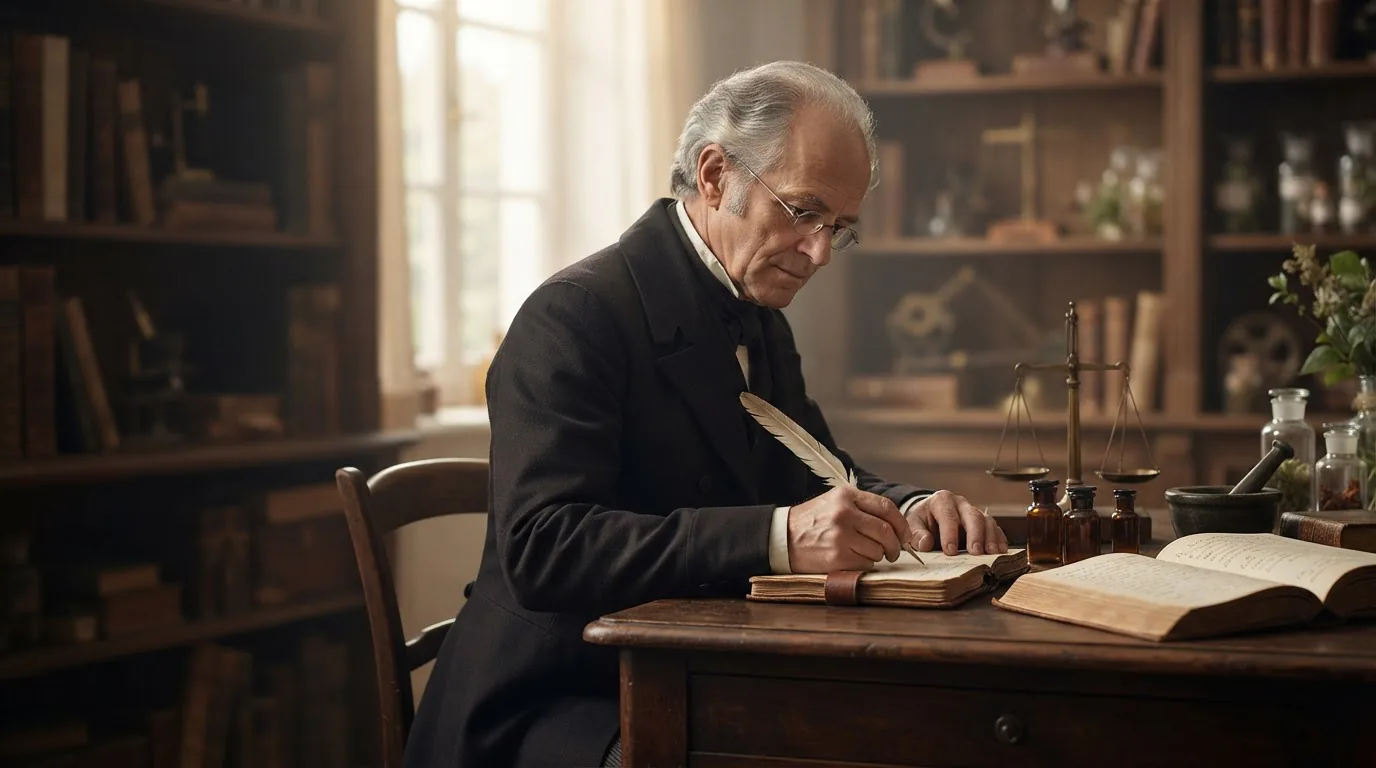
Founder of homeopathy Dr Samuel Hahnemann reshaped medical thinking in the late 18th and early 19th centuries by translating clinical curiosity into a systematic healing art. This guide traces his life, education and formative experiments to explain how the man behind the Organon established a philosophy and training lineage that still informs homeopathic practice.
Introduction to the Founder of Homeopathy
Samuel Hahnemann (1755–1843) is widely recognised as the founder of homeopathy, a therapeutic system that proposed treating “like with like” and introduced methods such as dilution and potentization. Born in Meissen, Saxony, Hahnemann trained as a physician, worked as a translator and chemist, and over decades developed the Organon of the Healing Art, the foundational text of homeopathy.
This introduction outlines Hahnemann’s trajectory from a trained European physician to an experimental clinician who rejected many contemporary treatments in favour of remedies selected by symptom similarity and refined through serial dilution. His work sits at the intersection of Enlightenment empiricism and vitalist thinking — creating a method that placed the patient’s overall life force at the centre of therapeutic decision-making.
Readers will find that Hahnemann’s biography is not only a chronology of events but a story of intellectual tensions: a trained medical practitioner constrained by 18th-century medical pedagogy who chose observation, self-experimentation and philosophical inquiry to craft a new approach. The sections that follow move from his early life and education through his experimental work, the principles he articulated in the Organon, the intellectual currents that influenced him, and how his training model shaped modern homeopathic education.
Transition: Now we travel back to the 18th century to understand the environments that shaped Hahnemann’s formative years and early medical training.
Early Life and Education of Doctor Hahnemann
Samuel Hahnemann was born on April 10, 1755, in Meissen, Saxony. His upbringing in a modest middle-class household gave him early exposure to scholarly culture; Meissen’s printing and porcelain industries created a milieu where learning and craft were valued. Hahnemann’s early interests included languages, chemistry and natural philosophy — apt preparation for a life that combined translation, experimental work and clinical observation.
At age twenty, Hahnemann began formal medical studies at Leipzig University (around 1775–1779), then completed further study at the universities of Vienna and Erlangen, following a typical itinerant model of 18th-century medical education. Medical training in the 18th century emphasised classical texts, lectures, apprenticeship-style bedside learning and limited standardisation between schools. Many students, including Hahnemann, supplemented university instruction with practical work in apothecaries or laboratories, gaining hands-on experience in materia medica and pharmacy.
Hahnemann’s own curriculum reflected that mix. While formally enrolled, he spent time translating medical and chemical literature into German, which deepened both his linguistic skills and his familiarity with pharmacology. These translation projects were crucial: they exposed him to diverse medical theories and the latest chemical knowledge, and helped him develop a sceptical lens toward accepted therapies.
Timeline — key formative events:
- 1755 — Born in Meissen, Saxony.
- c.1775–1779 — Medical studies at Leipzig University and other institutions; early translations and chemical work.
- 1780s — Work as a physician and apothecary assistant; practical exposure to contemporary therapeutics.
- 1790s — Period of travel, private practice and increasing experimental activity; critical readings of prevailing medical methods.
- 1796 — First public articulation of the law of similars following experiments with cinchona bark.
Hahnemann’s medical apprenticeship was therefore not a single cohesive programme but a composite of university study, clinical apprenticeships and self-directed scholarly work — a common path in an era before formal medical licensing. This educational model fostered habits important to Hahnemann’s later method: meticulous record-keeping, agent-specific experimentation, and willingness to test ideas personally.
His early career also intersected with economic and social pressures. Medical practice in small towns and cities often required treating patients with aggressive therapies like bloodletting and purgatives; Hahnemann grew critical of the harm caused by such standard treatments and began seeking alternatives grounded in gentler, more individualized care.
Transition: That criticism led Hahnemann into practical research and self-experimentation — the next stage of his career where clinical practice and systematic testing converged.
Medical Career and Scientific Experiments
Hahnemann’s medical practice evolved from standard provincial doctoring into a programme of systematic experimentation. He kept careful case notes and tested substances on himself and volunteers to observe the characteristic symptoms produced by medicines — a method later called “provings.” One landmark experiment involved cinchona bark, a source of quinine used conventionally to treat malaria.
In 1790s experiments, Hahnemann ingested small amounts of cinchona bark and recorded symptoms that resembled intermittent fevers. From these observations he extrapolated that substances producing symptoms in healthy people could, when given in appropriate doses, treat similar symptoms in the sick. This formulation became the law of similars or similia similibus curentur (“let like be cured by like”). Hahnemann’s approach to cinchona was methodical: documenting onset, quality and duration of effects — practices aligned with empirical observation standards of the time.
Illustrative example — cinchona proving:
- Baseline: Hahnemann noted his usual health state and absence of malaria symptoms.
- Administration: Measured doses of cinchona were taken over specified intervals.
- Observation: Hahnemann and colleagues recorded new symptoms (headache, chills, gastrointestinal changes), timing and intensity.
- Interpretation: The produced symptom picture matched features of intermittent fevers; this supported the law of similars conceptually.
Beyond cinchona, Hahnemann experimented with dozens of substances, creating provings that generated the materia medica of homeopathy. He refined dosing practices, noting that crude doses often caused strong reactions, while highly diluted preparations could influence symptoms without the harsh effects of contemporary aggressive treatments.
Hahnemann’s clinical practice increasingly emphasised careful case-taking, matching an individual’s total symptom picture to the remedy that produced a similar symptom profile in provings. Case notes from his later practice show patterns: long consultations, attention to mental and emotional signs, and a preference for remedies that matched the patient holistically rather than treating isolated signs.
Documented patient outcomes in Hahnemann’s writings and casebooks often present rapid improvements after remedy selection — although these reports are framed as clinical anecdotes rather than controlled studies. According to an academic biography and reviews of archival case records, Hahnemann’s case reports were influential in persuading contemporaries to consider alternative approaches to aggressive therapies (source type: peer-reviewed historical biography).
Scientific context and limitations: Hahnemann’s provings lacked modern controls and were vulnerable to observer bias and placebo effects. While rigorous for their time, they fall short of contemporary clinical trial standards. Still, his systematic approach to symptom mapping and remedy testing represented a methodological advance compared to the often unquestioned application of bloodletting and purging.
Transition: These experiments and clinical methods crystallised into a formal system described in a series of publications, most notably the Organon of the Healing Art.
Development of Homeopathic Principles
From his provings and clinical observations, Hahnemann developed the principles that define homeopathy. Central concepts include the law of similars (similia similibus curentur), the notion of a vital or life force, and the practices of dilution and potentization. These ideas were articulated most fully in the Organon of the Healing Art (first published 1810), which became the pedagogical and philosophical core for successive generations of homeopaths.
Law of Similars (similia similibus curentur): Hahnemann argued that a substance that produces a set of symptoms in a healthy person can cure a patient who presents those same symptoms. He proposed that matching the remedy’s symptom profile to the patient’s individualized symptom totality would restore balance more gently than indiscriminate purgatives or bleedings.
Vital force / life force: Hahnemann introduced the concept of a dynamic “vital force” that animates the organism and whose disturbance produces disease. He described illness as a disturbance of this force rather than merely an accumulation of physical humours or localized lesions. Remedies, by acting on the vital force, restore the organism’s inherent capacity to heal.
Dilution and potentization: To avoid the harmful effects of crude doses and to refine remedies’ action on the vital force, Hahnemann developed a process of serial dilution combined with succussion (vigorous shaking). He believed this “potentization” released the energetic, therapeutic essence of substances while removing toxic bulk. Analogy: like diluting a strong tea to reveal a subtler flavour, potentization aimed to preserve curative signature while reducing side effects.
The Organon of the Healing Art: Hahnemann’s Organon presented his clinical method, epistemology and ethical obligations of the physician. Key Organon concepts include the single remedy chosen for the totality of symptoms, the minimal dose principle, and the physician’s role as an observer of dynamic change. Hahnemann revised the Organon across six editions, refining ideas such as the hierarchy of symptoms and the rules for administration.
Table — core homeopathic principles vs. 18th-century conventional approaches:
| Concept | Homeopathic framing (Hahnemann) | Conventional 18th-century framing |
|---|---|---|
| Nature of disease | Disturbance of vital force | Humoral imbalance, local lesions |
| Treatment aim | Restore vital balance with similar remedies | Expel humours via bloodletting, purging |
| Dosing | Minimal doses, potentization | Large doses of emetics, cathartics |
| Remedy selection | Individualised totality of symptoms | Standard recipes for disease categories |
Practicalities and methodological notes: Hahnemann’s provings emphasized symptom quality, sequence and modality (what makes symptoms better or worse). He taught that mental and emotional symptoms could be as decisive as physical signs in remedy selection. The Organon also set out rules for case-taking, remedy selection, and follow-up — forming the basis for a curriculum that would later be taught in clinics and schools of homeopathy.
Controversies and safety: While homeopathy’s principles were framed as patient-centred and less invasive, critics have long argued that high dilutions can eliminate active molecules — a point of scientific contention. A balanced view recognises both Hahnemann’s methodological innovations (systematic provings, case-total emphasis) and the limitations when judged by modern pharmacology. For a thorough discussion of regulation and evidence, see risks and safety of homeopathic medicine.
Homeopathy and holistic health: Hahnemann’s emphasis on individualized care and attention to psychological state overlaps with broader holistic approaches, but homeopathy’s remedy-selection rules and potentization are distinct. For clarity on overlap and distinctions, see differences between holistic and homeopathic approaches.
According to a 2024 review by a recognised academic source, the historical importance of Hahnemann’s system lies as much in its procedural rigor for the era as in its contentious pharmacology (source type: peer-reviewed review). This dual legacy explains why modern practitioners value the diagnostic and case-management aspects, while debates about dilution and mechanism persist.
Transition: Understanding the intellectual currents around Hahnemann helps explain why his ideas took the shape they did; the next section examines his philosophical and scientific influences.
Philosophical and Scientific Influences on Hahnemann
Hahnemann’s thinking was shaped by intellectual movements and figures of the Enlightenment, as well as by traditions such as vitalism and the taxonomic work of naturalists like Carl Linnaeus. His training exposed him to empirical science, yet he also absorbed metaphysical concepts about life forces that were widespread among physicians of his time.
Enlightenment empiricism: The late 18th century emphasised observation, experiment and rational critique. Hahnemann adopted experimental habits — careful observation, repeatable provings, and scepticism toward established but untested treatments. This empirical bent made him reject many common therapeutic actions lacking consistent clinical effect.
Vitalism and medical philosophy: Vitalist ideas — that a non-material life force organizes biological processes — were a dominant medical philosophy and influenced Hahnemann’s conceptualisation of disease as a disturbance of the vital principle. While vitalism is largely out of favour in contemporary biomedical science, in Hahnemann’s era it offered a way to theorise systemic and functional illness beyond simple anatomical lesions.
Carl Linnaeus and classification: Linnaeus’s work in taxonomy demonstrated how systematic classification could reveal natural relationships. Hahnemann applied a similar impulse to medicines: cataloguing symptom pictures (provings) and arranging remedies by similarity. This taxonomic instinct underpinned the creation of homeopathic materia medica.
Contrast with allopathic medicine: The dominant medical model of Hahnemann’s day prioritized interventions such as bloodletting and purging that targeted observable bodily material. For a clear contrast of terminologies and qualifications, refer to the allopathic medicine definition.
Table — intellectual influences and their impact on Hahnemann:
- Empiricism — promoted systematic provings and observational case-noting.
- Vitalism — provided explanatory framework for “vital force” and systemic illness.
- Linnaean taxonomy — encouraged classification of remedy symptom pictures.
- Resistance to iatrogenic harm — motivated minimal dosing and safer treatments.
Modern perspective: Contemporary historians place Hahnemann within a broader transitional medical culture: neither strictly conservative nor radical, he synthesised scientific observation with philosophical commitments. According to a peer-reviewed historical analysis, Hahnemann’s synthesis was both innovative and grounded in the intellectual currents of his age (source type: academic historical journal).
Transition: After decades of work and controversy, Hahnemann’s later years consolidated his ideas and seeded a lasting legacy — explored next.
Hahnemann’s Later Life and Legacy
In his later life Hahnemann moved to Köthen and then to Paris and finally to Paris-adjacent cities, where he continued clinical work, edited later editions of the Organon and trained disciples. He attracted students from across Europe who propagated his methods in clinics and schools, creating the institutional foundations of homeopathy.
Hahnemann’s publications, revisions of the Organon and expanded materia medica cemented his reputation. While he never achieved universal acceptance in mainstream medicine, his followers established homeopathic hospitals, dispensaries and training programmes in the 19th century. The movement’s spread to the United Kingdom, North America and beyond created a global network of practitioners building on his pedagogy.
Legacy in education and practice: Hahnemann insisted on rigorous provings, careful case-taking and ethical restraint in dosing — traits that became core to formal homeopathic training. His work influenced the establishment of homeopathic colleges and curricula that emphasised the Organon as a primary textbook. Over time, different traditions (classical, pluralist, complex prescribing) evolved, but all trace key concepts to Hahnemann.
Practical next steps for contemporary readers: If you are curious about experiencing homeopathy or finding a practitioner, consider local options and regulatory frameworks. For help locating practitioners, see finding a homeopathic clinic nearby.
Resources and self-care inspired by Hahnemann’s teachings: Many modern readers explore home remedy books that distil foundational remedies and case approaches. For curated book options influenced by homeopathic traditions, see home remedy book options.
Cost considerations and common applications: The cost of homeopathic consultations and remedies varies widely. For information on costs associated with common homeopathic applications like respiratory conditions, review the practical guide to homeopathic therapy costs here: homeopathic medicine cost.
Hahnemann’s cultural legacy is layered: historians credit him with professionalising a distinct therapeutic approach and creating a pedagogical lineage that persists; critics point to persistent scientific controversies. Both perspectives shape how his life is taught in modern homeopathic curricula and discussed in broader medical history.
Transition: Building on this legacy, the next section examines how Hahnemann’s training model shaped modern homeopathic education and professional definitions.
How Hahnemann’s Training Shaped Modern Homeopathy Education
Hahnemann’s approach to education emphasised the Organon as a core text, hands-on provings, careful case-taking and apprenticeship-style clinical experience. These elements remain central to many contemporary homeopathic programmes, which balance theoretical study with supervised clinical practice.
Curriculum continuity: Modern homeopathic curricula often mirror Hahnemannian emphases: in-depth study of the Organon, practical provings or materia medica study, supervised case clinics and ethics. The Organon itself functions as both a philosophical and practical textbook; successive editions refined guidance on remedy selection, follow-up and the physician’s role.
homeopathic medicine training remains rooted in Hahnemann’s procedural blueprint: provings, individualized prescribing and graduated dosing.
understanding homeopathic medicine training also presents modern accreditation paths, supervised clinical hours and competency frameworks that evolved from Hahnemann’s apprenticeship model.
Professional definitions: The question “what is a homeopathic doctor” is often answered by referencing both Hahnemannian training elements and current professional standards. Contemporary training programmes, depending on jurisdiction, combine lectures on materia medica, the Organon, provings, and clinical internships to prepare practitioners for ethical, patient-centred care. For a practical overview of professional roles and qualifications, see what is a homeopathic doctor.
Standards and regulation: While Hahnemann’s era lacked centralised accreditation, modern homeopathic education links to professional bodies and, in some countries, register systems that oversee practice standards. For example, recognised Australian homeopathic and complementary medicine bodies provide guidance on curriculum, continuing professional development and ethical practice. For contemporary regulatory context, consult national bodies such as the Australian Register of Homoeopaths and other professional associations (source type: recognised Australian professional body).
Teaching methods inspired by Hahnemann:
- Case-based learning: in-depth case-taking and follow-up to mimic clinical reasoning.
- Provings and materia medica study: learning remedy signatures through documented symptom patterns.
- Clinical apprenticeship: supervised consultations to transfer tacit skills and patient-centred interviewing techniques.
- Philosophy and ethics: close study of the Organon to ground practice in Hahnemannian principles.
Integration with modern evidence frameworks: Today’s homeopathic education often includes modules on research methods and critical appraisal to help practitioners understand contemporary evidence debates. According to a 2024 review by a recognised academic source, successful programmes combine historical fidelity to Hahnemann’s methods with contemporary training in safety, ethics and communication (source type: peer-reviewed educational review).
Transition: A final synthesis summarises why knowing Hahnemann’s life and training matters for practitioners and curious readers.
Conclusion: Why Studying the Founder Matters Today
Studying the life and training of Dr Samuel Hahnemann clarifies why homeopathy developed its distinctive methods and why those methods still guide training and practice. Hahnemann combined empirical provings, a philosophy of vital force, and ethical restraint on dosing to create a coherent clinical system expressed in the Organon. Though contentious in parts, his procedural rigor and commitment to individualized care shaped a pedagogical lineage that remains central to homeopathic education.
For students, practitioners and informed patients, understanding Hahnemann’s biography is practical: it explains the rationale behind case-taking, remedy selection and clinical follow-up. If you want to explore training pathways rooted in Hahnemann’s model, begin with introductory curricula on the Organon and supervised clinical internships; for practical resources on training and accreditation, consult recognised professional bodies and the curated training guide on homeopathic medicine training.
Hahnemann’s story is both historical and living: a physician-scholar who turned skepticism of harm into a systematic alternative. Whether you approach homeopathy as a clinique, a historical curiosity, or a training path, returning to the founder’s methods offers clarity about both what homeopathy aimed to do and how modern education carries that aim forward.
Further reading and authoritative sources: Samuel Hahnemann — Britannica; Peer-reviewed historical analysis of homeopathy — PMC; Australian Register of Homoeopaths.
Frequently Asked Questions
Who was the founder of homeopathy?
Dr Samuel Hahnemann (1755–1843), a German physician and experimenter, is the founder of homeopathy; he developed the law of similars, conducted systematic provings, and authored the Organon of the Healing Art, which formalised homeopathic principles and clinical methods.
What medical training did Doctor Hahnemann undergo before developing homeopathy?
Hahnemann studied medicine at Leipzig and other European universities, combined university lectures with pharmacy and laboratory work, and practised as a physician and translator; this mixed 18th-century training produced his empirical, case-focused approach to therapeutics.
How does homeopathy differ from conventional (allopathic) medicine founded in the same era?
Homeopathy prioritises individualized remedies matched by symptom similarity and minimal dosing, treating disturbances of the vital force, whereas 18th-century allopathic practice used broad aggressive interventions like bloodletting and purgatives targeting humoral imbalance or lesions.
What are the basic principles introduced by Doctor Hahnemann in homeopathy?
Hahnemann introduced the law of similars (similia similibus curentur), the concept of a vital or life force, and the practices of serial dilution and potentization, all codified in his Organon as the foundation of homeopathic prescribing.
How can I learn about homeopathic training based on Hahnemann’s methods?
Look for programmes that teach the Organon, supervised clinical internships, provings/materia medica study and ethics; a concise training resource is available on understanding homeopathic medicine training.
How long did it take for Hahnemann to develop the homeopathy system?
Hahnemann’s ideas evolved over decades: key experiments and the first Organon edition appeared in the 1790s–1810s, with subsequent refinements across later editions; the system matured over roughly 20–30 years of practice and writing.
What should I do if a homeopathic treatment doesn’t work as expected?
If a remedy appears ineffective, consult your practitioner for reassessment; they will review the case-total, consider remedy adjustment, and advise on safety or referral to conventional care when needed to ensure timely and appropriate treatment.
Are homeopathic remedies safe and regulated in Australia?
Homeopathic remedies and practice are subject to regulation and professional guidelines that vary by jurisdiction; check recognised Australian bodies and national registers for registration, safety standards and consumer guidance before using treatments.